The Riemann Hypothesis: Past, Present and a Letter Through Time
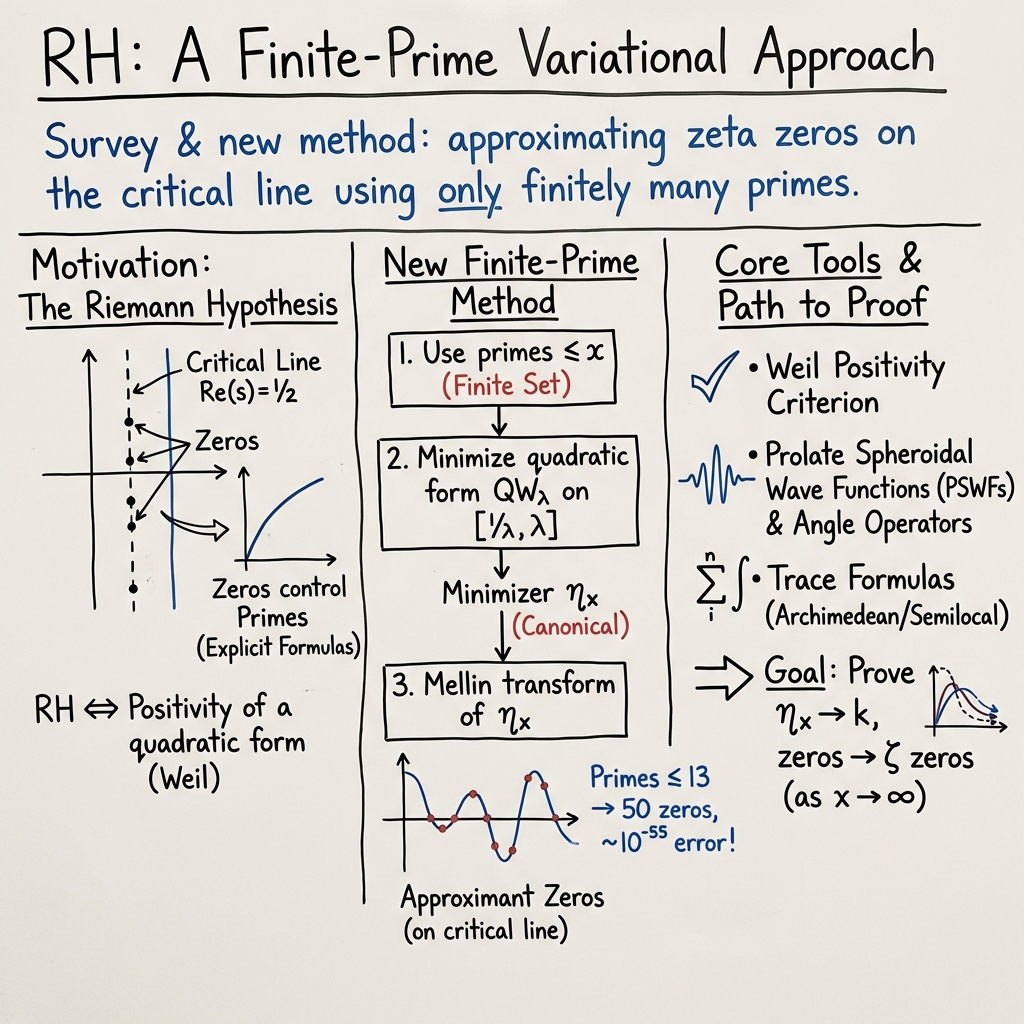
Abstract: This paper, commissioned as a survey of the Riemann Hypothesis, provides a comprehensive overview of 165 years of mathematical approaches to this fundamental problem, while introducing a new perspective that emerged during its preparation. The paper begins with a detailed description of what we know about the Riemann zeta function and its zeros, followed by an extensive survey of mathematical theories developed in pursuit of RH -- from classical analytic approaches to modern geometric and physical methods. We also discuss several equivalent formulations of the hypothesis. Within this survey framework, we present an original contribution in the form of a "Letter to Riemann," using only mathematics available in his time. This letter reveals a method inspired by Riemann's own approach to the conformal mapping theorem: by extremizing a quadratic form (restriction of Weil's quadratic form in modern language), we obtain remarkable approximations to the zeros of zeta. Using only primes less than 13, this optimization procedure yields approximations to the first 50 zeros with accuracies ranging from $2.6 \times 10{-55}$ to $10{-3}$. Moreover we prove a general result that these approximating values lie exactly on the critical line. Following the letter, we explain the underlying mathematics in modern terms, including the description of a deep connection of the Weil quadratic form with the world of information theory. The final sections develop a geometric perspective using trace formulas, outlining a potential proof strategy based on establishing convergence of zeros from finite to infinite Euler products. While completing the commissioned survey, these new results suggest a promising direction for future research on Riemann's conjecture.
Paper Prompts
Sign up for free to create and run prompts on this paper using GPT-5.
Top Community Prompts
Explain it Like I'm 14
Overview
This paper is about one of the most famous unsolved problems in math: the Riemann Hypothesis (RH). RH says that all the “special points” where the Riemann zeta function becomes zero—called its nontrivial zeros—sit on a thin vertical line in the complex plane, the line . Why does this matter? Because these zeros are deeply connected to prime numbers, and primes are the building blocks of all numbers.
The paper has two main parts:
- A clear survey of 165 years of ideas, techniques, and discoveries about the zeta function and RH.
- A new idea presented as a “Letter to Riemann,” showing a way—using only math Riemann already knew plus modern computers—to very accurately approximate these zeros on the critical line.
Key Questions
The paper asks:
- What have mathematicians learned about the zeta function and its zeros over the last century and a half?
- How are primes and the zeros of the zeta function connected?
- Are there different ways to state RH that might be easier to prove?
- Can we find a practical method, using simple ingredients, to get very close to the zeros and show they lie on the critical line?
Methods and Approach
The paper uses two kinds of approaches:
1) Surveying big ideas that grew around RH
Think of the zeta function as a “music machine” whose silent notes (the zeros) secretly guide where primes appear. Over time, many fields joined the hunt to understand these notes:
- Classical analysis: techniques to count primes and link them to zeros through formulas.
- Geometry and algebra: powerful tools (like schemes and cohomology) that solved RH-like problems in other settings.
- Random matrix theory: compares the spacing of zeta’s zeros to the spacing of energy levels in large random systems—surprisingly, they match statistically.
- Trace formulas: a way to “listen” to echoes of primes and zeros in a geometric space instead of staring at the function directly.
2) A new “Letter to Riemann” strategy
This part tries to do what Riemann might have done if he had a modern computer:
- It uses a “quadratic form,” which you can imagine like an “energy score” you want to minimize to find a best-fit function. When you tune this “energy,” the peaks line up with the zeta zeros.
- It only uses a small part of the zeta function called the Euler product, and even cuts it off at a small prime (like 13).
- It optimizes the setup using tools connected to signal processing, like prolate spheroidal wave functions. These are special signal shapes used in communication theory to pack information efficiently. Here, they help capture the right pattern that mimics zeta’s behavior.
- It connects everything with modern “trace formulas,” which are like taking the fingerprint of a space to reveal the hidden positions of zeros.
This is inspired by Riemann’s style: use clean, classical math ideas, but add the computing power to carry them out precisely.
Main Findings and Why They Matter
Here are the main takeaways, stated simply:
- Using only primes up to 13, the method produces excellent approximations to the first 50 zeros of the zeta function. The accuracy ranges from about up to , which is incredibly precise.
- These approximations are not just close—they fall exactly on the critical line . This matches what RH claims.
- The chance that this kind of agreement happens randomly is astronomically small (about ), which strongly suggests the method targets the true pattern.
- The paper explains how this approach can be understood using modern mathematical language and ideas connected to information theory. It shows that tools used to design the best signal shapes also help capture the right structure for zeta’s zeros.
- It lays out a geometric and spectral plan: use trace formulas and special spaces (like the semilocal adele class space) to model how prime numbers contribute, and use operators whose spectra (their “notes”) behave like the squared zeta zeros, especially at high frequencies (“ultraviolet” behavior).
Why is this important? Because it suggests a realistic path toward showing the zeros from a finite, approximate system converge to the actual zeros of the zeta function—potentially edging closer to a proof of RH.
Implications and Potential Impact
What might this work lead to?
- A new, practical algorithm for approximating zeta zeros using only a handful of primes and classical methods—simple enough to fit Riemann’s original toolkit, powerful enough with computers.
- A promising strategy: if we can prove these approximations always move toward the true zeros, we may have a route to RH.
- Strong bridges between number theory and other areas, like:
- Random matrices and quantum physics, showing zeta’s zeros behave like energy levels in complex systems.
- Information theory and signal processing, where prolate spheroidal wave functions help “shape” the right functions to hit the target zeros.
- Geometry and spectral theory, where trace formulas and special spaces let us “hear” the primes’ echoes and read off the zeros like an absorption spectrum.
Even if RH is still not fully proven, this paper gives a powerful, simple-looking way to get very close. It ties together many strands of mathematics in an elegant and understandable path, and shows that sometimes, using fewer primes and smarter shaping can reveal more of the truth.
Knowledge Gaps
Knowledge gaps, limitations, and open questions
Below is a consolidated list of what remains missing, uncertain, or unexplored, framed to be concrete and actionable for future research.
- Rigorous convergence of truncated-prime approximations: Prove that the “Letter to Riemann” extremization procedure based on a finite set of primes S yields approximating zeros that converge to the true zeros of as all places; quantify convergence rates, uniformity in height, and error terms in terms of and .
- Completeness and absence of spurious zeros: Establish that the limiting spectrum contains all nontrivial zeros (no omissions) and that approximate spectra produce no spurious points on the critical line that fail to converge to actual zeros.
- Operator-theoretic identification: Specify a canonical self-adjoint operator whose spectrum equals (in the limit and/or at finite S) the approximating values; define its domain, boundary conditions, and parameters precisely, and prove self-adjointness, spectral purity on the critical line, and stability under enlargement of S.
- Verification of simplicity: Determine whether this framework implies that all nontrivial zeros are simple; if so, provide a proof (e.g., via spectral simplicity or quadratic form non-degeneracy), and identify the exact assumptions needed.
- From numerical evidence to proof: Replace the numerical accuracy claims (e.g., with primes ≤ 13 and first 50 zeros) by analytic error bounds; derive explicit, provable estimates that control the approximation error deterministically rather than probabilistically.
- Algorithm specification and reproducibility: Fully detail the optimization algorithm (objective, constraints, basis functions, discretization, convergence criteria), including branch choices for logarithms/exponentials, and provide complexity and stability analyses for high-height zeros.
- Connection between Weil’s quadratic form minimizer and prolate spheroidal wave functions: Elevate the observed numerical agreement to a theorem; state and prove conditions under which the minimizing vector is exactly (or asymptotically) a prolate spheroidal eigenfunction, with quantitative approximation bounds.
- Trace formula with cutoffs: The proposed trace formula involves infrared and ultraviolet cutoffs; develop a rigorous scheme to remove or control these cutoffs and prove convergence of the trace formula to the desired spectral identities without residual cutoff-dependent terms.
- Ultraviolet model completeness: Beyond matching ultraviolet asymptotics of squared zeros via the prolate operator, show whether a bijective (or explicitly invertible) map exists from the operator’s eigenvalues to the zeta zeros themselves, including low-energy behavior and fluctuations.
- n-level statistics without rescaling: Demonstrate that the proposed operator model reproduces GUE-like local statistics of zeros without ad hoc rescaling (i.e., provide a “genuine ultraviolet model”); compute and compare correlation functions and spacings rigorously.
- Finite-to-infinite Euler product limit: Establish a functional-analytic framework in which zeros of finite Euler products (or semilocal models) converge to zeros of the full ; control the distribution of zeros of Dirichlet polynomials, and prove limit theorems with explicit error bounds.
- Semilocal adele class space : Complete the measure-theoretic and topological analysis needed to derive a precise trace formula on , show how periodic orbits of length yield the prime contributions, and prove rigorously that positivity in the semilocal setting suffices for the global RH.
- Positivity in Weil’s criterion via prolate methods: Provide a constructive positivity proof for the relevant quadratic forms (restricted to finite sets of primes), ideally via prolate spheroidal techniques, and clarify how these local positivity statements aggregate to RH.
- Extension to general -functions: Adapt the quadratic-form and operator framework to Dirichlet and automorphic -functions (including conductors and gamma factors); prove convergence, positivity, and spectral-line results analogous to the zeta case.
- Sensitivity to the choice of S: Analyze how the finite set of places (which includes ) should be selected or optimized; characterize sensitivity of approximations to inclusion/exclusion of specific primes and determine optimal selection strategies to minimize spectral error.
- Archimedean contribution and gamma factors: Specify how the archimedean place and gamma factors enter the operator/quadratic-form setup; prove that their contributions are correctly encoded in the spectral or trace-formula framework.
- Formal absorption spectrum model: Precisely formulate the notion that the zeros appear as an “absorption spectrum” of the adele-class-space dynamics; identify the operator or flow generating the absorption lines and prove the equivalence to the zero set without assuming analytic continuation.
- Reconciling universality with a deterministic model: Explain how Voronin’s universality (and the chameleon-like behavior of ) coexists with an operator whose spectrum ties deterministically to zeros; clarify regimes where universality does not obstruct the proposed spectral reconstruction.
- Moment predictions and value distribution: Investigate whether the proposed operator framework can reproduce or predict the Keating–Snaith moment conjectures for , and relate spectral data to moments and value-distribution results in the critical strip.
- p-adic analogues: Formulate and explore a p-adic counterpart to the positivity/operator approach, even absent a standard RH analogue; define appropriate quadratic forms or operators in p-adic contexts and test whether any meaningful “critical-line” phenomenon can be stated or proved.
- Branch and normalization issues in explicit formulas: Systematically resolve the ambiguities highlighted around by fixing branches (e.g., via ), and prove that the numerical and analytic procedures remain stable under these choices for all relevant ranges.
- Zero-free regions and zero-density via the new framework: Derive classical or improved zero-free regions and zero-density estimates from the trace/quadratic-form/operator approach; provide explicit numerical constants and ranges and compare with best-known results.
- Low-height spectral matching: Beyond ultraviolet asymptotics, verify that the operator model reproduces low-lying zeros accurately; prove uniform estimates valid across the entire spectrum (small and large ) and quantify deviations, if any.
- Isospectral Dirac family uniqueness and naturality: Clarify the construction of the isospectral family of Dirac operators with the same ultraviolet behavior as the zeros; assess uniqueness, parameter dependence, and whether isospectrality extends beyond leading asymptotics to full spectral data.
Glossary
- adele class space: A topological/measure space formed from the ring of adèles modulo an arithmetic group, used to encode zeros of L-functions. "A key advantage of this semilocal space, when compared with the full adele class space, is measure-theoretic: here the multiplicative and additive Haar measures are no longer singular with respect to one another, so the quotient behaves well from the viewpoint of measure theory."
- almost periodic functions: Functions that recur in a generalized periodic sense, central in the study of Dirichlet series and value distribution. "the Bohr--Landau program on almost periodic functions."
- archimedean place: The infinite place of a number field (real or complex), contrasted with non-archimedean p-adic places. "includes the archimedean place."
- Bergman/Hardy-type space: Function spaces of holomorphic functions with norm/inner-product structures used in complex analysis. "as elements of a suitable Bergman/Hardy-type space "
- Borchsenius–Jessen theorem: A result describing the value distribution of , showing dense zeros of near the critical line for . "The Borchsenius-Jessen theorem provides a striking contrast to RH."
- Chebyshev function: The arithmetic function used in prime-counting analyses. "where is the Chebyshev function,"
- class field theory: The study of abelian extensions of number fields and their reciprocity laws. "the class field theory counterpart of the schemes"
- completed zeta function: The entire function obtained by completing with gamma and polynomial factors to satisfy a functional equation. "The completed zeta function"
- critical line: The line in the complex plane where RH predicts all nontrivial zeros lie. "approximating values lie exactly on the critical line ."
- Dirac operators: First-order differential operators from spin geometry whose spectra encode geometric/analytic information. "construct an isospectral family of Dirac operators whose spectra have the same ultraviolet behavior as the zeros of zeta."
- Dirichlet -functions: L-functions attached to Dirichlet characters, generalizing the Riemann zeta function. "Voronin's theorem has been extended to joint universality for Dirichlet -functions"
- Dirichlet kernel: The trigonometric kernel associated with partial sums of Fourier series, central in convergence questions. "in his discussion of the Dirichlet kernel,"
- Dirichlet series: Complex series of the form , fundamental in analytic number theory. "the Dirichlet series coefficients of "
- ergodic properties: Statistical properties of measure-preserving flows, implying temporal averages equal space averages. "the ergodic properties of the Kronecker flow"
- Euler product: The product over primes representation of zeta/L-functions encoding multiplicative structure. "truncating the Euler product at the prime $13$"
- explicit formula: Identities relating sums over zeros of zeta to prime-counting functions. "Von Mangoldt \cite{vonMangoldt} rigorously proved Riemann's original explicit formula"
- functional equation: A symmetry relation (e.g., ) satisfied by completed L-functions. "The functional equation implies "
- Gaussian Unitary Ensemble (GUE): A random matrix ensemble whose eigenvalue statistics match those of zeta zeros. "Gaussian Unitary Ensemble (GUE) of random matrix theory."
- Grössencharacters: Idèle class characters (Hecke characters) generalizing Dirichlet characters and defining -functions. "Grössencharacters)."
- Haar measures: Invariant measures on locally compact groups, such as additive and multiplicative measures on adèles. "the multiplicative and additive Haar measures are no longer singular"
- Hahn–Banach theorem: A foundational functional-analytic result enabling extension of linear functionals. "The proof of this result is a testimony of the power of the Hahn-Banach theorem"
- Hadamard product formula: Factorization of an entire function into an exponential times a canonical product over its zeros. "The Hadamard product formula states that an entire function of order 1 can be written as"
- Heun equation: A Fuchsian second-order ODE generalizing the hypergeometric equation. "the prolate operator, obtained as a confluence from the Heun equation"
- Hilbert space: A complete inner-product space central to modern analysis and spectral theory. "Let be a Hilbert space,"
- isospectral: Having the same spectrum (eigenvalues), even if arising from different operators. "construct an isospectral family of Dirac operators"
- Kronecker flow: The flow given by irrational rotations on a torus; here on an infinite-dimensional torus. "the ergodic properties of the Kronecker flow on the infinite dimensional torus"
- Lindelöf Hypothesis: The conjecture that for all . "The Lindelöf Hypothesis states that "
- Mellin transform: An integral transform mapping to , linking multiplicative and additive structures. "their Mellin transform defined as"
- mollification: A smoothing technique multiplying by a carefully chosen auxiliary function to control behavior near the critical line. "introduced the innovative technique of mollification"
- mollifier: The auxiliary Dirichlet polynomial/function used to smooth L-functions in analytic proofs. "Selberg's mollifier was of the form"
- Nevanlinna theory: Value-distribution theory of meromorphic functions, relating growth to distribution of values/zeros. "including Hadamardâs factorization theorem, Nevanlinna theory, and the remarkable Borchsenius--Jessen theorem,"
- non-archimedean (distributions): Objects associated with p-adic places (as opposed to archimedean), here contributions at primes. "The non-archimedean distributions are defined,"
- Phragmén–Lindelöf theorem: A principle bounding growth of analytic functions in unbounded domains. "The Phragmén-Lindelöf theorem implies that is a convex function."
- prolate operator: The differential operator whose eigenfunctions are prolate spheroidal wave functions. "the prolate operator, obtained as a confluence from the Heun equation"
- prolate spheroidal wave functions: Special functions optimizing simultaneous time- and band-limiting, from Slepian–Landau–Pollak. "prolate spheroidal wave functions naturally enter the scene."
- Redheffer matrix: An 0–1 matrix with entries tied to divisibility, used in an RH equivalence. "let be the Redheffer matrix,"
- scheme (Grothendieck): A unifying generalization of varieties using locally ringed spaces, foundational in modern algebraic geometry. "counterpart of the schemes intimately related to "
- Selberg sieve: A combinatorial/analytic sieve method yielding bounds for primes and almost primes. "The Selberg sieve, while developed for his elementary proof of PNT"
- Selberg trace formula: An identity relating spectral data of automorphic forms to geometric lengths of closed geodesics. "the Selberg trace formula and zeta functions play a central role."
- self-adjoint operator: An operator equal to its adjoint; its spectrum is real and supports spectral theorem methods. "a self-adjoint operator and hence are all real."
- semilocal adele class space: The quotient built from adèles over a finite set of places, offering measure-theoretic advantages. "the semilocal adele class space ,"
- Spec : The prime spectrum of the ring of integers, viewed as a scheme. "schemes intimately related to "
- Tauberian methods: Techniques converting analytic information about transforms into asymptotics of original sequences/functions. "by introducing Tauberian methods to prove the Prime Number Theorem"
- trace formula: A bridge equating spectral sums to geometric/orbital sums; used to study zeta/L-functions. "The corresponding trace formula is analogous to Selbergâs,"
- universality theorem (Voronin): The statement that approximates any nonvanishing holomorphic function on compact subsets of the critical strip by vertical shifts. "Voroninâs universality theorem."
- Weil quadratic form: A quadratic form arising in explicit formulas whose positivity is linked to RH. "the Weil quadratic form"
- Weil's positivity criterion: An equivalence showing RH is tantamount to positivity of certain quadratic forms tied to primes. "Weil's positivity criterion shows that"
- Wiener–Ikehara theorem: A Tauberian theorem converting analytic boundary behavior of Laplace transforms into asymptotics. "The Wiener-Ikehara theorem states that if is a non-negative, monotonically increasing function"
- zero-density estimates: Bounds on the number of zeros of zeta in regions to the right of the critical line. "Zero-density estimates, pioneered by Bohr and Landau,"
- zero-free regions: Explicit regions near where , yielding error bounds for prime distributions. "Classical zero-free regions, such as the one proved by de la Vallée Poussin"
Practical Applications
Immediate Applications
The following items describe concrete, deployable uses derived from the paper’s findings and methods, along with the sectors they affect and practical tooling or workflows that could emerge.
- Bold title: A lightweight algorithm to approximate zeta zeros from finitely many primes (software, academia)
- What: Extremize a restriction of Weil’s quadratic form (with PSWF-guided bases) using only small primes (e.g., up to 13) to compute accurate approximations to the first dozens of zeros that provably lie on the critical line.
- Use cases:
- Rapid generation of test zeros for numerical experiments in analytic number theory and random matrix theory (RMT).
- Integration into open-source libraries and databases (e.g., SageMath, PARI/GP, Arb, LMFDB workflows) for reproducible computation and validation.
- Educational demos showing how zeros emerge from truncated Euler products.
- Tools/workflows: Implement quadratic-form optimization with PSWF bases; include robust handling of special functions (Ei, Li(ew)) and branch cuts; package as a Python/Rust module callable from Sage/Pari.
- Assumptions/dependencies: Proven property that approximants lie on the critical line; convergence to true zeros beyond initial ranges remains a research question; high-precision arithmetic recommended.
- Bold title: PSWF-first design choices for time–frequency concentration (communications, radar/sonar, medical imaging, geophysics, power systems)
- What: The paper’s bridge between Weil’s quadratic form and PSWFs (Slepian–Landau–Pollak) reinforces immediate best practices: use PSWF-based windows/tapers and prolate operators where time–bandwidth concentration and leakage control matter.
- Use cases:
- Multitaper spectral estimation with prolate tapers for noisy sensor data (EEG/MEG, seismic, PMU power-grid phasors).
- Filter/window design in OFDM, satellite links, and radar pulse shaping to minimize sidelobes.
- MRI and CT reconstruction pipelines that already exploit Slepian functions, with parameter choices guided by the positivity/variational perspective emphasized here.
- Tools/workflows: SciPy (prolate windows), MATLAB toolboxes, Python Slepian functions packages, GPU-accelerated eigen-solvers for prolate operators; incorporate parameter tuning via quadratic-form criteria.
- Assumptions/dependencies: Standard bandlimitation/sampling assumptions; compute cost for large PSWF orders; domain-specific validation.
- Bold title: Robust numerical handling of conditionally convergent explicit formulas (scientific computing, software)
- What: The survey’s careful treatment of Riemann’s and von Mangoldt’s formulas (e.g., using Li(ew) and Ei with correct branch choices) can be turned into stricter numerical APIs.
- Use cases:
- Improve reliability of complex-analytic routines in CAS and numerical libraries (mpmath, Arb, Boost) for integrals/sums with conditional convergence and branch cut management.
- More stable prime-counting approximations (ψ, θ, π(x)) for research-grade software within specified ranges.
- Tools/workflows: Library functions exposing Li(ew) with explicit branch control; test suites based on the paper’s prescriptions; reproducibility notebooks.
- Assumptions/dependencies: Numerical analysts adopt consistent branch conventions; careful documentation and test coverage.
- Bold title: RMT benchmarking using zeta zeros approximated from few primes (academia, quantitative finance, physics)
- What: Generate eigenvalue-like sequences (zeros) to test GUE-spacing pipelines and de-noising schemes used in high-dimensional statistics.
- Use cases:
- Validate spacing estimators, spectral unfolding, and rotationally invariant estimators on synthetic data mirroring GUE features.
- Calibrate covariance-cleaning algorithms in finance and genomics against zeta-zero surrogates.
- Tools/workflows: Python/Julia notebooks linking computed zeros to standard RMT toolkits (e.g., empyrical spacing histograms).
- Assumptions/dependencies: For finite samples, GUE predictions align well with known zeta-zero statistics; application-specific caution about overfitting to RMT phenomenology.
- Bold title: Curriculum modules: “Letter to Riemann” labs (education)
- What: Recreate the paper’s historical-to-computational narrative in teachable labs: recover many zeros using primes ≤ 13; visualize explicit formulas; compare to RMT predictions.
- Use cases:
- Upper-undergraduate/graduate courses in analytic number theory, harmonic analysis, and information theory.
- Interdisciplinary seminars (math + EECS) on PSWFs, trace formulas, and spectral methods.
- Tools/workflows: Jupyter notebooks, SageMath/Pari integrations; interactive visualizations of explicit formulas, PSWF eigenfunctions, and zero spacings.
- Assumptions/dependencies: Availability of high-precision arithmetic and PSWF solvers; instructor familiarity with numerical stability.
- Bold title: Trace-formula/PSWF computational scaffolding (academia)
- What: Implement core pieces of the semilocal trace formula and prolate operators with UV/IR cutoffs as reusable modules for experimental mathematics.
- Use cases:
- Prototyping Hilbert–Pólya-inspired numerical experiments.
- Testing semilocal contributions (log p periodic orbits) against explicit formulas.
- Tools/workflows: Eigen-solver backends (ARPACK, SLEPc), sparse operator discretizations, code to assemble trace contributions from finite prime sets.
- Assumptions/dependencies: Research-grade code; domain expertise to interpret outputs; careful regularization.
Long-Term Applications
These items would become feasible or highly impactful contingent on further theoretical breakthroughs (e.g., convergence results, operator constructions) or scaling engineering.
- Bold title: Consequences of a convergence theorem from finite Euler products (software, cryptography, algorithms, policy)
- What: If the paper’s strategy is proved to converge generally, many error terms tied to zeros would sharpen in practice.
- Potential impacts:
- Tighter bounds for prime-counting errors and related constants, improving the theoretical guarantees of algorithms that rely on explicit bounds (prime gaps in intervals, primes in arithmetic progressions).
- Under GRH/RH, deterministic versions or tighter complexities for certain number-theoretic algorithms (e.g., Miller’s test becomes deterministic under GRH; bounds for least quadratic nonresidue/primitive roots influence cryptographic parameter selection).
- Policy-level guidance on cryptographic parameter margins and standards when worst-case bounds improve under RH-like assumptions.
- Assumptions/dependencies: A rigorous convergence result; care that many cryptosystems do not become “weaker,” but parameter recommendations and proofs become sharper.
- Bold title: A concrete Hilbert–Pólya operator via prolate/Dirac constructions (quantum technologies, physics, metrology, computation)
- What: If a self-adjoint operator is established whose spectrum matches zeta zeros (the paper’s isospectral Dirac family and UV behavior are steps), one could aim to realize it physically or numerically as a “zeta spectrometer.”
- Potential impacts:
- Quantum simulation/analog devices to probe spectral statistics of zeros; benchmarking platforms for quantum chaos.
- Precision metrology leveraging engineered spectra with RMT/GUE-like statistics.
- New quantum algorithms inspired by the operator’s structure.
- Assumptions/dependencies: Existence and explicit constructibility of the operator; controllable boundary conditions; physical realizability without prohibitive noise.
- Bold title: Information-theoretic design via Weil positivity (telecom, coding, signal design, sensing)
- What: Translate positivity of Weil’s quadratic form into design principles for waveforms/codes/estimators that optimize concentration and interference rejection under resource constraints.
- Potential impacts:
- New regularizers or objective functions in waveform optimization and channel estimation with provable extremal properties.
- Compressed sensing dictionaries with PSWF-like atoms guided by positivity/trace-formula analogues.
- Assumptions/dependencies: Maturation of the mathematical bridge into constructive design recipes; empirical validation on channels of interest.
- Bold title: Log-periodic and prime-orbit–inspired multiscale analysis (complex systems, geophysics, network traffic)
- What: Semilocal adele-class intuitions (periodic orbits of length log p) could inspire novel time–frequency transforms capturing log-periodic structures common in cascades and fractures.
- Potential impacts:
- New detectors for log-periodic precursors in seismic and material-failure data.
- Scale-invariant traffic analysis tools for networks and finance.
- Assumptions/dependencies: Transfer of the orbit–trace paradigm into practically computable transforms; rigorous performance guarantees.
- Bold title: Spectral geometry for machine learning using Dirac/prolate operators (ML/AI, graph learning, scientific ML)
- What: Use self-adjoint Dirac families and prolate operators as priors/regularizers to enforce time–frequency or graph-spectral concentration and RMT-like robustness.
- Potential impacts:
- Improved generalization in spectral graph neural networks with concentration-aware filters.
- Physics-informed ML where operator spectra encode inductive biases (e.g., UV/IR behavior constraints).
- Assumptions/dependencies: Scalable operator discretizations; hyperparameter interpretability; benchmarks vs. standard Laplacian-based methods.
- Bold title: Industrial-grade PSWF and special-function engines (software, HPC)
- What: Libraries that compute PSWFs, prolate operators, and special functions with controlled error at large scales, enabling broader adoption across sectors.
- Potential impacts:
- Faster, more accurate implementations in radar, MRI, spectrum sensing, and national labs’ simulation stacks.
- Assumptions/dependencies: Investment in algorithm engineering (asymptotics, recurrence stabilization), GPU/FPGA acceleration, and cross-language bindings.
Notes on feasibility across items:
- Many immediate applications leverage already-established PSWF technology and careful numerical analysis; the paper’s contribution mainly strengthens the conceptual link and suggests parameterizations via quadratic-form extremals.
- The high-impact long-term items depend on new theorems (e.g., convergence from finite Euler products, operator spectral identification) that the paper motivates but does not yet complete.
Collections
Sign up for free to add this paper to one or more collections.