- The paper introduces a four-stage interaction model demonstrating that tailored preview modalities enable efficient transitions between virtual environments.
- Empirical results reveal that WiM interfaces reduce search time and that portal previews enhance pre-orientation during object retrieval.
- Direct, hand-centered interaction techniques minimize fatigue and improve workflow continuity, offering clear design guidelines for VR multitasking.
Efficient Transition Interfaces for VR: Empirical Analysis and Design Insights
Introduction
The proliferation of VR in productivity, collaboration, and content creation scenarios introduces new demands for seamless transitions between distinct immersive environments. Unlike desktop or mobile application switching, transitioning between virtual worlds is a spatially and cognitively complex challenge. The paper "From One World to Another: Interfaces for Efficiently Transitioning Between Virtual Environments" (2602.01423) systematically explores the design space of VR world-switching interfaces, empirically evaluating conceptual and technical aspects critical for efficient immersive context switching. This essay presents an in-depth analysis of their methodology, experimental findings, interface architectures, and discusses both practical and theoretical implications for the design of multitasking workflows in immersive computing.
Problem Space and Motivation
VR platforms lack the rapid, context-preserving app-switching metaphors available on desktops and smartphones. Typical transitions involve laborious 2D menu navigation, ignoring 3D spatial context and increasing cognitive friction. Furthermore, VR "applications" constitute fully-fledged worlds, demanding mechanisms that mitigate orientation loss and facilitate rapid task resumption following world transitions. The authors identify use cases underscoring these requirements: immersive content creation, collaborative work, social context management, spatial analytics, remote control, and cross-application interoperability. These scenarios require (1) efficient previews affording spatial understanding, (2) fluid interaction techniques for selection and navigation, and (3) transitions optimized for both speed and continuity.
Interaction Model and Interface Design
To decompose and operationalize the transition workflow, the paper introduces a four-stage interaction model: activation, selection, confirmation (often augmented with spatial preview), and transition (Figure 1). This model delineates user-driven actions from system-provided feedback and underpins the subsequent design of novel interface architectures.
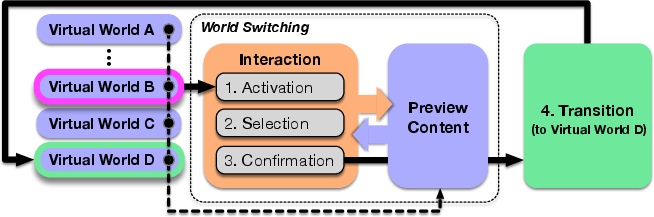
Figure 1: Interaction model delineating user and system phases in VR world switching, structuring activation, selection, preview, and transition.
The authors synthesize prior work on portals, worlds-in-miniature (WiMs), interaction metaphors, and transition effects, culminating in eight interface instantiations. These span two preview patterns—portal (first-person, windowed views) and WiM (exocentric, scaled-down models)—and four interaction metaphors: Hand Palette, Head Palette, World Wheel, and Gallery. The baseline is a traditional point-to-select 2D menu.
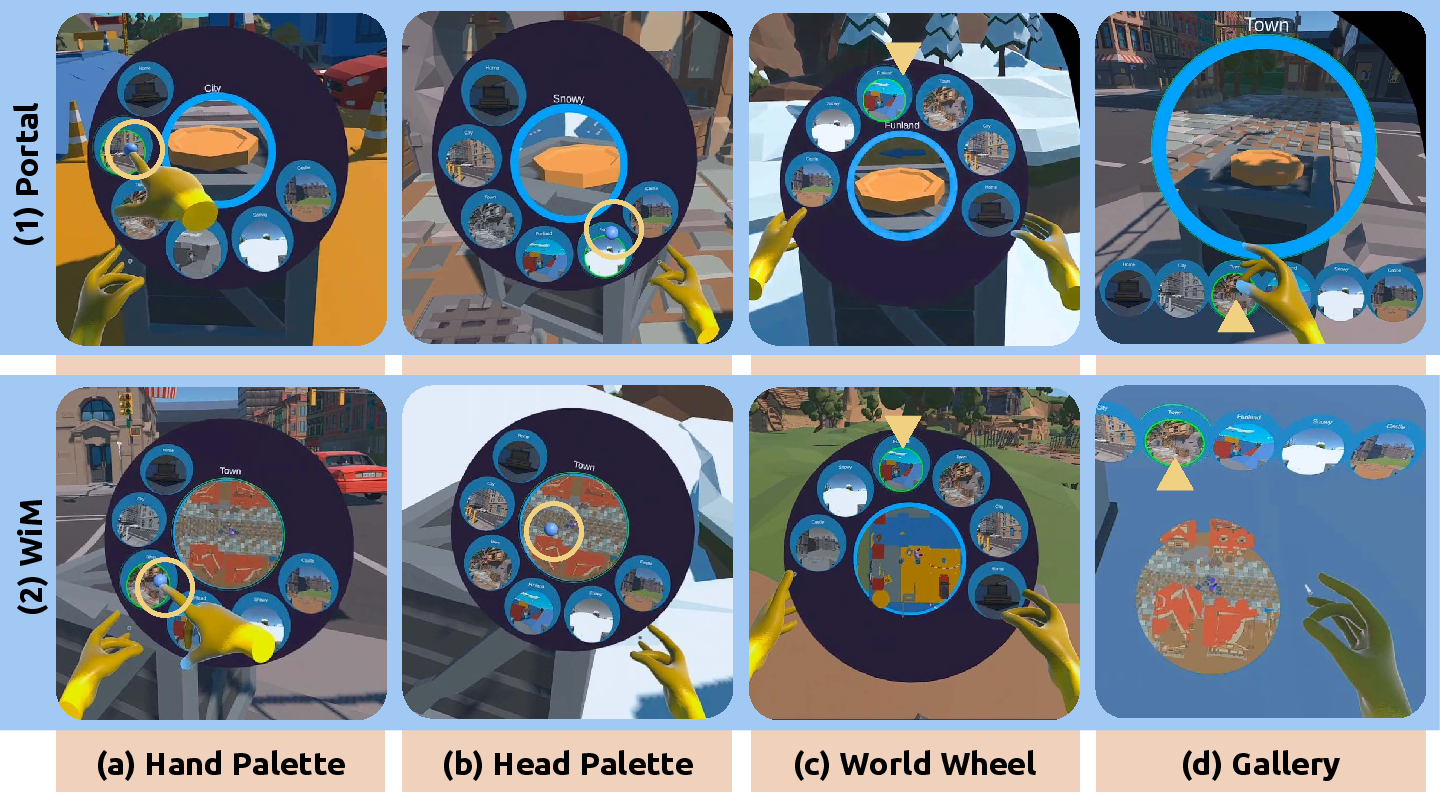
Figure 2: Eight world switching interfaces combining portal/WiM previews with four interaction modalities.
Experimental Methodology
A within-subjects empirical study (N=22) was conducted using a search-and-retrieve task distributed across six virtual environments. Each trial required participants to locate a spatially randomized object (coin), transition to the appropriate world, retrieve the object, and return to a home environment to deposit it. The study controlled for environmental and task confounds, using structurally similar environments (Figure 3) and consistent interaction logic across all conditions.

Figure 3: Examples of virtual environments used for the object retrieval task.
Three objective performance metrics were defined:
- Search Time: Delay from task onset until transition to the correct world, isolating spatial search and interface efficiency.
- Retrieve Time: Delay from world entry to object acquisition, sensitive to pre-orientation and preview quality.
- Deposit Time: Delay from object retrieval to successful deposit at home, serving as a proxy for return-to-home workflow efficiency.
Subjective measures included the NASA-TLX workload index, System Usability Scale (SUS), hedonic subscale of the UEQ, and a continuity questionnaire to assess flow continuity through transitions.
Quantitative Results
Search Time: Superiority of WiM Previews
Search Time varied significantly by interface (F(8,168)=47.03, p<0.001). All WiM interfaces produced significantly faster search times than baseline and portal-based techniques (Figure 4). The WiM World Wheel ($4.55$s median) and WiM Palette Hand ($5.01$s) were particularly efficient, contrasting with Portal interfaces, which yielded the slowest acquisition times.
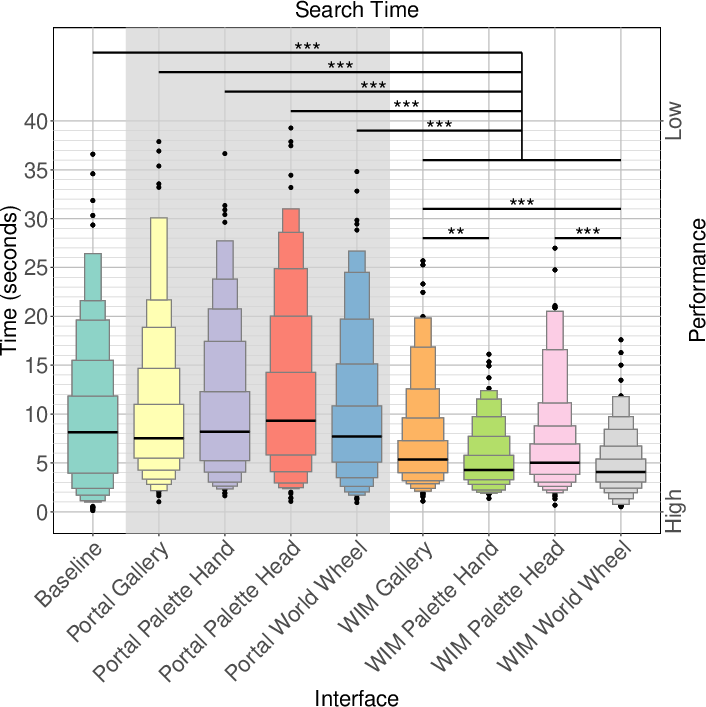
Figure 4: Search time distributions; WiM interfaces outperform portal and baseline systems.
Retrieve Time: Portals Enhance Pre-orientation
Portal previews facilitated lower retrieve times compared to WiM and baseline (F(2,42)=14.29, p<0.001), supporting the hypothesis that a direct first-person preview enables accurate pre-orientation and minimal corrective motion on arrival (Figure 5, left).
Deposit Time: Hand-Centric Techniques Expedite Return
Deposit time analyses revealed that Gallery-based techniques were significantly slower than Hand Palette and World Wheel interfaces (F(4,84)=7.45, p<0.001), highlighting the efficiency gains of direct, body-referenced interactions for rapid navigation and return (Figure 5, right).
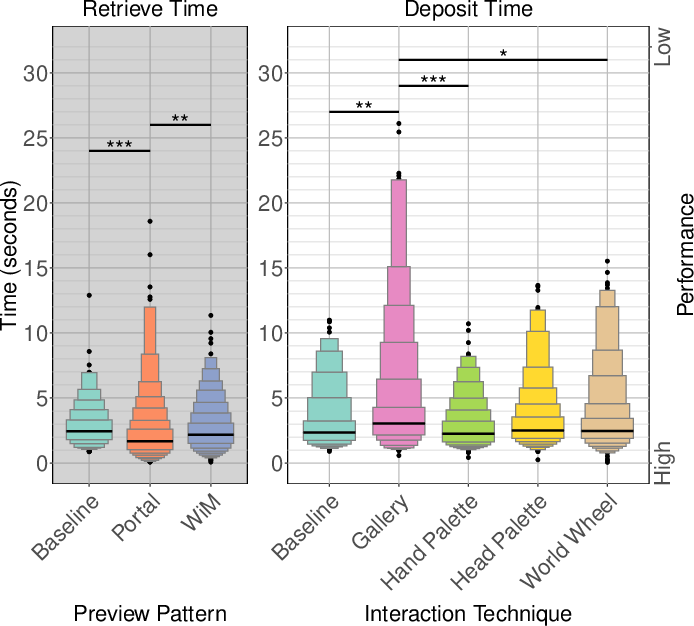
Figure 5: Retrieve times by preview pattern (left) and deposit times by interaction technique (right); direct hand-centric metaphors yield strongest performance.
Subjective Assessments
Hedonic experience (UEQ), perceived continuity, and usability (SUS) were all higher for preview-equipped interfaces versus baseline. Notably, WiM World Wheel and Hand Palette interfaces dominated user preference rankings (Figure 6), with WiM World Wheel being the most frequently rated as "best." Head-referenced and linear (Gallery) techniques scored lowest in subjective usability and induced greater perceived workload (NASA-TLX), corroborated by qualitative reports of physical fatigue and neck strain.
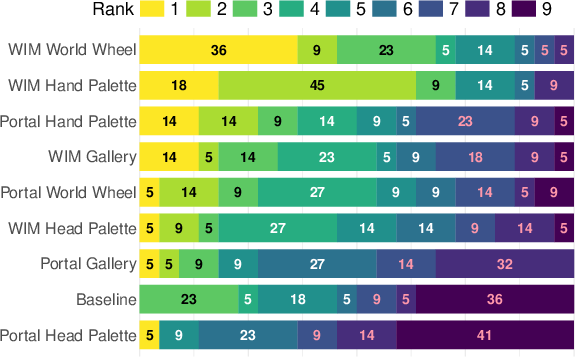
Figure 6: Interface preference distributions; WiM World Wheel and Hand Palette lead, baseline and Portal Head Palette trail.
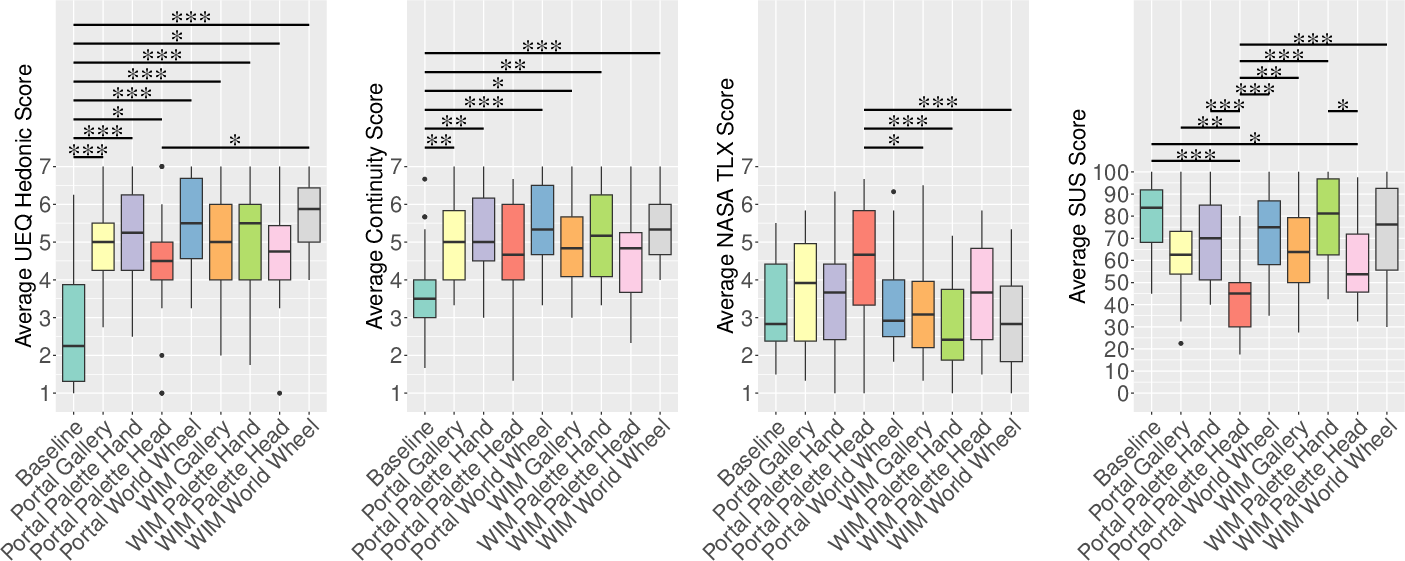
Figure 7: Subjective scores for hedonic quality (UEQ), continuity, workload (NASA-TLX), and usability (SUS); preview-enabled interfaces yield strong subjective benefits.
Qualitative Findings
Inductive thematic analysis yielded four salient themes:
- Preview Modality Impact: WiM previews enable efficient global scanning for spatial targets, while portals support precise pre-orientation.
- Control Fluency: Direct hand-based interactions (Hand Palette, World Wheel) are perceived as fast and precise, while linear scrolling (Gallery, Head Palette) induces imprecision and overshoot.
- Ergonomics: Prolonged two-handed or head-driven interactions introduce fatigue and awkward posture.
- Adaptability: Users seek context-sensitive previews and desire "muscle memory" affordances for high-frequency transitions.
Implications and Design Recommendations
- Task-Driven Preview Selection: WiM previews should be favored for global visual search, whereas portals are optimal for precise entry and alignment in cluttered or dynamic worlds. Systems can benefit from allowing users to toggle or combine these preview modalities depending on immediate search or navigation demand.
- Embodied Interaction Metaphors: Techniques leveraging direct, hand-centered selection (e.g., Hand Palette, World Wheel) offer both performance and fatigue minimization advantages for high-frequency transitions. Interfaces should avoid linear or head-based controls for routine switching due to ergonomic drawbacks.
- Interaction Streamlining: The strongest numerical performance gains are observed when world selection, preview, and confirmation are fused into a continuous, spatially consistent workflow supporting user-constructed spatial memory. Future designs should integrate manipulation through previews, extending recent work on interactive portals [ablett2023point], to further reduce transition overhead.
- Adaptive and Context-Aware Interfaces: Extensibility for user- and context-driven adaptation (e.g., via gaze- or voice-based triggers, use-frequency-based sorting) warrants exploration [lai2025adaptique].
Limitations and Future Directions
The study's scope encompasses transitions within a single VR application, abstracting typical productivity and collaboration workflows. Real-world scenarios with heterogeneous applications, multimodal input (e.g., gaze, controllers), or more complex environmental geometry may alter relative interface efficacy. Additionally, the cognitive and psychological correlates of rapid context switching in VR (e.g., potential for breaks in presence [skarbez2017surveypresence], spatial cognitive residue) remain underexplored and represent a frontier for future work. Extension to cross-reality or MR systems [mayer2024reviewtransitional, pavavimol2025transitions], and integration with adaptive predictive models, are high-potential areas.
Conclusion
This study delivers a foundational empirical analysis of VR world-switching interfaces, demonstrating that tailored preview modalities and embodied, direct selection metaphors measurably optimize both efficiency and user experience in spatial multitasking contexts. The findings provide actionable guidelines for designing spatially aware, context-sensitive transition mechanisms in emergent immersive productivity platforms. Ongoing research should further generalize these results to support robust, user-adaptive workflows across diverse XR ecosystems and application domains.
References:
- "From One World to Another: Interfaces for Efficiently Transitioning Between Virtual Environments" (2602.01423).