- The paper introduces a comprehensive framework that rigorously distinguishes weak and strong symmetry breaking in quantum systems using resource-theoretic principles.
- It demonstrates that popular proxies like Renyi-2 entanglement asymmetry fail monotonicity, emphasizing the need for strictly defined resource monotones.
- The study presents faithful strong symmetry-breaking monotones and conversion rates that guide diagnostics and state evolution in open quantum systems.
Resource-Theoretic Quantification of Strong and Weak Symmetry Breaking
Overview and Significance
The paper "Resource-Theoretic Quantifiers of Weak and Strong Symmetry Breaking: Strong Entanglement Asymmetry and Beyond" (2601.20924) introduces a comprehensive framework for quantifying symmetry breaking in quantum systems using resource-theoretic principles. Standard approaches to quantifying symmetry breaking, such as order parameters or correlation functions, are insufficient to provide a universally meaningful, operationally grounded, and monotonic measure under symmetric dynamics. This work rigorously separates the notions of weak and strong symmetry breaking, establishes a systematic resource theory for strong symmetry (beyond the existing resource theory of asymmetry for weak symmetry), and develops faithful monotones to quantify both.
The distinction is particularly essential for mixed states and open quantum systems, where weak symmetry only requires invariance under conjugation (allowing for exchange with an environment), while strong symmetry imposes more stringent constraints that forbid any such exchange. The operational resource theory developed here not only clarifies the structural features of symmetry breaking but also exposes which quantifiers are meaningful in macroscopic or i.i.d. limits and which ad hoc proxies fail essential monotonicity properties.
Classification of Symmetry and Resource-Theoretic Structures
The authors rigorously delineate three nested sets of symmetric states with respect to a symmetry group G acting via unitary representation U:
- Strong symmetric states: Remain invariant up to a phase, i.e., Ugρ=eiθgρ for all g∈G.
- Single-sector states: Weak symmetric states that are supported within a single irreducible representation sector after decomposing U.
- Weak symmetric states: Invariant under conjugation, UgρUg†=ρ.
This structure is visualized in a hierarchy (Figure 1), with critical distinctions—strong and single-sector states coincide for Abelian groups, but can be genuinely distinct or even empty for irreducible non-Abelian cases.
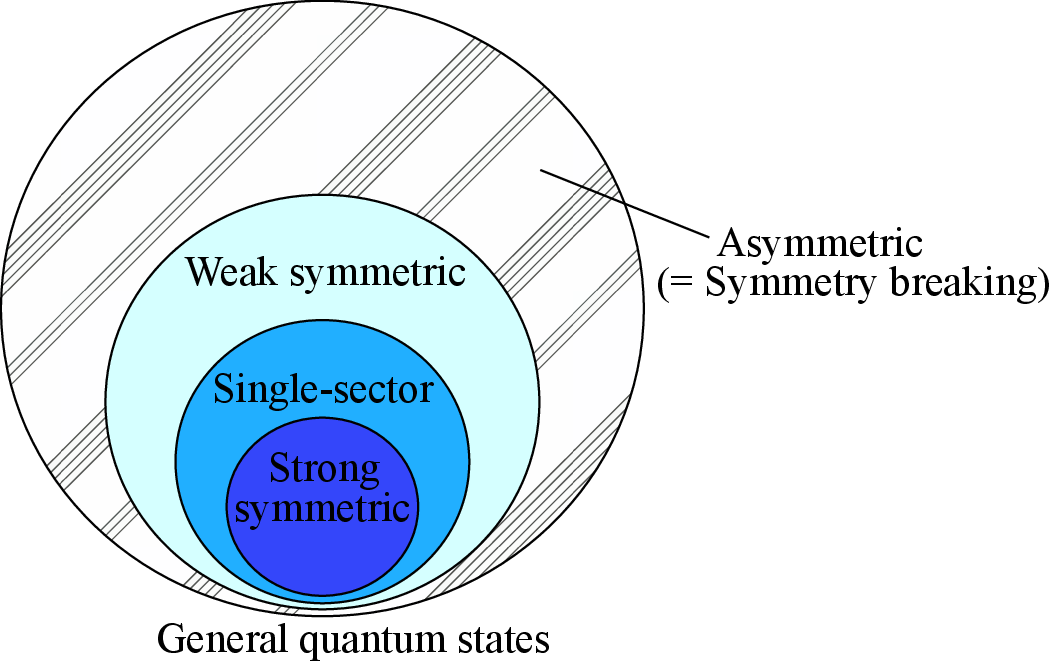
Figure 1: State space partitioning under group symmetry, with strong, single-sector, and weak symmetric sets nested and asymmetric states in the complement.
Failure of Renyi-2 and Model-Dependent Proxies
One of the core demonstrations is that widely used proxies such as the "Renyi-2" version of entanglement asymmetry—although computationally accessible and sensitive to symmetry breaking—are not monotonic under symmetric operations. Explicit qubit examples show this quantity can increase under weakly covariant channels, disqualifying it as a resource monotone and revealing the importance of strictly adhering to resource-theoretic axioms. This provides a necessary corrective to recent literature where such proxies have been used as quantitative diagnostics, e.g., for the quantum Mpemba effect.
Resource Theory of Strong Symmetry: Free States and Operations
The precise definition of free operations under strong symmetry is more restrictive than the standard covariant channels of weak asymmetry. Strongly covariant channels must commute with symmetry generators (Kraus operators satisfy KmUg=Ug′Km) and cannot exchange the conserved charge with the environment. This is operationally justified via a Stinespring representation where the environment is prepared in an invariant state, and no particles or conserved charges are exchanged:
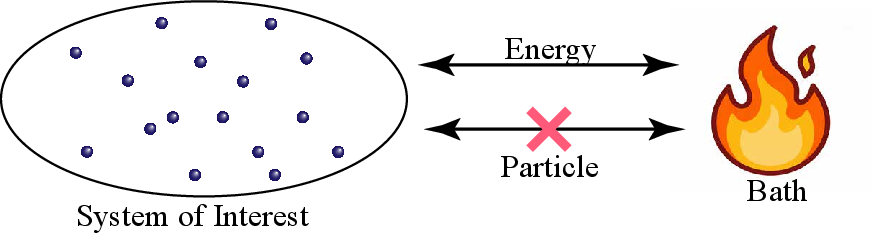
Figure 2: Energy exchange with a bath under weak covariance vs. strict particle-number conservation under strong covariance.
Notably, natural operations like partial trace or appending free states are not generically allowed under strong covariance unless equipped with compatible block structures, placing tight restrictions on the feasible transformations between systems.
Faithful Strong Symmetry-Breaking Monotones
The work introduces several monotones for strong symmetry breaking. The key proposals include:
- Strong entanglement asymmetry Ss-asym:
Ss-asym(ρ)=H{pν(ρ)}+S(G(ρ))−S(ρ)
where pν(ρ) are charge sector weights and G is group twirling.
- Faithful for single-sector structure, non-faithful for strong symmetry with non-Abelian G.
- Averaged logarithmic characteristic function L(ρ):
L(ρ)=∫Gdg[−log∣Tr(Ugρ)∣]
- Uniquely vanishes iff ρ is strong-symmetric, and is strictly monotonic under strong-covariant channels.
- Covariance matrices for compact Lie groups:
[C(ρ)]ij=21Tr(ρ{Xi,Xj})−⟨Xi⟩ρ⟨Xj⟩ρ
with {Xi} Lie algebra generators. Faithful for connected G, additive, and operationally related to the geometry of the state space.
i.i.d. Conversion Rates and Asymptotic Structure
A principal result is that, for U(1) symmetry, the unique monotone that determines reversible asymptotic state conversion rates under strong-covariant operations is the variance of the conserved charge Q:
R(ψ→ϕ)=VQ(ϕ)VQ(ψ)
for pure states ψ,ϕ and VQ(ρ)=⟨Q2⟩ρ−⟨Q⟩ρ2. This completely parallels the central role of entanglement entropy in entanglement theory and the quantum Fisher information (QFI) for weak asymmetry [Gour2008, Marvian2022, Yamashika2025].
Dynamics of Strong vs. Weak Symmetry Breaking
The work elucidates the irreversible conversion of weak symmetry breaking to strong symmetry breaking under strong-covariant (i.e., resource non-generating) dynamics in open systems. While the total symmetry-breaking resource (e.g., the variance) is preserved, the "quantum part" measured by QFI (or its generalization to the SLD-QFIM for compact groups) always decays, transferring from weak to strong symmetry breaking as decoherence proceeds. This is quantitatively illustrated by time-evolution under dephasing (see Figures 3 and 4):
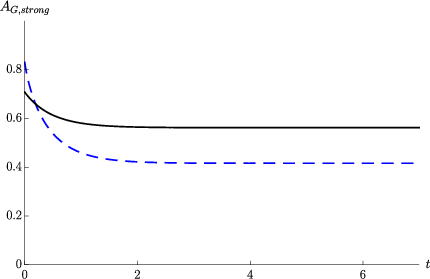
Figure 3: Strong asymmetry as a function of time under dephasing for two initial mixed qubit states, showing the cross-over indicative of a "Strong-Mpemba" effect.
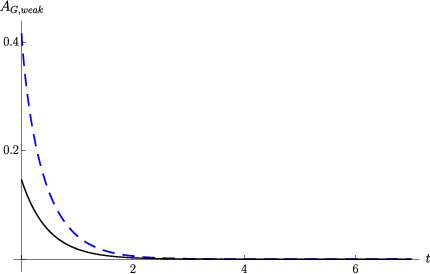
Figure 4: Weak asymmetry for the same system and evolution, noting monotonic decay and absence of cross-over.
This manifests, for instance, in the context of the "Strong-Mpemba Effect," where the ordering of initial asymmetry can reverse during time evolution, in contrast to weak asymmetry, where only monotonic decay occurs.
Applications and Generalizations
The framework is applied to ground states and thermal ensembles in conformal field theory, global quantum quenches, and spontaneous symmetry breaking in spin systems. The authors also propose natural extensions to generalized (non-invertible) symmetries, where the symmetrizer and strong symmetry sector projectors can be defined via the representation theory of finite-dimensional C-algebras, aligning with recent formalizations of fusion and tube algebras in high-energy and condensed matter physics.
Implications and Future Directions
The operational approach to symmetry breaking advocated in this work provides a rigorous foundation for symmetry-resolved diagnostics across quantum many-body and open-system physics, moving beyond heuristic measures to quantities with guaranteed monotonicity and direct physical significance. The strict separation of weak and strong symmetry provides the correct structure for quantifying resource conversion and dynamical irreversibility in a range of settings, including quantum thermodynamics, metrology, and symmetry-protected phases.
The explicit resource theories and monotones developed here are anticipated to interface naturally with ongoing work on non-invertible symmetries, symmetry-protected topological order in open systems, and the quantitative study of spontaneous and thermally driven symmetry breaking in mixed and macroscopic ensembles.
Conclusion
This work establishes a resource-theoretic foundation for the quantification of both weak and strong symmetry breaking, offering a systematic language for monotone construction, conversion rates, and operational diagnostics. The explicit identification of faithful strong-symmetry monotones, the breakdown of ad hoc proxies, and the rigorous treatment of dynamical evolution and macroscopic limits set a new standard for research in the quantification and manipulation of symmetries in quantum theory. The methodology and results are widely applicable and open numerous directions for further theoretical and experimental investigation.