- The paper presents a general framework for defining approximate clones using α-deletion and β-swap relaxations.
- It demonstrates that common voting rules like IRV, Ranked Pairs, and Schulze fail clone independence for nontrivial α>0 or β>0 when m≥4.
- Empirical analyses on elections, figure skating, and deliberation datasets show that robust clone independence holds in structured, near-perfect settings.
Independence of Approximate Clones in Ordinal Elections
Introduction
This paper introduces a rigorous framework for the study of approximate clones in ordinal elections and systematically analyzes their implications for the axiomatic property of clone independence in voting rules. Traditional social choice theory defines clones as candidates ranked adjacently by all voters; clone independence then demands that adding or removing any clone should not affect the election outcome except for the winner among the clone set. However, perfect clones are exceedingly rare in realistic settings. This work generalizes the notion of clones to approximate clones via two formal parameters, α-deletion and β-swap, and examines whether rules that are independent of clones provide any similar robustness for near-clones.
The authors introduce two quantitative relaxations of perfect clonality in preference profiles:
- α-deletion clones: Two candidates x and y are α-deletion clones if, after removing up to αn voters, x and y are adjacent in all remaining rankings.
- β-swap clones: Two candidates are β-swap clones if the average number of adjacent swaps required per voter to make x and y adjacently ranked is at most β.
Both measures reduce to the standard clone definition for α=0 or β=0. The paper provides a mathematical linkage between these parameters and the structure of the profile, including expected values for random and structured models and counterexamples illustrating their differences.
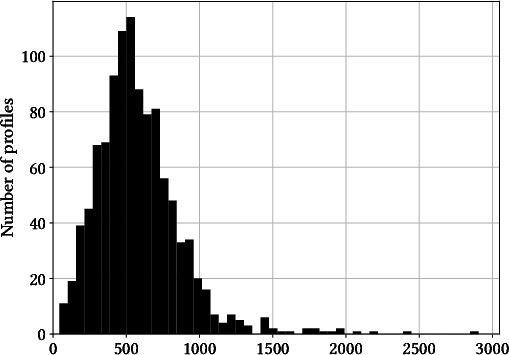
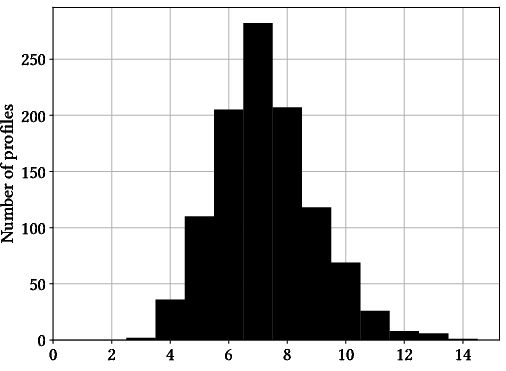
Figure 1: Distribution of the number of voters n in the Scottish local election dataset, showing scale and variability.
Theoretical Results: Limits of Clone-Independence Robustness
A core contribution is the negative result that generic voting rules, even those known to be independent of perfect clones—such as IRV, Ranked Pairs, and Schulze—fail to satisfy independence of approximate clones for any nontrivial α>0 or β>0 when the number of candidates m≥4. Specifically, the authors provide constructive profiles for which removing an approximate clone (in either deletion or swap sense) changes the winner, even in the weak sense where only one of the near-clones must satisfy independence. This impossibility result is robust across common Condorcet-consistent rules.
Notably, for m=3, a positive result emerges: in tie-free instances, IRV is weakly independent of α-deletion clones and β-swap clones when α≤1/3, and both Ranked Pairs and Schulze enjoy the property for all α>0 in simple profiles.
The paper further extends these results to structured domains, proving that any rule satisfying the Smith criterion and independence of Smith-dominated alternatives is weakly independent of approximate clones when the Smith set size is at most 3.
Empirical Analysis of Approximate Clones in Real-World Data
Datasets and Measurement
The authors empirically investigate the prevalence and impact of approximate clones using three real-world datasets:
- Local Scottish elections (ranked ballots with party structure),
- Figure skating competitions (expert judges, objective rankings),
- Mini-jury deliberation experiments (small groups, AI-generated statements).
For each, the minimal achievable α and β values for each candidate pair are computed, and the sensitivity of various rules to removal of approximate clones is assessed.
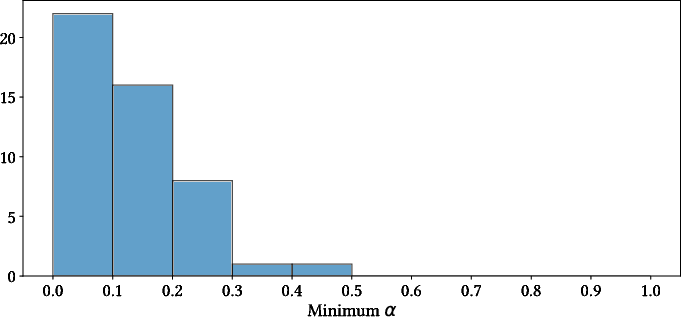
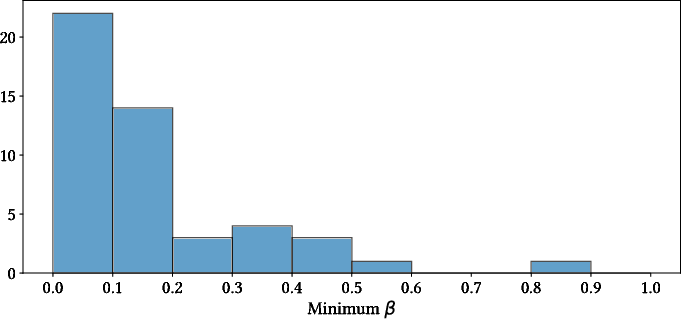
Figure 2: Distributions of the minimal α and β for which candidate pairs are approximate clones in the figure skating competitions dataset.
The figure skating data features the highest concentration of (near-)clones, attributed to highly correlated rankings from a small jury. The Scottish dataset, despite frequent party-based candidate clustering, does not yield perfect clones but does show low α and β for intra-party pairs, validating the relevance of the approximate clone model.
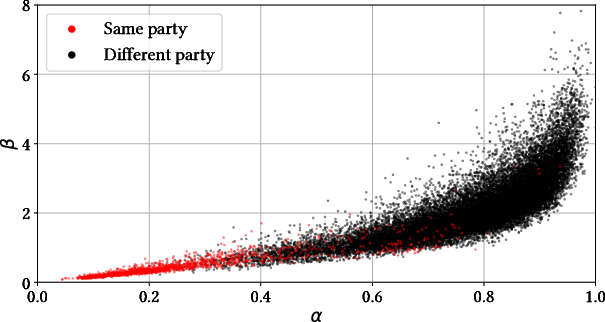
Figure 3: Scatter showing the correlation between α and β for all candidate pairs in the Scottish elections; same-party pairs are notably more clone-like.
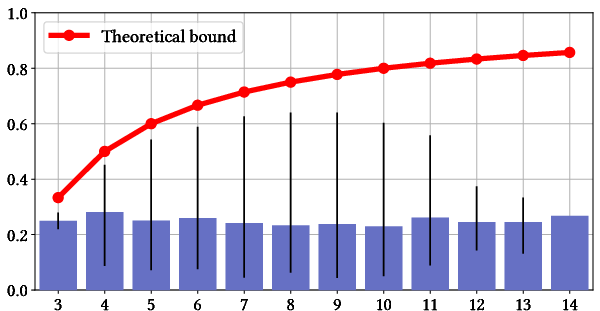
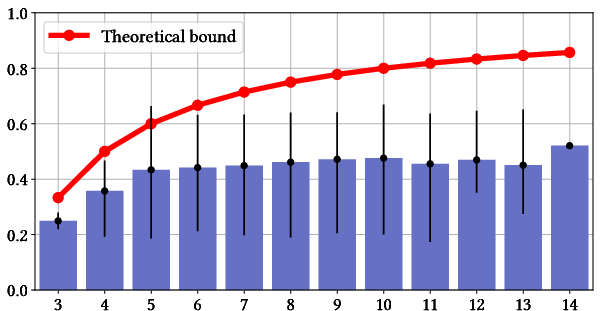
Figure 4: Average minimum α for clone-pairs versus number of candidates m in Scottish elections, compared to the theoretical random baseline.
Robustness of Voting Rules
The empirical assessment includes IRV and Ranked Pairs (clone-independent), Plurality, and Borda (clone-sensitive). For each, the paper reports the proportion of candidate pairs for which removing an approximate clone changes the winner. Across all datasets, IRV and Ranked Pairs nearly always satisfy independence of perfect clones (when present). For approximate clones (α<0.2), they also outperform Plurality and Borda in preserving outcomes, though the guarantee is not absolute.
Interestingly, the weak version of the axiom (demanding only that one of the approximate clones can be safely removed) is almost always satisfied in practical datasets, even for rules that are theoretically sensitive, highlighting the practical rarity of mutual spoilers via approximate cloning.
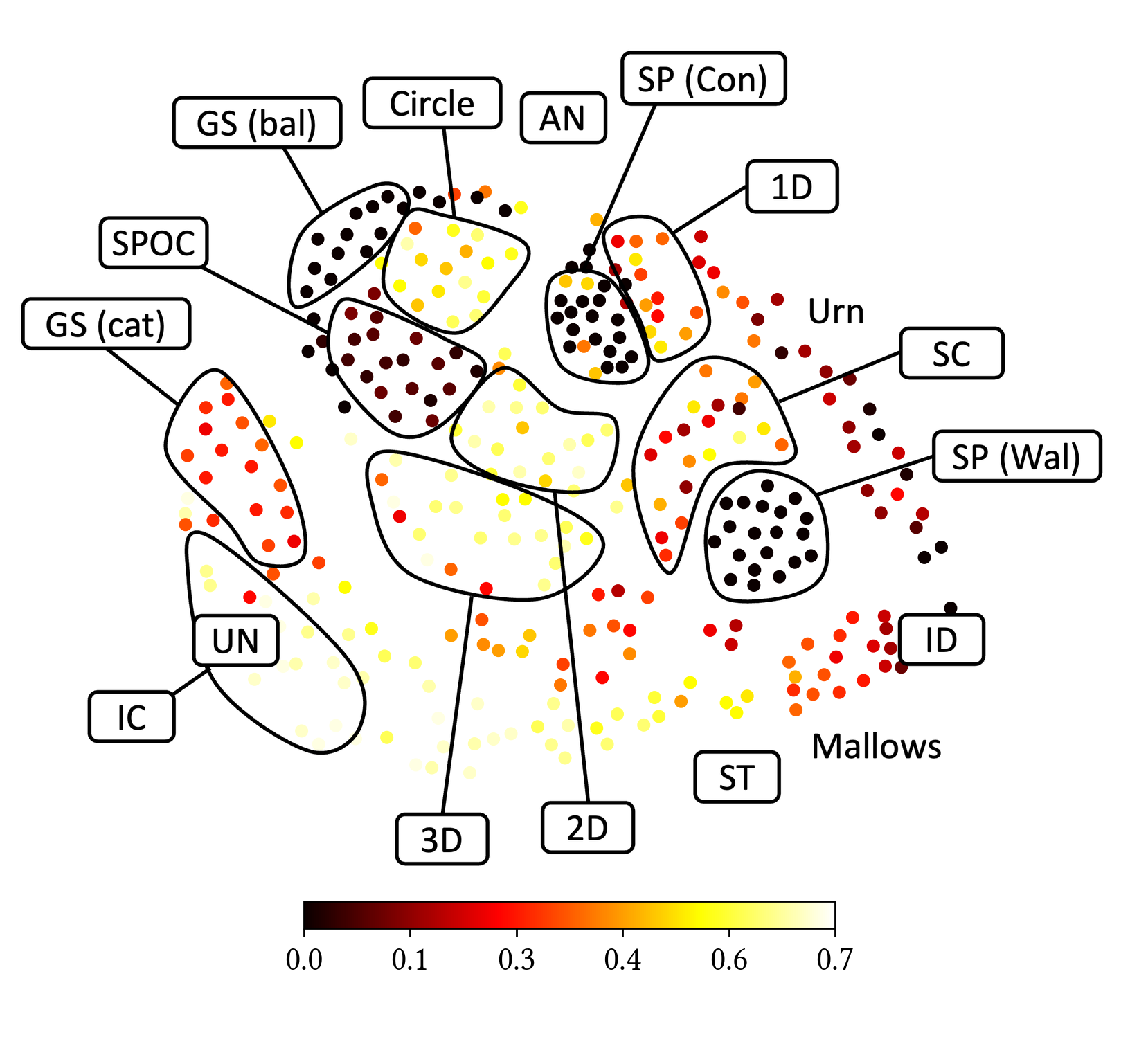
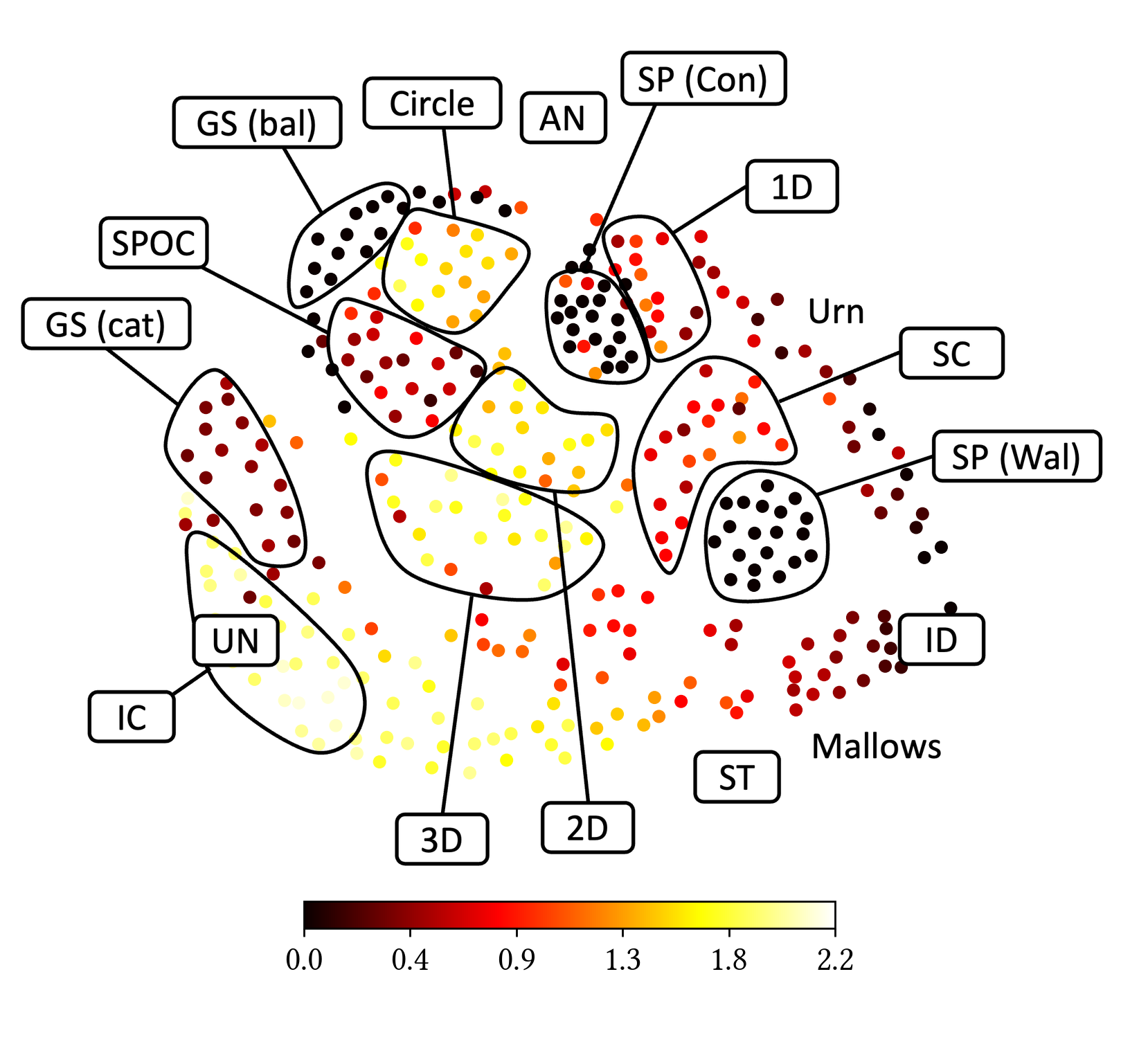
Figure 5: Visualization on the map of elections (10 candidates, 50 voters), showing the spatial distribution of minimal α (left) and β (right) for approximate clones. Structured domains exhibit lower values.
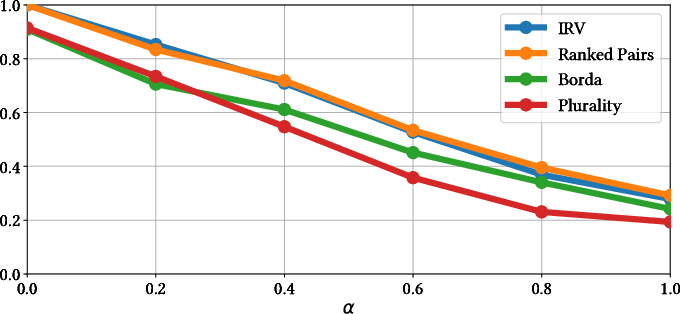
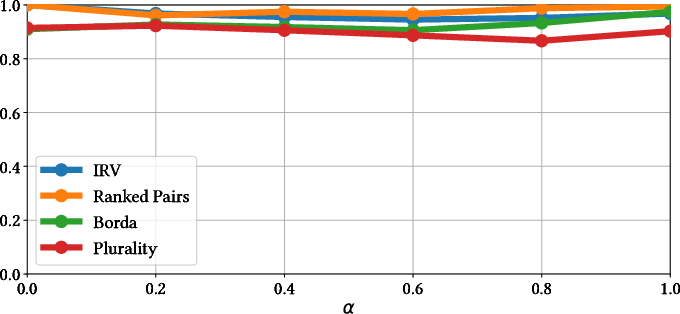
Figure 6: Proportion of candidate pairs for which rules satisfy weak independence of α-deletion clones, across α in the deliberation dataset.
The empirical findings support the theoretical insight that perfect clone independence is not robust to small perturbations in the ranking structure, but show that in practical instances—especially with high clone-likeness—robustness failures are rare for sophisticated rules.
Implications and Future Directions
The results have both theoretical and practical implications. From an axiomatic perspective, the main impossibility theorems indicate that, for m≥4, robustness to approximate clones cannot be guaranteed for any nontrivial threshold, even by the strongest known voting rules. This challenges the practical interpretability of clone independence as a shield against spoilers in real elections: in the absence of perfect clones, even the best rules can be sensitive to the introduction or withdrawal of near-clones.
However, empirical evidence shows that such situations are uncommon, especially for structured data (party-based elections, popularity contests, statements generated from the same premise). For highly correlated or identity-like profiles, or small candidate sets, rules such as IRV and Ranked Pairs align well with the philosophical intent of clone independence.
The work opens two significant directions:
- Randomization: Exploring randomized rules, or axioms parameterized by the degree of approximation (e.g., bounding change in winning probability as a function of α/β).
- Beyond Pairs: Generalizing approximate clone definitions to larger candidate sets or more expressive preference models, and analyzing corresponding axiomatic and computational properties.
Conclusion
This paper offers a rigorous treatment of approximate clones, exposes the limits of robustness for classic axiomatic guarantees in voting theory, and provides practical measurements in real-world elections. The results highlight a dichotomy: theoretical clone independence is a brittle guarantee under relaxation, yet in operational scenarios, sophisticated rules often behave robustly toward near-clones, especially in domains with pronounced candidate similarity. Developing new models to bridge this gap—perhaps via parameterized or randomized rule frameworks—remains an important agenda for social choice and computational voting theory.