Observations of the temporal evolution of Saturn's stratosphere following the Great Storm of 2010-2011. II. Latitudinal distribution of CO and stratospheric winds
Abstract: Saturn's Great Storm of 2010-2011 has produced two stratospheric hot spots, the "beacons," that eventually merged to produce a gigantic one in April and May 2011. This beacon perturbed stratospheric temperatures, hydrocarbon, and water abundances for several years. We aim to assess whether the beacon induced any perturbation in another oxygen species, namely CO. A second goal is to measure how the vortex perturbed the stratospheric wind regime. We conducted interferometric observations of Saturn in the submillimeter range with SMA and ALMA to spatially resolve the CO (J=3-2) and (J=2-1) emissions, respectively. We used a previously determined CO vertical profile as a template, to search for (i) the meridional distribution of CO and (ii) variations of the CO abundance associated with the storm. The high spatial and spectral resolutions of the ALMA observations enabled us to retrieve the winds from the Doppler shifts induced by the winds on the lines. Despite limitations resulting from the removal of baseline ripples, we find a relatively constant meridional distribution of CO. The average CO mole fraction implied by the adopted and rescaled 220-year-old-comet-impact vertical profile is (1.70.7) at 0.3\,mbar, i.e., where the contribution functions peak. We also find that the CO abundance has not been noticeably altered in the beacon. The winds measured at 1\,mbar show striking differences with those measured in 2018, after the demise of the beacon. We find the signature of the vortex as an anticyclonic feature. The equatorial prograde jet is 100 to 200 m.s slower, and broader in latitude, than in quiescent conditions. We also detect several prograde jets in the southern hemisphere. Finally, we detect a retrograde jet at 74N which could be a polar jet caused by the interaction of the Saturn magnetosphere with its atmosphere.
Paper Prompts
Sign up for free to create and run prompts on this paper.
Top Community Prompts
Explain it Like I'm 14
Overview
This paper studies what happened in Saturn’s upper atmosphere after a huge planet-wide storm in 2010–2011. The storm created very hot “beacons” high up in the air (the stratosphere). The researchers wanted to see:
- whether the storm changed how much carbon monoxide (CO) was in the stratosphere, and
- how the stratospheric winds were affected while the beacon was active.
Key Questions
The study asks two simple questions:
- Did the storm’s giant hot spot (the beacon) change the amount or spread of CO in Saturn’s stratosphere?
- What were the stratospheric wind speeds and patterns during the storm, and how did they compare to calmer times?
How They Did It
Think of Saturn as a distant object you can “listen” to using special radio ears. The team used two powerful radio observatories:
- SMA (Submillimeter Array) in March 2010, before the storm.
- ALMA (Atacama Large Millimeter/submillimeter Array) in January 2012, during the storm.
What they listened for:
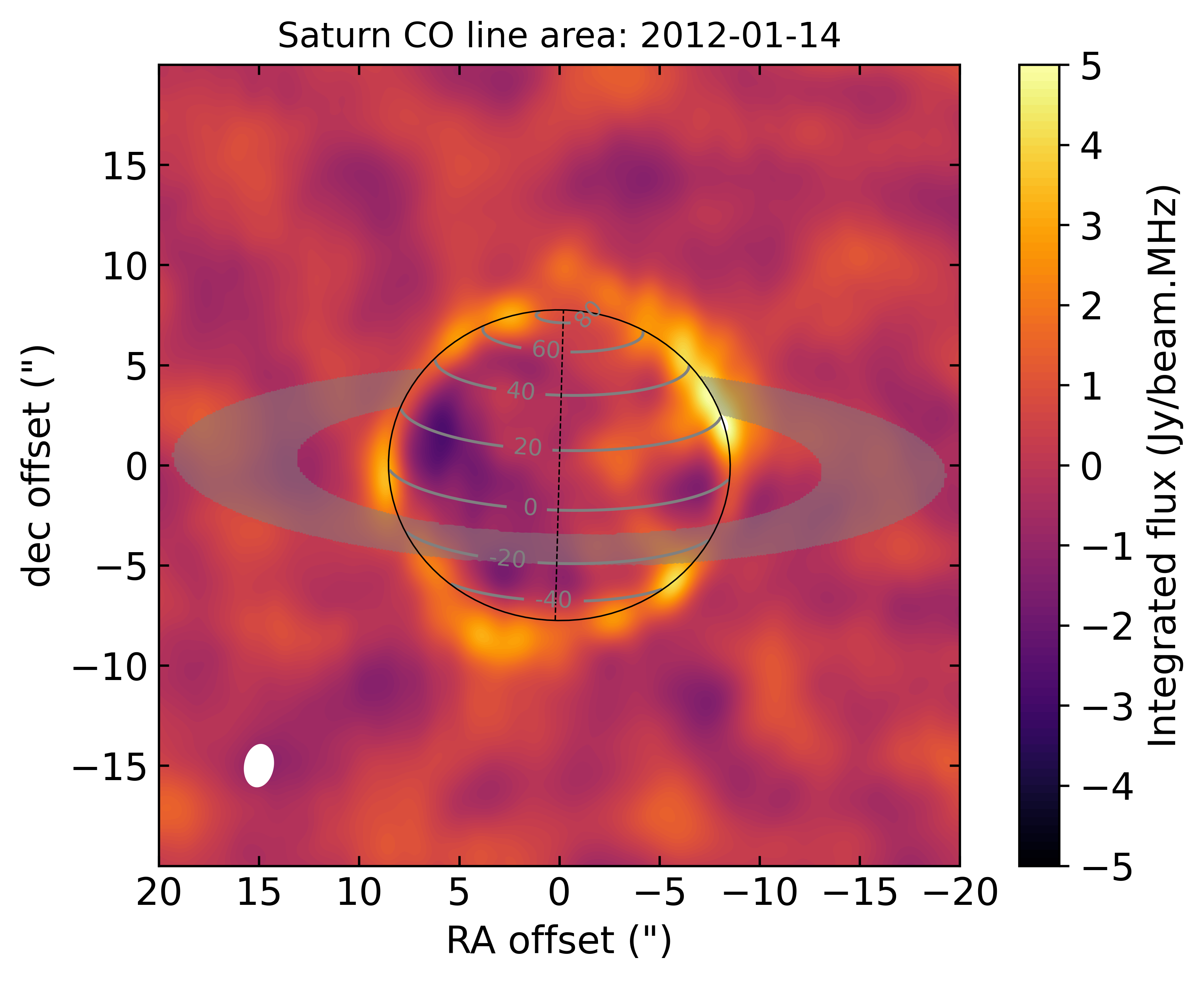
- CO gives off radio “notes” at very specific frequencies (called “lines,” here CO J=3–2 and J=2–1). By mapping these notes across Saturn, they can tell how much CO is present and where.
Key ideas explained simply:
- Stratosphere: A high layer of the atmosphere, above most clouds.
- Limb: The edge of the planet’s disc in images. Looking at the limb is like looking through more atmosphere at once, so faint signals are easier to detect.
- Doppler shift: Like the changing pitch of a passing ambulance siren. If gas moves toward us, its radio note shifts slightly one way; if it moves away, it shifts the other way. Measuring this shift tells wind speed.
- Interferometer: Many radio dishes working together as one giant, sharper “ear.”
- mbar: A unit of pressure. 1 mbar is very thin air compared to Earth’s surface pressure (~1000 mbar).
- Mole fraction: The fraction of air made of one gas. For example, 1.7×10⁻⁷ means 1.7 parts CO in 10 million parts air.
- Prograde/retrograde: Prograde winds go the same way Saturn rotates; retrograde go the opposite way.
- Anticyclonic: A vortex that spins the opposite sense of typical storm systems at that latitude, often linked to high-pressure regions.
Their approach in brief:
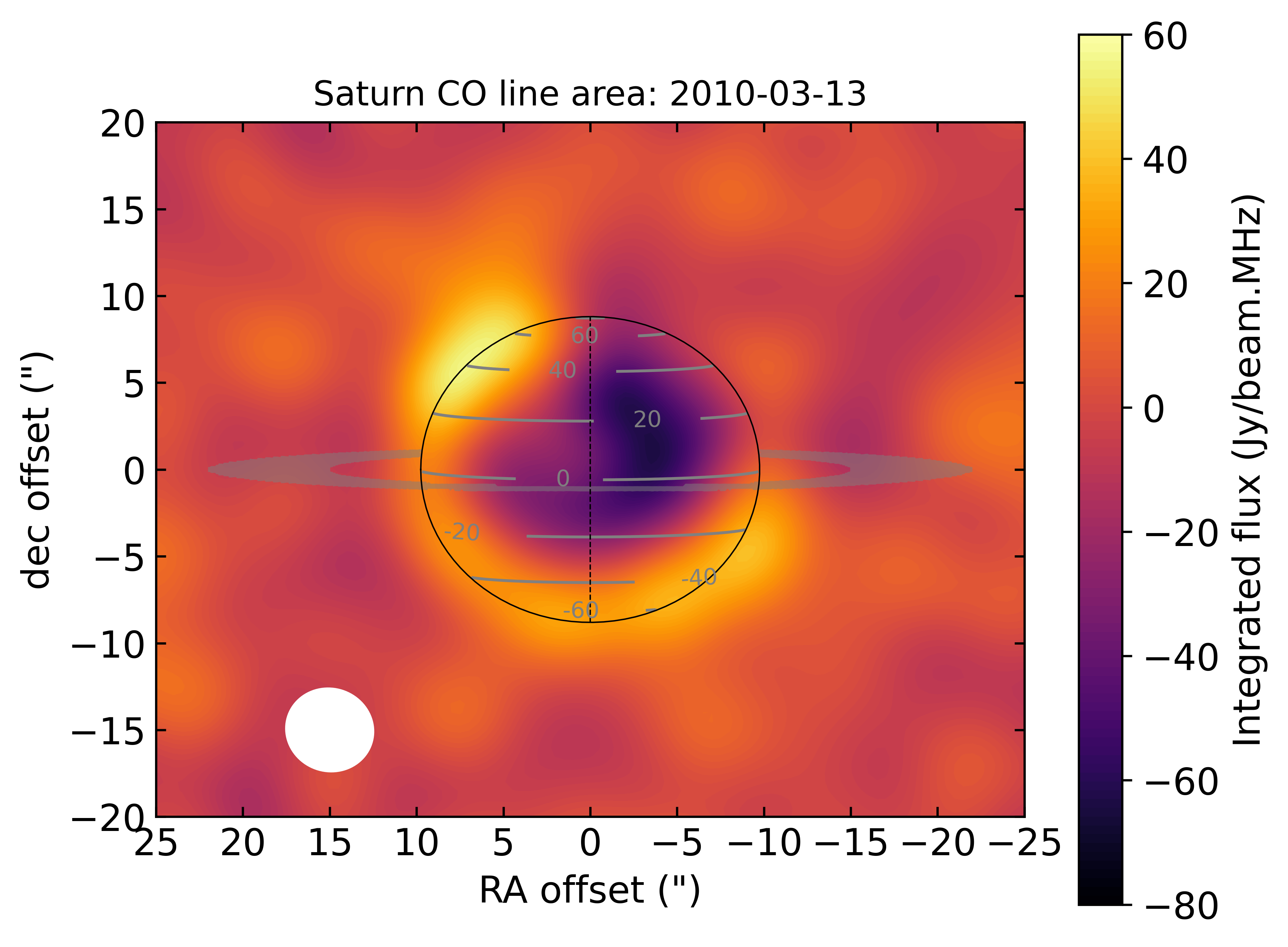
- Before the storm (SMA), they mapped CO around the limb.
- During the storm (ALMA), they mapped CO again and measured wind speeds from tiny Doppler shifts of the CO lines.
- Because CO’s exact vertical profile is hard to pin down from these data, they used a template based on a past event: a large comet impact about 220 years ago that likely delivered CO to Saturn’s stratosphere. They then scaled this template to fit the observations.
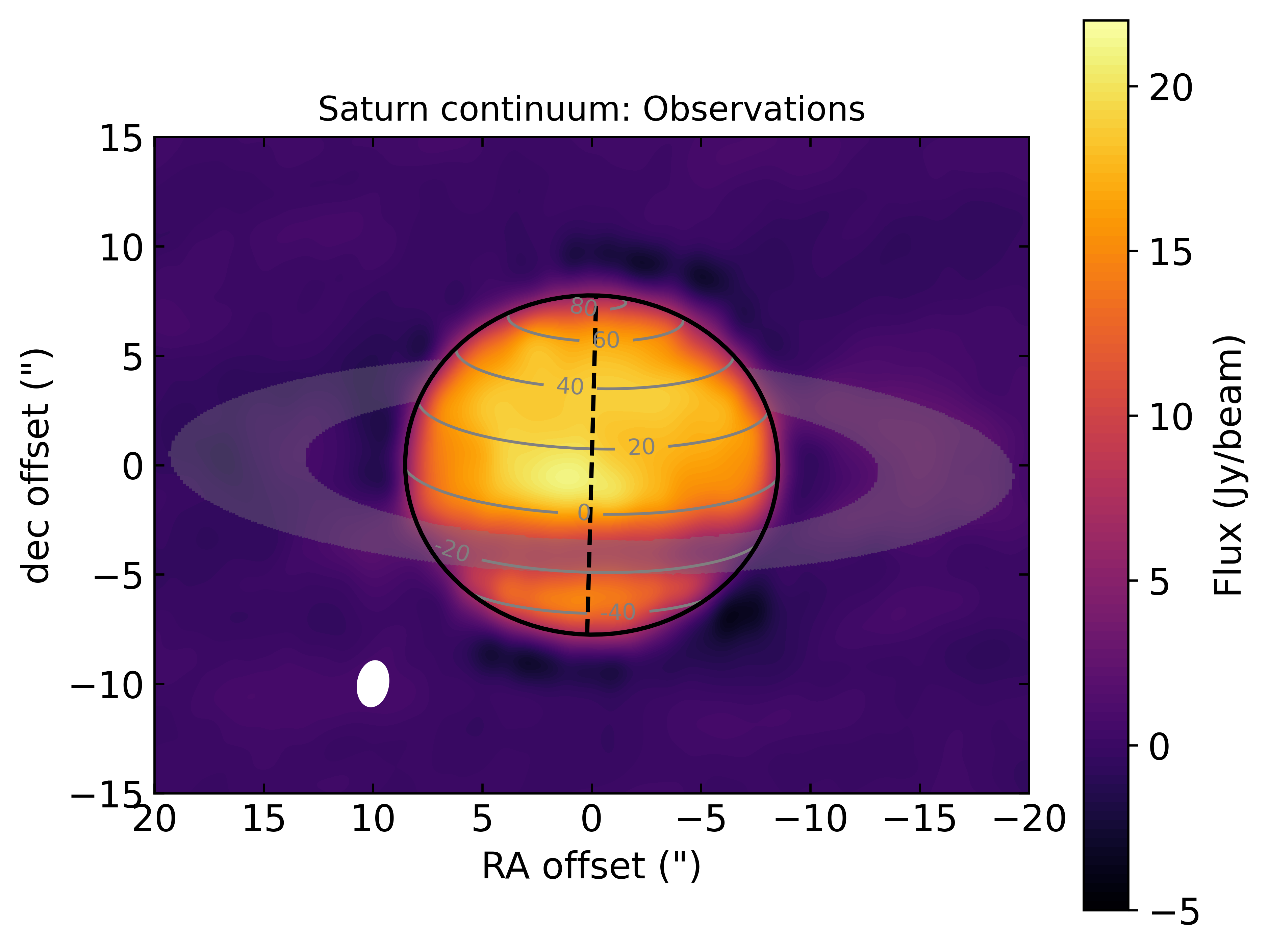
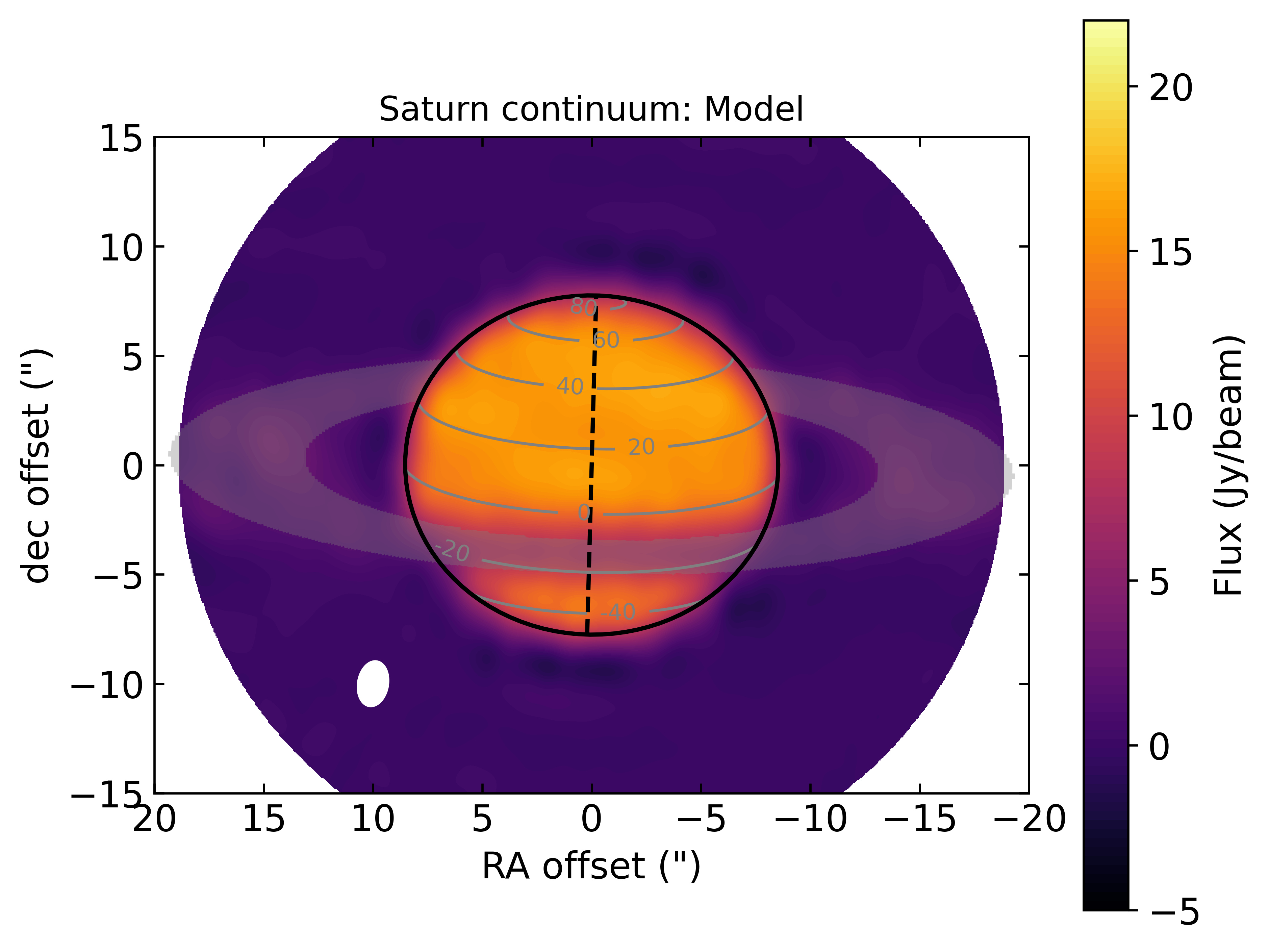
- They corrected for technical issues (like “baseline ripples,” which are unwanted wiggles in the radio data) and subtracted the strong radio “continuum” from Saturn to isolate the faint CO lines.
Main Findings
Here are the key results and why they matter:
- CO amount stayed fairly uniform by latitude and did not increase inside the hot beacon.
- Average CO mole fraction at about 0.3 mbar (where the CO signal is strongest) was roughly 1.7×10⁻⁷ (with an uncertainty of ±0.7×10⁻⁷).
- This suggests the beacon’s heating and vertical motions didn’t noticeably change CO, unlike some hydrocarbons and water that did change inside the beacon.
- A narrow CO absorption feature was seen near the equator on the planet’s disk (not the limb), hinting at a strong temperature inversion in the stratosphere there.
- That means temperatures were warmer below and cooler above within a thin layer, which can make CO absorb rather than emit at those frequencies.
- This matches the idea of Saturn’s equatorial “semiannual oscillation,” a regular up-and-down temperature pattern, though the exact size of the inversion from these data needs cautious interpretation.
- Winds during the storm were clearly different from calmer times:
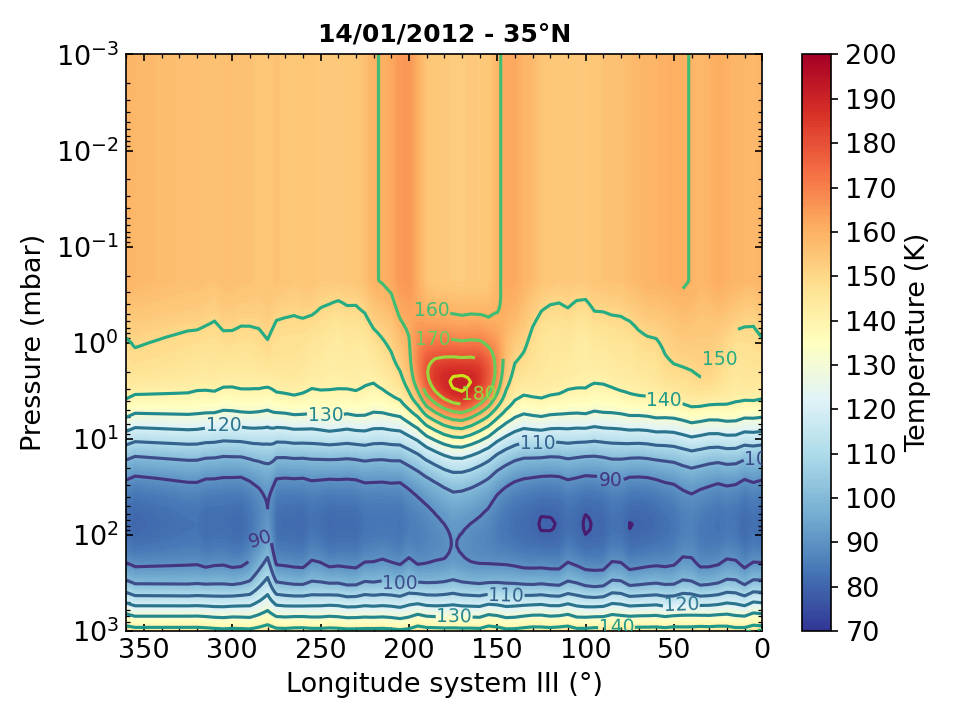
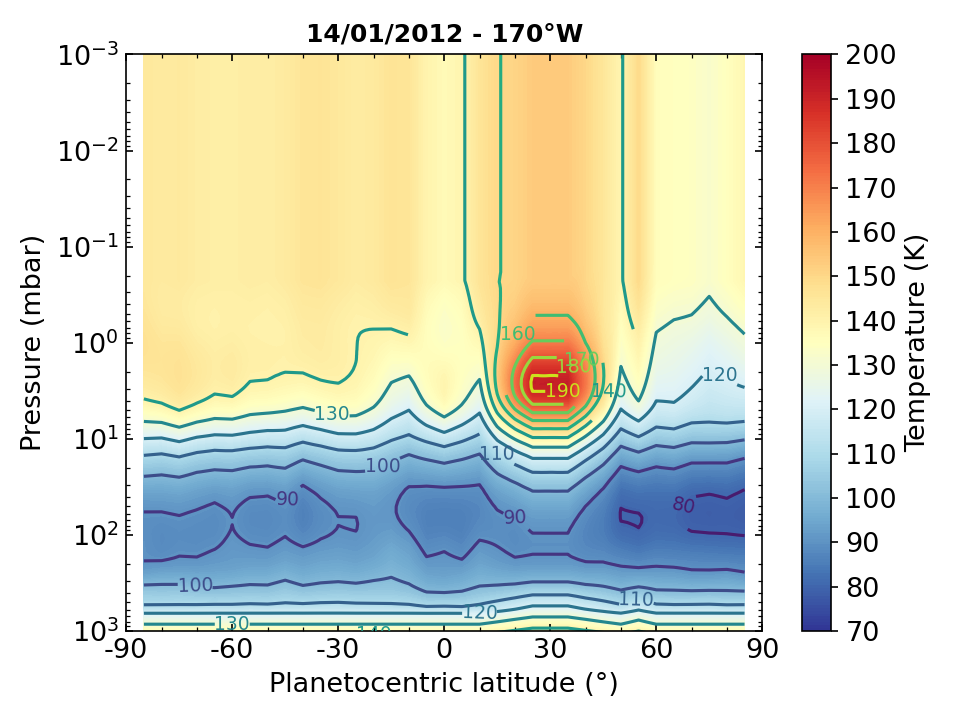
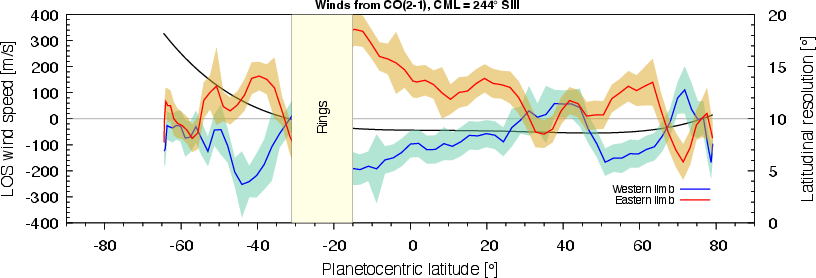
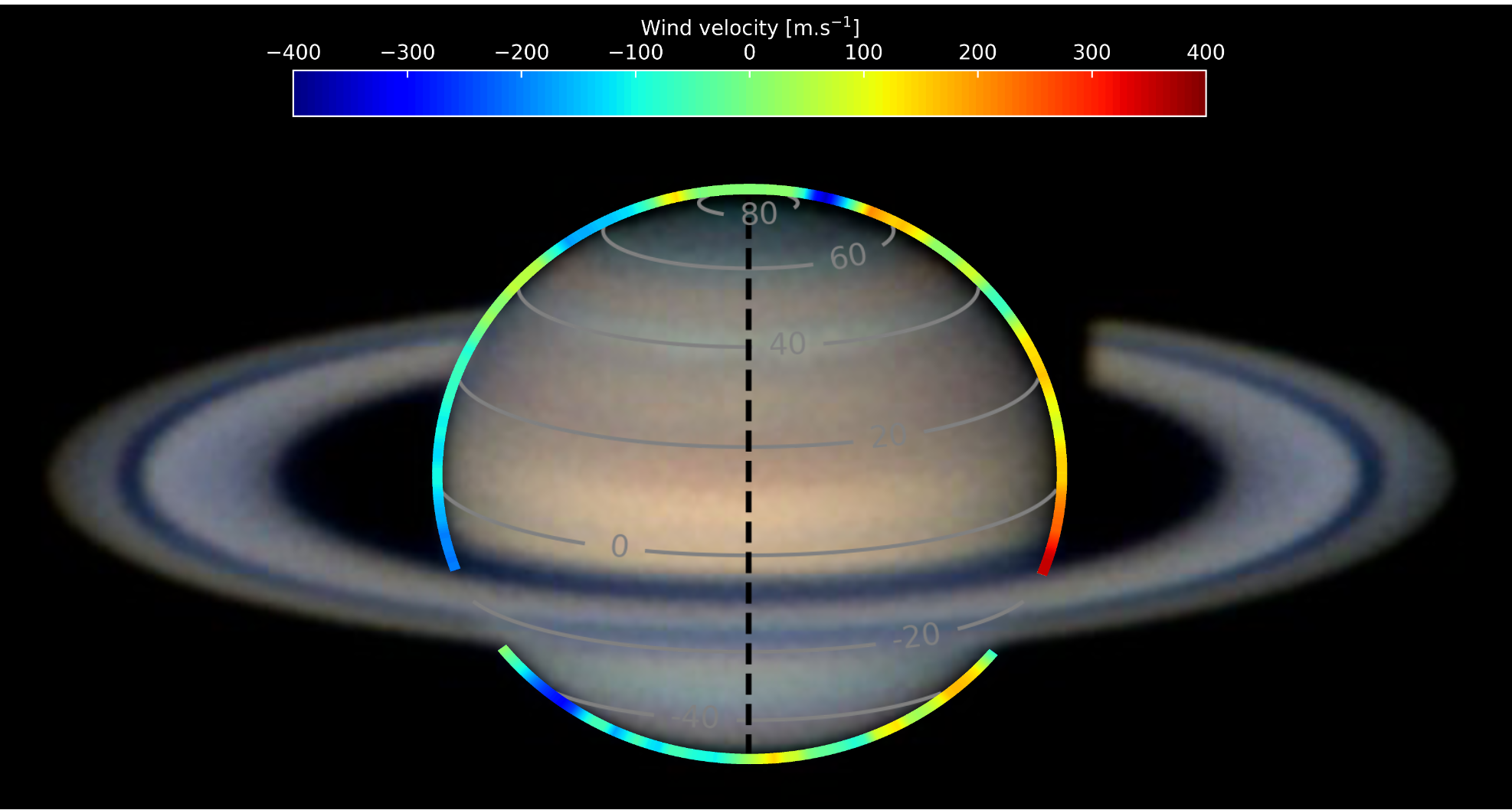
- Beacon signature: The winds showed an anticyclonic pattern around 40°N, consistent with a big hot vortex. Speeds were about ±60 m/s at the beacon’s edge.
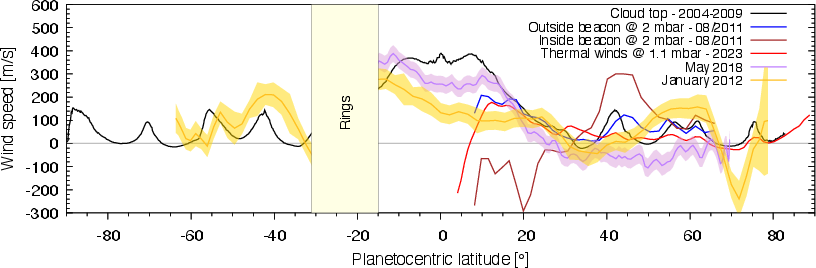
- Equatorial jet: The fast, prograde equatorial stratospheric jet was slower (by 100–200 m/s) and spread across a wider range of latitudes than measured in 2018 after the beacon had faded. This indicates the storm disturbed the usual balance.
- Southern hemisphere jets: Several prograde jets appeared in the south (around 40–50°S), the first such stratospheric measurements there.
- Possible polar jet: A strong retrograde jet was detected near 74°N. It might be linked to polar atmospheric changes or to Saturn’s magnetosphere interacting with the atmosphere (similar polar jets have been seen on Jupiter). More observations are needed to confirm this.
Why this is important:
- It shows that Saturn’s giant storm changed wind patterns high above the clouds, even if CO amounts stayed steady. This helps us understand how energy and motion move through a giant planet’s atmosphere after major events.
What It Means
- Chemistry vs. dynamics: The storm’s beacon changed some gases (hydrocarbons and water) but not CO. That suggests CO in the stratosphere is controlled largely by long-term external sources (like past comet impacts or ring material “raining” into the atmosphere) rather than short-term storm-driven changes.
- Storm impacts on winds: The storm significantly altered stratospheric winds, weakening and widening the equatorial jet and imprinting an anticyclonic pattern near the beacon. This provides real measurements of how big weather events can reshape a giant planet’s upper winds.
- Polar processes: The possible retrograde polar jet hints that Saturn’s magnetic environment might drive special wind patterns near the poles, an idea also supported by Jupiter’s observations.
- What’s next: As Saturn approaches equinox (when both hemispheres are lit similarly), new measurements can test these findings in both hemispheres, look for a matching southern polar retrograde jet, and watch how winds evolve with the seasons.
Overall, this research builds a clearer picture of how Saturn’s stratosphere reacts to extreme storms, helping scientists refine models of giant planet atmospheres and plan smarter future observations.
Knowledge Gaps
Knowledge gaps, limitations, and open questions
The following points summarize what remains missing, uncertain, or unexplored in the study, with concrete targets for future work:
- CO vertical profile remains unconstrained: reliance on a scaled “220-year-old comet impact” profile was necessary because bandpass/standing-wave issues removed broad line-wing information. Future work needs wider bandwidth, higher bandpass stability, and multi-transition CO observations to retrieve the true vertical distribution and test its time variability.
- Sensitivity limited to ~0.3 mbar: the analysis primarily probes CO near the line-center contribution peak (~0.3 mbar). Potential storm-induced CO perturbations at other pressure levels remain undetected; multi-line, multi-band observations are needed to sample a broader altitude range.
- No clear beacon-induced CO change detected: lack of enhancements inside the hot vortex may reflect sensitivity limits rather than true absence. Higher S/N, finer spatial resolution, and pressure-resolved retrievals are required to detect localized changes predicted by downwelling-driven scenarios.
- Equatorial absorption implies a strong SAO inversion, but amplitude is uncertain: the inferred ~50 K inversion near 0.1–0.2 mbar is not robust due to missing short spacings and interferometric filtering. Combined 12-m + ACA + total-power datasets and longitudinal mapping are required to quantify SAO amplitude, phase, and vertical structure circa 2012.
- Pre-storm winds could not be retrieved: standing-wave systematics and limited spectral resolution precluded wind retrieval from 2010 SMA data, leaving the pre-storm baseline unknown. Comparable-quality pre-storm wind measurements (for future storms) are essential to quantify storm-driven changes.
- Wind pressure level and vertical shear are poorly constrained: winds are assigned to ~0.2–1 mbar via modeled contribution functions, but vertical shear and exact altitude remain uncertain. Multi-transition wind tracers and/or pressure-diagnostic line wings at higher spectral resolution are needed to profile winds with height.
- Beam mixing forced narrow spectral fitting (±1.5 MHz): asymmetry from mixing limb and disk line-of-sight velocities can bias Doppler shifts. Longer-baseline configurations (higher PSR) and higher spectral resolution are needed to fit full line profiles robustly.
- Southern hemisphere jets: newly detected prograde jets (~50°S and ~40°S) lack confirmed connection to tropospheric jets and their seasonality is unknown. Repeat ALMA campaigns across seasons, with higher spatial/spectral resolution, should test persistence and troposphere–stratosphere coupling.
- Retrograde jet at ~74°N: its origin (auroral forcing vs. dissipating polar stratospheric vortex) is unresolved. Coordinated UV/IR auroral, magnetospheric, and sub-mm wind observations, plus searches for a southern counterpart near equinox, are required to discriminate mechanisms.
- Equatorial prograde jet weakening/broadening vs. 2018: the dynamics, momentum sources, and recovery timescales remain unclear. A time series spanning 2012–2018 (and beyond) is needed to track the jet’s evolution relative to thermal fields and storm aftermath.
- Beacon anticyclonic wind signature underestimated: retrieved peak speeds are ~4–5× smaller than thermal-wind inferences, likely due to spatial resolution, integration-time smearing, and method limitations. Higher-resolution, shorter-integration, and full-longitude mapping are required to capture peak vorticity.
- Limited longitudinal sampling: scheduling placed the beacon at the eastern limb and used ~1 hr integrations, averaging over ~30° longitude. Full-disk mosaics are needed to characterize longitudinal structure in both CO and winds.
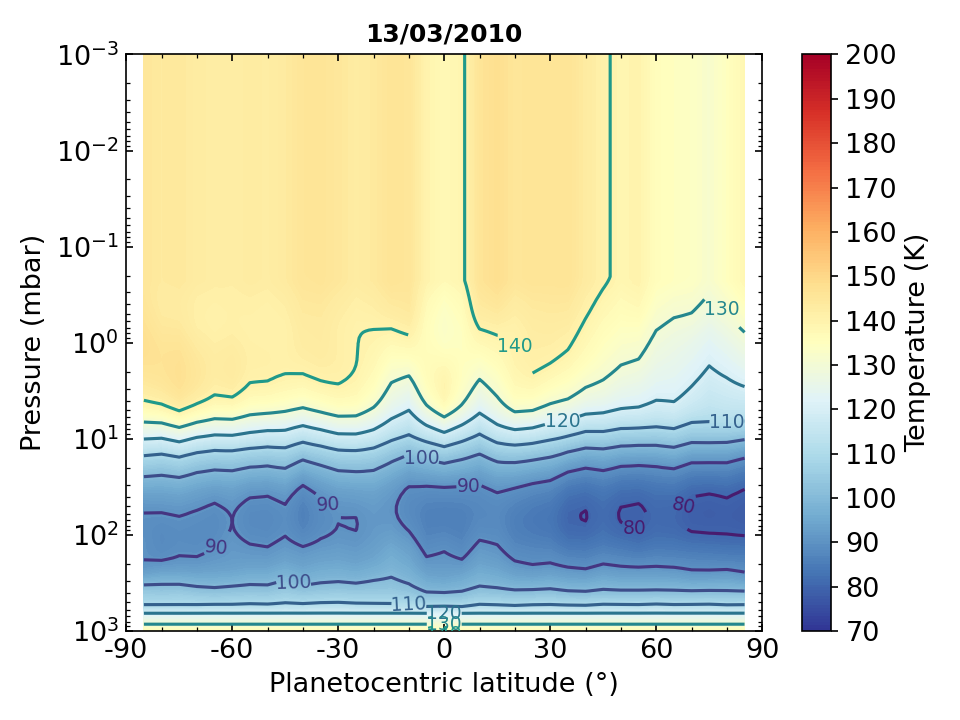
- Temperature-field assumptions at high altitude (2010): isothermal extrapolation above 0.2 mbar neglects equatorial oscillations and could bias CO retrievals and contribution functions. Better high-altitude temperature constraints (e.g., from limb IR data) are necessary.
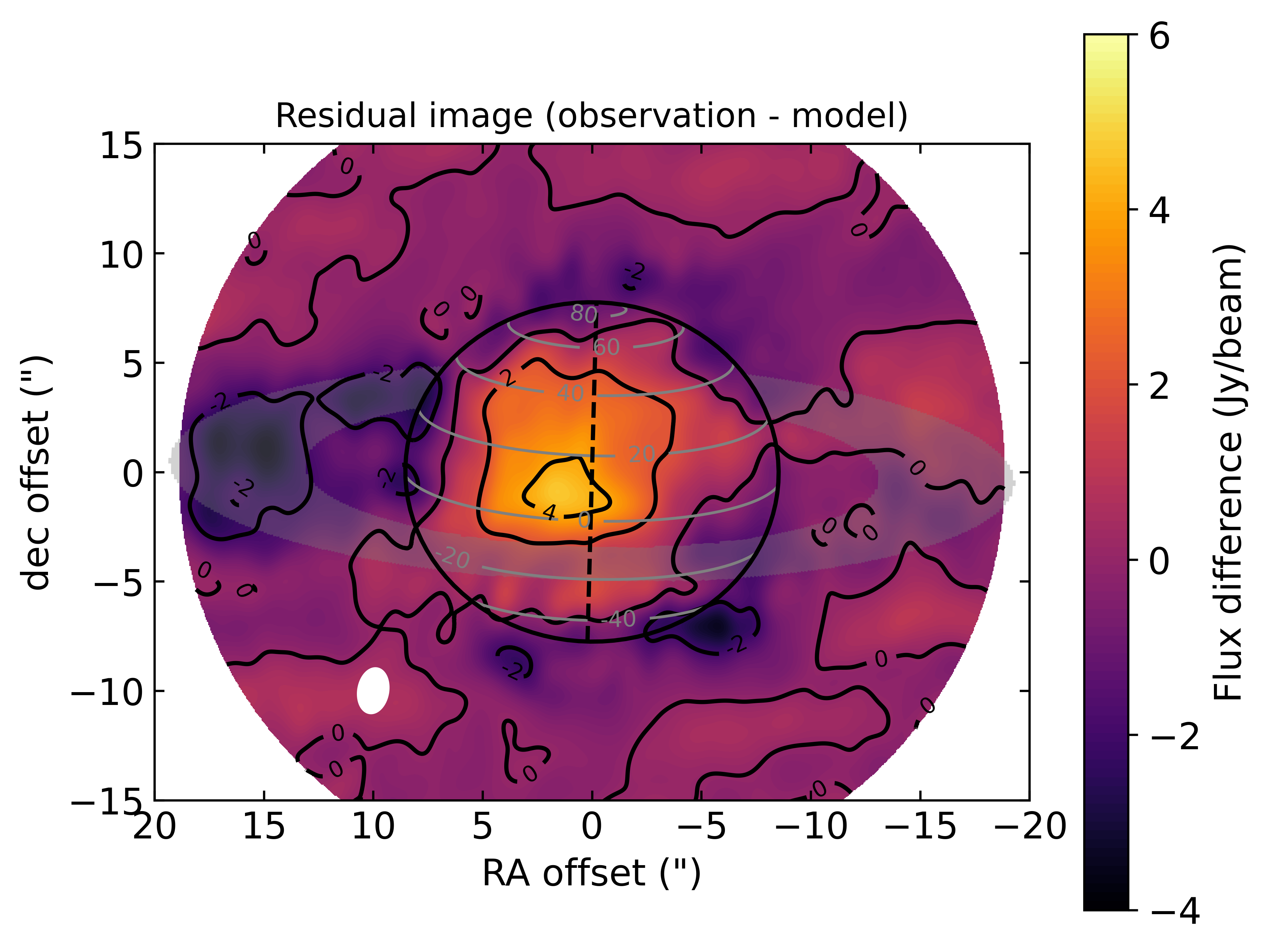
- Ring-related continuum and imaging artifacts: local mismatches (e.g., 20–40°N west limb; 40–50°S east limb) complicate fits and may bias abundance/wind retrievals. Improved ring radiative models and imaging strategies (e.g., multi-configuration deconvolution) are needed to reduce contamination.
- External CO sources remain untested: potential contributions from equatorial D-ring infall (mass-28) are not distinguished; no equatorial CO enhancement was detected, but sensitivity may be insufficient. Isotopologue observations (e.g., 13CO) or co-tracers could separate cometary vs. ring-rain sources.
- Tropospheric CO contribution is assumed negligible: broader bandwidth and improved baselines are needed to test and potentially constrain the tropospheric component and vertical exchange.
- Vertical transport (Kzz) is unconstrained: without a retrieved CO vertical profile, constraints on eddy diffusion and vertical motions are not obtained. Joint modeling of CO with other tracers (e.g., hydrocarbons, H2O) and multi-line inversions are required.
- Error budget lacks full propagation of temperature and spectroscopic uncertainties: abundance and wind uncertainties do not fully include T-field errors (e.g., SAO), continuum systematics, or line-broadening parameter uncertainties. A comprehensive uncertainty analysis is needed.
- No detection of SAO/SQO in winds: the non-detection could reflect coarse spatial resolution or storm disruption rather than absence. Higher-resolution wind maps near the equator are needed to isolate oscillatory signatures.
- Single-species wind tracer: only CO was used for Doppler winds. Cross-validation with other stratospheric lines (e.g., HCN, CH3C2H) would test consistency across altitudes and reduce species-specific biases.
- Ring shadowing gaps in latitude: winds from ~15°S–31°S were not retrieved. Observations at different ring opening angles or alternative epochs are required to fill this latitude gap.
- Sparse temporal sampling during storm: aside from January 2012, there is no in-storm temporal evolution of CO and winds. Repeated observations through the storm’s lifetime would clarify the dynamics and composition trajectory.
- Meridional CO homogeneity is only weakly constrained at high latitudes: larger uncertainties (and beam effects) limit detection of polar gradients. Higher S/N and angular resolution at high latitudes are needed to test for polar enhancements/depletions.
- Seasonality of mid–high latitude jets remains open: a broad prograde jet (50–67°N) appears in 2012 but not in 2018, suggesting seasonal variability. Systematic campaigns across seasons are required to establish seasonal cycles in stratospheric jets.
Practical Applications
Immediate Applications
The following applications can be deployed now, leveraging the paper’s methods, observational strategies, and data-processing innovations.
- Doppler wind retrieval pipeline for planetary atmospheres
- Sector: software, academia (planetary science), aerospace
- Use case: Implement the analytical wind-retrieval method that fits narrow-band spectral lines (e.g., CO J=2–1, J=3–2) to extract line-of-sight and zonal wind speeds at 0.2–1 mbar. Integrate with existing radio interferometry workflows (e.g., CASA).
- Tools/workflows: A CASA-compatible module or Python package (e.g., “StratoWind”) for uv-plane continuum subtraction, narrow-band fitting within ±1.5 MHz of line center, projection correction, and error budgeting.
- Assumptions/dependencies: Adequate SNR and spectral resolution; accurate temperature fields for contribution functions; correct beam-projection geometry; careful bandpass/baseline calibration to keep systematic errors <50 m/s.
- Interferometric calibration and baseline ripple mitigation cookbook
- Sector: telecommunications, RF/mm-wave instrumentation, software, academia
- Use case: Standardize a calibration workflow combining lower sideband transfer, bright calibrators (e.g., blazars, Mars), polynomial+sine removal of standing waves, and uv-plane continuum subtraction to recover faint lines atop strong continuum.
- Tools/workflows: A reproducible “calibration recipe” with QA checks for residual ripples and bandpass stability; scripts for primary-beam correction and multiscale CLEAN masks (planet+ring).
- Assumptions/dependencies: Availability of appropriate calibrators; stable instrumental passband; ripple periodicities tractable by sine/polynomial fits; visibility coverage sufficient to recover limb signal.
- Observation planning templates for limb-enhanced wind and composition retrieval
- Sector: academia, aerospace (mission ops), software (scheduling)
- Use case: Schedule planetary observations when target features (e.g., beacons/vortices) are on the limb to maximize path length and SNR; apply pointing and uv-distance scaling to coadd multi-date datasets; mask ring-contaminated latitudes.
- Tools/workflows: Planning notebooks linking ephemerides (e.g., JPL Horizons), limb geometry, sub-Earth latitude, and expected beacon drift; ring-shadow masks; amplitude normalization across dates.
- Assumptions/dependencies: Precise ephemerides; reliable drift-rate models; manageable ring contribution; compact array configuration yielding adequate PSR without excessive limb/disk mixing.
- Template-profile scaling for species retrieval under limited bandpass quality
- Sector: academia (remote sensing), software
- Use case: Adopt a physically motivated vertical profile (e.g., 220-year comet-impact CO distribution) and scale column abundances to fit line cores when broad wings are unreliable due to baseline limitations.
- Tools/workflows: Profile-scaling modules that constrain mole fractions at pressure levels where contribution functions peak (e.g., 0.3 mbar for CO J=2–1/J=3–2).
- Assumptions/dependencies: Validity of the template profile in the epoch/region of interest; modest line opacity; recognition that vertical structure is underconstrained without clean wings.
- Magnetosphere–atmosphere coupling diagnostics via polar jets
- Sector: academia (planetary aeronomy, space physics), policy (observatory time allocation)
- Use case: Use narrow-line Doppler measurements to detect and monitor polar retrograde jets potentially linked to auroral processes (e.g., the 74°N retrograde jet in Saturn), complementing UV/IR auroral observations.
- Tools/workflows: Joint campaigns combining ALMA sub-mm wind retrievals with UV auroral monitoring; cross-calibration with thermal wind balance products.
- Assumptions/dependencies: Sufficient polar visibility (season/equinox geometry); minimal ring interference; clear auroral signatures colocated in latitude; reliable projection corrections.
- Equatorial stratospheric thermal inversion (SAO) monitoring
- Sector: academia, aerospace, policy (facility coordination)
- Use case: Track semiannual oscillation-induced thermal inversions using disk-center narrow absorptions in CO lines; validate and refine temperature profiles (0.1–2 mbar).
- Tools/workflows: ACA observations to recover short spacings; coupled temperature retrievals tied to radiative transfer modeling; periodic monitoring campaigns.
- Assumptions/dependencies: Short-spacing coverage to avoid filtered flux; robust inversion retrievals despite interferometric limitations; known phase of SAO in target epoch.
- Educational and citizen-science integration with professional datasets
- Sector: education, daily life (amateur astronomy), policy (outreach)
- Use case: Incorporate amateur optical images (e.g., PVOL archive) into wind maps for contextual visualization; produce curricula demonstrating vortex dynamics, jets, and spectroscopic wind measurement.
- Tools/workflows: Public-facing visualization dashboards; lesson plans linking Doppler shifts to atmospheric motion; guided-journal workflows for amateurs contributing contextual imagery.
- Assumptions/dependencies: Proper image co-registration and metadata; policy support for open data; continued community engagement via archives like PVOL.
Long-Term Applications
The following applications require additional research, instrument development, scaling, or coordinated campaigns.
- Seasonal, global 3D wind climatology of giant planets
- Sector: academia, policy (multi-facility coordination), software
- Use case: Build longitudinally and seasonally resolved stratospheric wind atlases for Saturn (and other giants), quantifying jet variability (e.g., equatorial jet weakening/broadening post-storm), vortex signatures, and polar auroral jets across seasons.
- Tools/workflows: Multi-year ALMA/ACA campaigns, higher spectral resolution receivers, advanced deconvolution; data assimilation frameworks merging Doppler winds with thermal-wind balance and GCMs.
- Assumptions/dependencies: Long-term access to facilities; consistent calibration standards across seasons; refined temperature fields and contribution functions; improved PSR to reduce limb/disk mixing.
- Next-generation sub-mm/mm planetary wind mapper
- Sector: aerospace (instrumentation), energy/telecom (RF component suppliers), policy (mission planning)
- Use case: Design a dedicated instrument (ground or space-based) with higher PSR and spectral resolution for robust, wing-informed wind and composition retrievals at mbar levels, minimizing baseline ripple and short-spacing gaps.
- Tools/workflows: Heterodyne arrays with improved impedance matching to suppress standing waves; compact + extended array synergy; flight concepts for orbital sub-mm wind sounders.
- Assumptions/dependencies: Funding and technology readiness for low-noise mixers, stable local oscillators, improved backend digitizers; mission opportunities; robust thermal control.
- Exoplanet atmospheric wind and vortex detection via high-dispersion spectroscopy
- Sector: academia (exoplanets), software
- Use case: Adapt narrow-line Doppler wind retrievals to high-resolution near-IR/mm spectroscopy of hot Jupiters and sub-Neptunes (e.g., CO, H2O lines) to infer wind patterns, jets, and day-night circulation.
- Tools/workflows: ELT-class instruments + cross-correlation techniques; line-tracing contribution function modeling; template-profile scaling under sparse constraints.
- Assumptions/dependencies: Sufficient line SNR; disentangling planetary vs stellar/telluric signals; accurate temperature-pressure profiles; careful interpretation given limb vs disk-integrated signals.
- Magnetosphere–atmosphere coupling models constrained by polar jets
- Sector: academia (space physics, atmospheric dynamics), policy
- Use case: Develop physics-based models linking auroral energy deposition to stratospheric wind patterns, validating with polar retrograde jets in Saturn and Jupiter; extend to Uranus/Neptune with tailored magnetic geometries.
- Tools/workflows: Coupled MHD–GCM simulations; multi-wavelength campaigns (UV, IR, sub-mm); Bayesian inference combining wind and auroral proxies.
- Assumptions/dependencies: Confirmed detection and repeatability of polar jets; sufficient spatial resolution to resolve jet cores; cross-planet generality of auroral forcing.
- Advanced mm-wave signal-processing products inspired by interferometric ripple mitigation
- Sector: telecommunications, automotive radar, RF test and measurement, software
- Use case: Translate standing-wave/bandpass ripple mitigation methods (polynomial+sine fits, multi-source bandpass transfer) into commercial toolkits to improve calibration in mm-wave systems (e.g., 77 GHz radars, 5G/6G FR2).
- Tools/workflows: “RippleGuard” calibration libraries; QA dashboards for passband stability; adaptive fitting of periodic artifacts in spectra.
- Assumptions/dependencies: Artifact periodicities and amplitudes similar enough to benefit; availability of bright calibration sources or synthetic references; integration with industry test suites.
- Joint storm–chemistry–dynamics analyses for vertical transport diagnostics
- Sector: academia (planetary atmospheres), policy (facility time)
- Use case: Resolve discrepancies between hydrocarbon/H2O downwelling signals and apparently unchanged CO distributions inside storm beacons by coordinating multi-species, multi-line observations with improved vertical sensitivity.
- Tools/workflows: Multi-line campaigns (CO, hydrocarbons, H2O) with wider bandwidth to recover line wings; retrievals that jointly fit composition and temperature; sensitivity studies of vertical winds.
- Assumptions/dependencies: Access to wider instantaneous bandwidth and cleaner baselines; accurate ring/continuum modeling; improved vertical resolution via multiple lines and frequencies.
- Public-facing interactive planetary weather platforms
- Sector: education, daily life, software
- Use case: Build interactive apps that visualize time-evolving stratospheric winds, jets, and storm beacons on Saturn, drawing on Doppler wind products and thermal maps; enable guided exploration by students and enthusiasts.
- Tools/workflows: WebGL-based globe renderers; APIs serving wind slices and temperature fields; lesson modules connecting spectroscopy to dynamics.
- Assumptions/dependencies: Open-data licensing for derived wind products; sustained curation; performance budgets for large datasets.
Cross-cutting assumptions and dependencies
- High-quality calibration and baseline stability are critical; ripple removal and uv-plane continuum subtraction materially affect line-core fidelity and wind uncertainties.
- Accurate temperature fields and contribution functions are required to locate wind and composition sensitivity (0.2–1 mbar, peak near ~0.3 mbar for CO).
- Geometry matters: sub-Earth latitude, limb/disk mixing (PSR), and ring contamination can limit latitude coverage and introduce asymmetries.
- Template vertical profiles enable robust column/mole fraction estimates when wings are unreliable, but they may obscure true vertical redistribution and should be revisited with wider, cleaner bandwidths.
- Short-spacing recovery (e.g., via ACA) is essential for disk-center features (SAO absorption) and improves temperature inversion retrievals.
Glossary
- Atacama Compact Array (ACA): A subset of ALMA with smaller antennas used to recover short spatial frequencies. "A proper analysis of disk-center data would require dedicated observations with, for example, the Atacama Compact Array (ACA)."
- ALMA: The Atacama Large Millimeter/submillimeter Array, a high-resolution radio interferometer. "with SMA and ALMA to spatially resolve the CO (J=3-2) and (J=2-1) emissions, respectively."
- Anticyclonic: Refers to circulation opposite to the planet’s rotation (high-pressure vortex). "We find the signature of the vortex as an anticyclonic feature."
- Bandpass calibration: Correction of frequency-dependent gains across the observing band. "Passband calibration proceeded as follows."
- Baseline ripples: Spurious spectral undulations from instrumental or processing effects. "Despite limitations resulting from the removal of baseline ripples, we find a relatively constant meridional distribution of CO."
- Beacon: The storm-induced stratospheric hot spot on Saturn with enhanced temperatures and emissions. "The merged beacon lasted approximately 3 years"
- Clark algorithm: A CLEAN deconvolution method variant used in radio imaging. "We chose the Clark algorithm to compute the synthesized beam."
- Collision-induced absorption: Continuum absorption arising from molecular collisions (e.g., H2-H2). "The continuum is mainly caused by the collision-induced absorption spectra of H-H, H-He, and H-CH pairs."
- Comet-impact profile: A modeled vertical abundance profile resulting from a historical comet delivery. "rescaled 220-year-old-comet-impact profile of \citet{Cavalie2010}"
- Contribution function: A function describing pressure levels contributing to the observed line signal. "i.e., where the contribution functions peak."
- Doppler shifts: Frequency shifts of spectral lines caused by motion along the line of sight. "The retrieval of stratospheric winds from spectral line observations requires the measurement of Doppler shifts induced by the winds on the spectral lines"
- Double sideband (DSB) mixers: Receivers that detect both upper and lower sidebands around the local oscillator. "SMA operated double sideband (DSB) mixers"
- Ephemerides: Tables of celestial positions used for precise kinematic corrections. "which we obtain from JPL Horizons ephemerides."
- Heterodyne spectroscopy: Technique mixing the signal with a local oscillator to measure high-resolution spectra. "Heterodyne spectroscopy in the millimeter range with an interferometer offers the necessary spatial and spectral resolutions to do so."
- Interferometer: An array of antennas combining signals to achieve high angular resolution. "with an interferometer offers the necessary spatial and spectral resolutions to do so."
- Intermediate frequency (IF): The downconverted frequency band used within the receiver signal path. "which utilized the same intermediate frequency (IF) signal path"
- Ion and Neutral Mass Spectrometer (INMS): Cassini instrument measuring composition of neutral and ionized species. "More recently, the Cassini Ion and Neutral Mass Spectrometer (INMS) instrument, during the final and proximal orbits of the mission, revealed a strong flux"
- Limb: The apparent edge of the planetary disk where atmospheric path length is maximized. "The CO line is consistently detected in emission only at the planetary limb"
- Line area map: Image of integrated line intensity across the field, often highlighting emission regions. "CO (J=3-2) line area map, as observed with SMA on March 13, 2010."
- Line broadening parameters: Quantities describing how collisions and other effects widen spectral lines. "We have computed the line broadening parameters following \citet{Fletcher2007} for NH, \citet{Levy1993,Levy1994} for PH, and \citet{Dick2009} for CO."
- Line-of-sight (LOS): The direction between observer and target used to project velocities and geometry. "mixing the contributions of disk and limb line-of-sights (LOS) that have different LOS-projected planet rotation velocities"
- Local oscillator (LO): Stable signal used in heterodyne systems to downconvert astronomic frequencies. "after local oscillator (LO) downconversion"
- Meridional distribution: Latitudinal variation of a quantity (e.g., abundance) across the planet. "to search for (i) the meridional distribution of CO"
- Mole fraction: The fraction of a species relative to total molecules, often used for atmospheric abundances. "The average CO mole fraction implied by the adopted and rescaled 220-year-old-comet-impact vertical profile is (1.70.7)#1{-7} at 0.3\,mbar"
- Multiscale algorithm: A deconvolution approach in CLEAN using multiple spatial scales during imaging. "We used the multiscale algorithm in the clean process"
- Passband: The frequency range and its gain/phase response across an instrument’s band. "strong standing waves in the passband"
- Phase switching technique: Method to separate sidebands and improve calibration in heterodyne receivers. "sideband separation occurring after local oscillator (LO) downconversion through a standard phase switching technique."
- Planetocentric latitude: Latitude measured from the planet’s center (as opposed to planetographic). "All latitudes given in this paper are planetocentric latitudes."
- Polar jet: A strong zonal wind feature near polar latitudes. "Finally, we detect a retrograde jet at 74N which could be a polar jet caused by the interaction of the Saturn magnetosphere with its atmosphere."
- Precipitable water vapor (PWV): Column amount of water vapor, key for submillimeter transparency. "corresponding to a mean of atmospheric precipitable water vapor of 0.4\,mm."
- Primary beam (FWHM): The antenna’s main sensitivity lobe width at half maximum. "The SMA primary beam full width at half maximum (FWHM) of 35'' at the CO (J=3-2) frequency"
- Prograde jet: Zonal wind flowing in the same direction as planetary rotation. "The equatorial prograde jet is 100 to 200 m.s slower"
- Radiative transfer: Modeling of emission, absorption, and scattering through an atmosphere. "We use the line-by-line radiative transfer model of \citet{Cavalie2019}"
- Retrograde jet: Zonal wind flowing opposite to planetary rotation. "Finally, we detect a retrograde jet at 74N"
- Ring shadowing: Attenuation of planetary radiation by rings blocking or absorbing light. "excluding those affected by ring shadowing."
- Semiannual oscillation (SAO): A periodic stratospheric temperature variation near the equator. "The equatorial latitudes of Saturn are known to host a semiannual oscillation (SAO) of the stratospheric temperatures"
- Selfcalibration: Iterative calibration using the target’s own signal to improve phase/amplitude. "both after selfcalibration."
- Standing waves: Stationary interference patterns causing passband ripples in spectra. "The standing wave removal stage comprises the subtraction of sine waves and/or polynomials from the raw spectra."
- Sub-Earth latitude: The latitude of the point on the planet directly facing Earth. "a sub-Earth latitude of 3.4N"
- Subcompact configuration: An interferometer setup with short baselines for larger-scale sensitivity. "inner six antennas of the subcompact configuration"
- Submillimeter: Wavelength regime (~0.3–1 mm) used for atmospheric line observations. "We conducted interferometric observations of Saturn in the submillimeter range with SMA and ALMA"
- Synthesized beam: The effective resolution element produced by interferometric imaging. "The synthesized beam realized from the visibility data was 5.0'' 4.7''"
- System III (SIII): Jovian/Saturnian longitude system tied to internal magnetic rotation. "SIII stands for System III."
- Thermal inversion: A layer where temperature increases with altitude, producing absorption features. "Such absorption can consequently be caused only by a local thermal inversion"
- Thermal wind balance: Relation linking vertical wind shear to horizontal temperature gradients. "inducing the injection of westward momentum in these layers according to the thermal wind balance"
- Thermochemistry: Chemical processes governed by high-temperature equilibrium in deep atmospheres. "It has an internal source \citep{Fouchet2017} that is caused by the deep thermochemistry of water and methane"
- uv distances: Baseline lengths expressed in spatial frequency units used in interferometry. "by applying the relevant scaling factor on the uv distances in the January 22 data."
- uv-plane: The Fourier domain of interferometry where visibilities are measured and processed. "coupled with the continuum subtraction in the uv-plane"
- Wind contribution function: Weighting that locates atmospheric levels contributing most to Doppler wind signals. "The wind contribution function pertaining to the CO (J=2-1) observations is plotted with a solid red line."
- Zenith opacity: Atmospheric attenuation measured at zenith, important for calibration. "225\,GHz zenith opacity consistently below 0.04"
- Zonal winds: East–west (longitudinal) wind components around the planet. "The zonal wind speeds, after correcting for the projection factor caused by the sub-Earth point latitude in January 2012 (15.1N) and the relative longitude with respect to the central meridian, are displayed"