- The paper introduces a synthetic impactor modeling framework that minimally perturbs NEOMOD3-derived NEO orbits to generate dynamically realistic Earth-impact trajectories.
- It quantifies LSST’s size-dependent discovery efficiencies, reporting 79.7% for >140 m PHAs and only 10.5% for 10–20 m impactors due to photometric and cadence limitations.
- The study advocates integrated survey solutions, combining deep imaging from LSST with high-cadence systems like Argus to enhance early detection and planetary defense.
Synthetic Impactor Modeling Approach
The study introduces a streamlined methodology for generating synthetic near-Earth object (NEO) impactor populations tailored for survey simulation. By minimally perturbing NEOMOD3-derived NEO orbits, synthetic trajectories are produced that precisely cross Earth at a chosen epoch, preserving the intrinsic distributions of a, e, and i while adjusting the mean anomaly to force an Earth-impact geometry. This construction yields robust, dynamically realistic samples for evaluating survey detectability in the context of planetary defense.
The procedure identifies, for each candidate NEO, orbital nodes coincident with Earth's orbit and shifts the epoch such that both bodies arrive at the intersection simultaneously. Thus, the generated population effectively samples the relevant hazard space across spectral and dynamical regimes without biasing the population toward rare orbital classes.
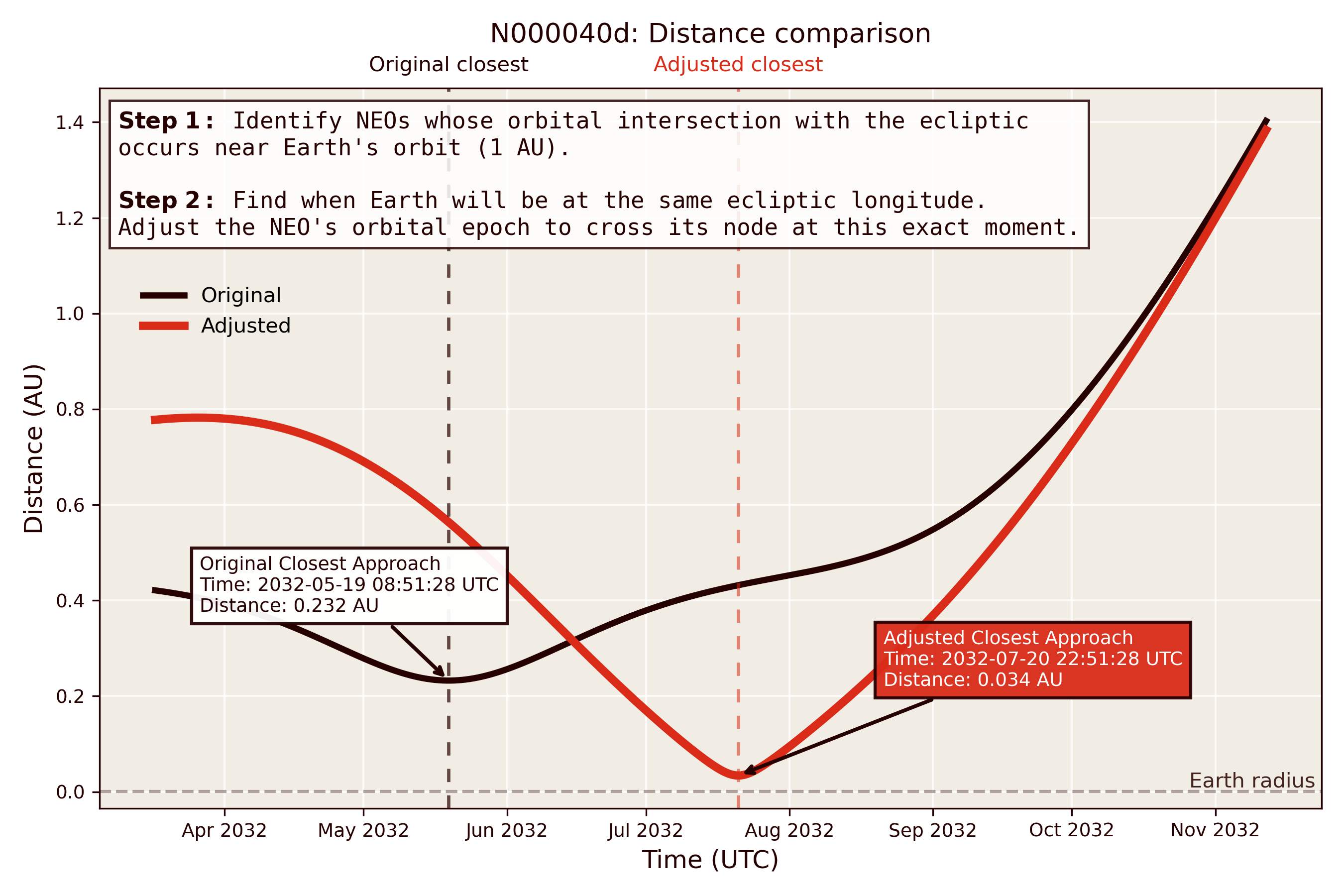
Figure 1: Synthetic impactor production—orbital epoch adjustment yields direct Earth-crossing geometry with minimal alteration of orbital elements, preserving dynamical realism.
LSST Survey Simulation and Detection Criteria
Detectability is modeled using the Sorcha simulation suite, incorporating LSST's cadence, pointings, limiting magnitude, instrument noise, and MOPS-style linkage requirements. The model assesses both intrinsic visibility and survey loss modes, categorizing non-detections into pointing, magnitude, and linking failures. Objects are considered discovered only if their detections form tracklets on at least three nights within a 15-day window, reflecting operational linkage standards.
The synthetic population is divided into physically motivated hazard bins: 10–20 m (Chelyabinsk-class), 20–50 m (Tunguska-class), 50–140 m (regional hazards), and >140 m (continental-scale, PHA). This regime stratification is central to interpreting planetary-defense performance under real survey constraints.
Size-Dependent Discovery Efficiencies
LSST's overall impactor discovery efficiency is 13.7%, but is strongly size-dependent. Discovery rates are 79.7% for large (>140 m) PHAs, dropping to 50.3% for upper mid-sized (50–140 m), 26.8% for lower mid-sized (20–50 m), and 10.5% for small (10–20 m, Chelyabinsk-scale) impactors. The histogram evidences a steep cutoff below ∼20 m, driven primarily by photometric limitations.
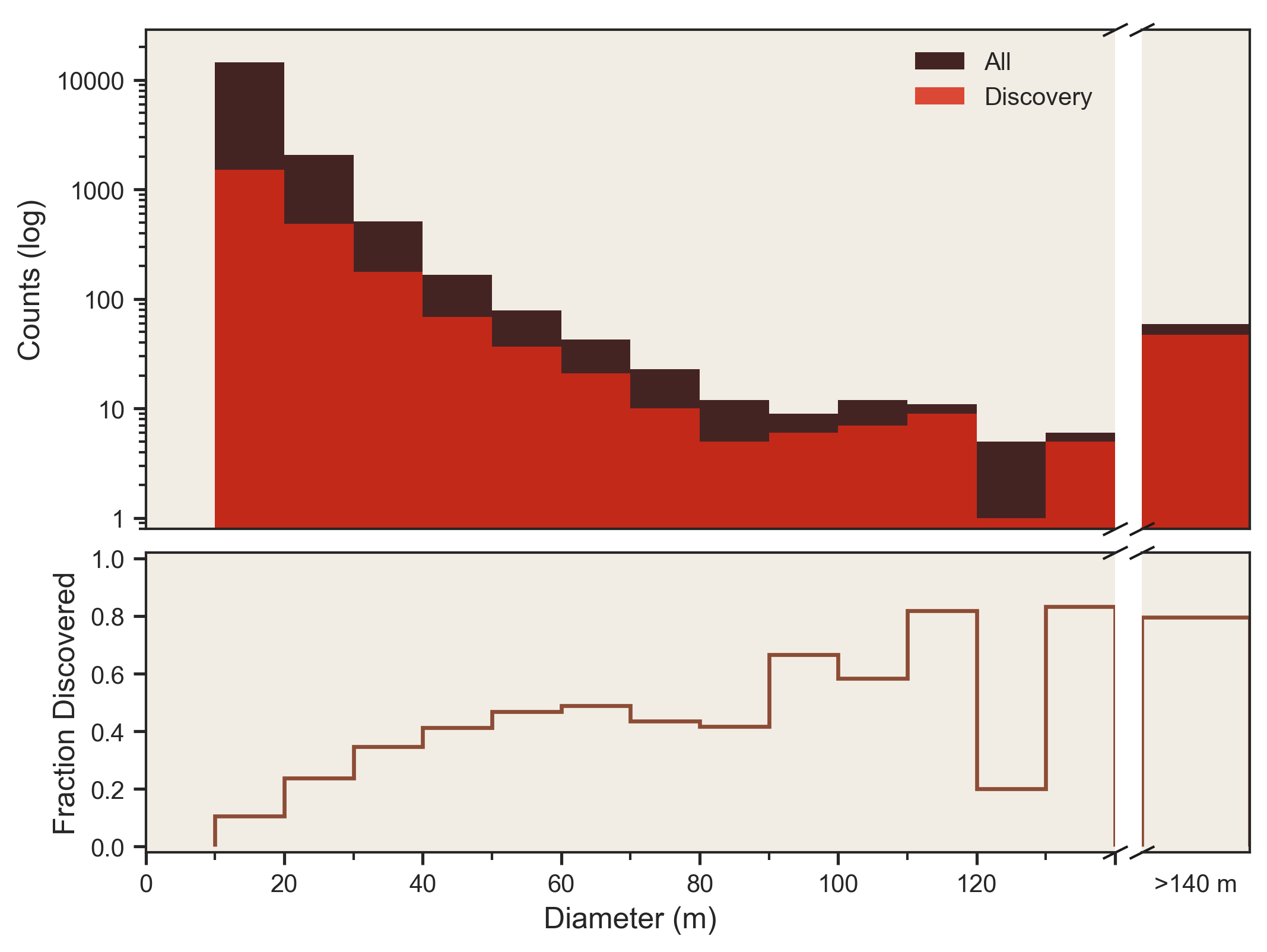
Figure 2: Size-dependent discovery rates—LSST efficiency increases sharply with impactor diameter, with only a small fraction of sub-50 m objects detected prior to impact.
These rates imply that while LSST is operationally effective in the PHA regime, its completeness for city- and region-scale threats is substantially lower, with only a minority of airburst-class bodies discovered in time for mitigation.
Warning Time Distributions and Temporal Constraints
Pre-impact warning times are a critical metric for actionable planetary defense. For >140 m objects, LSST achieves a median warning time of 1218 days, with 39% discovered >1 year in advance. However, the situation is more acute for smaller objects: 10–20 m impactors are typically detected 12.4 days pre-impact (median), and 20–50 m at 21.5 days, with only 2.1% and 0.4%, respectively, discovered with >1 year warning. The bulk of discoveries in these bins occur only weeks before impact, precluding long-lead mitigation strategies.
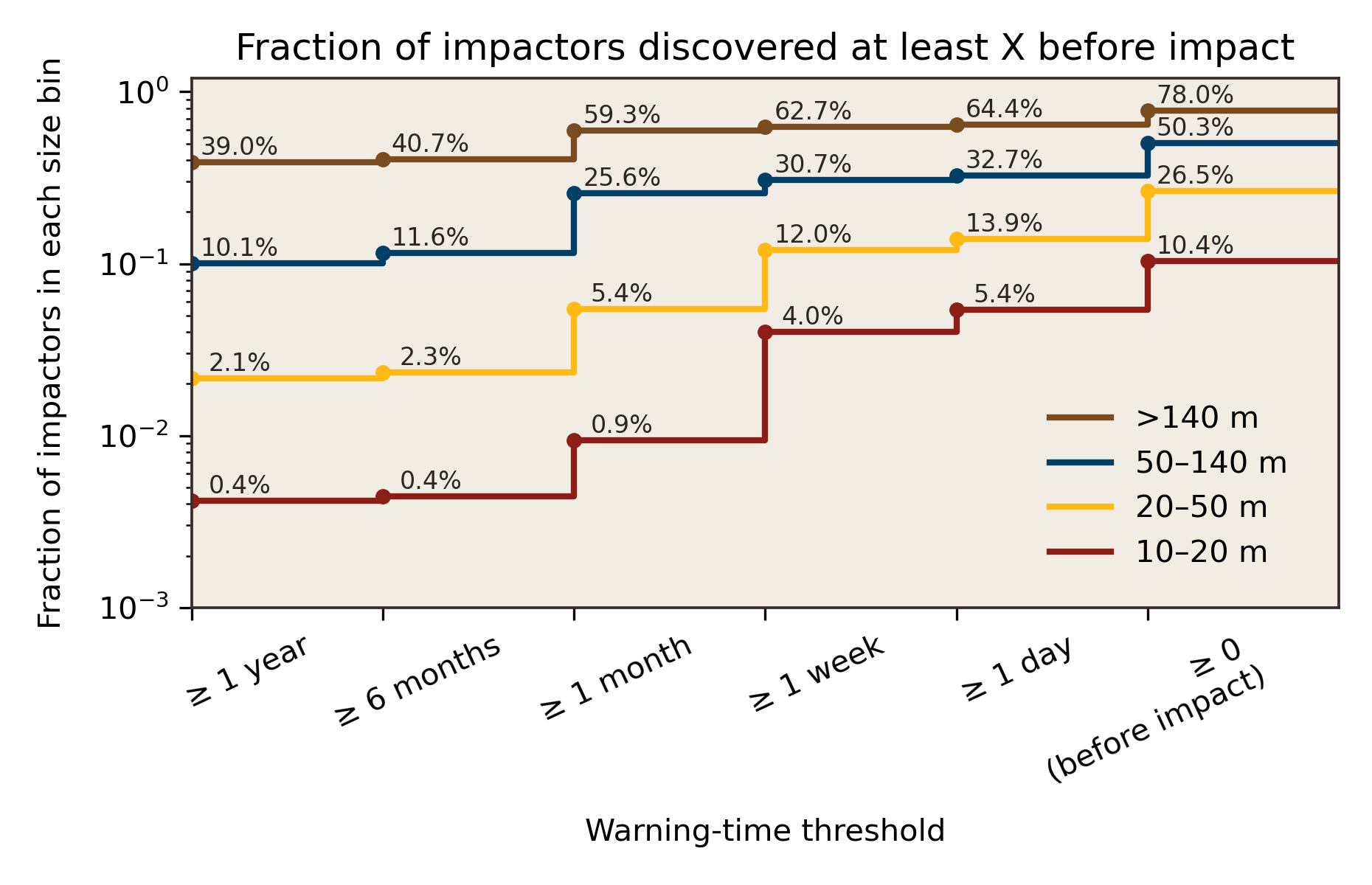
Figure 3: Cumulative warning times—year-scale warnings are rare for sub-100 m objects, with most discoveries occurring weeks or days before impact.
Short lead times for small impactors are a direct consequence of their reduced visibility; they generally remain below the survey's detection limit except during close approach, at which point their encounter velocity and apparent motion make rapid linkage challenging under LSST cadence.
Survey Loss Modes: Depth vs Cadence Tradeoff
Analysis of non-detections reveals a sharp division in dominant failure modes: small impactors (10–20 m) are missed primarily due to photometric losses (>65%), while cadence-driven linking failures become increasingly important with size, comprising 83% of missed large (>140 m) objects. Pointing losses are negligible due to LSST's all-sky coverage. Thus, LSST is fundamentally cadence-limited for large bodies and depth-limited for small ones.
Complementary High-Cadence Surveys: Argus Case Study
The study simulates a high-cadence, shallow-depth Argus-like survey, finding that nearly all missed objects in Argus arise from photometric losses, while cadence-driven linking failures are nearly eliminated. Argus achieves 61% discovery for >140 m impactors, but completeness drops to below 1% for impactors e050 m due to its shallow limiting magnitude. Notably, Argus’s dense cadence enables robust linkage for all detectable objects at close approach, capturing many impactors that LSST detects but fails to link.
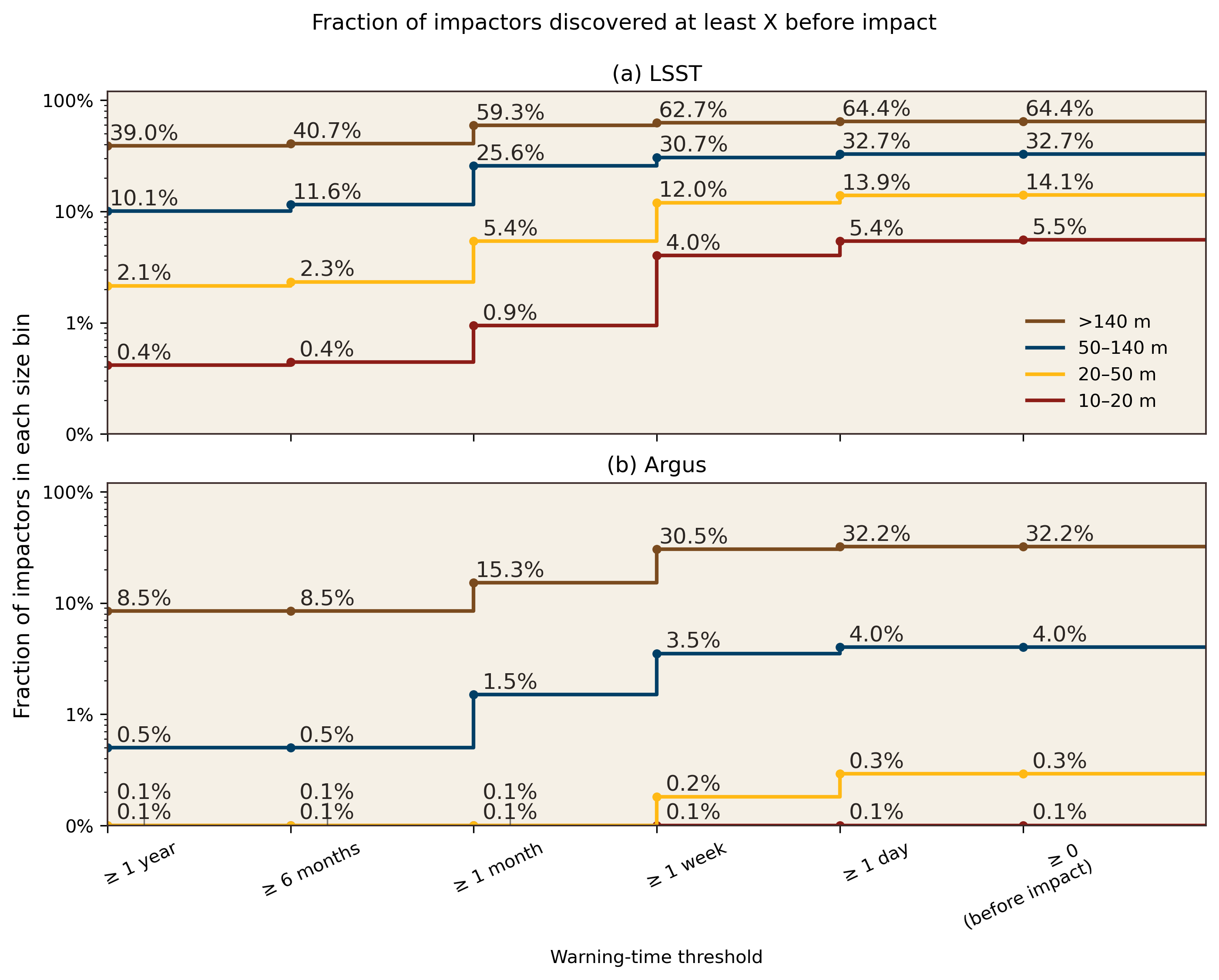
Figure 4: LSST vs Argus warning-time comparisons—Argus discoveries are almost exclusively short warning, whereas LSST retains moderate long-lead capability for large, bright impactors.
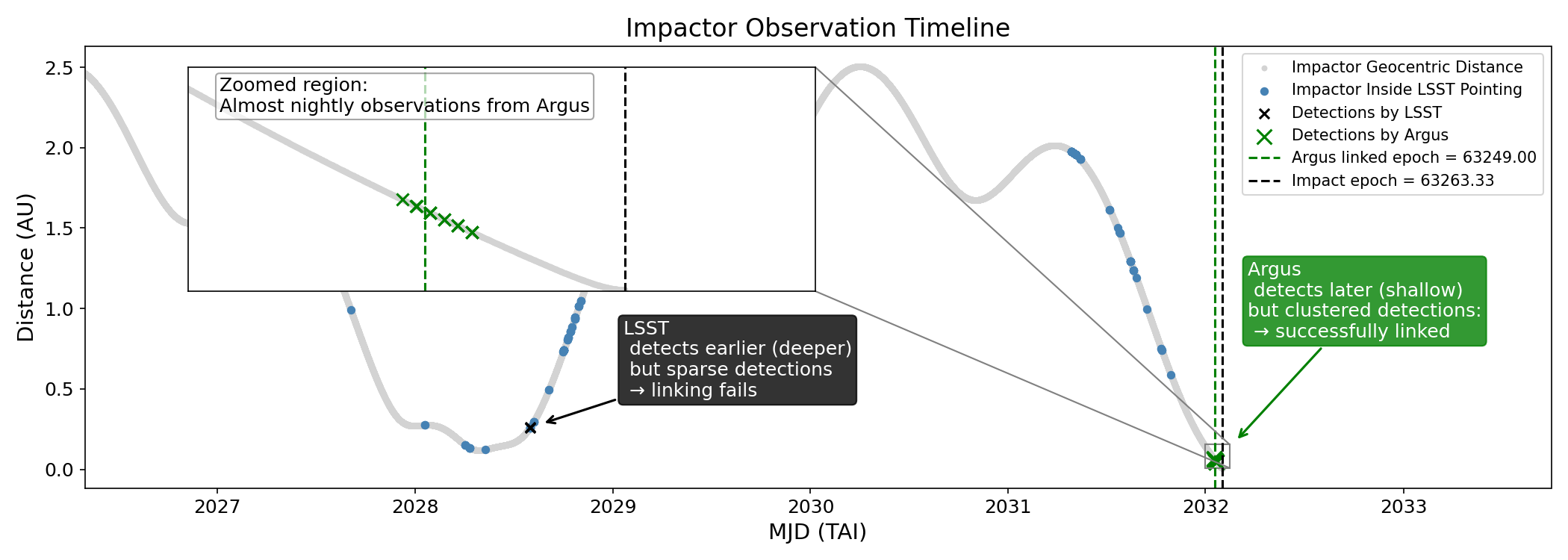
Figure 5: Timeline example—LSST provides early but sparse detections; Argus delivers dense coverage near impact, ensuring successful linkages despite shallower depth.
Early-Survey Impact Time Bias
Investigation of discovery statistics for impacts after the survey's initial two years confirms minimal bias from survey startup, except for the largest bodies. Discovery rates and warning times do not significantly improve for smaller objects by excluding early-epoch impacts, indicating that the limiting factors are intrinsic to survey design rather than temporal coverage.
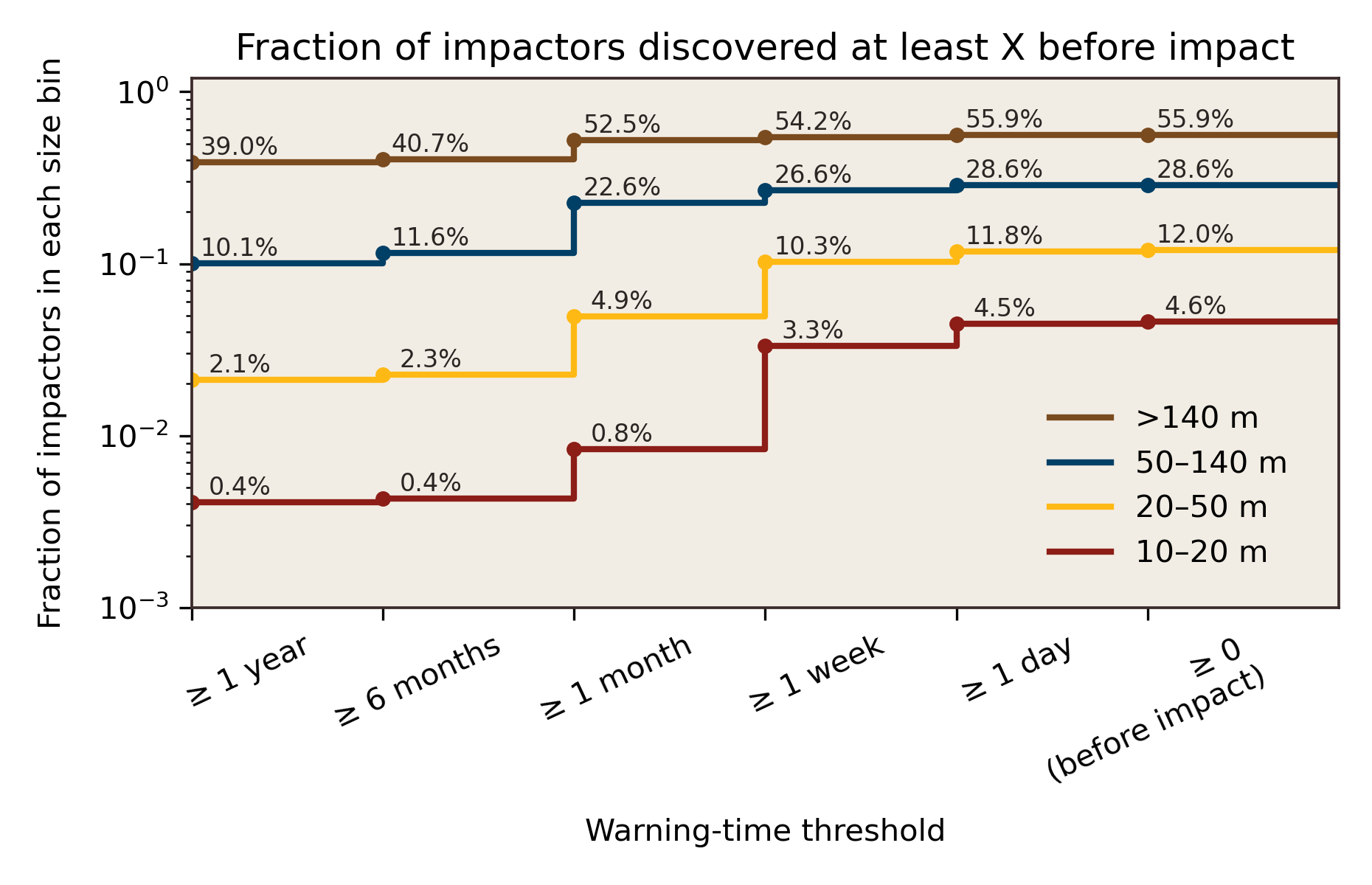
Figure 6: Cumulative warning-time distributions for post-2027 impactors—early-survey bias is negligible for sub-100 m objects.
Practical and Theoretical Implications
The analysis establishes that LSST alone cannot guarantee long-lead warnings across all hazardous size spectra, especially for urban- and region-scale impactors. Survey design tradeoffs between depth and cadence yield complementary strengths; LSST offers faint, early detection, while high-cadence systems like Argus ensure robust late-phase linkage. The findings argue for a coordinated, multi-survey network integrating both cadence-rich and depth-rich architectures, with cross-survey linkage and rapid triggered follow-up as essential operational features.
From a research perspective, the synthetic impactor generation framework offers scalable sampling for future planetary-defense simulation. Future work should incorporate true Earth-impactor criteria, full orbital diversity, operational survey coordination, and integration of follow-up resources for improved readiness. End-to-end pipeline development crossing detection, linkage, orbit determination, and impact probability assessment is recommended to quantify operational effectiveness.
Conclusion
This work quantifies the Vera Rubin Observatory's performance regarding imminent asteroid impactor discovery. While LSST achieves high completeness for large PHAs, long-lead warning for smaller objects remains rare due to compounded photometric and cadence limitations. Dense, all-sky, high-cadence facilities are required to address LSST’s cadence-induced losses, underscoring a strategic need for integrated survey solutions in planetary defense planning. The study’s methodology and results provide actionable guidance for survey design, operational coordination, and future simulation frameworks in asteroid hazard mitigation.
(2601.16255)