- The paper demonstrates that massive close-in planets can shield white dwarfs by ejecting or capturing over 80% of high-eccentricity asteroids before they pollute the star.
- It employs high-precision N-body simulations to analyze the effect of planetary mass, orbital distance, and fragmentation on asteroid removal efficiency.
- Results reveal that protection improves with increasing planet mass and tighter orbital separations, reconciling differences in observed pollution levels.
Introduction
A significant fraction of white dwarfs exhibit signatures of ongoing accretion from remnant planetary systems, manifested as metal absorption lines in their atmospheres. These features—known as "white dwarf pollution"—trace the accretion of planetary debris, predominantly from tidal disruption of planetary bodies that are dynamically transported into the stellar Roche sphere. The presence of pollution requires an efficient delivery mechanism for debris. It has long been hypothesized that surviving planets in white dwarf systems are critical actors in facilitating this transport, via gravitational scattering of asteroids and minor bodies onto star-grazing orbits.
However, a subset of white dwarfs with detected planetary companions, notably WD 1856+534 with its tightly bound giant planet, do not exhibit detectable metal pollution. This challenges the paradigm of canonical planetary-driven pollution and raises the possibility that massive close-in planets may instead serve as dynamical barriers, ejecting or capturing incoming debris before it contaminates the stellar atmosphere.
This paper presents an ensemble of high-precision, short-term N-body simulations to systematically quantify the efficacy of close-in planets as "protectors" against asteroid-driven pollution. It evaluates the dynamical pathways for asteroid scattering, disruption, and ejection, and establishes parameter regimes (mass, semi-major axis) where planetary shielding is operative. The work directly addresses whether planets of varying properties are capable of suppressing the dominant pollution channel: dynamically-driven, high-eccentricity asteroid delivery.
Physical Model and Simulation Framework
The modeled system consists of a white dwarf, a close-in giant planet on a circular orbit, and a population of asteroids initialized on highly eccentric orbits with pericenters near or within the Roche radius of the star.
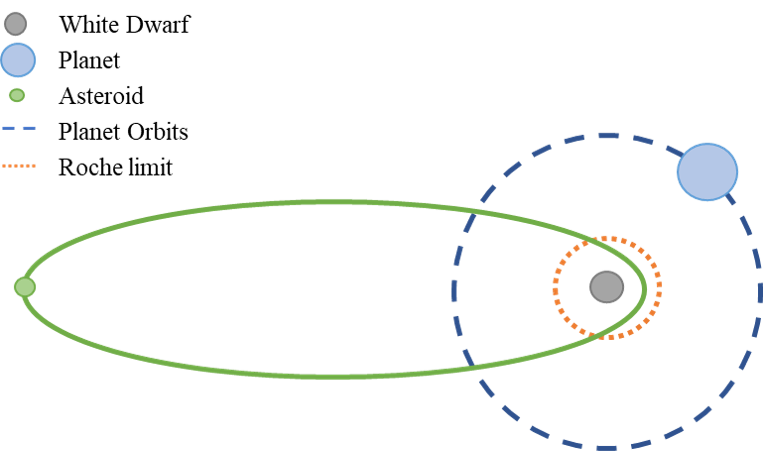
Figure 1: Schematic representation of the simulated white dwarf system, showing a planet on a circular orbit and an asteroid on a highly eccentric trajectory. The asteroid's periapsis is close to or inside the stellar Roche limit.
White dwarf and planet parameters were benchmarked to the observed WD 1856+534b system: MWD=0.518M⊙, RWD=0.0131R⊙, ap=0.02 au, with the planet's mass primarily set to 13.8 MJup (theoretical upper limit) but varied across a wide range to probe mass dependence. The planet's physical radius across different masses uses updated empirical mass-radius relations [muller_mass-radius_2024].
Asteroids are treated as massless test particles and drawn from semi-major axes aast∈[1,10] au to represent an inner-system reservoir. Initial asteroid pericenters qast are uniformly sampled within (0.5, 1.0) rRoche, ensuring trajectories that would lead to near-disruptive passages in the absence of a planet. Both coplanar and three-dimensional initial configurations are considered, enabling assessment of inclination effects.
Integration is performed over 10Tast, where Tast is the asteroid's initial orbital period, with the duration motivated by tidal disruption timescales and capture/ejection efficiencies.
Dynamical Outcome Classification and Metrics
Each simulation tracks the fate of the asteroid, assigning it to one of five exclusive classes:
- Ejected-OutRoche: Ejected before entering the Roche radius.
- Ejected-InRoche: Ejected after passing through the Roche zone, pre-accretion.
- Collide: Collision with the planet.
- Crash: Collision with the white dwarf.
- Bound: Remains bound without colliding or being ejected by the end of the simulation.
This outcome structure enables robust calculation of the "protection fraction" FProtection—the proportion of asteroids removed from polluting the white dwarf (via ejection or planetary collision):
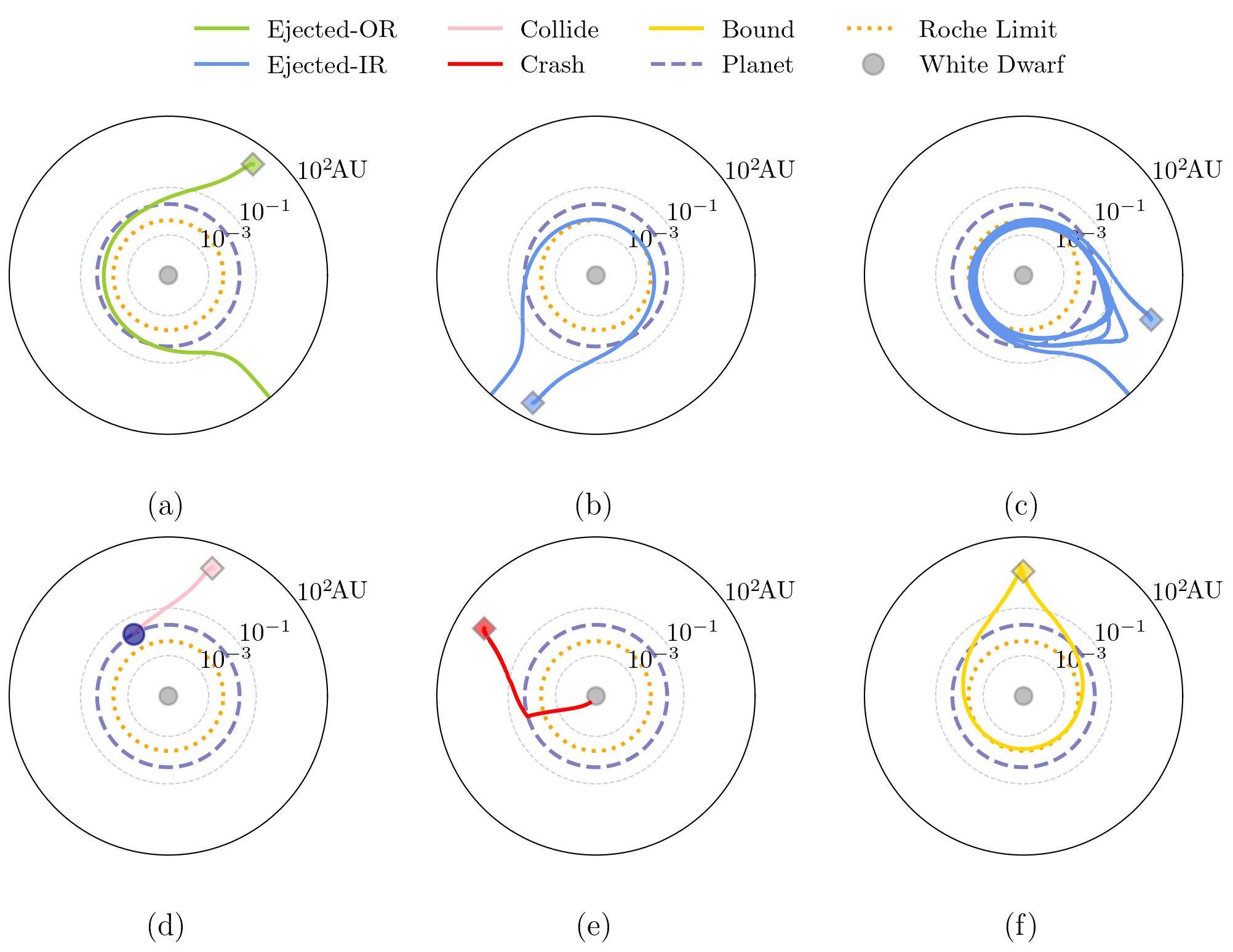
Figure 2: Representative asteroid trajectories for each classification. Asteroids can be ejected prior to entering the Roche zone, post-entry, collide with the planet, directly impact the white dwarf, or remain bound for extended periods.
The fate space is further analysed in terms of final orbital energy and closest approach to the white dwarf.
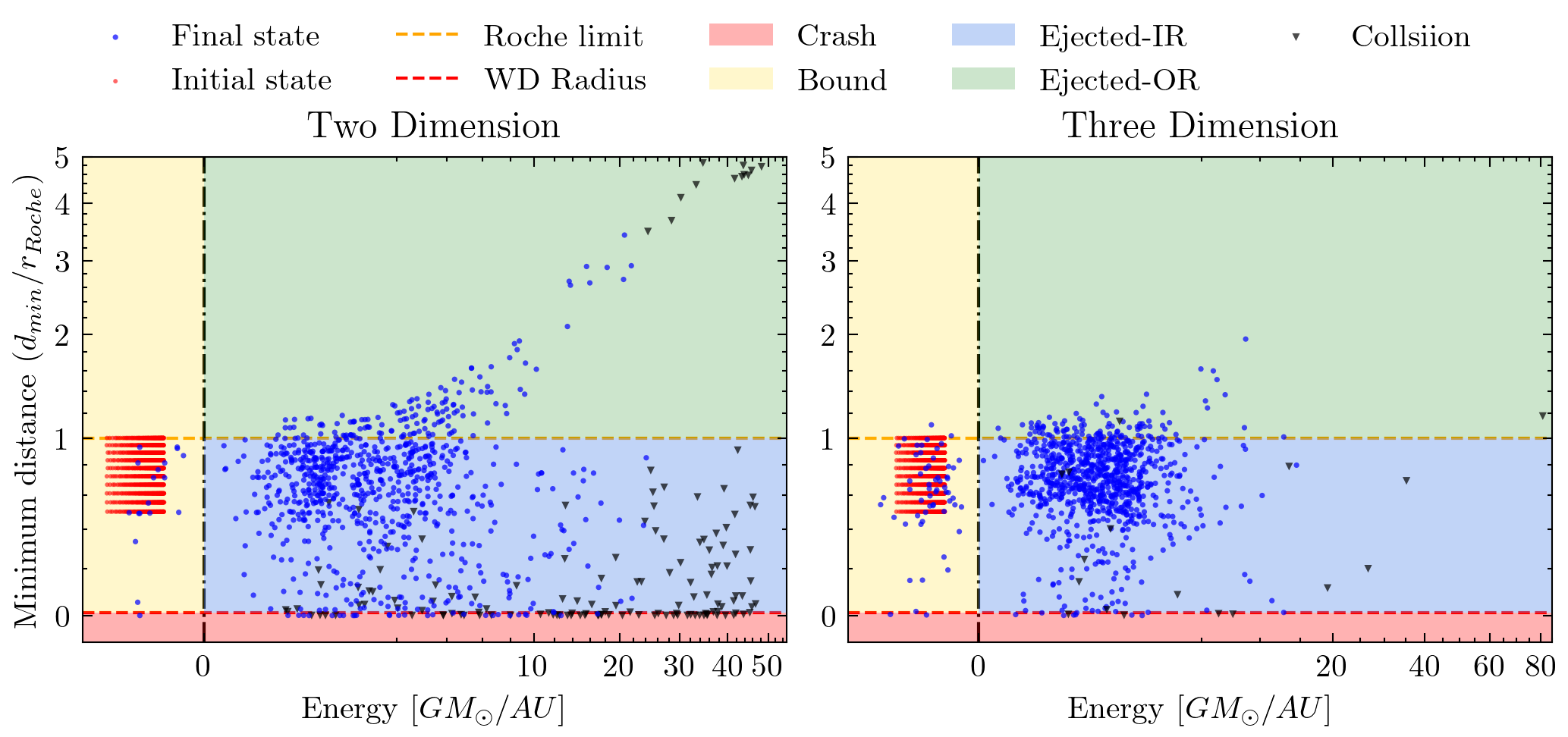
Figure 3: Distribution of asteroids in final energy-minimum distance space. Dots denote the fate classification: ejection (bound/unbound), collisions with the white dwarf or planet, and the initial state (red dots) are indicated.
Numerical Results
Protection Efficiency for Benchmark Case
For a WD1856+534b-like system (ap=0.02 au, Mp≳0.5MJup), the simulations yield the following core results:
Dependence on Planet Mass and Orbital Separation
The efficacy of dynamical protection is strongly sensitive to both planet mass and orbital distance:
- At fixed ap=0.02 au, protection remains >80% for Mp≳0.1MJup and rises toward ∼95% at Mp∼5−13.8MJup.
- Increasing ap to 0.5–1.0 au reduces the protection fraction to ≲70% even for massive planets.
These trends are consistent with analytical scaling using a Safronov-like criterion, parameterized as the close-encounter ratio Λc.
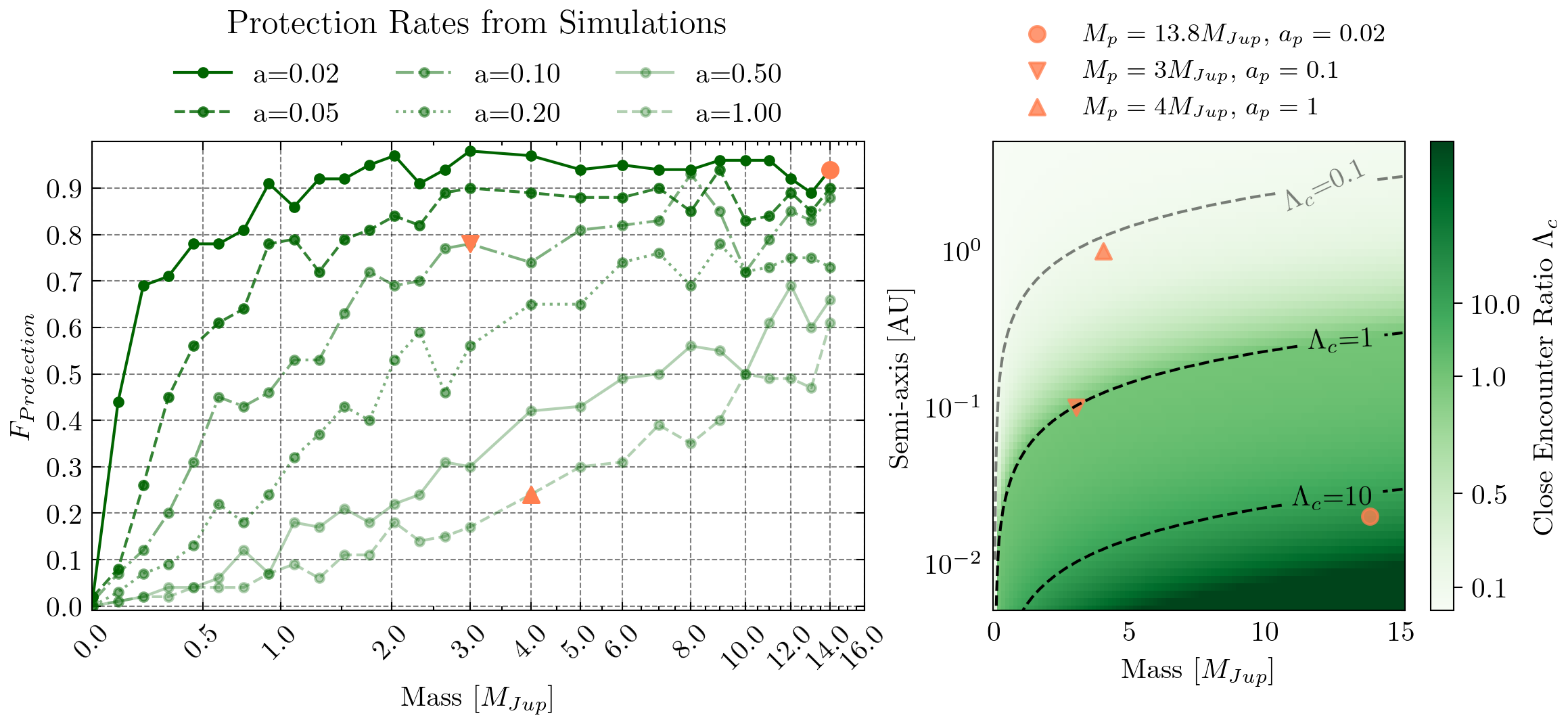
Figure 5: (Left) Protection fraction as a function of planetary mass for different semi-major axes. (Right) Contours of the close-encounter ratio Λc in the (Mp,ap) parameter plane.
Tidal Fragmentation and Debris Removal
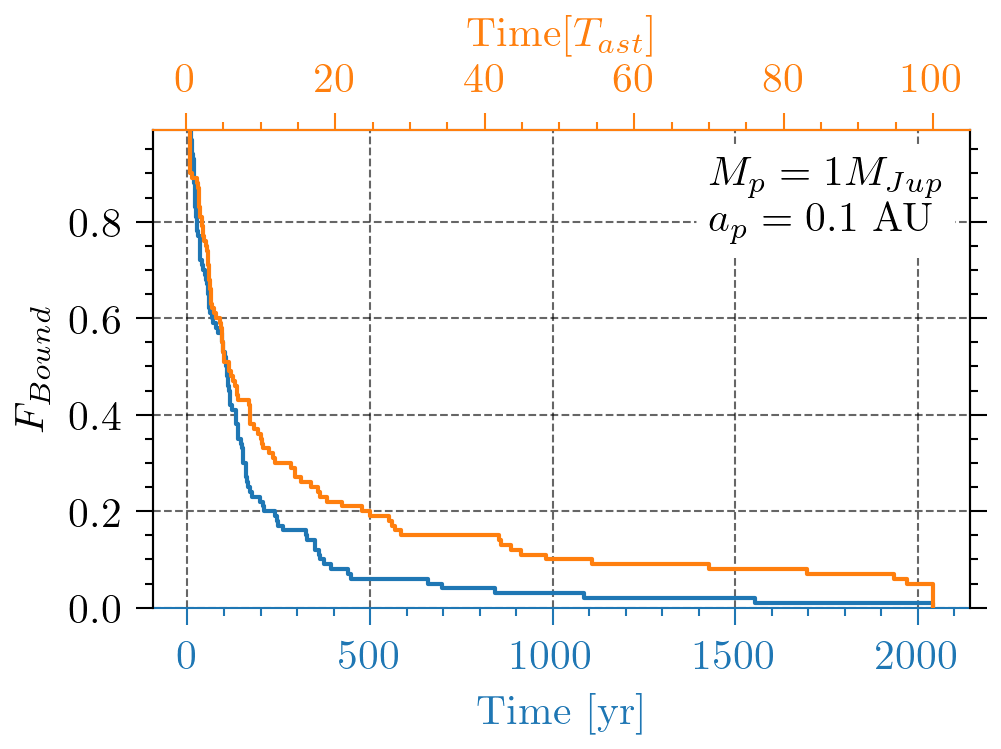
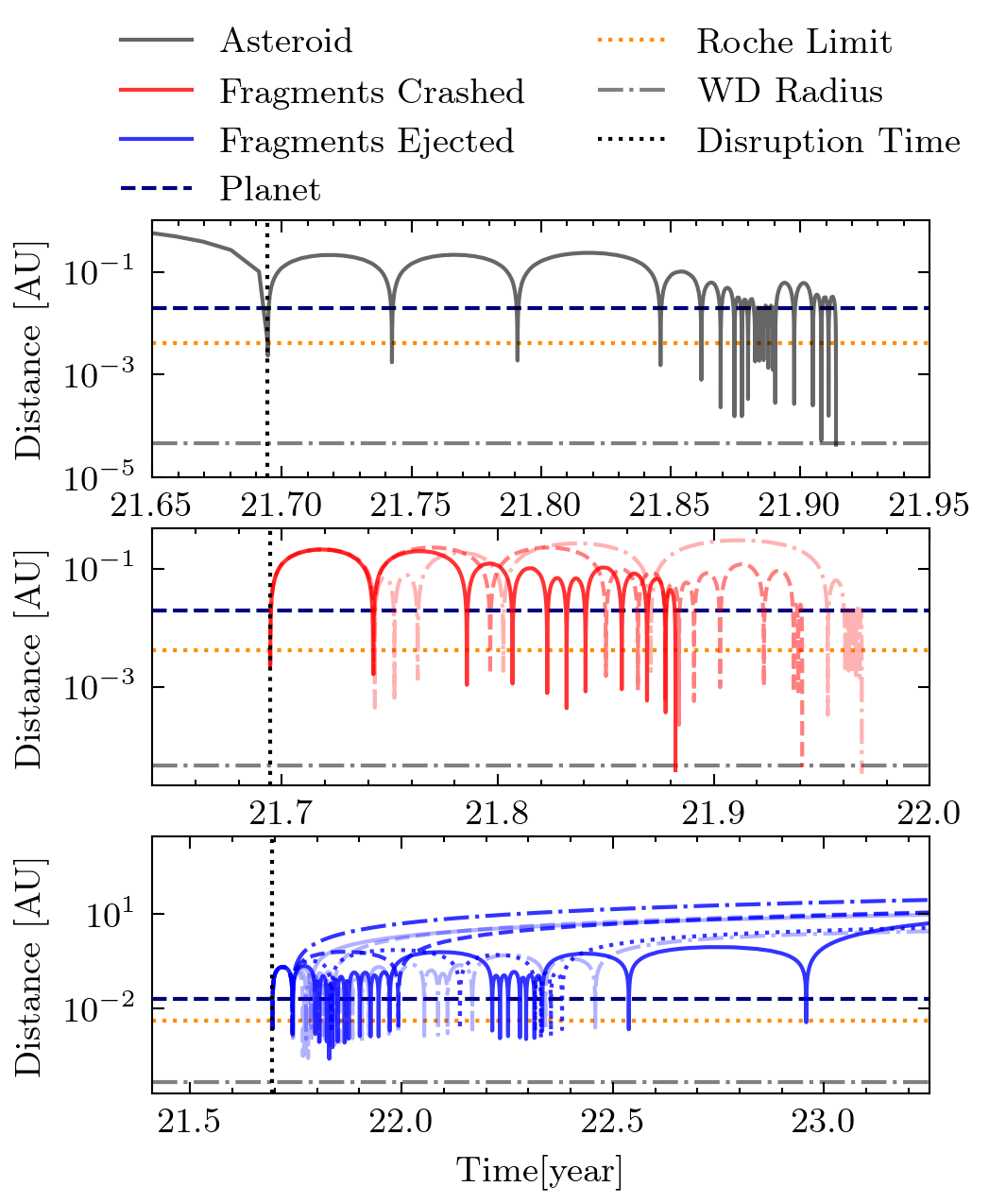
A crucial extension evaluated the impact of asteroid fragmentation upon Roche passage. A parent asteroid, upon first entry into the Roche sphere, is instantaneously split into multiple fragments. Tracking individual fragment evolution, the simulations demonstrate:
Three-Dimensional Effects
Isotropic inclination distributions (3D) further enhance planetary protection, yielding shielding fractions of ∼97% for fiducial planet parameters. However, for lower-mass or more distant planets, the efficiency degrades more quickly than in the coplanar case.
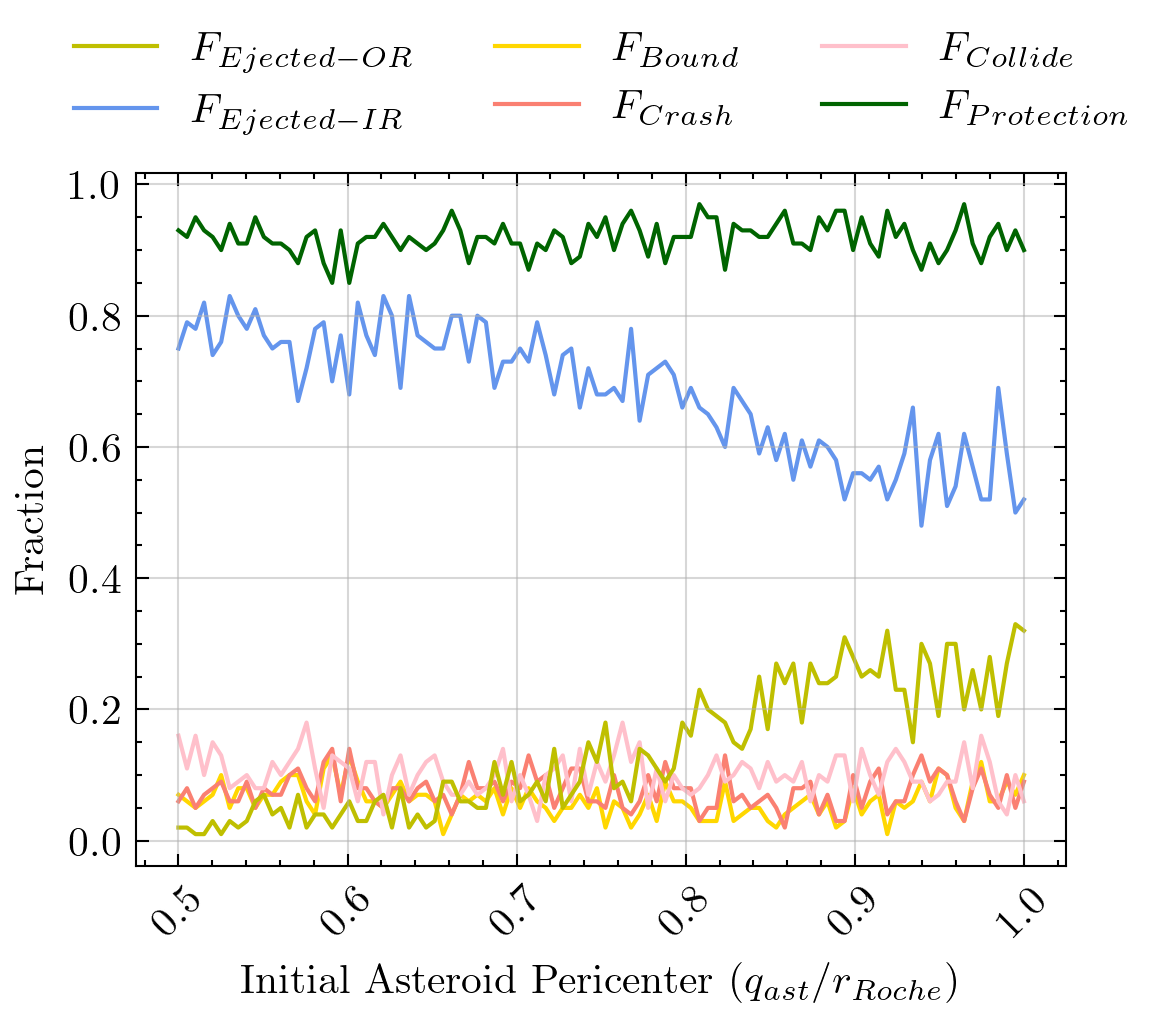
Figure 7: Fractional classification outcomes as a function of asteroid initial periapsis location, illustrating insensitivity of protection efficiency to initial perihelion parameters within studied ranges.
Implications and Context
Interpretation of Observations
The dynamical barrier produced by close-in giant planets reconciles the absence of pollution in WD 1856+534 and similar systems, despite the prevalence of high-pollution rates in other white dwarfs. The results demonstrate that the majority of potential asteroid polluters are either dynamically ejected or intercepted by the planet, with only a small residual contribution from orbiters that remain bound for many orbits.
These findings suggest that the mere presence of a massive close-in planet leads to a statistical suppression of white dwarf pollution by roughly an order of magnitude compared to systems lacking such protection. This offers an explanation for the decoherence between planetary presence and pollution fraction across the white dwarf population.
Consistency With and Advancement Over Previous Work
Prior studies focused on radiative drag-driven migration or on wide-orbit planetary perturbers [veras_white_2020, pham_polluting_2024], but did not systematically assess the direct dynamical barrier posed by close-in planets to highly eccentric asteroid influx [rogers_wd0141-675_2023]. The current work expands the theoretical framework and quantifies the planet mass–separation regime necessary for effective protection.
Theoretical and Practical Implications
- Planetary system architecture is a critical regulator of white dwarf pollution rates. Systems containing close-in gas giants (particularly with ap≲0.1 au and Mp≳0.5MJup) should be characterized by significantly lower photospheric metal abundances.
- Distant and low-mass planets have dramatically reduced shielding capability, suggesting that in these systems, classical pollution mechanisms remain effective.
- The signature of planetary protection may manifest as enhanced compositional enrichment of the planet itself, particularly in the case of planetary interception and accretion of polluters—a potential target for infrared and high-resolution characterization.
- Future white dwarf planetary system surveys (notably with JWST and ground-based facilities) should test for anti-correlations between close-in planetary presence and white dwarf pollution signatures to further validate and refine these theoretical expectations.
Conclusion
This study provides a rigorous numerical demonstration that close-in (sub-au), massive planets can serve as efficient dynamical barriers, reducing the pollution of white dwarfs by highly eccentric asteroids to below 20% of the unfiltered rate, with effectiveness scaling positively with mass and inversely with orbital separation. The results explain the lack of metal pollution in planetary systems like WD 1856+534 and delineate a quantitative framework for predicting pollution rates as a function of system architecture. Non-detection of pollution in certain planetary systems, therefore, does not challenge the broader paradigm of planet-mediated pollution, but instead illuminates the distinct dynamical role played by close-in planetary companions.
Further systematic discoveries of white dwarf systems with varied planetary architectures will enable empirical discrimination between stochastic and planet-suppressed pollution scenarios, deepening our understanding of post-main-sequence planetary system evolution.