- The paper introduces a blended dynamics framework that integrates classical consensus theory with quantum Lindblad dynamics to model open quantum networks.
- It demonstrates that sufficiently strong diffusive coupling ensures exponential convergence of local quantum states to a blended equilibrium, with error bounds quantified via the Frobenius norm.
- Numerical simulations on three-qubit networks and the Dicke model validate the theory by showing consensus-like clustering and coherent synchronization under the proposed dynamics.
Blended Dynamics and Emergence in Open Quantum Networks: An Expert Summary
Introduction and Motivation
This paper introduces and rigorously develops a blended dynamics framework for open quantum networks subject to diffusive couplings, synthesizing methodologies from classical consensus and clustering theory with open quantum systems modeled via Lindblad equations. The principal aim is to characterize emergent phenomena—specifically classical-like clustering, quantum synchronization, and coherent dynamics—in heterogeneous quantum networks that are either dissipative or experience inseparable Hamiltonian and environmental interactions. The work systematically extends classical blended dynamics theory to the quantum regime, providing theoretical proofs, explicit gain conditions, and numerically validated claims about collective quantum state evolution and its attractor properties.
Mathematical Preliminaries
The formalism is grounded in the standard description of open quantum systems, leveraging the density operator ρ evolving under Lindblad-type master equations that ensure complete positivity and trace preservation. The quantum nodes (qubits) are interconnected via general Hamiltonian couplings, environmental Lindblad dissipations, and local swap-based diffusive interactions defined over an undirected graph G=(V,E). These diffusive couplings generalize classical consensus mechanisms to the quantum domain by driving local reduced states (ρj) towards consensus, mimicking the action of the classical combinatorial Laplacian in the quantum operator algebra.
Graph-theoretic structures underpin the network topology, and the theory exploits induced graphs of operator basis elements to encode higher-order symmetries and coupling topologies. Notations are consistent with modern quantum information and control theory conventions.
Blended Reduced-State Dynamics and Classical Emergence
For open quantum networks where the Hamiltonian H and Lindblad operators Ll are separable (Assumption 1), the Lindblad dynamics for individual reduced states is augmented with a consensus-type diffusive term. In this regime, the authors define blended reduced-state dynamics: the average evolution of local dynamics yields a quantum analog of the classical blended system, which, in the limit of strong coupling gains Kc→∞, accurately tracks the transient and asymptotic dynamics of each local qubit.
The main theoretical result establishes that if the blended system admits a unique equilibrium, then each local reduced state ρj(t) exponentially converges to a small neighborhood of this steady state for sufficiently large coupling gain, with explicit bounds on gain and error quantification. Notably, even when the equilibrium is replaced by an invariant subspace, the reduced states converge to its vicinity with precision controlled by Kc.
Empirically, for a system of three qubits with distinct dynamics (coherent, lowering, raising) and sufficiently large Kc, all reduced states cluster around the same steady state, as measured by the Frobenius distance to the blended equilibrium (Figure 1).
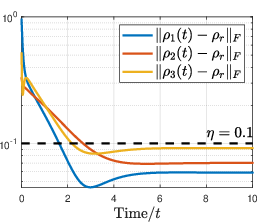
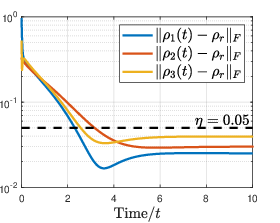
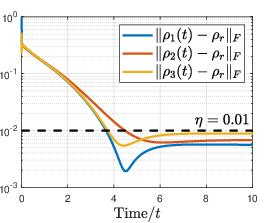
Figure 1: The time evolution of the Frobenius distance between the reduced states ρ1(t), ρ2(t), and ρ3(t) and the blended steady state for various coupling strengths.
For non-relaxing blended dynamics, Theorem 2 proves closeness between ρj(t) and the time-dependent trajectory of the blended system over arbitrary finite windows, with proximity maintained by strong coupling. For purely Hamiltonian cases with non-commuting drivers and no dissipation, all reduced trajectories synchronize with the blended trajectory up to a quantifiable error, as demonstrated by numerical simulations of the time-dependent Frobenius norms in a three-qubit network (Figure 2).
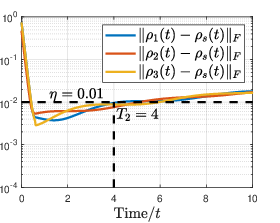
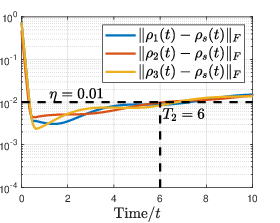
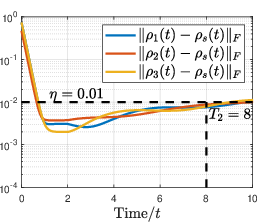
Figure 2: The time evolution of the Frobenius distance between reduced states and their blended trajectory in a coherent-only network, with coupling-strength-dependent accuracy.
Visualization of the Bloch vector trajectories further confirms tight clustering around the blended trajectory when Kc is large (Figure 3).
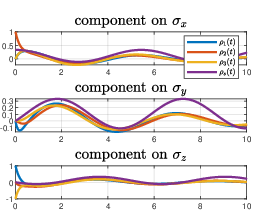
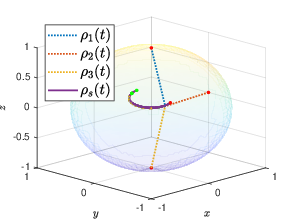
Figure 3: The trajectories of the Bloch vector components of ρj(t) and the blended state, showing clustering under strong diffusive coupling.
Induced Graphs and Blended Coherent Dynamics
For the general, inseparable case (e.g., H contains nonlocal terms), the theory constructs the induced graph associated with the quantum network: a higher-order graph whose nodes are operator basis elements (e.g., ∣l⟩⟨l′∣), and whose topology reflects both the system graph and the symmetries of the swap operators. The evolution of the vectorized density vec(ρ) under the Lindblad equation and swap-induced diffusion is described as a linear system over the induced graph.
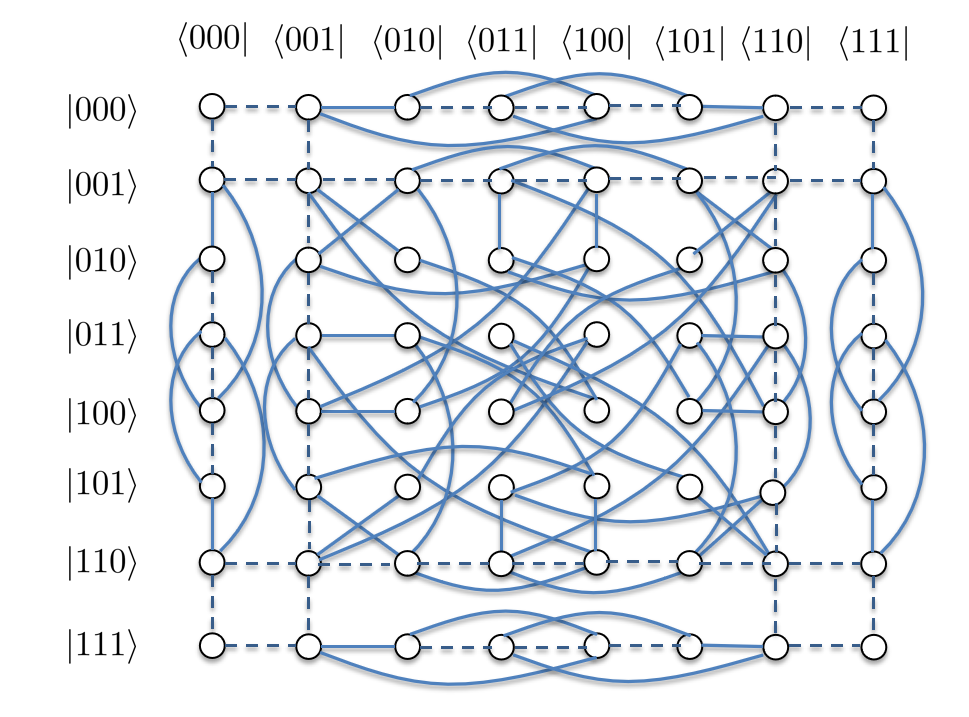
Figure 4: Structure of the induced graph for a 3-qubit network, displaying how swap-induced diffusion interconnects operator basis elements.
In the strong coupling regime, the state vector collapses onto the permutation-invariant subspace associated with the nullspace of the induced Laplacian. The authors define the blended coherent dynamics: the projection of the Lindblad+Hamiltonian drift onto this invariant subspace. The main theorem states that, after a finite time with sufficiently large Kc, the global quantum state ρ(t) remains arbitrarily close (in Frobenius norm) to the orbit generated by the blended coherent dynamics.
The induced model predicts clustering within each connected component of the induced graph—this generalizes classical clustering and consensus to quantum-coherent trajectories, including states with entanglement and other genuinely nonclassical correlations.
A visualization of this mechanism, where once intra-component consensus is achieved, only coherent dynamics couple the components, is shown in Figure 5.
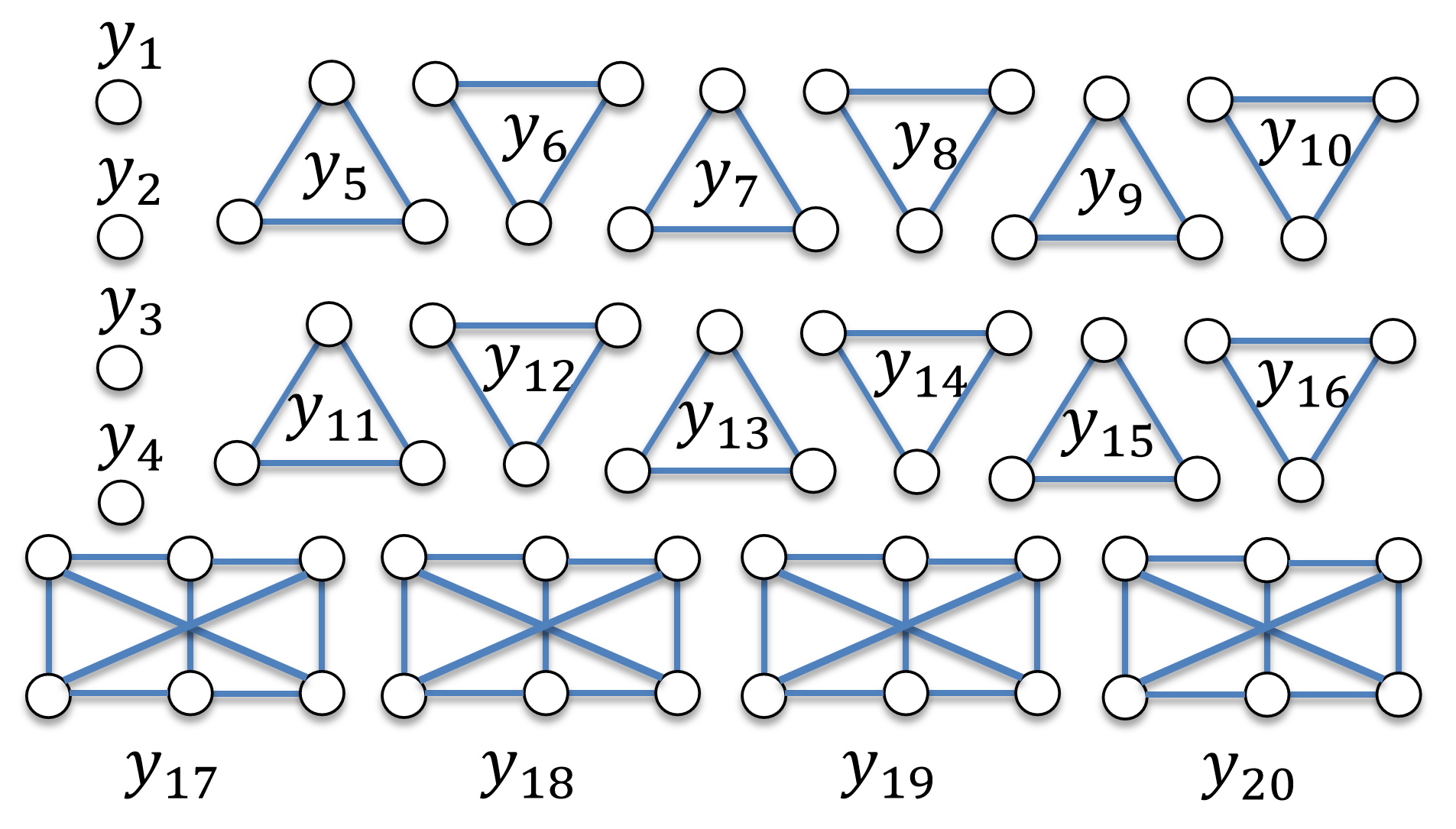
Figure 5: The blending process in the induced graph—once intra-component consensus is achieved, coherent coupling persists between clusters.
Global Symmetrization and Numerical Validation
The approach further demonstrates that, for any initial state, the density matrix ultimately converges to a permutation-invariant state with arbitrarily small error, provided Kc is sufficiently large and time exceeds a minimal threshold. This holds for both finite and infinite horizon, with explicit error and gain bounds.
The Dicke model, a paradigmatic inseparable Hamiltonian exhibiting collective dissipation and nonlocal couplings, is utilized as a nontrivial testbed. Numerical simulations confirm: (i) for arbitrary precision and time interval, the system trajectory tracks the blended coherent orbit; (ii) as time grows, the state approaches permutation invariance (Figures 6 and 7).
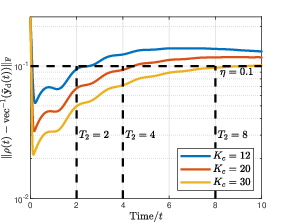
Figure 6: Time evolution of ∥ρ(t)−vec−1(y~d(t))∥F in the Dicke model, for varying Kc and different intervals, confirming blended coherent orbit attraction.
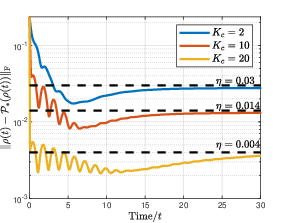
Figure 7: Asymptotic convergence of the state to its permutation-invariant projection under strong coupling.
Theoretical and Practical Implications
This framework demonstrates, for both separable and inseparable quantum networks, that complex collective behavior—clustering, consensus, symmetrization—admits precise analytical characterization via blended dynamics. The explicit gain/error/time quantification facilitates principled engineering of robust quantum consensus, synchronization, and distributed quantum information processing algorithms in realistic architectures affected by dissipation and environmental coupling.
On the theoretical side, the extension to inseparable systems bridges the gap between classical and quantum emergent phenomena, rigorously justifying the use of drift-averaged and invariant-subspace-reduced dynamics for predicting collective quantum evolution. The induced graph approach provides a unifying algebraic-combinatorial framework for analyzing high-dimensional quantum systems with structured interactions.
For future research, the framework opens avenues for analyzing quantum networks with weak coupling, consensus in noisy discrete-time quantum systems, and practical realization in quantum technologies such as quantum communication, modular quantum computing, and robust quantum memory design.
Conclusion
This paper systematically develops an explicit blended dynamics theory for open quantum networks, providing rigorous bounds, constructive gain conditions, and clear operational interpretations via induced graphs and symmetrization. Strong empirical evidence supports analytical claims, and the framework generalizes classical networked dynamics to systems with intrinsically quantum-coherent and dissipative behavior, supplying a critical theoretical tool for the study and design of emergent multi-node quantum phenomena.
Reference: "Blended Dynamics and Emergence in Open Quantum Networks" (2601.14763)