What is a Gravitational Path Integral? {\it or} Gravitational Path Integrals as Fluctuating Gravito-Hydrodynamics
Abstract: We show how Gravitational Path Integral formulae for various quantities that have been computed in the literature, follow from a few coarse grained hydrodynamic assumptions about the relations between space-time geometry, entropy, and fluctuations of the modular Hamiltonian of causal diamonds. These remarks have implications for the way we think about such path integrals in relation to a more fundamental model of quantum gravity, and to questions about which space-time topologies are actually summed over in real models.
Paper Prompts
Sign up for free to create and run prompts on this paper using GPT-5.
Top Community Prompts
Explain it Like I'm 14
Overview
This paper asks a big question: what are “gravitational path integrals” really doing? Instead of treating them as exact quantum calculations of spacetime, the author argues they are better understood like weather forecasts for spacetime—coarse, statistical descriptions of how geometry “flows” and fluctuates on large scales, much like hydrodynamics (the physics of fluids). The key idea is that Einstein’s equations act like fluid equations for spacetime, and many famous path-integral results (like black hole entropy or “wormhole” contributions) naturally follow from simple, statistical rules about entropy and fluctuations.
Key Objectives
The paper aims to:
- Explain why many path-integral calculations in gravity (especially in “Euclidean” or imaginary time) should be viewed as statistical/hydrodynamic averages, not literal quantum evolutions.
- Rephrase a famous result by Jacobson: Einstein’s equations can be derived from an entropy law, showing gravity as hydrodynamics.
- Show that energy in a region of spacetime is like an “entropy deficit” (some of the fundamental bits are frozen or constrained).
- Build a fluctuating, hydrodynamic model of spacetime regions (“causal diamonds”) that reproduces path-integral formulas— including “wormhole-like” terms—without assuming a full microscopic quantum gravity theory.
- Clarify when and why sums over exotic spacetime shapes (topologies) are relevant.
Methods and Approach (in everyday language)
Before the details, here are the main ingredients and how to picture them:
- Causal diamond: Imagine you stand at one moment, then a little later. The causal diamond is the spacetime region that light could travel from the first moment to the second and back. It’s a natural “chunk” of spacetime to study.
- Entropy-area rule: A core rule says the “information content” (entropy) tied to a causal diamond’s boundary is proportional to its area:
- Think of the boundary like a screen of pixels; the bigger the screen, the more information it can carry.
- Energy as an entropy deficit: If you put matter or energy inside the diamond, you “freeze” some of those boundary pixels. That reduces the entropy compared to the empty diamond. So energy shows up as “missing entropy.”
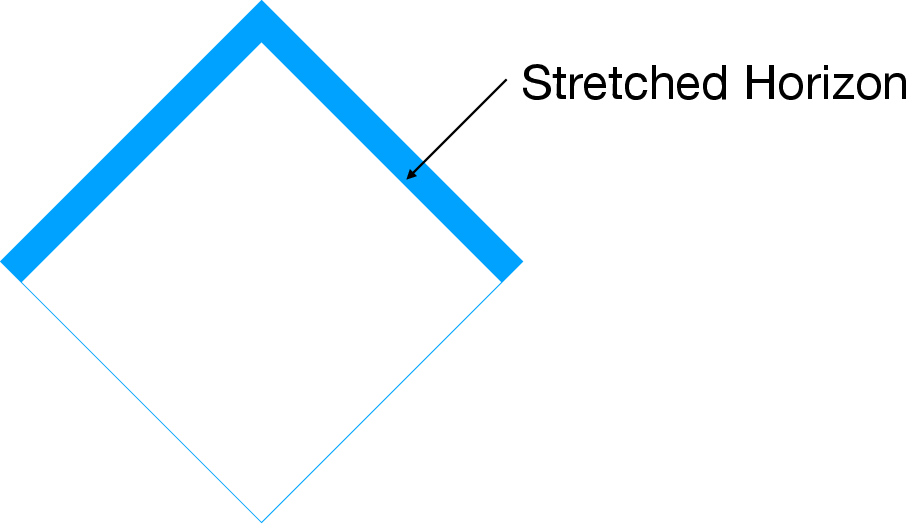
- Fluctuations like weather noise: Real fluids fluctuate. Here, the paper assumes spacetime’s “hydrodynamic” variables fluctuate too—especially near a “stretched horizon” (a very thin layer just inside the boundary). These fluctuations look like random “white noise” on very short (Planck) time scales.
- Horizon vibrations as a 1+1D CFT: Previous work showed that the random wiggles on a horizon can be modeled by a simple kind of theory that lives on a 2D surface (one time + one space direction), with a strength proportional to area. This fixes how big the fluctuations are—crucially, their variance matches the average, a hallmark of thermal/statistical behavior.
Putting it together, the method is:
- Postulate Jacobson’s “entropy law” for every causal diamond (“Covariant Entropy Principle”): the average and variance of a certain “modular Hamiltonian” (an energy-like operator for the diamond) are both .
- Treat the geometric shape of the diamond’s boundary as the hydrodynamic variable (like water height), with its time evolution obeying equations derived from Einstein’s equations.
- Add a random, horizon-localized stirring term (the fluctuating entropy current) whose size is fixed by the area law. This acts like noise forcing the fluid.
- Write a statistical path integral for these fluctuating variables. When you average over the noise, you generate an “effective action” that looks nonlocal across the boundary—mathematically similar to the “wormhole” terms people find in gravitational path integrals.
- Apply this to quantities like the spectral form factor (a diagnostic of chaotic dynamics), showing how the “connected piece” comes from fluctuations (or, in certain cases, from a Lorentzian “double cone” wormhole geometry).
Main Findings and Why They Matter
- Gravity as hydrodynamics: The paper strengthens the view that Einstein’s equations are like fluid equations for spacetime, coming from an entropy-area rule. Many path-integral results are, therefore, statistical hydrodynamic predictions, not microscopic quantum mechanics.
- Empty regions already carry entropy: Even an “empty” causal diamond has entropy equal to its boundary area divided by . This matches the idea that the vacuum has lots of entanglement across boundaries (like hidden information shared across the “screen”).
- Energy = frozen bits (entropy deficit): Matter/energy in a region corresponds to constraining some of those boundary degrees of freedom, lowering entropy relative to the empty diamond. This gives a physical picture for why localized energy gravitates while empty regions with horizons can look locally similar but behave differently.
- Fluctuations fix the “connected” contributions: The random horizon fluctuations produce the small but important connected parts in quantities like the spectral form factor (often linked to the “ramp” seen in chaotic systems). In black hole cases with a fixed horizon area, these corrections can be captured by a Lorentzian “double cone” wormhole geometry—closely related to, but not identical to, Euclidean wormholes.
- Not all topologies are needed (and many are not justified): The paper argues you do not generally need to sum over all possible spacetime shapes (topologies). In most realistic spacetimes (like ours, with zero or positive cosmological constant), higher-genus topologies don’t have observable effects. They may matter for special, idealized cases like stable black holes in AdS (anti–de Sitter) space, where a dual field theory lives on the boundary and random-matrix-like statistics could apply.
- AdS is special: With negative cosmological constant (AdS), the “empty” global state is pure (not mixed) and is best understood via a boundary conformal field theory (CFT). There, the infinite-area limit is handled differently and neatly matches the AdS/CFT correspondence. For flat or de Sitter space (our universe is close to one of these), the “empty” state for large regions is mixed and saturates the entropy bound, reinforcing the hydrodynamic, statistical viewpoint.
Implications and Potential Impact
- Reframing gravitational path integrals: Instead of thinking of them as computing exact, microscopic quantum answers, we should treat them like hydrodynamic/statistical tools. This perspective resolves puzzles like “factorization” issues and explains why Euclidean techniques often produce coarse-grained, thermodynamic results (like entropy and ramps) rather than exact quantum spectra.
- Clarity on wormholes: “Wormhole” terms can be seen as statistical correlations generated by integrating out horizon fluctuations. In black hole settings with a constant area, the relevant geometry is a Lorentzian double-cone, not necessarily a Euclidean wormhole—helping reconcile different approaches in the literature.
- Limits on topology sums: Broad sums over wild spacetime shapes are neither necessary nor well-defined in general. Only certain two-dimensional topologies (related to how we glue time contours) are robustly supported by the hydrodynamic picture, and higher-genus corrections matter mainly in special AdS setups.
- Practical focus on observables: In real-world spacetimes (flat or de Sitter), only short-to-intermediate-time, coarse-grained signatures like parts of the “ramp” might be observable. Very long-time predictions (like recurrences) are not physically measurable, so theories should not overemphasize them.
A short note on AdS vs. our universe
- AdS (negative cosmological constant): The boundary area becomes infinite at finite proper time, and the “empty” state is pure—best described by a boundary CFT. Stable black holes can act like true equilibrium systems, so random-matrix-type behavior and higher-genus topologies can become meaningful.
- Flat or de Sitter (zero or positive cosmological constant): The empty diamond state is mixed and saturates the entropy bound; localized energy is an entropy deficit; black holes are unstable (they evaporate). Only early-time, coarse-grained features are realistically accessible.
Five quick takeaways
- Spacetime behaves like a fluid on large scales; Einstein’s equations are its hydrodynamics.
- An “empty” region has entropy proportional to its boundary area; adding energy reduces that entropy (freezes boundary bits).
- Random horizon fluctuations are key; they produce the small connected pieces in path-integral results.
- Many “wormhole” effects are hydrodynamic/statistical, not literal sums over all spacetime shapes.
- AdS is special (matches to a boundary CFT); our universe (flat/de Sitter–like) supports the hydrodynamic, coarse-grained view most directly.
Knowledge Gaps
Knowledge gaps, limitations, and open questions
Below is a single, concrete list of unresolved issues the paper leaves open, focusing on what is missing, uncertain, or left unexplored:
- Formal derivation and domain of validity of the Covariant Entropy Principle (CEP) for arbitrary causal diamonds, including spacetimes with matter, singularities, and nontrivial quantum states beyond the “empty diamond.”
- Operational definition, construction, and uniqueness of the “empty diamond state” in a full quantum gravity model (e.g., within Hilbert bundles), and its compatibility across different geodesics and overlapping diamonds.
- First-principles justification of the Carlip–Solodukhin near-horizon CFT (central charge ∝ area) for generic diamonds: when does this CFT description hold, and what precisely fixes its cutoff?
- Quantitative determination of the UV cutoff in the horizon CFT and the coefficient α in the induced nonlocal “wormhole-like” action; compute α in explicit setups (e.g., JT gravity with matter, higher-dimensional AdS, Gauss–Bonnet or other higher-curvature theories).
- Verification (or falsification) of the assumed temporal white-noise behavior of entropy-current fluctuations at Planck-separated steps; characterize possible nonwhite correlations and their impact on hydrodynamic predictions.
- Robustness of the fluctuation ansatz when caustics, strong curvature, or coordinate breakdowns arise near extremal surfaces; how to patch Gaussian null coordinates without losing control of the symplectic structure.
- Precise treatment of gauge fixing and BRST measure when translating hydrodynamic data tied to one geodesic into a generally covariant gravitational path integral; demonstrate factorization and consistency of the construction.
- Extension of the hydrodynamic Hamiltonian framework (in terms of and ) to include dissipative transport (viscosities, diffusion) and stochastic terms beyond the single fluctuating operator (total transverse volume).
- Systematic inclusion of matter: how , , and couple to the hydrodynamic variables and to the entropy-current fluctuations; derive modified equations and correlators in matter backgrounds.
- Rigorous mapping between the proposed statistical (hydrodynamic) path integral and standard Euclidean gravitational path integrals for observables beyond entropies (e.g., correlators, response functions), with explicit checks in solvable models.
- Clarify which observables factorize and which do not in this hydrodynamic framework; quantify factorization-violation scales and compare with AdS/CFT expectations for boundary correlators.
- Determine when the connected piece of the spectral form factor (SFF) exhibits a linear ramp in time-dependent gravitational systems with growing Hilbert spaces (e.g., nonstationary diamonds); characterize the regime where no ramp is expected.
- Provide an explicit higher-dimensional construction of the Lorentzian double-cone wormhole contributing to the SFF (including boundary conditions), and reconcile its complex quasi-normal modes with physical interpretation and Euclidean counterparts.
- Criteria for including higher-genus two-dimensional topologies in the statistical path integral: identify control parameters, test random-matrix universality in AdS black holes, and compare magnitude against higher-derivative corrections to the action.
- Compute the impact of higher-curvature corrections on near-horizon CFT data (central charge, stress-tensor correlators) and on the induced nonlocal transverse action; provide benchmarks in specific gravity theories.
- Make the nonlocal transverse action more explicit: characterize its kernel beyond the factorized √h(t,x)√h(−t,y) form, explore locality restoration mechanisms, and assess causality constraints in the transverse directions.
- Operationalize measurement: specify coarse-grained detector models that couple to and ; derive experimentally accessible predictions (e.g., finite-time SFF during black-hole evaporation in asymptotically flat spacetime).
- Provide a constructive solution to the Hilbert-bundle consistency conditions for overlapping diamonds (density-matrix matching), beyond the assertion that the gravitational path integral “solves” them; test in toy models.
- Clarify and quantify the “energy as entropy deficit” principle: give a local expression for energy–momentum in terms of constrained q-bits, include the positive localized entropy term systematically, and map to standard stress tensors in various backgrounds.
- AdS-specific program: explicitly build the “pure empty diamond state” via tensor networks/TNRG, derive hydrodynamic variables and modes (including sound), and compute the different coefficient relating entanglement capacity to entropy claimed in the appendix.
- Time-contour dependence: develop a precise derivation of the hydrodynamic action on the doubled thermal circle used for SFF (per Swingle–Winer) in gravitational systems, and delineate its breakdown time vs. Heisenberg time.
- Thickness, placement, and dynamics of the stretched horizon: quantify its finite-width effects on the CFT two-point function, determine dependence on dimension and curvature, and assess corrections from the shifting location of the maximal surface.
- Explore alternative formulations: can the induced statistical nonlocality be recast as an average over random couplings (à la Coleman) with a controllable ensemble? If so, identify the ensemble and its relation to horizon fluctuations.
- De Sitter limitations: develop a concrete framework for finite-time, finite-entropy observables (e.g., the ramp) measurable by realistic detectors; quantify the scrambling-time bound and its effect on path-integral/topology predictions.
- Establish benchmarks where the hydrodynamic/statistical interpretation demonstrably matches (or deviates from) standard quantum-gravity calculations of graviton amplitudes, to calibrate when “GPI as fluctuating hydrodynamics” is reliable.
Glossary
- AdS/CFT correspondence: A duality relating a gravity theory in anti–de Sitter (AdS) space to a conformal field theory (CFT) on its boundary. "The AdS/CFT correspondence has taught us that the infinities of the negative c.c. case are handled very differently."
- Asymptotically AdS: Spacetimes that approach anti–de Sitter geometry at infinity. "In asymptotically AdS space this can be continued to space-like infinity and encoded in gauge invariant boundary correlators."
- Bekenstein-Hawking entropy: Black hole entropy proportional to the horizon area divided by 4 times Newton’s constant. "associated with the Bekenstein-Hawking entropy of black holes"
- BRST formalism: A method for handling gauge symmetries in quantum field theory using ghost fields and a cohomological symmetry. "we can use the covariant path integral and the BRST formalism to translate information from the Gaussian null coordinates around one set of nested causal diamonds, to any other one."
- Brownian SYK Model: A time-dependent (random-in-time) variant of the Sachdev–Ye–Kitaev model used to study chaotic dynamics. "the {\it Brownian SYK Model}\cite{SSS1}"
- Causal diamond: The intersection of the future of one event and the past of another, representing a spacetime subsystem. "for every causal diamond in the space-time."
- Central charge: A parameter measuring the number of degrees of freedom in a 2D conformal field theory. "because the central charge was large, a cutoff CFT was adequate,"
- Closed Time Path contour: A time-contour technique (aka Schwinger–Keldysh) for computing real-time correlation functions in non-equilibrium systems. "Schwinger-Keldysh or Closed Time Path contour."
- Conformal boundary: The boundary at infinity of AdS spacetime where the dual CFT lives. "time on the conformal boundary."
- Conformal field theory (CFT): A quantum field theory invariant under conformal transformations, often living on the AdS boundary. "a $1 + 1$ dimensional conformal field theory (CFT) on the stretched horizon"
- Covariant Entropy Principle (CEP): The postulate that the modular Hamiltonian expectation value equals area/(4G) for every causal diamond. "we'll call the ansatz that a causal diamond has $\langle K \rangle = \frac{A_{\diamond}{4G_N}$ the {\it Covariant Entropy Principle} (CEP)."
- Covariant entropy bound: A conjectured bound limiting entropy through light-sheets by area/(4G). "the covariant entropy bound\cite{fsb},"
- Cosmological constant (c.c.): A constant energy density of spacetime that sets its large-scale curvature (positive for de Sitter, negative for AdS). "values of the cosmological constant (c.c.)."
- Double cone Lorentzian wormhole: A Lorentzian spacetime geometry connecting two boundaries, used to model connected contributions to spectral form factors. "the double cone Lorentzian wormhole geometry"
- Double trumpet geometry: A Euclidean geometry in JT gravity related to the double cone via analytic continuation. "the double trumpet geometry\cite{sss} is a different real slice through the same complex geometry."
- Einstein–Hilbert Lagrangian: The action functional for general relativity proportional to the Ricci scalar integrated over spacetime. "the perturbative use of the Einstein-Hilbert Lagrangian to compute Feynman diagrams."
- Entropy current S_vv: A hydrodynamic current representing local entropy flow along a null direction on the stretched horizon. "a fluctuating entropy current "
- Euclidean gravitational path integrals: Integrals over Euclideanized metrics used to compute thermodynamic or coarse-grained gravitational quantities. "Euclidean gravitational path integrals."
- Euclidean wormhole: A Euclidean signature spacetime connecting boundaries, contributing non-locally to path integrals. "is not equivalent to a Euclidean wormhole."
- Extrinsic curvature: The curvature describing how a surface is embedded in a higher-dimensional spacetime. "the extrinsic curvature of this surface"
- Fast scrambling: Extremely rapid spread of information across a system, conjectured to occur in black holes. "fast scrambling\cite{lshpss} of information on the holographic screen."
- Gaussian null coordinates: A coordinate system adapted to null surfaces that simplifies near-horizon analyses. "we can set up Gaussian null coordinates"
- Hilbert bundle: A framework where quantum states live in Hilbert spaces fibered over spacetime trajectories (geodesics). "the Hilbert bundle formulation of quantum gravity\cite{hilbertbundles},"
- Holographic principle: The idea that the degrees of freedom in a volume are encoded on its boundary area. "According to the holographic principle, the degrees of freedom giving rise to the fluctuations all live in the vicinity of the maximal area surface on the diamond,"
- Holographic screen: The boundary surface encoding the degrees of freedom of a spacetime region. "on the holographic screen."
- Holographic Space-time (HST): A proposed framework modeling spacetime dynamics via holographic degrees of freedom on causal diamond boundaries. "Holographic Space-time (HST) models\cite{hst}"
- JT gravity: Jackiw–Teitelboim gravity, a 2D model capturing aspects of black hole dynamics and holography. "In the case of JT gravity the double trumpet geometry\cite{sss} is a different real slice through the same complex geometry."
- Modular Hamiltonian: The logarithm of a density matrix (up to constants) generating modular flow for a subsystem. "Here is the modular Hamiltonian of the subsystem represented by the diamond,"
- Murray–von Neumann Type III_1: A classification of von Neumann algebras; Type III_1 factors have no trace and appear in QFT local algebras. "Type in the Murray von Neumann classification,"
- Quasi-normal mode frequencies: Complex frequencies characterizing damped oscillations of perturbations in black hole spacetimes. "complex quasi-normal mode frequencies,"
- Raychaudhuri equation: A key equation describing focusing of geodesic congruences, used to relate area changes to curvature. "We can use the Raychaudhuri equation to compute the variation in area of the diamond."
- Ricci curvature: A contraction of the Riemann tensor encoding volume/area change properties of geodesics. "only the Ricci curvature contributes."
- Ricci scalar: The scalar curvature obtained by tracing the Ricci tensor; appears in the gravitational action. " is the Ricci scalar of ."
- Schwinger-Keldysh contour: A closed time path used to compute real-time expectation values in quantum systems. "From the point of view of real time path integrals these hydrodynamic path integrals are computing approximations to path integrals on a Schwinger-Keldysh or Closed Time Path contour."
- Spectral form factor (SFF): A diagnostic of spectral correlations and quantum chaos, often involving |Z(t+iβ)|². "The most interesting calculations are those of spectral form factors."
- Stretched horizon: A timelike surface just outside a horizon (at roughly Planckian proper distance) used as a regulator. "on the stretched horizon (a Planck sized interval just inside the horizon),"
- Tensor network: A structured decomposition of many-body quantum states, useful for modeling holographic duals and RG flows. "The tensor network/error correcting code construction of the CFT ground state,"
- TNRG: Tensor Network Renormalization Group, a scheme for coarse-graining lattice models toward continuum CFTs. "according to the TNRG, we've been coupling together nodes with nearest neighbor couplings and finding a pure lattice state that approximates the CFT ground state."
- Virasoro generator L0: The zero-mode generator of the Virasoro algebra in 2D CFT, related to energy/scale. "if , the Virasoro generator of a CFT on the stretched horizon,"
- White noise: Random fluctuations with no time correlations (delta-correlated), used to model stochastic forcing. "our system is subjected to {\it white noise}."
Practical Applications
Immediate Applications
Below are actionable uses that can be deployed now, primarily in academic and research settings, with some cross-cutting software and policy implications.
- Academic (theoretical physics; gravity and holography)
- Use the hydrodynamic reinterpretation of gravitational path integrals (GPI) to compute coarse-grained, time-averaged observables (e.g., connected parts of spectral form factors) without assuming a microscopic Euclidean quantization of gravity.
- Workflow: pick a time-like geodesic; construct nested causal diamonds; compute the area A(t) of maximal surfaces; set up Gaussian null coordinates; evolve the conjugate pair (h_ab, πab) under the Hamiltonian derived from Einstein’s equations; treat the horizon entropy current S_vv as a stochastic source with the Carlip–Solodukhin (CS) CFT two-point function; separate disconnected (classical action) and connected (fluctuations) contributions.
- Assumptions/dependencies: validity of the Covariant Entropy Principle (CEP: ⟨K⟩ = (ΔK)2 = A/4G_N); large-central-charge CS horizon CFT with a model-dependent cutoff; background solves vacuum Einstein’s equations; hydrodynamic/coarse-grained regime.
- Academic (AdS/CFT; black hole physics)
- Compute connected spectral form factor contributions (linear ramp) for fixed-area horizons using Lorentzian double-cone wormholes as effective fluctuation geometries; translate detector-based hydrodynamics into boundary CFT correlators via BRST/covariant gauge fixing.
- Tools/products: analytic recipes for the ramp based on double cone/double trumpet equivalence; boundary correlator extraction from Gaussian-null-coordinate hydrodynamics.
- Assumptions/dependencies: stationary horizons (Killing symmetry); AdS backgrounds or JT-like models; acceptance that wormhole contributions are statistical/hydrodynamic (Lorentzian), not microscopic Euclidean.
- Academic (quantum chaos; condensed matter)
- Apply the hydrodynamic theory on the “two-circle” imaginary-time contour to reproduce the connected spectral form factor ramp up to the Heisenberg time (Swingle–Winer framework), using gravity-inspired fluctuating hydrodynamics as a template for chaotic many-body systems.
- Tools/workflows: map Brownian SYK–style collective field methods to non-local hydrodynamic action with a single fluctuating operator (transverse volume); compare against random-matrix predictions.
- Assumptions/dependencies: chaotic dynamics with hydrodynamic long-time tails; identification of appropriate cutoffs; large effective central charge analogs (or many-body degrees of freedom).
- Software (scientific computing)
- Prototype numerical solvers for non-local, stochastic hydrodynamic equations of the transverse geometry h_ab with white-noise sources localized on stretched horizons; Monte Carlo integration of S_vv using the CS two-point function; separation of classical vs. fluctuation contributions in spectral form factors.
- Products: open-source library for non-local stochastic PDEs with gravity-inspired kernels; benchmarking datasets for hydrodynamic ramp computations.
- Assumptions/dependencies: model-dependent cutoff parameter α; numerical stability in Gaussian null coordinates; validation against SYK/JT toy models.
- Education and training (academia)
- Integrate CEP, causal-diamond modular Hamiltonians, and “energy-as-entropy-deficit” into graduate curricula; use these results to teach why Euclidean GPI is best viewed as fluctuating hydrodynamics for coarse-grained quantities.
- Materials: lecture notes, problem sets on spectral form factors and hydrodynamic fluctuations; comparative modules on Lorentzian vs. Euclidean wormholes.
- Assumptions/dependencies: curricular adoption; availability of worked examples (e.g., JT gravity, AdS black holes).
- Science policy and research communication
- Provide guidance that higher-genus Euclidean topology sums are not generally justified for real-world gravity; caution against claims tied to de Sitter recurrence times and factorization in coarse-grained contexts.
- Use-cases: programmatic reviews, funding calls, peer-review checklists for claims reliant on Euclidean GPI as “first-principles” quantum gravity.
- Assumptions/dependencies: community acceptance; alignment with current best practices in holography/quantum chaos.
Long-Term Applications
These opportunities need further theoretical development, experimental platforms, scaling, or broader community adoption before deployment.
- Quantum technologies (quantum computing; benchmarking and device physics)
- Design fast-scrambling benchmarks and protocols that emulate Brownian SYK and hydrodynamic ramp behavior; probe thermalization and non-local coupling architectures informed by gravito-hydrodynamic fluctuations.
- Products: quantum processor benchmarks for scrambling and spectral form factor measurement; hardware testbeds that realize tunable non-local interactions.
- Assumptions/dependencies: scalable platforms capable of implementing non-local couplings and measuring spectral form factors; error mitigation and coherent control at many-body scale.
- Experimental condensed matter and cold atoms (quantum simulation)
- Engineer lattice/tensor-network simulators that approximate AdS-like structures, study hydrodynamic ramp and non-local “wormhole-like” couplings (via random coupling ensembles), and validate random-matrix universality in controlled settings.
- Workflows: build tensor-network states with large effective “central charge”; implement controlled stochastic couplings; measure connected spectral form factors and hydrodynamic correlators.
- Assumptions/dependencies: precise control over interactions and disorder; measurement protocols for long-time dynamics; mapping between simulator parameters and hydrodynamic analogs.
- Computational gravity/holography (software ecosystems)
- Develop full-fledged simulation frameworks that implement the Hilbert-bundle viewpoint for observers, gauge-fix to Gaussian null coordinates, and compute detector-observed spectral form factors in diverse backgrounds (AdS, asymptotically flat).
- Products: integrated packages for gravito-hydrodynamics with BRST gauge machinery, non-local fluctuation kernels, and boundary-CFT translators; reproducible pipelines for connected/disconnected path integral contributions.
- Assumptions/dependencies: robust numerical methods for non-local stochastic actions; community standards for validation; modular interfaces with existing GR and holography codes.
- Astrophysics (black hole phenomenology)
- Use insights about Lorentzian double-cone wormholes and complex quasi-normal modes to refine waveform modeling or late-time ringdown analyses; explore links between non-local hydrodynamic fluctuations and observable signatures in idealized settings.
- Tools/workflows: semi-analytic models for connected contributions to correlators; parameterized models that incorporate complex mode structures.
- Assumptions/dependencies: clear mapping from theoretical fluctuations to measurable signals; disentangling environmental and detector systematics; applicability beyond toy models.
- Standards and community practices (academia/policy)
- Establish norms that treat GPI as a hydrodynamic/statistical tool for coarse-grained observables; define when higher-genus topology averaging is warranted (e.g., stable AdS black holes with random-matrix statistics) and when it is not (real-world de Sitter or unstable black holes).
- Products: best-practice guidelines, living documents, and consensus statements across gravity, holography, and quantum chaos communities.
- Assumptions/dependencies: broad engagement; evidence-backed case studies; evolving consensus with new results.
- Education and outreach (long-term curricular development)
- Create advanced textbooks or modules that unify Jacobson’s thermodynamic gravity, CS horizon CFT fluctuations, non-local hydrodynamic actions, and Hilbert-bundle observer frameworks; train the next generation to bridge gravity, quantum chaos, and condensed matter hydrodynamics.
- Assumptions/dependencies: maturation of examples beyond JT gravity; availability of pedagogical computational toolkits; sustained funding for interdisciplinary curricula.
Collections
Sign up for free to add this paper to one or more collections.