The gravitational wave landscape of cosmic string networks with varying tension
Published 15 Jan 2026 in hep-th, astro-ph.CO, and hep-ph | (2601.10790v1)
Abstract: We fully classify the phenomenology of gravitational wave emission from scaling cosmic string networks with varying tension and compute the spectral indices of the resulting stochastic backgrounds. In string compactifications, periods of varying tension occur when moduli acquire a time-dependence. We present concrete examples in type IIB string theory as D3- and NS5- branes wrapping internal cycles, which become dynamical due to the effect of moduli potentials. Moreover, we use Swampland constraints to derive general bounds on the allowed time-variation of the effective string tension in FLRW backgrounds and on the resulting spectral indices.
The paper demonstrates that gravitational wave backgrounds from cosmic strings vary with time-varying tension, yielding three distinct emission scenarios.
The paper employs type IIB string compactifications and Swampland-inspired constraints to derive bounds on the power-law evolution of string tension.
The paper establishes that specific GW spectral indices, including a case where μ∼t⁻¹, can probe early-universe dynamics independent of the cosmic background.
Gravitational Waves from Cosmic String Networks with Varying Tension
Overview
This work provides a comprehensive classification of the gravitational wave (GW) backgrounds generated by scaling cosmic string networks when the string tension varies as a function of cosmic time. By leveraging explicit constructions in type IIB string theory, phenomenological potentials, and Swampland constraints, the paper derives general bounds on the allowed time variation of the effective string tension and the resulting GW spectral indices. This analysis significantly extends previous studies focused on constant-tension cosmic strings, revealing new possibilities for observational cosmology and string theory phenomenology.
Swampland-Inspired Constraints on Time-Varying String Tension
The authors employ Swampland arguments, in particular the Emergent String Conjecture (ESC), to derive upper limits on the admissible rate of string tension variation in expanding FLRW backgrounds. By treating the string tension μ as related to a quantum gravity cutoff scale in the context of string/M-theory compactifications, robust bounds are established for any homogeneous cosmological trajectory. These bounds are expressed as a constraint on the parameters n (characterizing the redshifting of the energy density, ρ∝a−n) and q (power-law for the tension, Gμ∼t−q), and take the general form
qn≤4d−1
for d-dimensional cosmologies, with stronger versions in decompactification limits.
This formalism ensures compatibility between effective field theory validity and string model-building, and sharply delimits the parameter space for physically meaningful GW signals sourced by varying-tension strings. An important implication is that tension evolution scenarios with excessively high q are excluded, directly impacting the observability and spectral shape of the GW background.
Realizations in Type IIB Compactifications
Within the landscape of string compactifications, varying-tension cosmic strings naturally arise from wrapped p-branes in situations where certain internal moduli fields evolve cosmologically. The paper focuses on explicit scenarios in type IIB string theory with toroidal or fibred Calabi-Yau (CY) internal geometries, leveraging known moduli stabilization mechanisms (LVS and GKP), loop-induced corrections, and BHP conjecture control over Kähler potentials.
For wrapped D3 and NS5-branes, the time-dependence of the tension is explicitly calculated, yielding the following robust power-law scalings (depending on the wrapped cycle and modulus hierarchy):
μ(t)∝t−1 or μ(t)∝t−1/2 for decreasing tension
μ(t)∝t+1 or μ(t)∝t+1/2 for growing tension
These behaviors are tightly linked to the properties of the scalar potential and the cosmological attractor solutions (tracker or kination-type) in the early universe. Notably, the case μ∼t−1 leads to a GW spectral index that is independent of the background equation of state, a feature absent with constant tension.
Classification of the GW Spectral Landscape
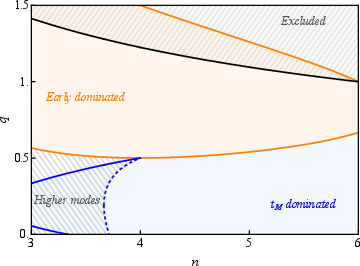
The primary phenomenological result is a tripartite classification of the gravitational wave backgrounds produced by scaling string networks with generic power-law tension evolution in a FLRW universe. The key parameter space is mapped in terms of n (equation of state) and q (tension evolution), as illustrated in the following figure.
Figure 1: Regions in (n,q) parameter space—where Gμ∼t−q—delineating the three distinct gravitational wave emission scenarios discussed in the main text.
Within this diagram:
Scenario 1 (orange): The GW background is dominated by string loops radiating immediately at their formation. The corresponding GW spectral index is
A=2[1+n−2qn−2],
with a potential for blue-tilted (A>0) spectra for increasing q.
Scenario 2 (blue): The GW background is dominated as string loops radiate at a characteristic intermediate lifetime, specifically when they have lost half their energy, yielding a different power-law index B.
Scenario 3 (white): At larger q or for specific backgrounds, higher harmonics or late-time emission dominate, and the spectral index saturates at −1/3 due to the cumulative role of multiple loop modes.
The Swampland bounds, excluded regions, and detailed scenario boundaries are all determined analytically and explicitly marked.
Implications and Theoretical Significance
This systematic treatment demonstrates that cosmic superstrings with time-varying tension—realizable in concrete string compactifications—can yield gravitational wave spectra with much steeper high-frequency power laws than the constant-tension case. This opens up the possibility of probing pre-BBN cosmology and early-universe moduli dynamics with high-frequency GW detectors. The stringent Swampland-inspired bounds also provide a model-independent upper limit on the possible GW spectral index for any varying-tension cosmic string network consistent with quantum gravity:
A≤2[1+n−26n−2].
The independence of the spectral index from the background in certain cases (e.g., μ∼t−1) is a strong claim and differentiates these models from conventional cosmic string phenomenology.
Future Directions
The techniques developed can be extended to incorporate richer moduli potentials, more intricate string/brane combinatorics, or additional matter components in the early universe. Precise calculations of GW amplitudes, detailed frequency window predictions for LISA, PTA, and proposed high-frequency searches, and their interplay with reheating, moduli decay, or axions merit further investigation. From the Swampland perspective, deeper connections between tension evolution, other Swampland criteria, and observable GW features are a promising avenue.
Conclusion
This study delivers a rigorous classification of the gravitational wave signatures of scaling cosmic string networks with varying tension, anchored in string theory constructions and quantum gravity consistency conditions. The analytic mapping of the (n,q) plane, explicit calculation of spectral indices, and Swampland-bounded parameter space together provide a comprehensive phenomenological framework, with direct relevance for future observational probes of the early universe and the structure of string vacua.