- The paper establishes a combinatorial framework for HEIs by encoding inequalities as (0,1) matrices and proving that null reductions of superbalanced HEIs are HEIs.
- It characterizes centered inequalities by showing that inclusion dominance is necessary and sufficient, thereby reinforcing key majorization properties in holographic settings.
- The framework provides new analytical tools for classifying the Holographic Entropy Cone and informs future bootstrap and algorithmic verification strategies in quantum gravity.
Combinatorial Frameworks for Holographic Entropy Inequalities
Introduction
The structure of entanglement entropy functions—in classical probability, quantum mechanics, and especially in holographic quantum gravity—has long been a locus for deep theoretical investigations. Holographic entropy inequalities (HEIs), linear constraints obeyed by Ryu–Takayanagi entropies and equivalently the minimum cut function on weighted graphs, demarcate the cone of entropy vectors realizable by holographic states. The paper "Combinatorial properties of holographic entropy inequalities" (2601.09987) presents a comprehensive combinatorial framework for HEIs, resolving several conjectures and establishing new necessary and sufficient conditions for classifying and generating these inequalities.
From Entropy Functions to Graph Min-Cuts
The entropy function F:2Ω→R+, with submodularity as its core property (strong subadditivity), exhibits further constraints in classical, quantum, and holographic settings. In the static AdS/CFT correspondence, the Ryu–Takayanagi (RT) prescription equates the entanglement entropy SX for a subsystem X to the minimal area of a bulk surface homologous to AX; more generally, SX is isomorphic to the min-cut function on a weighted undirected graph with labeled external (boundary) vertices. The cone of such entropy vectors is dubbed the min-cut cone, also known as the Holographic Entropy Cone (HEC).
Key Concepts and Conjectures
Prior work—especially [Grimaldi, Headrick, Hubeny 2025]—introduced a suite of conjectures examining the relations between HEIs and their null reductions (inequalities formed by retaining only those terms containing a given index). In particular, an outstanding question was whether the validity of null reductions could "bootstrap" to the validity of the original HEI, and whether HEIs universally enforce certain majorization properties in reduced settings.
The present work introduces a systematic combinatorial framework, utilizing (0,1)-matrix representations of inequalities and various dominance/majorization notions between these matrices.
Matrix Representations and Dominance Notions
HEIs are encoded as pairs of (0,1) matrices (L,R) each with N+1 rows (for N+1 parties; one is the purifier) and variable numbers of columns (corresponding to terms in the inequality on each side). The various combinatorial properties studied include:
- Balance and Superbalance: A matrix pair is balanced if every party appears equally often on both sides; superbalanced if this is further true for each pair of parties— crucial for primitive HEIs.
- Contraction Maps: Central to the "proof-by-contraction" method for HEIs, a contraction map f satisfies f(L(i))=R(i) and contracts the Hamming distance between any two bit strings, and the existence of such a map is equivalent to the HEI property.
- Dominance: A dominance map matches subsets of LHS columns to RHS columns such that, for each party, the total count is dominated.
- Inclusion Dominance: A refinement requiring subset inclusion relations to be preserved under the dominance map, corresponding to a form of nested dominance.
- Region Dominance: Generalizing balance, for any subset of parties, the number of LHS terms containing a region does not exceed the corresponding RHS count.
- Majorization (PCM/BCM): Matrix majorization notions formalize when all positive (or binary) linear combinations of LHS columns are majorized by combinations on the RHS.
Summary of Main Results
The paper establishes a network of logical relations among these combinatorial properties, resolving the conjectures of [Grimaldi:2025jad]. Key results are as follows:
- Resolution of Null Reduction Conjectures: All null reductions of a superbalanced HEI are again HEIs. However, not every inequality with all null reductions HEIs is itself an HEI, showing the non-triviality of the converse.
- Characterization of Centered Inequalities: Centered inequalities—those balanced and in which every term contains a fixed "central" party—are precisely the null reductions of superbalanced inequalities. The existence of a contraction map for centered inequalities is shown to be equivalent to the inclusion dominance property.
- Majorization Constraints: The paper proves that null reductions of HEIs satisfy positive-combinations majorization (PCM), linking the physical light-cone configurations to deep combinatorial structure.
- Necessary and Sufficient Combinatorial Criteria: For centered inequalities, inclusion dominance is necessary and sufficient for the HEI property.
- Logical Hierarchy: The relations among all combinatorial properties (inclusion dominance, dominance, PCM, BCM, and region dominance) are charted precisely and counterexamples for converse statements are provided.
The following logical implication structure is established for centered inequalities:
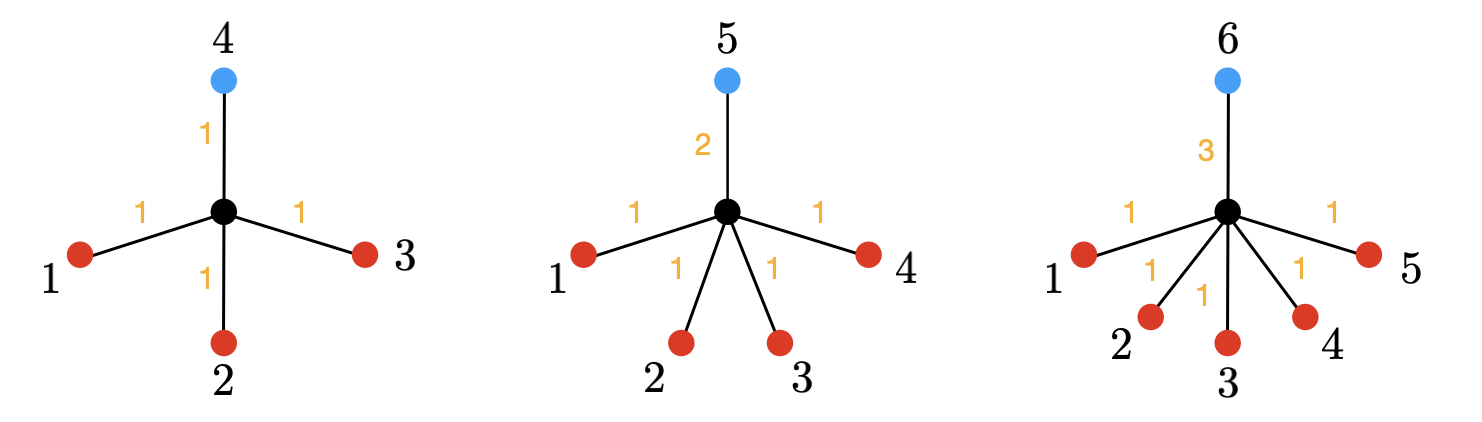
Figure 1: Examples of star graphs for k=3,4,5, which play a role as minimal models capturing region dominance in the proofs of the main theorems.
Implications for Holographic Entropy and Quantum Gravity
The established combinatorial properties provide new tools for analyzing the structure of the Holographic Entropy Cone, and for classifying its facets and rays in both H- and V-representations. Resolving the constraints reinforced the expectation that HEIs (and hence allowed holographic entropy vectors) obey a strong majorization property in the presence of light-cone configurations and under null reductions—corroborating physical arguments about the universality of such inequalities in both static and time-dependent settings. At a technical level, the identification of inclusion dominance as a necessary and sufficient criterion for centered HEIs provides a combinatorial toolkit for future classification and for generation of candidate inequalities.
Further, the paper raises questions about the effectiveness of "bootstrap" strategies for the HEC, i.e., systematically building up high-N HEIs from their behavior under local reductions. Also of notable interest is the suggestion that the combinatorial dominance conditions may be a universal feature underlying renormalization group structures in holography and the role of entanglement in emergent geometry, as explored in very recent work [Czech:2026tgj].
Prospects and Future Directions
Several avenues for future exploration are explicitly outlined:
- Extending the Combinatorial Framework: Analyzing broader classes of inequalities and uncovering the detailed extremal structure (rays and facets) of the centered cones.
- Algebraic Structure and Algorithms: Investigating efficient algorithms for verifying the stronger majorization properties (PCM/BCM) and their ramifications for the entropy cone structure.
- Physical Interpretation: Relating combinatorial dominance to explicit quantum information-theoretic or geometric constraints typical of holographic CFTs and quantum gravity.
- Universal Conjectures: The conjecture that non-primitive, superbalanced HEIs may be characterized by the behavior of all null reductions remains tantalizingly open for higher N, with partial positive evidence to date.
Conclusion
By establishing a unifying combinatorial framework and resolving deep conjectures about the structure of holographic entropy inequalities, this paper substantially advances the mathematical theory underpinning the Holographic Entropy Cone. The explicit connections drawn between null reductions, majorization, and centered inequalities lay the groundwork for ongoing efforts to classify the full suite of linear entropy inequalities arising in AdS/CFT, and to understand emergent spacetime from the information-theoretic structure of entanglement. These results will inform both practical algorithms for entropy inequality verification and conceptual investigations into the nature of quantum gravity (2601.09987).