- The paper demonstrates that the Gross–Mende single saddle approximation fails, showing both real and imaginary parts contribute at leading order.
- It systematically classifies an infinite family of complex saddles, linking each saddle to modular transformations and specific multiplicity patterns.
- High-precision numerical bootstrap techniques are employed to match asymptotic expansions with analytic predictions, paving the way for nonperturbative S-matrix studies.
Precision Asymptotics of String Amplitudes: Revisiting the Saddle Structure
Introduction and Motivation
The high-energy, fixed-angle regime of closed string scattering amplitudes offers a profound probe into the non-local features of string theory. The canonical Gross–Mende (GM) analysis predicted that at fixed genus, amplitudes are exponentially suppressed at large s, with a unique saddle dominating. However, recent high-precision numerical studies reveal a persistent tension with these expectations, specifically at one loop: the Gross–Mende result only captures the coarse enveloping exponential, while finer structure—especially the phase and oscillatory contributions—contradicts the single-saddle prediction. Both real and imaginary parts of the amplitude contribute at leading order, violating the GM expectation of a purely imaginary asymptotic form.
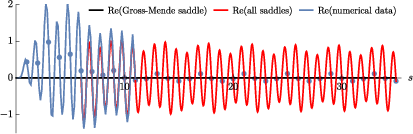
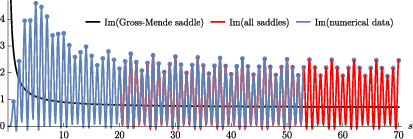
Figure 1: Comparison between numerical one-loop amplitude data (blue), Gross–Mende saddle prediction (black), and the sum over all complex saddles (red) for θ=2π as a function of s (amplitude stripped of leading prefactors).
This discrepancy prompts a systematic classification of contributing saddle-point geometries and their multiplicities in the high-energy regime, leading to a refined asymptotic expansion that matches explicit numerical data and reveals a new, richer analytic structure.
Enumeration and Structure of Complex Saddles
The core of the analysis is the high-energy, fixed-angle (s→∞, θ fixed) behavior of the one-loop four-graviton amplitude in type II superstring theory, given as an eight-dimensional integral over the moduli and vertex operator positions on the torus:
A=∫F(ℑτ)5d2τ∫T2j=1∏3d2zji<j∏∣ϑ1(zij∣τ)∣−2sije2πsij(ℑzij)2/ℑτ
where the kinematic invariants sij are fixed and F denotes the fundamental domain.
The classical GM analysis relied on a saddle at the real section of moduli space, but this is insufficient due to analytic subtleties: the path integral must be understood as complexified, allowing independent integration over (τ,τˉ), not just τ along the real-fundamental domain contour. In this larger moduli space, an infinite family of complex saddles with identical real action but distinct phases dominates the high-energy limit.
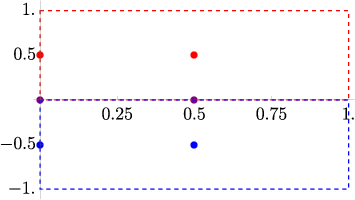
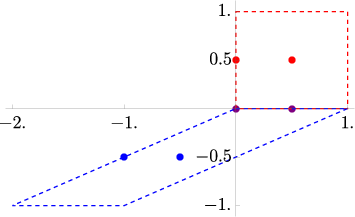
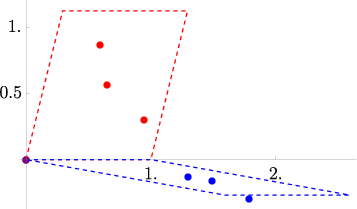
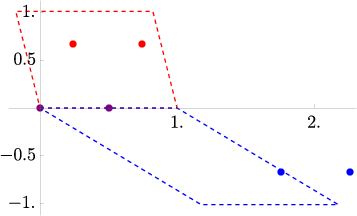
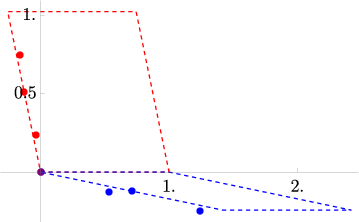
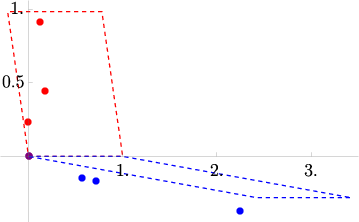
Figure 2: A collection of sample saddles for t=−2s. Red points denote left-moving insertions, blue points right-moving ones on the complex plane; parallelograms visualize torus fundaments for τ and τˉ. Only the Gross–Mende saddle is “real” (first panel); all others are complex.
Each leading saddle is associated with an element γ of the congruence subgroup Γ(2)⊂PSL(2,Z), acting as modular transformations on τ. The right-moving moduli are fixed to τθ∗, where τθ is defined by inverting the modular lambda function given the physical kinematical ratio −ts as:
λ(τθ)=−ts
and the other coordinates are related via modular images. These "complex Gross–Mende" saddles generically have insertion points at half-periods of the torus (with permutations under modular transformations). Much evidence from numerical saddle hunting shows that only these configurations yield minimal real part of the action.
Analytic Properties and the Role of Infinite Sums
Each saddle point contributes with a phase and a multiplicity, so the asymptotic expansion is:
A(s,θ)∼γ∑Mγ(s,θ)Aγ(s,θ)
where Aγ is the local expansion around the saddle and Mγ its multiplicity.
Analytical structure and symmetries restrict possible Mγ. A central result is that these multiplicities can be bootstrapped from analytic constraints and matched to high-precision numerical evaluations. The infinite family of saddles, when summed, produces an "oscillatory tail" on top of the exponential fall-off, leading to nontrivial interference effects in real and imaginary parts.
The sum over saddles exhibits rich analytic features, including leading singularities for even integer values of s, non-analyticities resembling logarithmic thresholds, and boundedness of the amplitude for s in the first quadrant of the complex plane—confirmed both analytically and numerically. These features are robust to changes in the calculation contour.
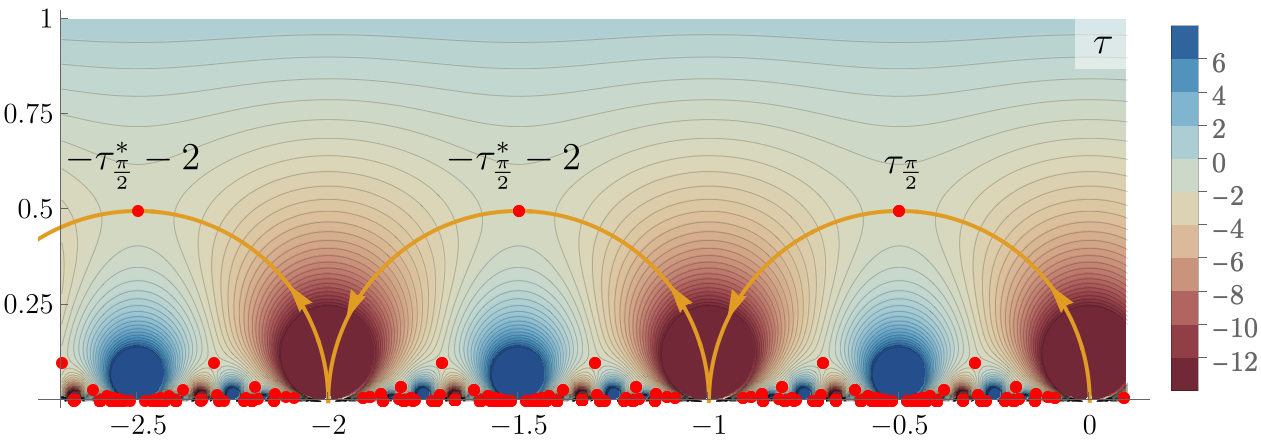
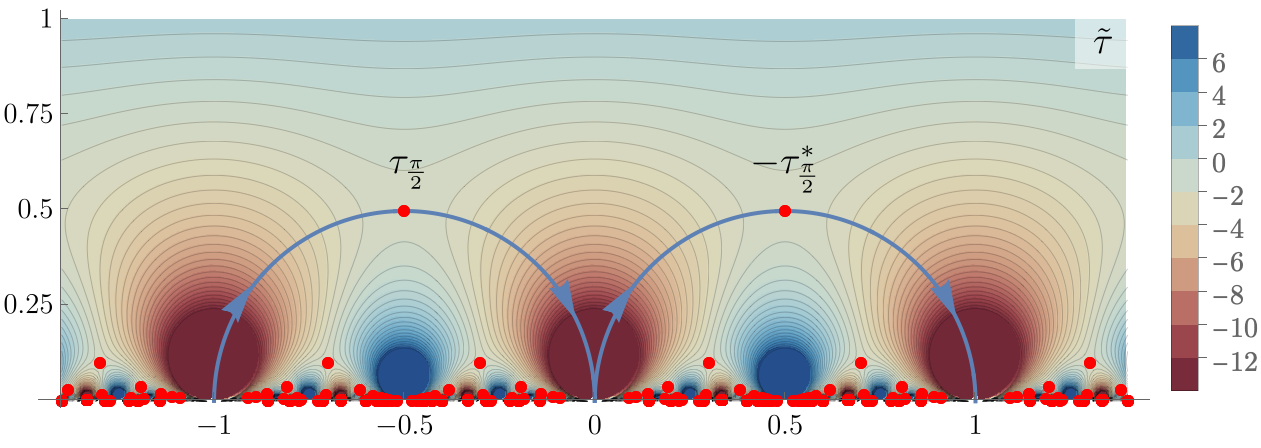
Figure 4: The steepest descent contour used for the toy-model version of the amplitude, demonstrating that relevant saddle points occur as images under modular transformations.
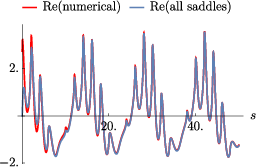
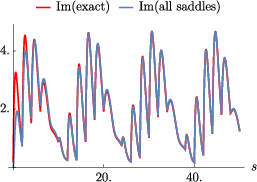
Figure 3: Comparison of the direct evaluation of the toy integral versus its saddle approximation, showing excellent agreement for both real and imaginary parts in the high-s regime.
Numerical Bootstrap of Saddle Multiplicities
A significant technical contribution is the extraction of saddle-point multiplicities Mγ(s,θ) from numerical data. This is achieved through:
- High-energy double (real and imaginary) precision calculations with Rademacher expansion and unitarity/Baikov-based techniques,
- Fourier analysis in the kinematical variables (binning amplitudes multiplied by predicted exponential oscillations),
- Cross-validation against analytically continued amplitude data,
- Systematic matching against theoretical bootstrap ansätze.
Numerics indicate that only a subclass of "elementary" saddles contributes—those labeled by certain types of modular representatives. The tail sum over these saddles yields the correct oscillatory structure and analytic singularities, while non-elementary saddles appear to have zero multiplicity within the bounds of numerical uncertainty.
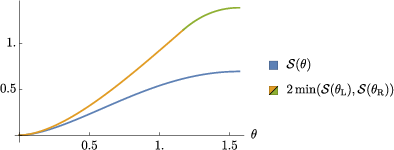
Figure 5: The fall-off rate of the tail sum contribution isolated against the full amplitude, demonstrating how multiplicities stabilize and the correct asymptotic is established at large s.
Algorithmically, after correcting for symmetries (crossing, complex conjugation, etc.), the data conforms with the expectation that Mγ for elementary saddles takes the form of specific polynomials in exp(±2πis), typically with only a handful of undetermined constants remaining at the edge of numerical resolution.
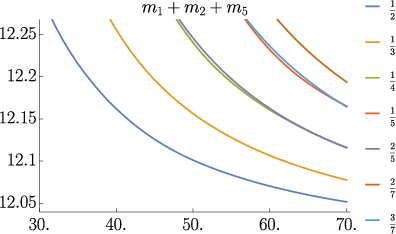
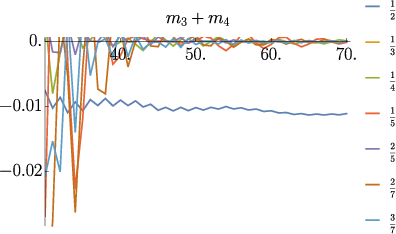
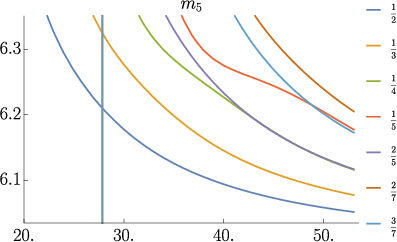
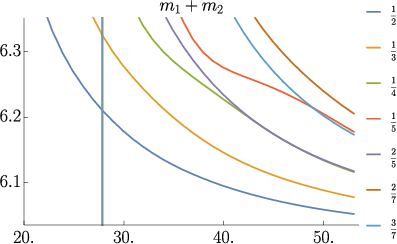
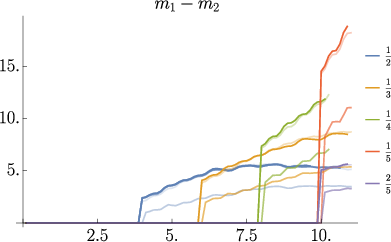
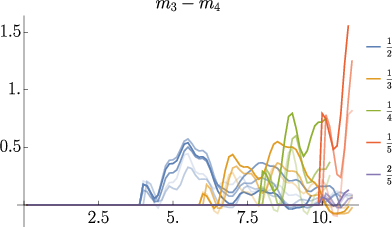
Figure 6: Numerical extraction of the saddle multiplicities as a function of s. The bin-averaged data, filtered for predicted oscillatory contributions, converges toward expected integer multiplicities for the dominant saddles.
Toy Model, Thresholds, and Theoretical Implications
The construction and analysis of a holomorphically factorized toy integral, closely related to the full amplitude via the approximate holomorphic factorization, illustrates precisely how the infinite family of leading saddles emerges, which contribute with analytically controlled (and physically meaningful) phases and multiplicities.
Discontinuities due to massive intermediate states ("thresholds") persist in the amplitude, but the exponential suppression of individual channels at large s ensures that their contributions are subleading; only the collective tail sum causes the dominant logarithmic non-analyticities at even-integer s.
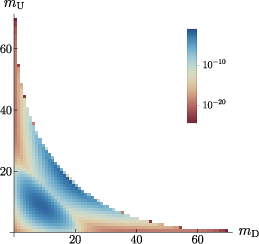
Figure 8: The relative contribution of various internal mass levels to the decay width (coefficient of the double pole), illustrating that high-energy behavior is nonlocally shared across many internal channels.
Consequences for Higher Genus, Nonperturbative Regimes, and the S-Matrix Bootstrap
The analysis, while focused on one-loop amplitudes, is argued to extrapolate to higher genus: the expected dominant contribution at genus g is from (g+1)-fold covers of the sphere by a torus, and complex modular images as at one-loop. The exponential suppression is then determined by a universal function of s/(g+1) with superimposed oscillations from the sum over complexified saddles.
For fixed genus, the high-energy amplitude remains regular, but the perturbative expansion in genus inevitably breaks down at large s, and for s≫O(gc)log(1/gs) (with the string coupling gs), the nonperturbative behavior must take over.
The boundedness property along imaginary s is established and is argued to be orthogonal to standard S-matrix bootstrap bounds, opening a new potential tool for the non-perturbative bootstrap study of quantum gravity amplitudes.
Conclusion
This work provides, for the first time, a fine-grained, data-guided, and analytically consistent description of the fixed-angle asymptotic expansion of the one-loop string amplitude, accounting for the entire infinite family of modular-generated complex saddles and their oscillatory structure. The approach combines complex analysis, modular geometry, numerical bootstrap, and theoretical constraints to produce a precise and predictive formalism for high-energy string amplitudes.
The results have immediate implications for the analytic structure of string scattering, the S-matrix bootstrap at finite coupling, and the relation between perturbative and non-perturbative quantum gravity, and establish an approach that is likely to be extendable to higher genus and potentially to other systems with modular moduli integrals and intricate saddle landscapes.