Formation of massive multiple-star systems: early migration and mergers
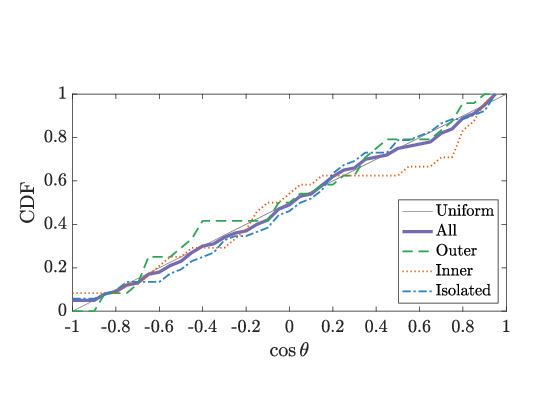
Abstract: Massive stars are often found in multiple systems, yet how binary-star systems with very close separations ($\lesssim$ au) assemble remains unresolved. We investigate the formation and inward migration of massive-star binaries in Solar-metallicity environments using the star-cluster formation simulation of Chon et al. (2024), which forms a $1200\,M_\odot$ stellar cluster and resolves binaries down to 1 au separation. Our results indicate that stars more massive than $2\,M_{\odot}$ predominantly assemble in binary or triple configurations, in agreement with observations, with member stars forming nearly coevally. In most of these systems, the inner binary hardens by one to three orders of magnitude and reaches a steady-state within the first $0.1\,$Myr. Notably, all binaries whose final separations are below 10 au are hardened with the aid of circumbinary discs, highlighting disc-driven migration as a key to produce tight massive binaries. We further find that binaries form with random inclinations relative to the initial rotation axis of the cloud, and that mutual inclinations in triple systems follow an isotropic distribution, implying that stochastic interactions driven by turbulence and few-body dynamics are crucial during assembly and migration. Finally, stars with $M>2\,M_{\odot}$ often undergo repeated merger events during cluster evolution, yielding extreme mass ratios ($q<0.1$). Some of these products may evolve into compact-object binaries containing a black hole or neutron star, including X-ray binaries and systems detectable by Gaia.
Paper Prompts
Sign up for free to create and run prompts on this paper using GPT-5.
Top Community Prompts
Explain it Like I'm 14
What this paper is about
This paper studies how very big stars (especially ones more than about twice the Sun’s mass) end up in close pairs or small groups. The authors use a detailed computer simulation to watch a giant cloud of gas collapse and form a star cluster. They focus on how pairs of stars move closer together early on, sometimes merging into one, and how discs of gas around them help tighten their orbits to very small distances.
The main questions the researchers asked
- How do massive stars form close pairs (binaries) with separations as small as the distance from the Sun to Earth (about 1 au) or even less?
- Which processes are most important for shrinking (or “hardening”) star pairs: breaking up of filaments or discs, interactions with gas, or encounters with other stars?
- Do the angles of the stars’ orbits have any preferred direction, or are they random?
- How often do stars merge in these young clusters, and what kinds of systems might these mergers eventually create (like black hole or neutron star pairs)?
How they did the study (in simple terms)
The team ran a high‑resolution, physics‑rich computer simulation of a star‑forming cloud:
- Think of a giant, cold, rotating, and slightly turbulent “fog” in space, about 6,300 times the mass of the Sun. Gravity makes parts of it clump and collapse into stars.
- The simulation tracks gas using a method called “smoothed-particle hydrodynamics” (SPH). Imagine representing the gas with many tiny particles that move and interact like marbles in a thick fluid, obeying the laws of physics (gravity, pressure, heating, cooling).
- When a clump gets dense enough, the code creates a “sink particle,” which stands in for a newborn star. Sink particles can:
- Accrete (pull in) nearby gas and grow.
- Merge if they come too close (this is limited by the simulation’s resolution).
- The code also includes radiation from massive stars (light that heats and pushes on surrounding gas), and realistic cooling processes (ways gas loses heat).
- They saved roughly 11,000 snapshots and looked for gravitationally bound pairs or triples. To find and classify systems, they:
- Identified bound pairs by checking which stars are the most tightly linked by gravity.
- Grouped nearby gas regions using a “friends-of-friends” method (like finding clusters of points that are close enough to be considered part of the same blob).
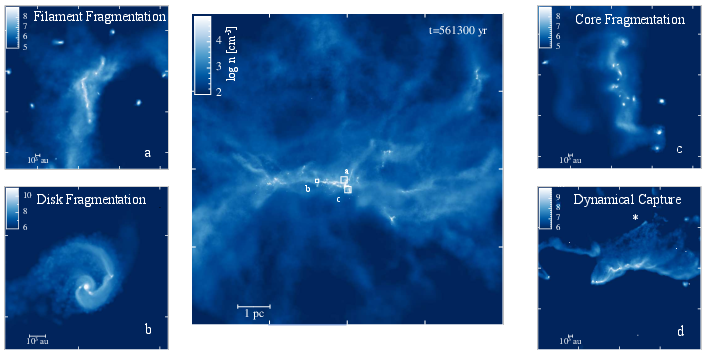
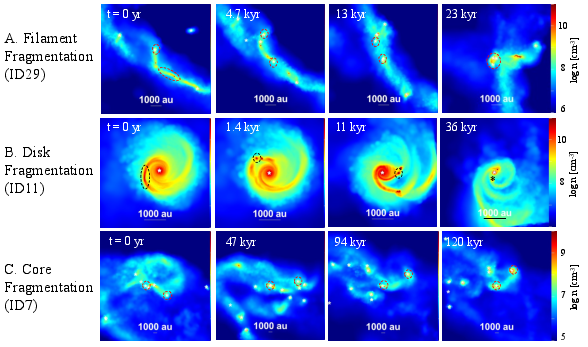
- Classified how the binaries formed by the shape of the gas: filament fragmentation (long spaghetti-like clouds breaking up), disc fragmentation (massive, spinning discs splitting), core fragmentation (roundish blobs splitting), or dynamical capture (stars formed separately that later pass close enough to become a pair).
- To judge when discs matter, they estimated disc sizes by checking how fast the gas rotates compared to the speed needed for a circular orbit (the “Keplerian” speed). If stars are close enough that their discs overlap or form a disc around both stars (a “circumbinary disc”), disc interactions are happening.
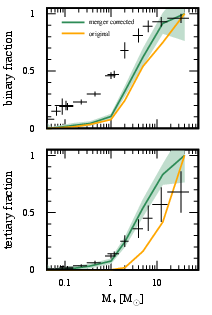
- Because the simulation allows stars to merge at separations of about 1–10 au (larger than real stellar sizes), the team also made a “merger-corrected” sample: they treated those mergers as very tight binaries that would likely have survived in reality. This checks how sensitive the results are to resolution limits.
What they found and why it matters
- Massive stars mostly form in pairs or triples:
- Stars heavier than about 2 times the Sun’s mass usually end up in binary or triple systems, matching real observations.
- The stars in a pair tend to form around the same time.
- Early and rapid shrinking (“hardening”) is common:
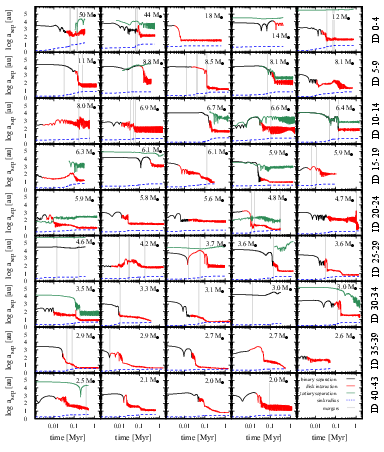
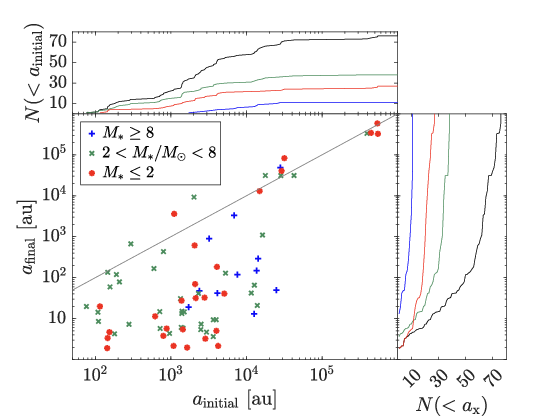
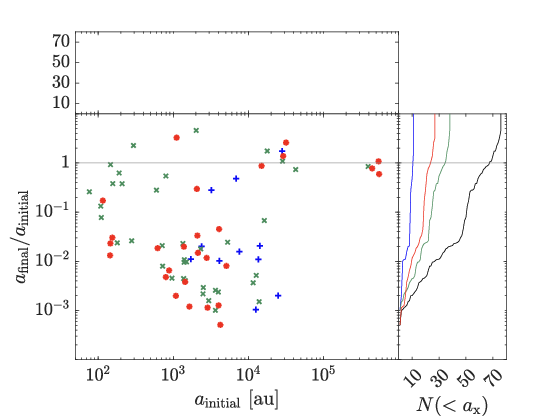
- Inner binaries typically tighten by 10–1,000 times within the first 0.1 million years.
- All binaries that end up extremely close (final separation under 10 au) pass through a circumbinary disc phase. In other words, disc‑driven migration is essential for making the tightest massive binaries.
- How binaries form depends on star mass:
- Low‑mass primaries (≤ 2 solar masses): filament fragmentation is common.
- Intermediate‑mass primaries (2–8 solar masses): disc fragmentation dominates.
- High‑mass primaries (≥ 8 solar masses): core fragmentation (more chaotic splitting) dominates.
- Very wide binaries (thousands of au) often come from dynamical capture (stars formed in different places later snagging each other).
- Migration happens in phases:
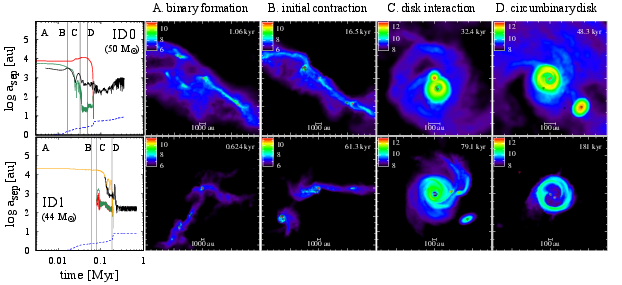
- Initial contraction: stars move closer due to gravity in their birth cloud; orbits often start eccentric (more oval‑shaped).
- Disc interaction: once separations are similar to disc sizes (~100 au), spirals in the discs pull away orbital energy and angular momentum, shrinking separations to tens of au.
- Circumbinary phase: a ring around both stars continues to drain angular momentum, slowly tightening the orbit to under 10 au if gas persists.
- Orbits are randomly oriented:
- Binaries and triples don’t prefer any particular tilt relative to the original cloud’s spin axis. In triples, the mutual tilts are essentially random (“isotropic”).
- This suggests turbulence and chance encounters play big roles.
- Mergers are frequent for massive stars:
- Stars with more than 2 solar masses often experience multiple merger events in the cluster.
- These can produce extreme mass ratios (the smaller star is less than 10% of the bigger one’s mass).
- Some merged systems may later become black hole or neutron star binaries, which can show up as X‑ray binaries, be spotted by Gaia, or eventually emit gravitational waves.
- The overall picture fits real data:
- The simulated trends in multiplicity (how many stars end up in pairs/triples) and separations align with observations, including a “two‑peak” distribution with very wide and much tighter binaries.
Why this research is important
- It pinpoints disc‑driven migration (especially circumbinary discs) as a key step in creating very tight massive binaries. This helps explain how such systems arise early, long before we can easily observe them.
- It shows that turbulence and multi‑body interactions are crucial. The random orientations and frequent mergers mean the early life of massive stars is messy but predictable in its statistics.
- It identifies pathways that can lead to compact‑object pairs (neutron stars or black holes), which are major sources of gravitational waves and high‑energy events. Understanding their birth environments helps us connect star formation to later cosmic fireworks.
- It guides observations: if tight binaries form early via discs, looking for signs of circumbinary discs and early hardening in young clusters could test these ideas.
- It highlights the need for even more detailed simulations (including jets, winds, and supernova feedback, which were not modeled here) to fine‑tune how fast and how far binaries shrink.
In short
Massive stars often grow up in pairs and small groups. Early on, discs of gas around them act like cosmic brakes, robbing the stars of orbital energy so they spiral closer. Turbulence and chance encounters make their orbits randomly tilted, and mergers are common. These early processes set the stage for the tight, massive binaries we see today—and for the compact‑object systems that later light up the universe with X‑rays and gravitational waves.
Knowledge Gaps
Knowledge gaps, limitations, and open questions
Below is a single, focused list of the study’s unresolved issues, methodological limitations, and concrete open questions that future work could address.
- Generality of results beyond a single setup:
- Only Solar-metallicity cloud modeled; how do migration, fragmentation channels, multiplicity fractions, and tight-binary formation efficiencies vary with metallicity (via dust opacities, cooling, and photoevaporation)?
- Single initial condition (rotating Bonnor–Ebert sphere, transonic turbulence, rigid rotation); test sensitivity to cloud mass, size, virial parameter, Mach number (supersonic vs transonic), rotation profile (rigid vs differential), and turbulence spectrum/driving.
- Turbulence is initialized but apparently not driven; assess how sustained turbulent driving (e.g., solenoidal/compressive forcing) alters fragmentation pathways and migration.
- Missing physics and feedback channels:
- No magnetic fields (MHD) are included; quantify how magnetic braking, magnetized disc structure, and magnetic winds/outflows change disc fragmentation, angular momentum transport, and binary hardening.
- Protostellar jets/outflows and line-driven OB winds are excluded; determine their impact on disc masses, longevity, and the efficiency/timescale of disc- and circumbinary-driven migration.
- Radiation feedback modeled for M*>10 M⊙ only; incorporate feedback from intermediate-mass stars (e.g., FUV photoevaporation, accretion luminosity) and radiation pressure to test disc dispersal and migration suppression in 2–8 M⊙ systems.
- Supernova feedback and stellar evolution are absent; follow post-formation evolution (mass loss, SN kicks) to assess survival of tight binaries and pathways to X-ray binaries and GW sources.
- Sink particle and merger treatment:
- Sink radii scale with mass (≈0.85–>10 au) and stars merge when separation < sum of sink radii; this likely inflates merger rates and suppresses formation of very tight binaries among massive stars. Perform runs with smaller, physically motivated sink radii (linked to protostellar radii and Roche limits) and non-merging interaction prescriptions.
- Gravitational softening and large sink radii can bias close-orbit dynamics; quantify how these choices affect eccentricity damping, pericenter passages, and hardening rates.
- The “merger-corrected” sample treats all mergers as unresolved binaries and subtracts merger mass without modeling post-merger accretion, orbital elements, or feedback; develop a more realistic subgrid model for mergers vs near misses, including subsequent accretion, angular momentum, and luminosity changes.
- Disc identification and torque budget:
- Disc identification uses an ad hoc v_rot/v_Kep > 0.7 threshold; validate against kinematic and morphological diagnostics (e.g., specific angular momentum profiles, Q parameter, spiral mode analysis) and assess sensitivity to threshold choices.
- The claim that tight binaries (<10 au) are hardened “with the aid of circumbinary discs” is qualitative; directly measure torque budgets (gas gravitational torques, viscous stresses), accretion rates, h/r, and effective α to quantify the relative importance of disc vs few-body interactions in hardening.
- Distinguish the contributions and timescales of circumstellar-disc migration vs circumbinary-disc migration across mass regimes; identify conditions that lead to stalling vs runaway hardening.
- Multiple-system architecture and dynamics:
- Multiplicity capped at three during identification; allowing only triples may bias system architectures and mutual inclination statistics. Extend analysis to quadruples and higher-order hierarchies and reassess inclination distributions and stability.
- Binding identification via iterative replacement of bound pairs can obscure transient hierarchies and resonances; compare with hierarchical clustering/tree-based binding analyses and long-term stability criteria.
- The reported isotropic mutual inclinations in triples need robustness checks: quantify sample size, selection effects, and the role of turbulence vs disc-mediated alignment/misalignment; test dependence on initial angular momentum of the cloud and magnetic alignment.
- Formation mode classification:
- Formation mode (filament vs disc vs core vs capture) relies on FoF connectivity and axis-ratio cuts (λ-based thresholds). Conduct sensitivity tests on density thresholds, linking lengths, and λ thresholds, and cross-validate with kinematic diagnostics (e.g., rotational support, shear, convergence).
- Dynamical capture defined by n_th below the initial cloud mean density (104 cm⁻³); examine how this criterion performs in denser clusters and sustained turbulence, and whether it misclassifies late-time interactions within gas-poor environments.
- Statistical robustness and convergence:
- The sample (≈76 binaries, subset of massive/intermediate-mass systems) from a single simulation limits statistical power; run ensembles with varied random seeds and initial parameters to quantify uncertainties in multiplicity fractions, separation distributions, and hardening rates.
- Provide resolution and numerical-method convergence tests (varying particle mass, sink radius, gravitational softening, SPH viscosity) and cross-code comparisons (SPH vs AMR/grid) to evaluate fragmentation and migration fidelity.
- Long-term evolution and end states:
- The simulation ends at ≈1.7 Myr, while many binaries (especially massive ones) continue evolving; extend runs to several Myr to capture late-time disc dispersal, secular evolution (e.g., Kozai–Lidov in hierarchies), and cluster dynamical processing.
- Quantify the fraction of systems that would produce compact-object binaries (BH/NS + companion) with realistic stellar evolution, wind mass loss, and SN kicks; predict observable populations (X-ray binaries, Gaia astrometric binaries) with mock catalogs.
- Observational connections:
- Generate synthetic observables (e.g., radial velocity variability distributions, interferometric disc morphologies, maser kinematics, ALMA continuum/line maps) to test the inferred early-time hardening and disc-driven migration against data.
- Assess whether the bimodality in observed massive-binary separations (∼10⁴ au and ∼1–100 au) emerges robustly across parameter space, and identify which channels (disc vs filament vs core vs capture) dominate each peak.
- Eccentricity and mass-ratio evolution:
- Eccentricity damping during disc interaction is described qualitatively; measure eccentricity evolution rates and final distributions as functions of mass, disc properties, and interaction history.
- Mass ratios tend toward unity in inner binaries while tertiaries evolve independently; quantify accretion partitioning mechanisms (streaming through circumbinary cavities, preferential accretion) and the conditions that produce extreme mass ratios (q<0.1).
- Environmental photoevaporation:
- External irradiation/photoevaporation by nearby massive stars is mentioned as halting migration in low-mass systems; model and quantify external UV fields and gas removal rates self-consistently to determine when circumbinary migration stalls.
- Cluster-scale dynamics:
- The role of global cluster potential, gas expulsion, and tidal fields on binary survival and hardening is not isolated; perform controlled experiments varying cluster density and gas removal to disentangle cluster vs disc vs few-body contributions.
- Definition of “binary formation epoch”:
- Binary birth is tied to sink creation times and early gas connectivity; explore alternative definitions that account for pre-sink core pairing, transient bound states, and capture onset to better track assembly histories.
Glossary
- Accretion: The process by which an object grows in mass by accumulating surrounding material. "The sink particle may accrete gas particles around and grow in mass."
- Angular momentum: A measure of rotational motion that must be transferred or removed for orbital migration or collapse. "Spiral arms rapidly extract angular momentum from the binary system"
- Apocentric separation: The maximum distance between two bodies on an eccentric orbit (the apocenter). "The eccentricity gradually decreases, as indicated by the decline in apocentric separation, that is, the peak of the separation decreases with time."
- Astronomical unit (au): A standard unit of length in astronomy equal to the average Earth–Sun distance. "resolves binaries down to 1 au separation."
- Bimodal distribution: A distribution with two distinct peaks. "the distribution of massive binary separations is bimodal, with one peak at au and another at â$100$ au"
- Binary hardening: The process by which a binary’s separation decreases, increasing its binding energy. "the inner binary hardens by one to three orders of magnitude and reaches a steady-state within the first Myr."
- Bonnor-Ebert sphere: A pressure-confined, self-gravitating isothermal gas sphere used as a model for molecular cloud cores. "The simulation begins from a rotating and turbulent Bonnor-Ebert sphere"
- Circumbinary disc: A disc of gas and dust that orbits around both members of a binary system. "Once the disc radius becomes larger than twice the binary separation, we define the disc as a circumbinary disc."
- Circumbinary phase: The evolutionary stage when both circumstellar discs are embedded within a common disc encompassing the binary. "We define the circumbinary phase as the stage in which each circumstellar disc becomes fully embedded within the disc of its companion star."
- Circumstellar disc: A disc of gas and dust surrounding an individual young star. "Spiral arms are waken at the circumstellar disc due to the self-gravity of the disc."
- Cloud-in-cell (CIC) method: A numerical interpolation scheme for mapping grid-based fields to particle positions. "Gas particle velocities are interpolated from this grid using the cloud-in-cell (CIC) method."
- Collapsar: A massive star collapse scenario that can produce long gamma-ray bursts and heavy elements. "although additional channelsâincluding collapsarsâmay also contribute significantly"
- Compact-object binaries: Binary systems containing compact remnants like black holes or neutron stars. "Some of these products may evolve into compact-object binaries containing a black hole or neutron star"
- Core fragmentation: The splitting of a dense gas core into multiple protostellar objects. "All other cases are classified as core fragmentation."
- Cosmic microwave background radiation: The residual radiation from the Big Bang that permeates the universe. "heating by cosmic microwave background radiation and local stellar irradiation"
- Disc fragmentation: The breakup of a massive, self-gravitating disc into bound clumps or protostars. "If and , we interpret the progenitor cloud as disc-like and classify the mode as disc fragmentation."
- Disc torques: Gravitational and hydrodynamical forces from discs that alter orbital angular momentum. "Such fragments may subsequently migrate inward through disc torques"
- Disc-driven migration: Inward orbital evolution caused by interactions with surrounding disc material. "highlighting disc-driven migration as a key to produce tight massive binaries."
- Dynamical capture: The formation of a bound system when initially unbound objects lose energy through interactions. "We determine the dynamical capture mode occurs when the threshold density is lower than the mean density of the initial cloud"
- Dynamical time: The characteristic timescale for gravitational collapse or orbital motion in a system. "comparable to the dynamical time of the initial filament"
- Eccentricity: A parameter describing how non-circular an orbit is. "Eccentricity versus separation of binary systems at the end of the simulation."
- Eigenvalues: Scalars indicating the magnitude of stretching along principal axes of a tensor. "We then diagonalize the moment-of-inertia tensor to obtain its eigenvalues"
- Few-body dynamics: Gravitational interactions among a small number of bodies leading to complex orbital evolution. "few-body dynamics are crucial during assembly and migration."
- Friends-of-friends (FoF): A clustering algorithm that links nearby particles into groups based on a distance criterion. "we perform a friends-of-friends (FoF) search on gas particles with densities exceeding a variable threshold"
- Gaia: A space observatory mapping the positions and motions of stars with high precision. "including X-ray binaries and systems detectable by Gaia."
- Gamma-ray bursts: Extremely energetic cosmic explosions emitting intense gamma radiation. "energetic explosions such as supernovae and gamma-ray bursts"
- Gravitational softening: A numerical technique that reduces force singularities at small separations in N-body simulations. "Note that the gravitational softening for sink particles is set to be $0.2~$au"
- Gravitational-wave (GW) emission: Ripples in spacetime generated by accelerating massive objects like compact binaries. "compact-object systems associated with high-energy transients and gravitational-wave (GW) emission."
- Gravitationally unstable: A state where self-gravity overcomes pressure support, leading to collapse or fragmentation. "massive circumstellar discs can become gravitationally unstable and fragment"
- Hierarchical triple evolution: Orbital evolution in triple systems with nested inner and outer orbits. "Alternative pathwaysâincluding migration in gravitationally unstable discs, multi-body interactions, and hierarchical triple evolutionâmay also play an important role"
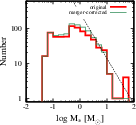
- IMF (Salpeter initial mass function): A mathematical description of the distribution of stellar masses at birth with a specific power-law slope. "The dashed line shows the Salpeter IMF with "
- Isotropic distribution: A distribution with no preferred direction. "mutual inclinations in triple systems follow an isotropic distribution"
- Keplerian velocity: The orbital speed expected from Kepler’s laws around a central mass. "We first estimate the disc radius by comparing the rotational velocity () to the Keplerian velocity ($v_\text{Kep$)"
- Kilonovae: Transient optical/infrared events powered by radioactive decay of heavy elements from neutron-star mergers. "binary neutron-star mergers power short gamma-ray bursts and kilonovae"
- Larson’s law: An empirical relation describing velocity dispersion scaling with size in molecular clouds. "following a power spectrum consistent with Larsonâs law, "
- Mass ratio (symmetric mass ratio): The ratio of the secondary’s mass to the primary’s mass in a binary. "Final symmetric mass ratio (, where is the most massive star in the binary)"
- Merger-corrected sample: A reconstructed dataset treating numerical mergers as surviving tight binaries to assess biases. "we construct an alternative "merger-corrected" stellar sample"
- Moment-of-inertia tensor: A tensor quantifying mass distribution relative to an axis, used to characterize shapes. "We then diagonalize the moment-of-inertia tensor "
- Mutual inclination: The angle between the orbital planes in a multi-body system. "mutual inclinations in triple systems follow an isotropic distribution"
- Nucleosynthetic yields: Elements produced by stars and expelled into the interstellar medium. "They drive chemical enrichment through nucleosynthetic yields from stellar winds and supernovae"
- OB stars: Massive, hot, luminous stars of spectral types O and B. "identified binary and higher-order systems in a massive protocluster expected to form OB stars."
- Pericentric distance: The minimum distance between two bodies on an eccentric orbit (the pericenter). "the typical pericentric distance during the first close passage is on the order of several hundred au"
- Pericentric passage: The event when an orbiting body reaches its closest approach to its companion. "which marks the first pericentric passage."
- Photoelectric heating: Gas heating via ejection of electrons from dust grains by ultraviolet photons. "The radiative processes considered include hydrogen photoionization and the associated photoheating, molecular hydrogen dissociation, photoelectric heating, and dust heating."
- Photoevaporation: Removal of gas due to heating and escape driven by radiation. "external irradiation from nearby massive stars photoevaporates the circumbinary disc"
- Photoionization: Ionization of atoms or molecules by absorption of photons. "The radiative processes considered include hydrogen photoionization and the associated photoheating"
- Protocluster: A forming, embedded stellar cluster in an early evolutionary stage. "identified binary and higher-order systems in a massive protocluster expected to form OB stars."
- Protostar: A young, still-forming star accreting material from its surroundings. "Figure~\ref{fig:overall} shows the projected density distribution of the simulated cloud at time Myr after the formation of the first protostar"
- Ray tracing (RSPH): A method for propagating radiation along rays through a medium; RSPH is a specific implementation. "The rates of photoionization, molecular dissociation, and photoelectric heating are computed using the ray-tracing scheme RSPH"
- r-process nucleosynthesis: Rapid neutron-capture process producing heavy elements in astrophysical sites. "provide one major origin of -process nucleosynthesis"
- Sink particle: A numerical representation of a forming star that can accrete gas and participate in dynamics. "A sink particle is inserted once the gas density exceeds $2 \times 10^{15}~\mathrm{cm^{-3}$."
- Smooth-particle hydrodynamics (SPH): A Lagrangian method for simulating fluids using particles. "The star formation process is followed by using the smooth-particle hydrodynamic (SPH) simulation code, {\tt Gadget3}"
- Solar metallicity: A chemical composition similar to that of the Sun, used as a reference for simulations. "We will focus exclusively on the simulation at Solar metallicity."
- Star-cluster formation simulation: A computational model following the birth and evolution of a stellar cluster. "using the star-cluster formation simulation of Chon et al. (2024), which forms a stellar cluster"
- Tertiary: A third star bound to a binary, forming a triple system. "If the binary has a tertiary companion, its separation is shown as a solid green line."
- Tidal interaction: Gravitational forces between extended bodies or discs that redistribute energy and angular momentum. "Tidal interaction is expected to play a significant role"
- Transonic turbulence: Turbulent motions with velocities comparable to the sound speed. "we impose a transonic turbulence with a velocity dispersion "
- Type-I migration: Rapid inward migration of low-mass bodies due to linear disc–planet interactions. "which is similar to ``Type-I migration''"
- Ultra-violet (UV) and far-UV photons: High-energy photons capable of heating, ionizing, and dissociating gas. "the radiation transfer of the ultra-violed (UV) and far-UV photons using ray-tracing method."
- Velocity dispersion: The spread of velocities in a system, often indicating turbulent or thermal motions. "with a velocity dispersion "
- X-ray binaries: Systems where a compact object accretes from a companion, emitting X-rays. "including X-ray binaries and systems detectable by Gaia."
Practical Applications
Immediate Applications
The following applications can be deployed now by leveraging the paper’s findings, simulation methodology, and analysis workflow. Each item lists sectors, potential tools/workflows, and key assumptions/dependencies.
Academia and Observational Astronomy
- Targeted ALMA/ngVLA campaigns to detect circumbinary discs around massive protostars
- What: Prioritize high-resolution interferometric imaging of embedded massive protostars to identify circumbinary discs and spiral arms, and to measure disc radii and thickness (h/r), testing the result that sub-10 au binaries require a circumbinary-disc phase.
- Sectors: Astronomy (observatories, survey design)
- Tools/Workflows:
- Observational pipelines to derive v_rot/v_Kep radial profiles from spectral-line data cubes and infer disc radii using the v_rot/v_Kep ≳ 0.7 criterion.
- Multi-epoch ALMA follow-up to measure accelerating orbital motion during rapid early-time hardening.
- Assumptions/Dependencies: Requires long-baseline sensitivity and good uv-coverage; interpretation assumes gas kinematics are not dominated by strong outflows (jets/winds not modeled in the simulation).
- Early-time multiplicity and age tests in OB associations
- What: Combine cluster ages with radial-velocity dispersion and multiplicity statistics to test 0.1 Myr hardening timescales, coeval formation of companions, and bimodal separation distributions.
- Sectors: Astronomy (stellar clusters), Education (graduate labs)
- Tools/Workflows: Multi-epoch spectroscopy (e.g., VLT/Keck), Gaia DR3/DR4 astrometry for acceleration, Bayesian hierarchical models linking age and RV dispersion.
- Assumptions/Dependencies: Cluster ages must be well constrained; selection effects in RV and astrometry carefully modeled.
- Gaia-based search strategies for tight massive binaries and hierarchies
- What: Prioritize astrometric acceleration searches for OB stars in young clusters, using predictions of isotropic mutual inclinations and rapid early hardening.
- Sectors: Astronomy (Gaia exploitation)
- Tools/Workflows: Cross-matching Gaia accelerations with ALMA disc detections; eccentricity and inclination inference combining astrometry + RV.
- Assumptions/Dependencies: Sensitivity limits for bright/embedded sources; crowding and extinction in young regions.
- X-ray binary progenitor identification in embedded regions
- What: Use the paper’s finding of frequent early mergers and extreme mass ratios (q < 0.1) to flag systems likely to evolve into HMXBs/LMXBs.
- Sectors: High-energy astrophysics
- Tools/Workflows: Joint ALMA + Chandra/eROSITA target lists in massive protoclusters; population-level priors for extreme-q systems.
- Assumptions/Dependencies: Mapping from early-time stellar mergers to compact-object binaries depends on subsequent stellar/binary evolution prescriptions.
Computational Astrophysics and Software
- Deployable post-processing pipeline for binary identification and formation-channel classification
- What: Package the paper’s analysis workflow (gravitationally bound-pair reduction; FoF with adaptive linking lengths tied to SPH smoothing lengths; inertia-tensor morphology classification; v_rot/v_Kep disc definition) as an open-source toolkit for SPH/AMR simulations.
- Sectors: Software for astrophysical simulations
- Tools/Workflows:
- Python/C++ modules for: bound-structure reduction, formation-time progenitor-cloud extraction, ellipsoid eigen-analysis, disc-radius inference.
- Integration with yt/Arepo/Gadget/Phantom outputs.
- Assumptions/Dependencies: Calibration of thresholds (e.g., morphology ratios, v_rot/v_Kep = 0.7) may need tuning across codes/resolutions.
- Synthetic observation generator for circumbinary-disc diagnostics
- What: Produce mock continuum + line cubes from simulations to train observers/ML classifiers to recognize circumbinary discs and spiral torques.
- Sectors: Software, ML in astronomy
- Tools/Workflows: RADMC-3D/Polaris pipelines; labeled training sets keyed to formation channel and migration phase.
- Assumptions/Dependencies: Radiative transfer fidelity; mapping turbulence statistics from simulations to observed noise/systematics.
- Update priors in binary population-synthesis codes
- What: Incorporate immediate priors for initial orbital separations (including strong early hardening), isotropic mutual inclinations for triples, and a high early-merger incidence for M > 2 Msun.
- Sectors: Gravitational-wave astrophysics, stellar evolution modeling
- Tools/Workflows: Modules for COMPAS/StarTrack/BSE to add a disc-driven migration stage (<0.1 Myr) and a circumbinary requirement for sub-10 au binaries.
- Assumptions/Dependencies: Quantitative migration efficiencies may vary with feedback and environment not included (jets/winds).
Policy, Strategy, and Infrastructure
- Telescope time allocation emphasizing embedded, high-resolution studies of massive multiplicity
- What: Allocate ALMA/VLA/ngVLA time to image early circumbinary phases; prioritize young, massive protoclusters and hierarchical triples.
- Sectors: Observatory policy, program committees
- Tools/Workflows: Coordinated multi-facility proposals (ALMA + Gaia + RV); standardized proposal language citing required angular/velocity resolution and cadence.
- Assumptions/Dependencies: Competing priorities; weather and scheduling constraints.
- Data standards for simulation outputs enabling cross-team comparability
- What: Encourage community formats for sink-particle metadata (accretion history, mergers, radiative outputs) and snapshot cadence to reproduce formation-channel and migration analyses.
- Sectors: Research infrastructure, data policy
- Tools/Workflows: HDF5 schemas; community repositories (e.g., ASCL/Zenodo).
- Assumptions/Dependencies: Community adoption and maintenance.
Education and Outreach
- Course modules and visualization assets on massive-binary formation
- What: Use snapshots and evolutionary sequences (fragmentation modes, disc migration, circumbinary phase) in advanced undergraduate/graduate curricula and planetarium programs.
- Sectors: Education, public outreach
- Tools/Workflows: Interactive notebooks (yt + Plotly) to reproduce FoF/morphology classification; VR-ready 3D renderings of discs and filaments.
- Assumptions/Dependencies: Access to derived or sample simulation data; licensing for public use.
Long-Term Applications
These applications require further validation, scaling, or development—e.g., broader parameter exploration, additional physics (jets/winds/SNe), or next-generation facilities.
Astronomy and Gravitational-Wave Astrophysics
- Predictive population models for compact-object binaries informed by early disc-driven migration
- What: Revise BBH/BNS/BHNS formation channels and rates by integrating sub-10 au circumbinary requirements and early-time mergers producing extreme mass ratios; propagate to GW detection forecasts (current and 3G detectors).
- Sectors: GW astronomy, stellar evolution, chemical evolution
- Tools/Workflows: Coupled star-cluster + binary evolution pipelines; joint inference with LIGO–Virgo–KAGRA catalogs and EM counterparts (kilonovae/XRBs).
- Assumptions/Dependencies: Requires simulations spanning metallicity, feedback, cluster masses, and longer times to compact-object formation; sensitivity to subgrid prescriptions.
- Galaxy-scale feedback models incorporating massive multiplicity
- What: Embed multiplicity-dependent radiative/mechanical feedback and merger-driven mass growth into subgrid models in galaxy simulations (e.g., FIRE/TNG), affecting ionizing photon budgets and SN timing.
- Sectors: Cosmological simulations, reionization studies
- Tools/Workflows: New subgrid recipes for coeval binaries/triples, isotropic inclinations, and early hardening; calibration against ALMA/JWST observations of star-forming regions.
- Assumptions/Dependencies: Extrapolation from a single-cloud initial condition; missing feedback channels in the current simulation.
- Unified inference of triple-system architectures and inclinations
- What: Develop joint astrometry+RV+imaging inference frameworks to recover isotropic mutual inclination distributions and test few-body/turbulent assembly predictions.
- Sectors: Observational methodology
- Tools/Workflows: Probabilistic dynamical modeling for hierarchical triples; large-sample analyses in OB associations.
- Assumptions/Dependencies: Requires next-gen catalogs (Gaia-NIR, ELT interferometry) to resolve multiplicity in embedded regions.
Computational Methods and Cross-Domain Analytics
- Generalized 3D morphology and kinematics classifiers for complex media
- What: Mature the inertia-tensor + adaptive FoF + rotational support (v_rot/v_Kep) methodology into a domain-agnostic toolkit for structure identification in noisy 3D fields (applicable to other simulation/data-heavy sciences).
- Sectors: Software, data science (potentially materials science, geophysics)
- Tools/Workflows: Library with pluggable physics modules (e.g., gravity vs. other potentials); benchmarking on public datasets.
- Assumptions/Dependencies: Requires adaptation beyond astrophysical assumptions (Keplerian rotation analogs).
- Exascale workflows for ultra–high-cadence snapshot analysis
- What: Standardize scalable snapshot-parsing and event-detection (mergers, captures, hardenings) across 104–105 outputs, enabling near-real-time “simulation observatories.”
- Sectors: HPC, computational science
- Tools/Workflows: Task-parallel analysis (Dask/Ray), I/O-optimized formats, in-situ analytics.
- Assumptions/Dependencies: Access to exascale resources; code–analysis co-design.
Survey and Facility Strategy
- Design inputs for next-generation facilities (ngVLA, ELT, 3G GW detectors)
- What: Use the predicted timescales, separations, and inclination distributions to set angular resolution, cadence, and sensitivity requirements for resolving circumbinary discs and early hardening in massive protostars.
- Sectors: Facility planning, policy
- Tools/Workflows: Simulation-driven requirement studies; “design reference science cases” incorporating disc-driven migration.
- Assumptions/Dependencies: Robustness of predictions across metallicity/environments; incorporation of additional feedback physics.
Public Engagement and Citizen Science
- Citizen-science classification of disc morphologies and formation channels
- What: With synthetic training sets, crowdsource identification of spiral structure, gaps, and disc–binary interaction signatures in ALMA/JWST images.
- Sectors: Outreach, data-driven discovery
- Tools/Workflows: Zooniverse-style platforms; ML active learning loops to prioritize uncertain cases.
- Assumptions/Dependencies: Requires large labeled datasets and careful de-biasing.
Notes on Key Assumptions and Dependencies
- Physics coverage: The base simulation includes radiative feedback but omits jets/winds/SNe; sink-based mergers occur at ≳1 au scales, whereas real stellar radii are ≪1 au—merger rates and survival of ultra-tight binaries may differ.
- Initial conditions and scope: Results derived from a single 6,300 Msun cloud at Solar metallicity; generalization to other metallicities, cloud masses, and turbulent spectra requires further runs.
- Resolution and cadence: ≈1 au spatial resolution and ≈180 yr temporal cadence are strengths but still limit sub-au processes and rapid transient interactions.
- Post-processing thresholds: Morphology classification (axis ratios) and disc identification (v_rot/v_Kep ≥ 0.7) are pragmatic and may require recalibration for different datasets/codes.
- Observational systematics: Embedded sources suffer from extinction, confusion, and inclination biases; ALMA/gaia/jwst capabilities set detection limits impacting feasibility and completeness.
Collections
Sign up for free to add this paper to one or more collections.

