- The paper demonstrates yield and hotspot temperature enhancements through applied B-fields over 5–70 T in multiple ignition-class ICF designs.
- It employs fully-integrated 2D rad-MHD simulations with the Lasnex code to capture key effects like suppressed thermal conductivity and enhanced alpha deposition.
- Results show that magnetization benefits vary with design, offering up to 12× yield increases for low-mix targets while high self-heated designs may experience performance degradation.
Integrated Radiation-Magneto-Hydrodynamic Simulations of Magnetized Burning Plasmas
Introduction and Motivation
This paper presents an integrated computational study of magnetized high-gain inertial confinement fusion (ICF) implosions, focusing on ignition-class designs driven by hohlraums on the NIF. The analysis is motivated by the potential of imposed magnetic fields to alleviate hotspot energy losses, increase alpha particle energy deposition, and thereby enhance yield and hotspot temperature. Prior work on the OMEGA laser and Sandia's Z-machine demonstrated field compression and yield enhancement under magnetization, but only in sub-ignition and non-layered configurations. Here, fully-integrated 2D radiation-magnetohydrodynamic (rad-MHD) simulations, using the Lasnex code standard ICF model, interrogate the parameter space of field strengths (up to 100 T initial B-fields) in both current and future/high-potential target designs. The study targets both the response of recent experimental shots—BigFoot (N180128), HYBRID-E (N210808, N221204)—and two advanced designs: Enhanced Yield Capability (EYC, 3 MJ drive) and Pushered Single Shell (PSS). The aim is to quantitatively resolve the scaling of yield, burn-averaged ion temperature, and hydrodynamic shape with seed field, as well as to delineate mechanisms responsible for performance enhancement or degradation in magnetized ICF.
Physical Mechanisms and Simulation Methodology
Magnetizing a hohlraum-driven ICF target modifies central plasma transport primarily through suppression of transverse electron thermal conductivity and alteration of alpha deposition. The effect is characterized by electron Hall parameter He=ωceτei≳1, causing thermal flux to be strongly anisotropic with respect to the field. Applied fields of 5–80 T (axial), easily attained in experiments and further compressed under implosion, can reach stagnation values ∼30–100 kT in the core. Key consequences are:
- Hotspot Magnetoinsulation: Cross-field thermal conductivity is reduced as κ⊥/κ∥∼He−2. This leads to localized heating, increasing thermal pressure and boosting nuclear reaction rates.
- Alpha Magnetization: Confined alpha particle orbits (small gyro-radius relative to hot spot scale) yield augmented local energy deposition before leaving the burning core, amplifying self-heating and fuel burn.
- Hydrodynamic Effects: The application of high-field magnetization can drive hydrodynamic asymmetries (notably, p2/p0 and p4/p0 modes), affecting hotspot convergence and risk of polar jetting/“cap” burn-through.
Simulations are conducted with Lasnex in RZ-2D, fully integrating both hohlraum and capsule. The symmetrized drive (“quasi-1D” x-ray coupling equalization) provides an upper bound for performance absent drive-induced asymmetries, allowing isolation of MHD effects. The model includes NLTE atomic physics, full CBET modeling, detailed hohlraum and hardware geometry, and a buoyancy-drag hydrodynamic mix model for shape/yield calibration to experiments. Tuning is performed via the ANTS Bayesian framework, matching shock timing, bangtime, and low-mode shapes to measured NIF shot diagnostics.
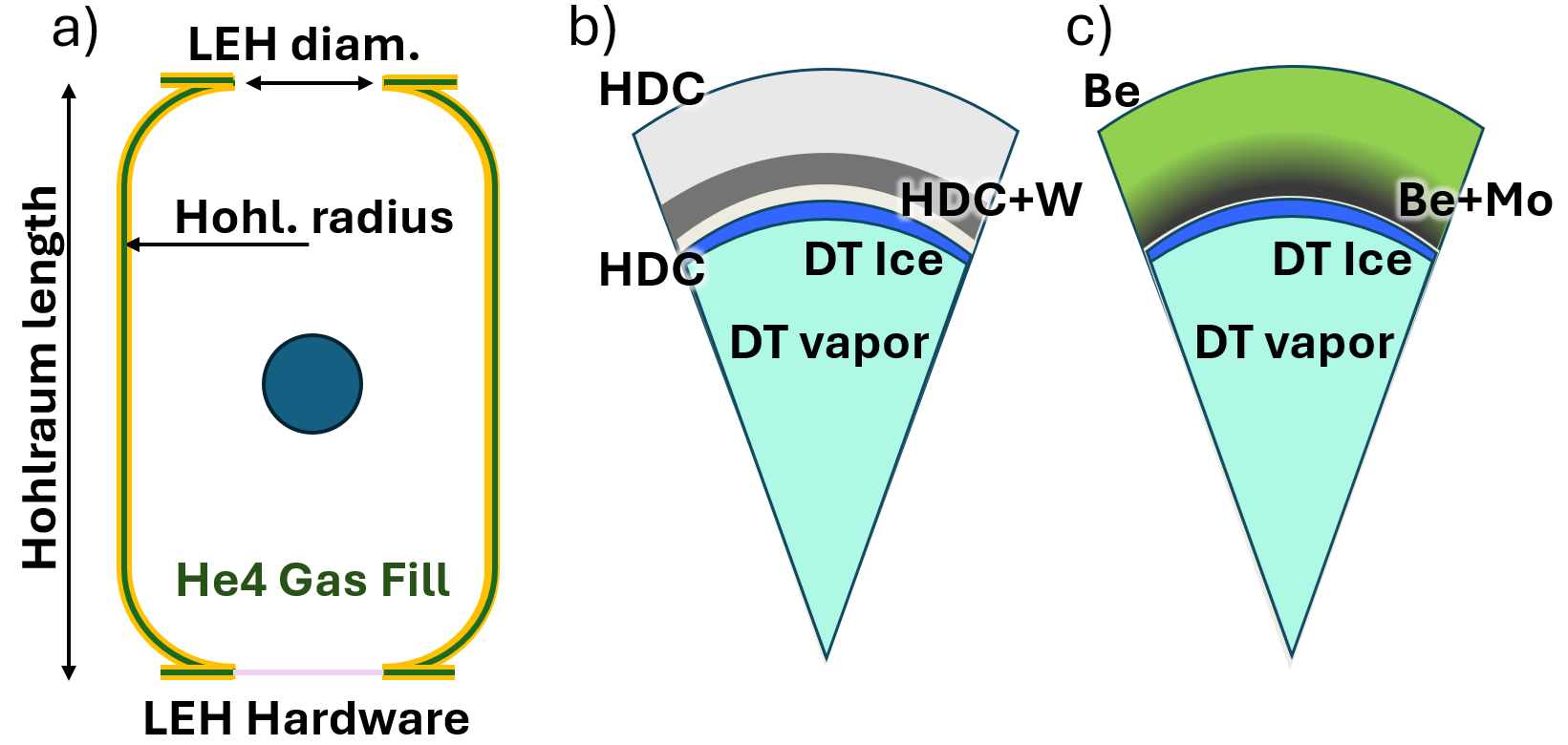
Figure 1: Visualizations of hohlraum and capsule geometries for studied NIF designs.
Target Selection and Experimental Benchmarking
The study scrutinizes five designs:
- N180128 (BigFoot): ~1.8 MJ, HDC-W ablator; circa 2018, non-igniting but highest historical yield at the time.
- N210808 (HYBRID-E): ~1.89 MJ; first to exceed 1 MJ yield and all classical Lawson criteria.
- N221204 (HYBRID-E): ~2.05 MJ; first to surpass breakeven (Q>1), achieving 3.2 MJ output.
- EYC: A projected 3 MJ-class design engineered for further yield increase.
- PSS: Beryllium/Mo/Ar ablator for “Pushered” single-shell with unique graded-density profiles, optimized for high ρR and low temperature.
The baseline (unmagnetized) simulation for each design is rigorously tuned to experimental neutron, x-ray, and shape data. This ensures that subsequent magnetized scaling is physically meaningful.
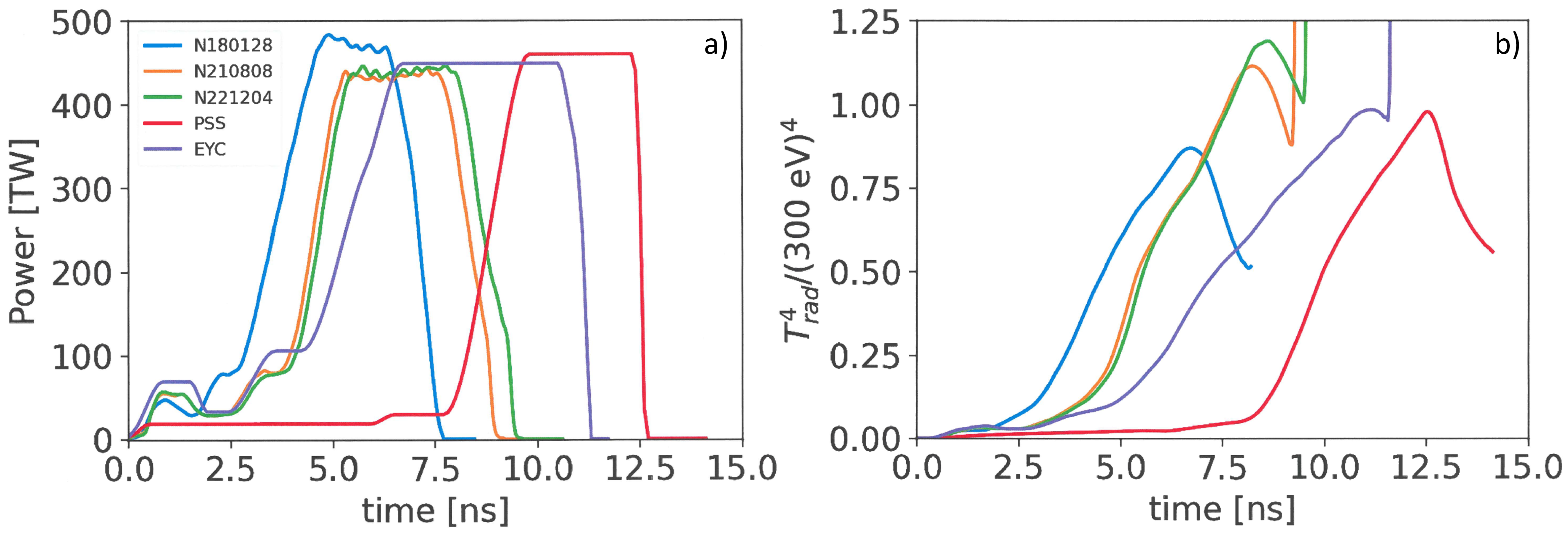
Figure 2: Laser drive profiles and resulting hohlraum radiation temperature histories for all designs.
Effects of Magnetization on Historical and Future Designs
Modest field application (up to 30 T) yields a maximum 2.1× gain in yield and a 50% increase in burn-averaged Ti, with diminishing returns as MHD-induced asymmetry degrades the shape at higher B. Magnetization primarily increases pole hotspot temperature, with the main limitation being hydrodynamic pressure reduction on the equator, as evidenced in density and temperature profiles at bangtime.
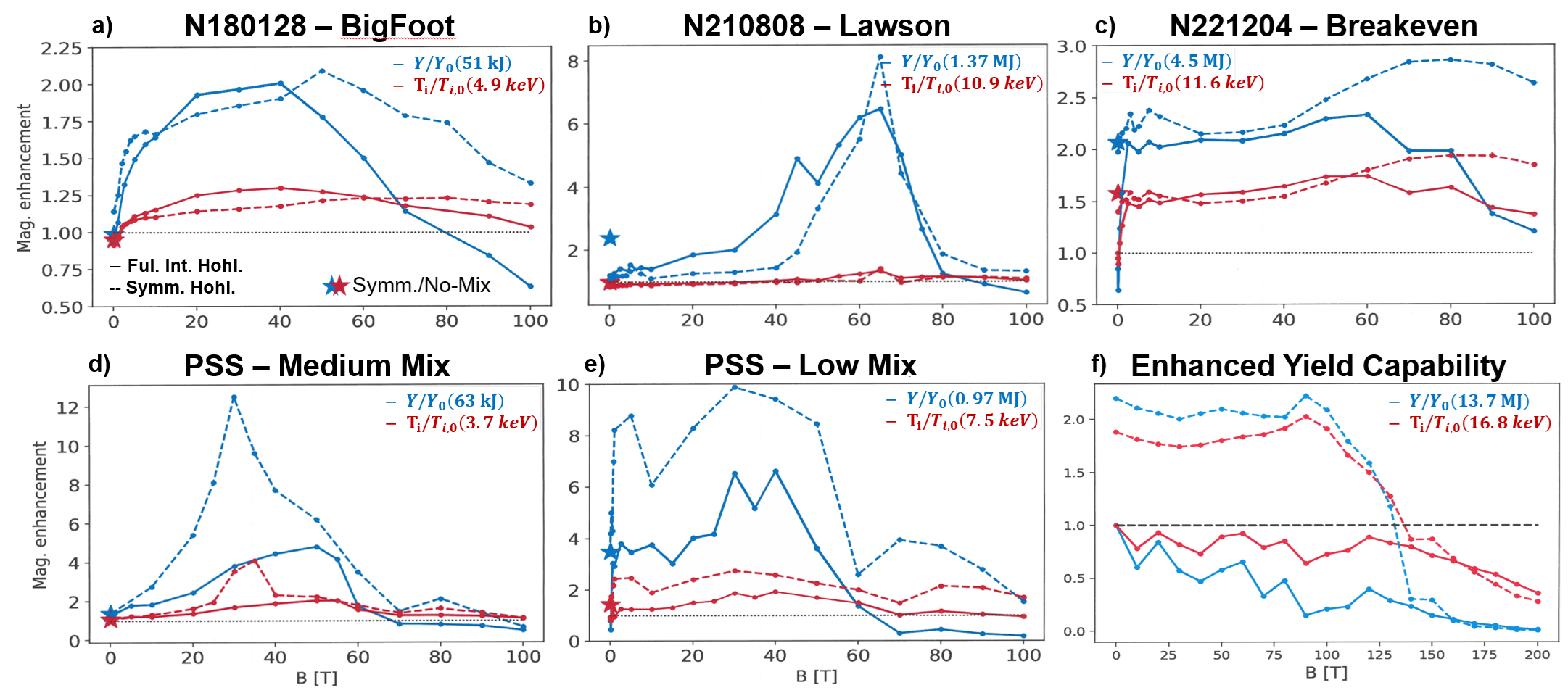
Figure 3: Yield and ion temperature enhancement as a function of applied B-field for multiple designs and mix scenarios.
N210808 (HYBRID-E) – First Ignition-Class
A striking 6–8× enhancement in yield is observed at 65 T, with the hotspot average ion temperature rising by 50%. The asymmetric case even outperforms the symmetrized drive for moderately strong fields, indicating that field-induced shape evolution can be beneficial under certain drive conditions. However, at very high B, shape degradation (cap break-out, equatorial resistance) becomes dominant, capping attainable yield increases.
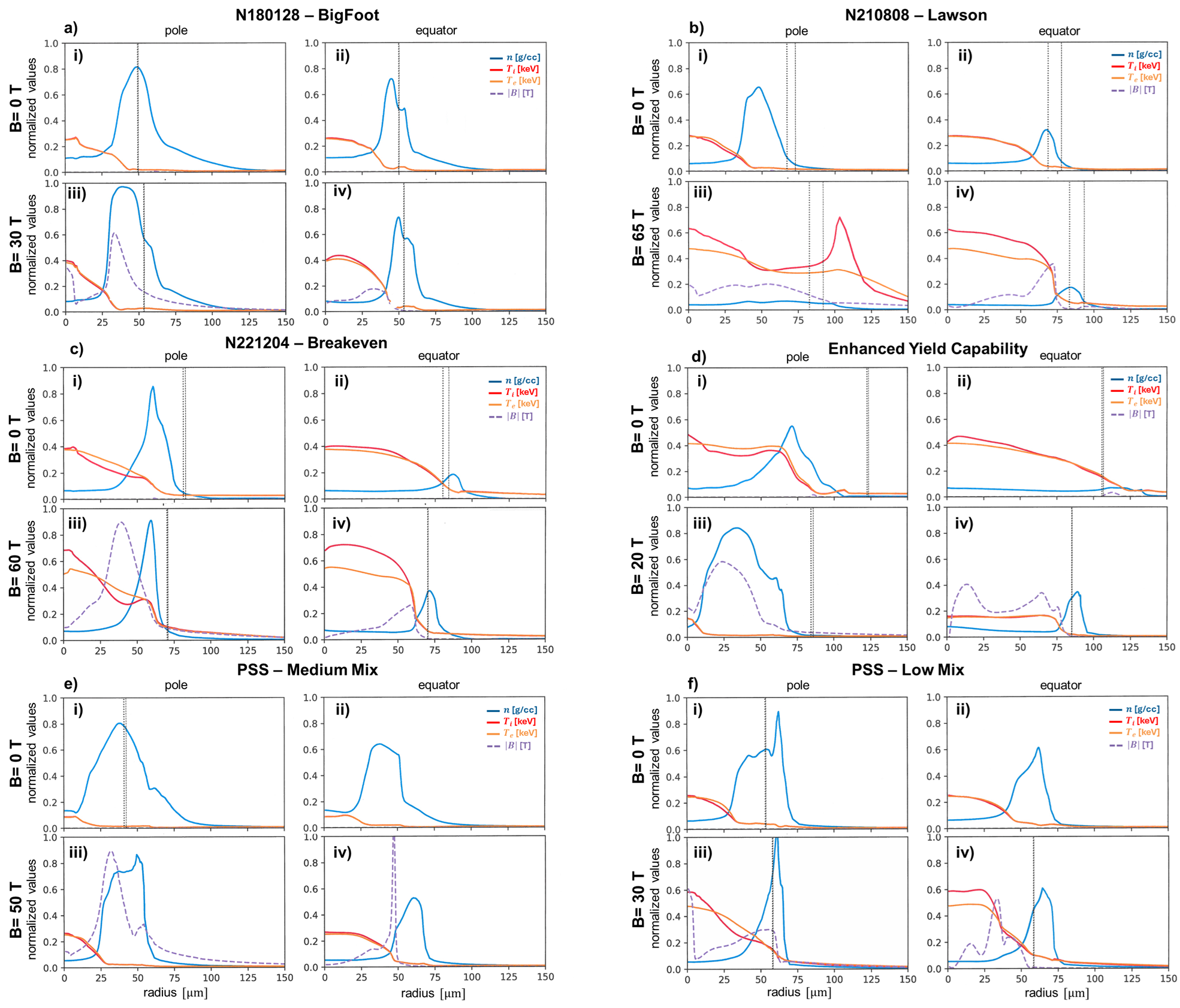
Figure 4: Density and temperature lineouts at key spatial locations (pole/equator) for unmagnetized and magnetized N210808 at bangtime.
N221204 (HYBRID-E) – First Breakeven
The N221204 design exhibits 2–3× yield enhancement at 50–70 T, but the relative improvement saturates more quickly and is less dramatic than for N210808. Interestingly, even fields as low as 5–10 T provide a significant (>1.5×) boost to yield, and the upgrade to 3 MJ EYC further reduces the efficacy of magnetization. This implies a correlation between baseline (unmagnetized) hotspot temperature and the marginal benefit of B-field application: when baseline Ti is already high, the bracketing cross-section for D-T fusion (∼ 50 keV) limits further self-heating benefit.
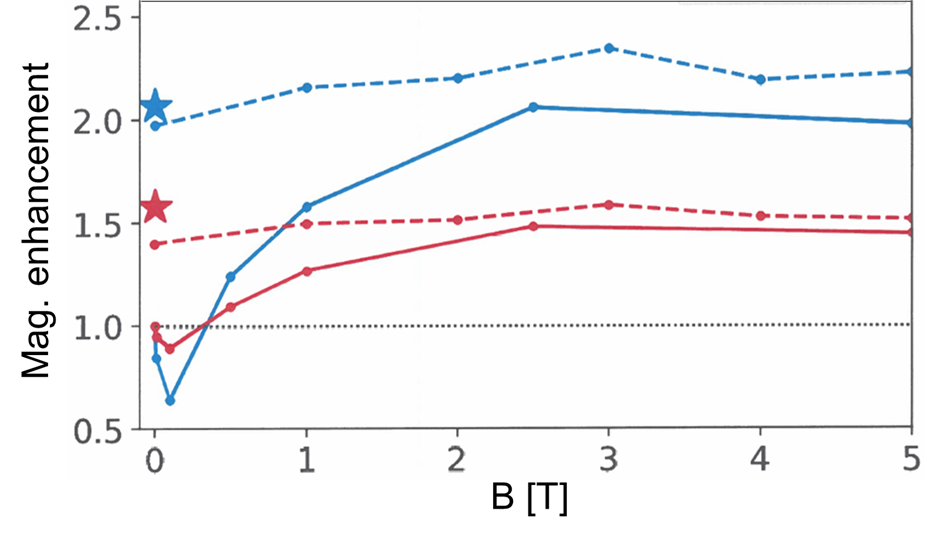
Figure 5: Low-field region: even 1–10 T seed fields markedly increase yield for low-mix PSS designs, implying prospects for permanent-magnet experiments.
Pushered Single Shell (PSS)
The PSS shows remarkable sensitivity to magnetization, especially for designs with minimal mix. Symmetrized and low-mix cases exhibit up to 10–12× yield enhancement at 30–50 T; even a 1 T field can double the yield. The amplified effect is attributable to the low baseline hotspot temperature (where suppressed losses have the strongest leverage) and the design’s intrinsically high ρR, which dramatically increases burn fraction under enhanced alpha deposition.
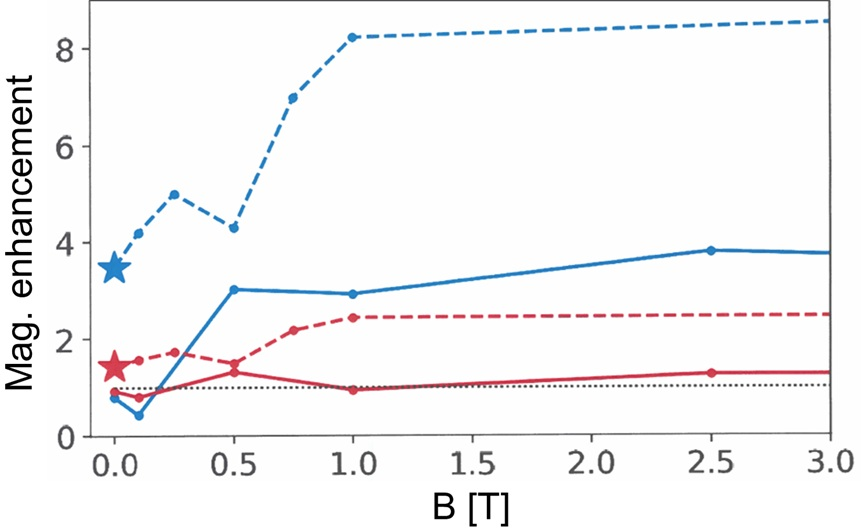
Figure 6: Yield and burn-averaged Ti as functions of seed field for PSS (low-mix).
Enhanced Yield Capability (EYC, 3 MJ)
For the EYC design, which enters a regime of already maximized self-heating, further application of external field does not yield positive results—in fact, yield is degraded with increasing B past a threshold; the design is robustly ignited already, and cross-field transport restriction leads to hydrodynamic instabilities rather than further yield increase. Only very specific B-field configurations or further optimization could potentially recover benefit.
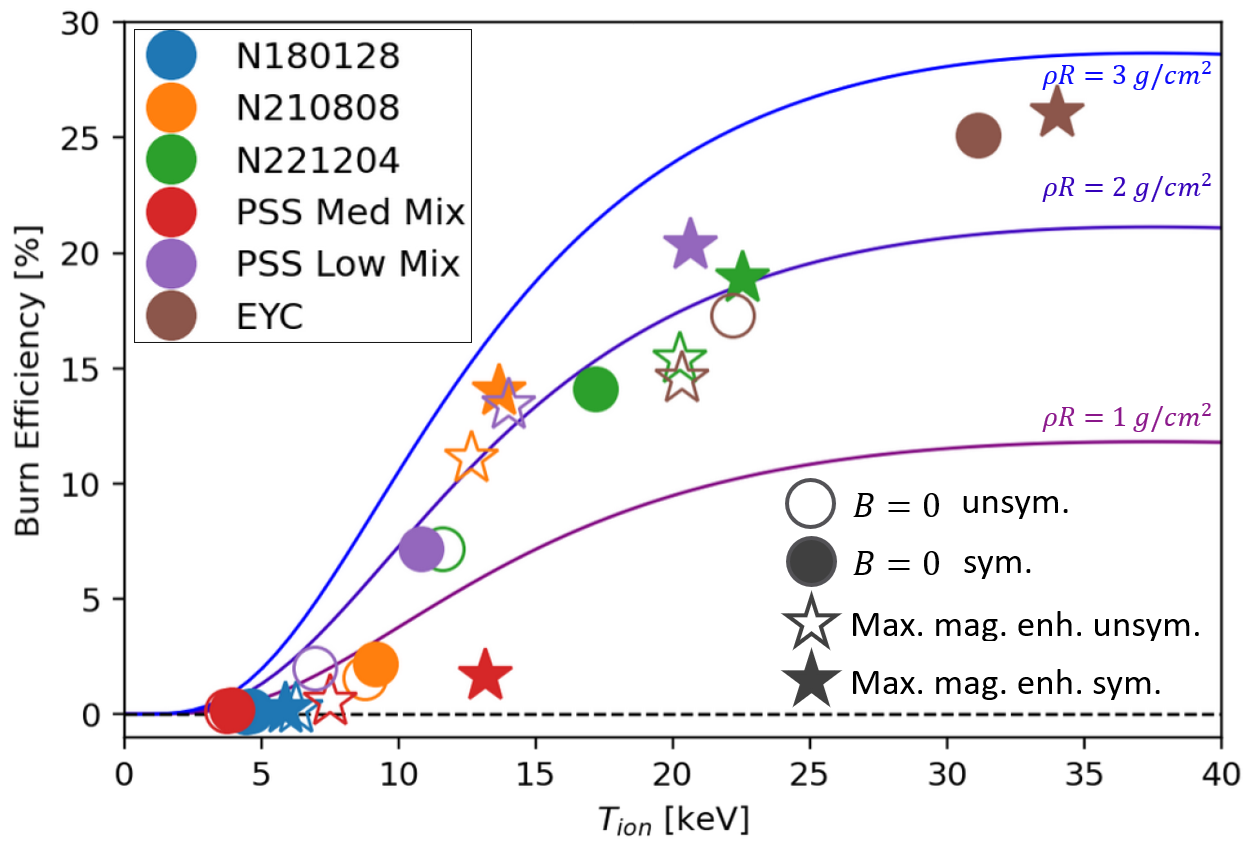
Figure 7: Burn fraction as a function of fuel areal density and peak ion temperature for all designs and applied B-fields, showing approach to theoretical limits.
Mechanisms, Instability, and Shape Effects
Hydrodynamic shape control remains a dominating uncertainty at high magnetization. Symmetrized runs clarify the upper limit for achievable gain by constraining drive-induced asymmetries, but real-world implosions invariably experience shape swings and residual kinetic energy. Significant attention is paid to the interplay between drive symmetry, Rayleigh-Taylor suppression, MHD-induced oblate/prolate configurations, and late-time cap formation followed by enhanced polar burn. Simulations show that magnetization can both mitigate and exacerbate instability, depending on configuration, with the optimal regime favoring moderate field strength (5–70 T).
Lineout analysis at bangtime reveals that the principal effect of external magnets is not only restriction of heat loss but also a strongly modified evolution of the ablator-ice interface, alpha confinement at the cap, and increased temperature disequilibration (evidence for strong ion shock heating).
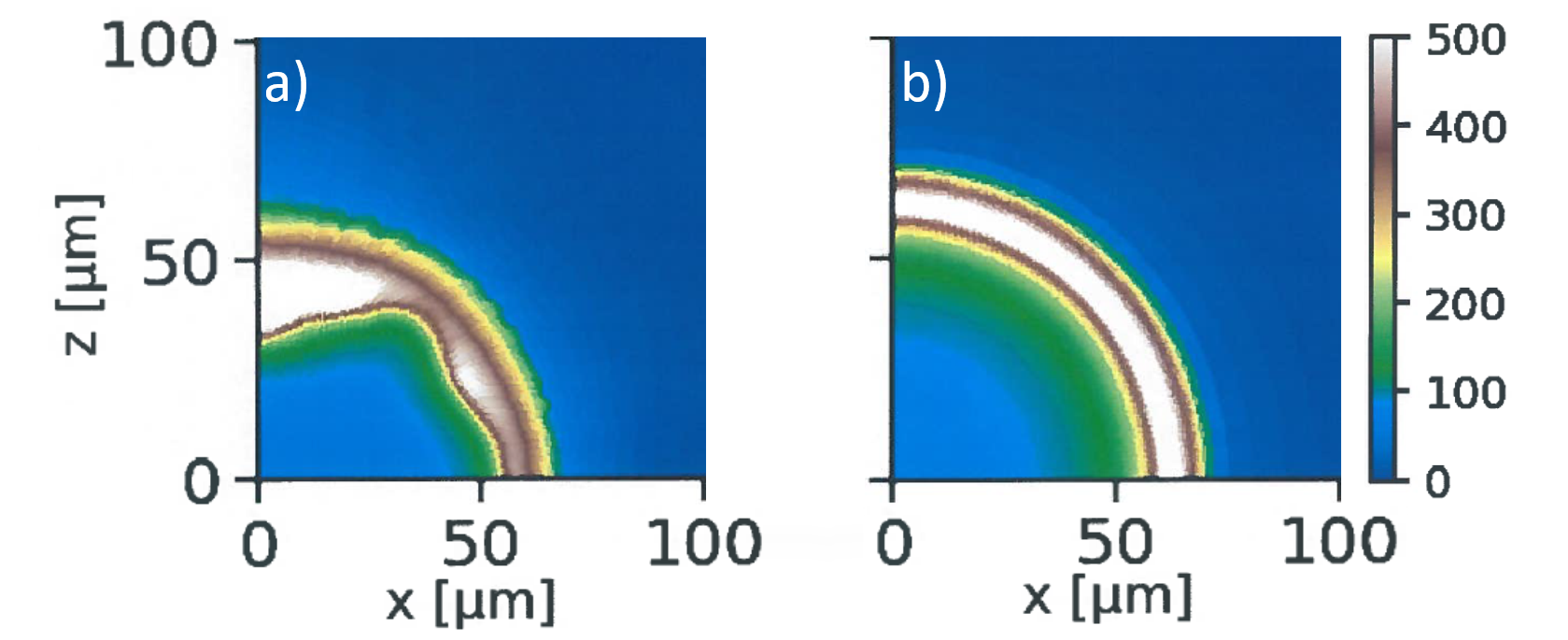
Figure 8: Comparison of unsymmetrized (a) and symmetrized (b) density cross-section for N210808, highlighting polar cap features induced/enhanced by MHD effects.
Practical and Theoretical Implications
Key quantitative outcomes:
- Yield enhancement of $2$–12× is achieved with 5–75 T axial fields, with optimal enhancement at 30–70 T for most designs.
- Even low fields (1–5 T) provide a nontrivial (1.5–3×) performance gain in appropriately designed targets, presenting a compelling case for experimental campaigns using permanent or low-cost smagnetic field configurations.
- Efficacy of magnetization is inversely correlated with baseline (unmagnetized) ignition margin: for already robustly burning designs (e.g., EYC), further heat confinement offers diminishing and even negative returns due to shape distortion and hydrodynamic limits—consistent with the physics of the DT reaction and self-heating equilibrium.
- For high-ρR, low-velocity designs (PSS), magnetization leverage is maximal, suggesting future facility upgrades and experiments should target this regime for maximum gain.
Advanced Design Recommendations and Future Directions
The study establishes that the maximal benefit from imposed B-fields is obtained in designs that are not yet fully self-heated, have high fuel areal density, and retain significant hydrodynamic integrity up to stagnation. Future advances are likely in:
- Optimization of initial field topology: non-axial (mirror/closed) geometries may further suppress cross-field loss and alpha leakage.
- Field-shimmed or fuel-geometrically graded targets: engineering fuel and ablator layer thickness spatially to exploit enhanced polar or equatorial heating under field-constrained conduction and alpha orbits.
- Numerical optimization and adjoint-based design: given the complexity and nonlinearity of the integrated system, high-efficiency surrogate optimization (e.g., Gaussian processes) and advanced tuning protocols are mandated.
Conclusion
This comprehensive integrated simulation study delineates the performance envelope of magnetized ignition-class ICF designs. Applied fields in the 5–70 T range provide substantial yield and temperature enhancement in today’s and near-term designs, particularly for capsules not yet robustly ignited in the unmagnetized state. For highly self-heated or asymmetry-sensitive regimes, the benefit of further magnetization is limited or negative without additional design response. The results advocate for a programmatic focus on low-to-moderate field experimental campaigns, aggressive development of high-ρR, low-velocity (and PSS-type) designs, and field/capsule co-optimization in next-generation target and facility planning.