Resummation of the C-Parameter Sudakov Shoulder Using Effective Field Theory
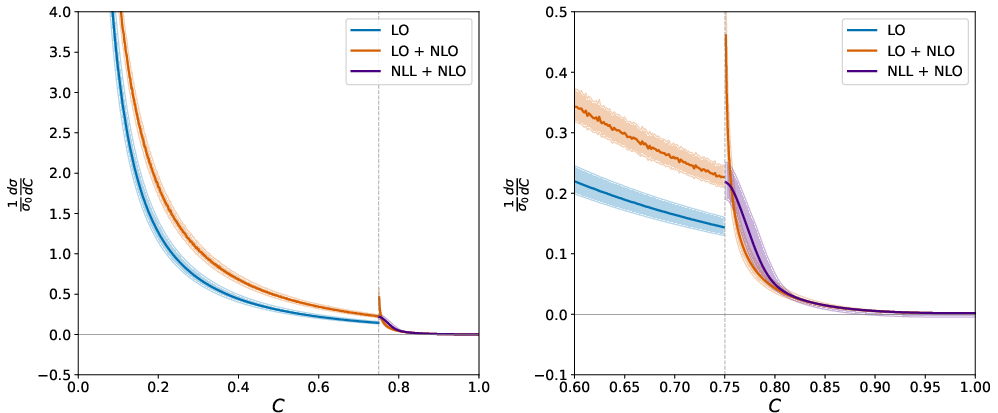
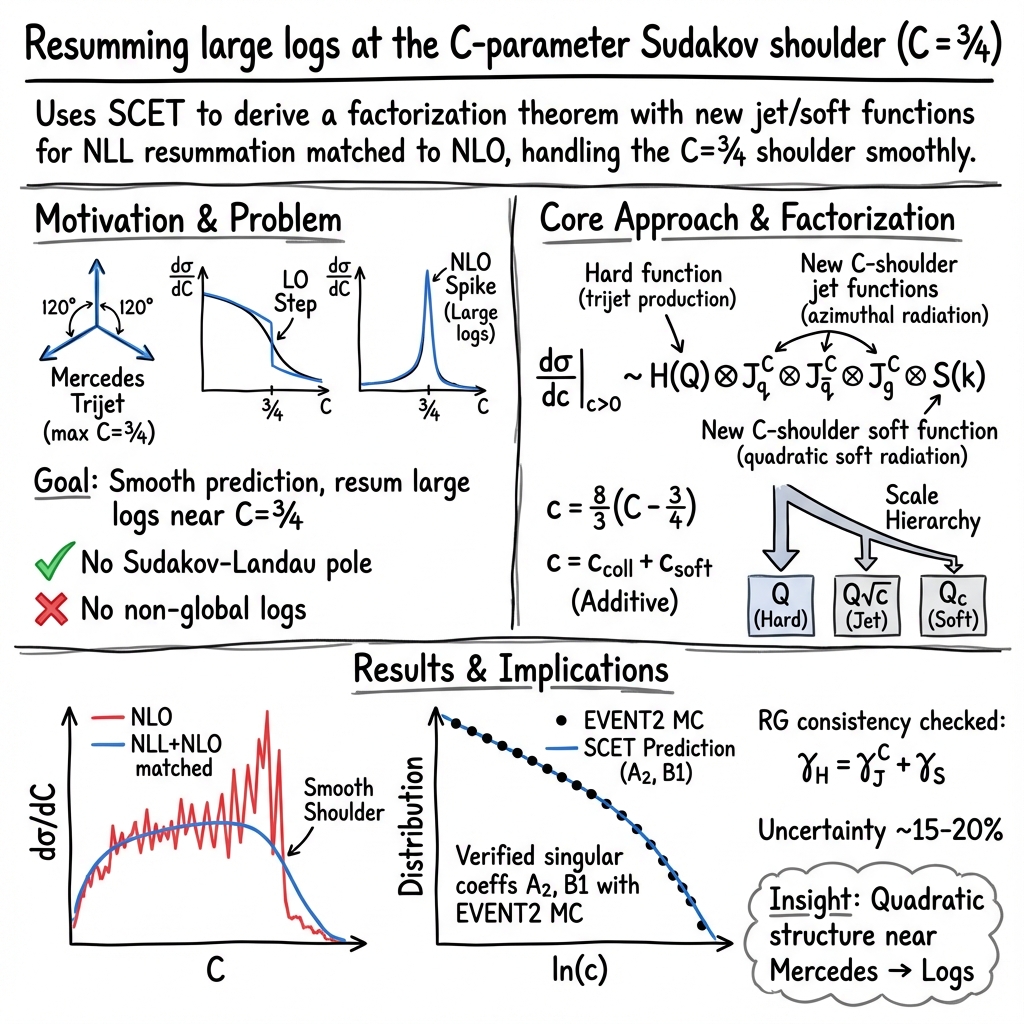
Abstract: The C-parameter distribution in annihilation exhibits a kinematic shoulder at , where three-parton final states reach their maximum and a fourth parton is required to exceed it. This boundary generates large logarithms that must be resummed. Using soft-collinear effective theory, we derive a factorization theorem involving new jet and soft functions specific to the C-parameter measurement, in which soft radiation contributes quadratically in transverse momentum. This quadratic structure explains the step discontinuity at leading order. We compute all ingredients at one loop, validate against Monte Carlo, and present matched NLL+NLO results. Unlike thrust and heavy jet mass, the C-parameter has no Sudakov--Landau pole, making momentum-space resummation straightforward. All calculations, numerical analysis, and manuscript preparation were performed by Claude, an AI assistant developed by Anthropic, working under physicist supervision.
Paper Prompts
Sign up for free to create and run prompts on this paper.
Top Community Prompts
Explain it Like I'm 14
What this paper is about
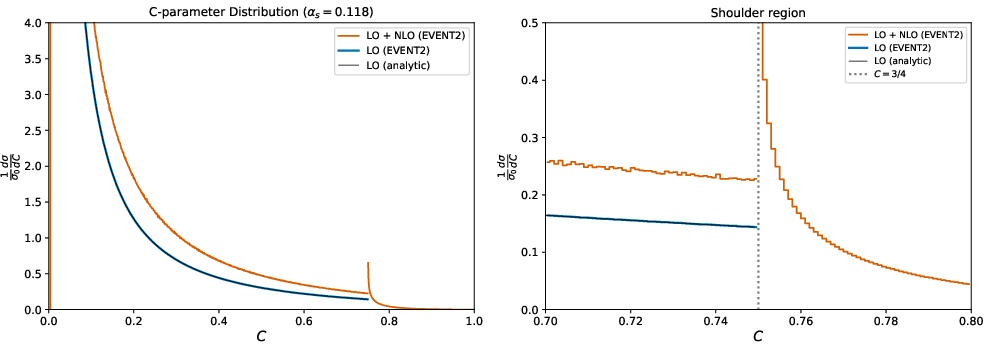
This paper studies a special “edge” in a graph that shows how particles fly apart after an electron and a positron collide. The graph uses something called the C-parameter, a number between 0 and 1 that tells you how spread out the particles are in space. There’s a sharp edge (called a Sudakov shoulder) at C = 3/4. With only three particles, you can reach C = 3/4 but not go beyond it; to get C > 3/4 you need at least a fourth particle. That sharp edge creates math problems (“big spikes”) in standard calculations. The authors explain why this happens and how to fix it using a powerful method called effective field theory. They also build new tools specific to the C-parameter and show that their predictions match computer simulations.
The main questions
- Why does the C-parameter graph have a sharp edge (a “shoulder”) at C = 3/4, and why do usual calculations blow up (spike) just above that point?
- Can we write the math in a clean way that separates the problem into simpler parts (hard, jet-like, and soft radiation), so we can “resum” (add up) the big corrections that cause the spike?
- What are the exact ingredients (new “jet” and “soft” functions) needed for the C-parameter, and do they work as expected?
- Can we combine the resummed result with standard calculations to get a smooth, accurate curve that matches data and simulations?
How the researchers approached it
Key ideas in simple terms
- Event shape: The C-parameter is a single number that tells you how the sprays of particles (jets) are arranged. Think of it as a “shape score” for the event.
- The sharp edge (Sudakov shoulder): At C = 3/4, three equally spaced jets (like a Mercedes logo with 120° between them) hit their limit. To go past it, you must add another particle. This creates a sudden change in the graph—like reaching the top step of a staircase and needing an extra boost to climb higher.
- Why the spike appears: Tiny, extra particles and splittings can push you just above the edge. The math for those tiny additions produces large “logarithms” (they’re just certain big terms) that pile up and make the curve blow up unless you treat them carefully.
- Soft and collinear radiation:
- Soft = very low energy particles.
- Collinear = particles that fly almost in the same direction.
- These are the main sources of the big spikes (big logarithms).
- Effective field theory (SCET): A “zoom lens” method. It separates the problem into:
- Hard part (the main three-jet punch at high energy),
- Jet parts (sprays of particles moving in three directions),
- Soft part (gentle, low-energy radiation).
- Each part is easier to handle, and then you put them back together.
- Factorization: Splitting the full calculation into a product (and convolution) of the hard, jet, and soft pieces. This makes the big logarithms appear in a controlled way so you can resum (sum) them to all orders.
- New jet and soft functions: For the C-parameter edge, the “soft” part is special: it depends on the square of how far a soft particle sticks out of the event plane (out-of-plane motion). That “quadratic” dependence is the heart of the C = 3/4 step. The authors define and compute the specific jet and soft functions that measure these effects.
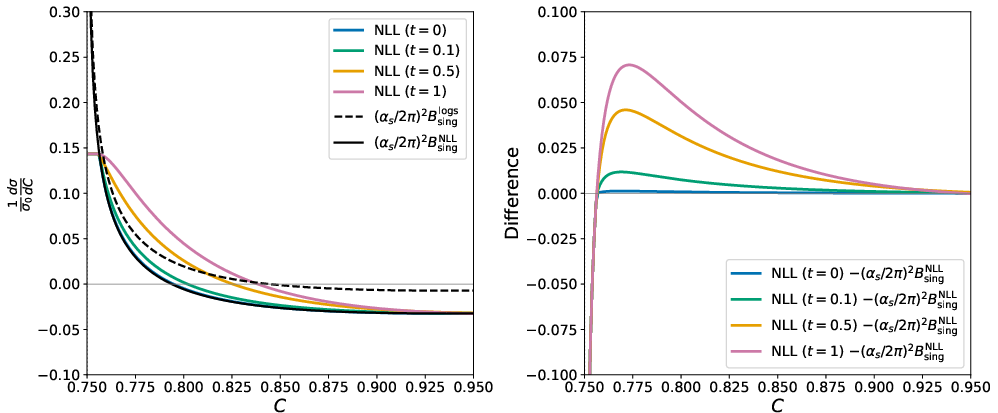
- Resummation + matching: Resummation tames the big spikes near the edge; matching combines the resummed result with normal next-order calculations so the whole curve is accurate both near and far from the edge.
What they found and why it matters
- A clean factorization formula for the C-parameter shoulder: They wrote down a precise way to split the problem into hard, jet, and soft parts, each with a natural energy scale. This shows exactly where the big logarithms come from and how to sum them.
- New building blocks for C-parameter: They defined and computed, at one loop (first quantum correction), the special jet and soft functions tailored to how the C-parameter “measures” out-of-plane motion. This explains the physics behind the step at C = 3/4:
- For thrust (a different event shape), the change near its edge is linear (like distance r).
- For the C-parameter, the change is quadratic (like r2).
- This difference is why thrust gently goes to zero at its shoulder, while the C-parameter has a flat step and then a spike at next order.
- No “Sudakov–Landau pole” problem: Some observables run into a nasty mathematical infinity when you try to resum in momentum space. The C-parameter avoids this because its contributions from the three jets and soft radiation simply add up. That makes the resummation straightforward and cleaner.
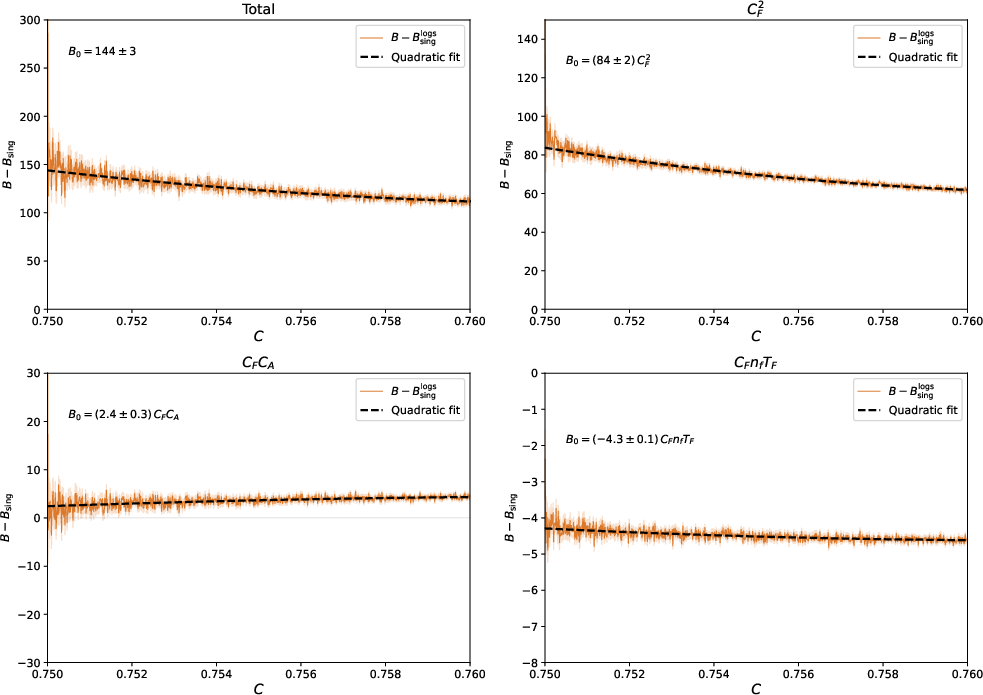
- Big terms confirmed: They showed the size of the largest logarithmic terms agrees with earlier expectations and depends on a specific color combination from QCD (this is a standard check in particle physics).
- Smooth, realistic predictions: By combining resummation (NLL accuracy) with next-order fixed calculations (NLO), they remove the unphysical spike just above C = 3/4 and get a smooth “shoulder.” They checked their results against a trusted computer program (EVENT2), and the agreement is good.
- Simpler than some other observables: Because the C-parameter is “global” (every particle counts), tricky extra logarithms (called non-global logs) don’t show up here at leading order. Also, the three jets contribute symmetrically, which reduces complications.
Why this is important
- Better precision in strong-force studies: Event shapes like the C-parameter are used to measure the strength of the strong force (the coupling αs). Getting the shoulder region right removes biases and makes those measurements more reliable.
- A clear method for tricky edges: The paper provides a roadmap—using SCET, factorization, and resummation—for handling sharp edges inside the allowed range of an observable, not just at its endpoints. That helps for other event shapes and future analyses.
- Practical simplicity for C-parameter: No special tricks are needed to avoid mathematical infinities. That makes it easier to implement accurate predictions directly in momentum space.
- Insight into the physics: The work explains in plain terms why the C-parameter behaves so differently from thrust at their shoulders: the C-parameter depends on the square of the out-of-plane motion. That single fact controls the step at leading order and the spike at the next order, and resummation turns the spike into a smooth curve.
In short, the paper turns a sharp, troublesome feature in the C-parameter distribution into a well-understood, smooth prediction. This strengthens the toolkit physicists use to test quantum chromodynamics (QCD) and to measure its key parameters with high precision.
Knowledge Gaps
Knowledge gaps, limitations, and open questions
Below is a single, consolidated list of what remains missing, uncertain, or unexplored in the paper, stated concretely to guide future work:
- Compute the new C-shoulder jet functions J_qC(m2, μ), J_gC(m2, μ) and the soft function S(k, μ) at two loops (including their constant terms and anomalous dimensions) to enable NNLL/N2LL accuracy and quantify the full NLO-to-NNLO singular structure above the shoulder.
- Provide an all-orders proof (beyond leading power) that non-global logarithms are absent in the shoulder factorization for the C-parameter, including multi-gluon webs and potential subleading-power effects.
- Analyze and quantify subleading-power corrections near the shoulder, including event-plane recoil/axis shifts induced by soft radiation, corrections to measurement additivity, and potential Glauber contributions.
- Develop a dedicated nonperturbative model (shape function) for the shoulder region consistent with the quadratic soft measurement k⊥²/k⁰, determine the leading power correction scaling, and assess whether a universal parameter (analogous to Ω₁ for thrust/C-parameter in the two-jet limit) exists here.
- Characterize the renormalon structure of the shoulder soft/jet functions and its impact on power corrections and scheme choices; determine if universality with two-jet event-shape power corrections survives in the shoulder regime.
- Extend the factorization and resummation to include massive final states and hadron-mass effects by using the eigenvalue definition of C (rather than the massless pair-sum), and derive how jet and soft measurements are modified for heavy flavors and realistic hadronization.
- Specify and validate the rapidity-regularization scheme (if needed) for the soft function with measurement 4∑k⊥²/k⁰, and demonstrate explicitly the absence or cancellation of rapidity divergences at one and two loops.
- Incorporate hard-function corrections beyond the symmetric Mercedes point (virtual and real hard fluctuations) into the factorization, and quantify O(c) corrections to the use of A(3/4) extracted at Born level.
- Test the robustness of the momentum-space resummation at higher orders (NNLL/N2LL), checking for potential spurious singularities or numerical instabilities that might appear even without a Sudakov–Landau pole.
- Validate the resummed predictions against state-of-the-art fixed-order (NNLO/N3LO if available) and perform detailed comparisons to LEP data near C ≈ 3/4, accounting for binning/unfolding, to assess α_s sensitivity and practical phenomenological utility in the shoulder region.
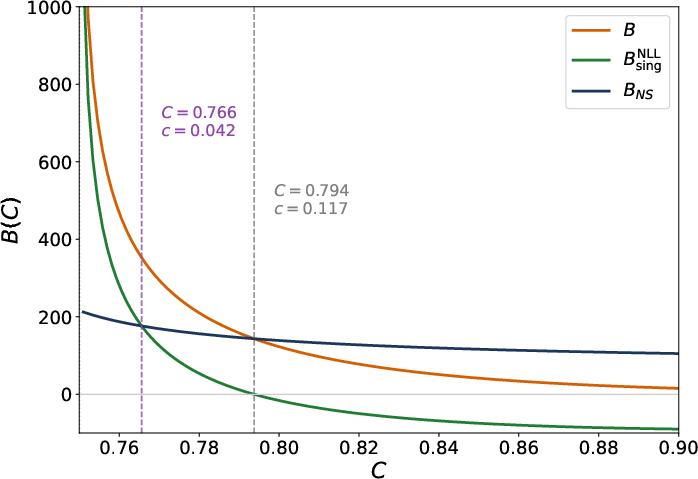
- Systematically study the impact of profile-scale choices and matching prescriptions (definition and construction of σ_NS(c)) on central values and uncertainties, and provide a transparent, reproducible uncertainty assessment across c → 0⁺ and finite c.
- Investigate azimuthal/spin correlations in multi-emission collinear radiation to verify that the sin²φ weighting embedded in the jet measurement operator exponentiates as assumed and does not induce factorization-breaking effects beyond single emission.
- Explore joint or unified resummation that interpolates smoothly between the small-C two-jet region and the shoulder region near C = 3/4, ensuring consistent treatment of logarithms across the full C range.
- Clarify the color-structure dependence of the soft anomalous dimension beyond NLL, including potential mixing among color configurations for three Wilson lines, and confirm whether the simple color factor 2C_F + C_A remains the sole driver at higher orders.
- Provide explicit one-loop expressions (and renormalization details) for the new jet and soft functions used at NLL, ensuring they can be independently reproduced and used as building blocks for higher-order calculations.
- Assess experimental systematics specific to the shoulder (data sparsity, resolution near the discontinuity, axis-finding biases for the event plane), and develop analysis strategies to exploit the shoulder region in precision studies (or to quantify its limitations).
- Examine the effect of electroweak corrections (ISR/FSR photons, Z/γ interference) and heavy-quark decays on the shoulder distribution, and outline how to incorporate these effects consistently in the SCET framework.
Practical Applications
Overview
Based on the paper’s findings—an SCET-based factorization and NLL+NLO resummation for the C-parameter Sudakov shoulder, new C-specific jet and soft functions, validated against Monte Carlo, and a momentum-space resummation without a Sudakov–Landau pole—the following are practical applications for industry, academia, policy, and daily life. Each item notes the sector(s), what to build or do, why the paper enables it, and key assumptions or dependencies.
Immediate Applications
The following can be deployed now with existing methods, data, and tools:
- Precision QCD analyses for e⁺e⁻ data (academia; HEP industry)
- What to do: Incorporate the paper’s NLL+NLO shoulder resummation for the C-parameter into αs extraction pipelines and global event-shape fits (alongside thrust and heavy jet mass).
- Why enabled: Provides a factorization theorem and resummed cumulant R(c) tailored to the C-parameter shoulder, eliminating the NLO spike and stabilizing fits near C=3/4.
- Tools/workflows: Update fit codes (e.g., Professor/Rivet workflows) with the new kernel and matching; add “shoulder-aware” profile scales and uncertainty bands.
- Assumptions/dependencies: Valid in the shoulder region; relies on parton-level inputs with appropriate hadronization corrections; current experimental C>0.75 data are sparse but still usable for cross-checks.
- Implementation in resummation libraries and analysis toolkits (software; academia)
- What to build: A “C-shoulder” module for SCET-oriented libraries (e.g., SCETlib-like packages) implementing the new jet/soft functions, the cumulant R(c), and matched NLL+NLO predictions.
- Why enabled: The paper defines the measurement operators, one-loop ingredients, and matching strategy with profile scales.
- Tools/workflows: Python/C++ modules callable from analysis frameworks; validation scripts comparing to EVENT2 and public e⁺e⁻ datasets.
- Assumptions/dependencies: Requires careful regularization of plus-distributions; numerical stability near c→0; reuse of vetted anomalous dimensions.
- Monte Carlo validation and tuning in the shoulder region (software; HEP industry)
- What to do: Use the resummed C-parameter predictions around C≈0.75 as a benchmark for parton showers (Pythia, Herwig, Sherpa), focusing on out-of-plane radiation modeling.
- Why enabled: The paper provides a clean, global observable with no leading-power non-global logs and no Sudakov–Landau pole—an ideal test bed.
- Tools/workflows: Rivet analysis plugin comparing showers to NLL+NLO predictions in bins just above the shoulder; tune-specific χ² metrics.
- Assumptions/dependencies: Requires separation of hadronization/systematics; shower tunes may need localized adjustments without breaking other regions.
- Curriculum and training materials on shoulders and EFT (education; academia)
- What to do: Develop course modules and computational labs showing how quadratic measurement structures lead to step discontinuities and how SCET resums shoulder logs.
- Why enabled: Clear contrasts with thrust (linear vs quadratic near the boundary), plus fully worked one-loop ingredients and matching strategy.
- Tools/workflows: Jupyter notebooks reproducing A(3/4), building R(c), and overlaying Monte Carlo vs resummed predictions.
- Assumptions/dependencies: Requires only standard numerical/scientific Python tools; no advanced experimental data access needed.
- Analysis guidance for experimental systematics near C=3/4 (academia; HEP industry)
- What to do: Update event-shape analyses to avoid misinterpreting the fixed-order spike at C=3/4⁺, including shoulder-resummed templates and fit-range recommendations.
- Why enabled: The resummed formula replaces the unphysical spike with a smooth Sudakov shoulder, improving stability.
- Tools/workflows: Template-based fits, systematic variation of profile scales, and “with/without shoulder resummation” diagnostic plots.
- Assumptions/dependencies: Applicability primarily to e⁺e⁻ datasets; detector resolution in out-of-plane momentum must be modeled.
- AI-assisted research workflows (software; academia; R&D operations)
- What to do: Adopt an “AI + expert supervision” workflow for derivations, coding, and manuscript preparation, mirroring the paper’s pipeline.
- Why enabled: The paper explicitly demonstrates an end-to-end AI-assisted physics workflow (derivations, numerical checks, documentation) validated against Monte Carlo.
- Tools/workflows: Use large-model assistants for code scaffolding, symbolic checks, and documentation; enforce human-in-the-loop review gates and reproducibility checklists.
- Assumptions/dependencies: Institutional policies on AI use; reproducibility standards; availability of validation datasets (e.g., EVENT2-style).
Long-Term Applications
These require additional research, scaling, higher-order calculations, or new datasets:
- High-precision αs programs at future e⁺e⁻ colliders (health of HEP program; policy; academia)
- What to do: Integrate C-parameter shoulder resummation into global multi-observable fits for FCC-ee/CEPC to reach sub-percent αs determinations.
- Why enabled: C is global and additive near the shoulder (no Sudakov–Landau pole), simplifying momentum-space resummation; complements thrust/HJM shoulders.
- Tools/products: End-to-end precision pipelines including NNLL(+), NNLO fixed order, and nonperturbative shape functions; public code releases for community use.
- Assumptions/dependencies: Availability of higher-order ingredients; high-statistics datasets near C≈0.75; robust hadronization models and power-correction treatments.
- Automated resummation tools that recognize “shoulder” structures (software; academia/industry)
- What to build: A framework that detects kinematic shoulders, derives measurement operators, and assembles SCET factorization with minimal human input—augmented by AI assistants.
- Why enabled: The paper provides a template for shoulder factorization (hard/trijet, new jet/soft functions, cumulant R(c)), including additivity criteria.
- Tools/products: “Resummation-as-a-Service” libraries with operator definitions, canonical scales, and profile-scale automation; benchmarking suites (“ResumBench”).
- Assumptions/dependencies: Symbolic and numerical automation of loop integrals; databases of anomalous dimensions; human QA for edge cases.
- Extensions to hadron colliders and non-global observables (academia; HEP industry)
- What to do: Generalize shoulder resummation to pp/ep event shapes with initial-state radiation, underlying event, and potential non-global logarithms.
- Why enabled: The C-parameter case clarifies how additivity and globalness remove key obstacles; methods can guide observable design to minimize NGLs.
- Tools/workflows: Factorization proofs in SCET with beam functions; joint resummation of ISR/FSR effects; comparisons to LHC measurements.
- Assumptions/dependencies: More complicated soft sectors (NGLs) and power corrections; requires new measurements and possibly modified observables.
- Parton-shower developments informed by shoulder physics (software; HEP industry)
- What to build: Shower modules that better model out-of-plane soft/collinear emissions near kinematic boundaries, incorporating quadratic measurement sensitivity.
- Why enabled: The paper’s identification of c_soft ∝ k⊥²/ω and c_coll ∝ sin²φ·m² maps directly onto shower emission kinematics and azimuthal correlations.
- Tools/products: New recoil and azimuthal handling in showers; validation against shoulder-resummed analytics.
- Assumptions/dependencies: Balancing accuracy across phase space; ensuring backward compatibility with existing tunes.
- Detector and analysis optimization for out-of-plane sensitivity (HEP instrumentation; policy)
- What to do: Explore detector designs and analysis strategies that improve resolution of out-of-plane momentum components, which dominate C>3/4 at leading power.
- Why enabled: The measurement operators weight k⊥ (soft) and sin²φ (collinear) out of the event plane; improved resolution boosts shoulder-region precision.
- Tools/workflows: Simulation studies for tracker/calorimeter granularity; analysis-level corrections tied to out-of-plane observables.
- Assumptions/dependencies: Trade-offs with other performance metrics; cost and complexity constraints for future facilities.
- Cross-domain analytics: designing global, additive metrics to avoid “non-global” pathologies (software/data science; industry)
- What to do: Apply the principle that global, additive observables avoid non-global logarithm-like instabilities when modeling systems with sharp thresholds (e.g., network traffic near rate limits, manufacturing yield near specification edges).
- Why enabled: The paper shows how additivity and globalness simplify resummation and stabilize predictions near internal boundaries.
- Tools/products: Metric-design guidelines and libraries that enforce additivity and “global coverage” in monitoring/alert systems; simulation tools for threshold behavior.
- Assumptions/dependencies: Requires translating EFT-inspired reasoning to domain-specific stochastic models; validation against domain data.
- Metric design in ML and performance engineering (software/ML; industry)
- What to do: Prefer quadratic vs linear sensitivity near critical points to avoid artificial kinks or spikes in scoring metrics; use additivity to simplify aggregation and calibration.
- Why enabled: The paper’s linear (thrust) vs quadratic (C) contrast shows how local metric geometry dictates continuity and stability at boundaries.
- Tools/workflows: Metric libraries with “boundary-aware” options; evaluation protocols that check for step/kink artifacts.
- Assumptions/dependencies: Empirical demonstration in target domains; careful handling of interpretability and calibration.
Notes on assumptions and dependencies common across applications
- Validity region: The SCET shoulder factorization is for small positive c ≡ (8/3)(C−3/4); accuracy degrades far from the shoulder without higher-order resummation or matched multi-jet descriptions.
- Perturbative order: Results are NLL+NLO; some target precisions (e.g., FCC-ee αs goals) may require NNLL(+)/NNLO inputs and refined nonperturbative modeling.
- Hadronization/power corrections: Essential for data confrontation; must be modeled or extracted from fits, especially near boundaries.
- Data availability: Existing e⁺e⁻ datasets have sparse statistics near C≈0.75; future colliders will change this.
- Generalization limits: The absence of a Sudakov–Landau pole and of leading-power NGLs is specific to the C-parameter’s additive, global nature and may not carry over to other observables without redesign.
Glossary
- Additivity (of the observable): Property that a measurement decomposes into a sum of independent contributions from different modes or regions. Example: "the observable is additive across all jets---the shift is the sum of contributions from each jet and the soft function."
- Anomalous dimension: A scale-dependent quantity controlling the renormalization-group evolution of operators or functions in quantum field theory. Example: "The single-log coefficient contains from the jet anomalous dimensions and running coupling"
- Born cross section: The leading-order (tree-level) prediction for a process before radiative corrections. Example: "where is the Born cross section for ,"
- C-parameter: An event-shape observable built from the eigenvalues of the linearized momentum tensor that quantifies the shape of hadronic final states in . Example: "The C-parameter is defined as"
- Cumulant: The integral of a differential distribution up to a given value; here, the integrated SCET kernel controlling the shoulder region. Example: "The cumulant is defined as the integral of the SCET kernel:"
- Cusp anomalous dimension: A universal anomalous dimension associated with lightlike Wilson lines with a cusp; governs double-logarithmic Sudakov behavior. Example: "The cusp anomalous dimension enters with color factor "
- Effective field theory: A framework that captures physics at a given scale by systematically integrating out higher-energy modes. Example: "How does one systematically organize the resummation using modern effective field theory techniques?"
- Elliptic integrals (complete): Special functions (of the first, second, and third kind) arising in integrals of algebraic functions, appearing here in the analytic LO coefficient. Example: "the complete elliptic integrals of the first, second, and third kind, respectively, defined by"
- EVENT2: A parton-level Monte Carlo program that computes fixed-order (NLO) event-shape distributions in . Example: "We validate these predictions against EVENT2 Monte Carlo."
- Factorization theorem: A statement that a cross section separates into convolutions of functions each associated with distinct momentum regions (hard, collinear, soft). Example: "Using soft-collinear effective theory, we derive a factorization theorem involving new jet and soft functions specific to the C-parameter measurement,"
- Hard function: The short-distance coefficient (squared Wilson coefficient) obtained when matching QCD onto SCET operators at the hard scale. Example: "The hard function is the squared Wilson coefficient from matching QCD onto the three-jet SCET operator at Mercedes kinematics"
- Heavy jet mass: An event-shape observable defined as the larger invariant mass of the two hemispheres in annihilation. Example: "Unlike thrust and heavy jet mass, the C-parameter has no Sudakov--Landau pole, making momentum-space resummation straightforward."
- Infrared- and collinear-safe: Observables defined so that soft and collinear emissions do not change their value, ensuring perturbative integrability. Example: "infrared- and collinear-safe observables can produce divergent perturbative predictions at points inside the physical region"
- Jet function: A function describing collinear radiation along a jet direction subject to a specific measurement operator. Example: "The C-shoulder jet function for a quark jet is"
- Lagrange multipliers: A method for constrained optimization used here to determine the kinematic maximum of for three-parton states. Example: "we use Lagrange multipliers:"
- Mercedes (symmetric trijet configuration): The symmetric three-jet configuration with equal energies and 120° separations that maximizes for three partons. Example: "hence the name ``Mercedes'' commonly used in the literature for this trijet topology."
- Monte Carlo: Stochastic simulation methods used to estimate perturbative predictions and validate analytical results. Example: "validate against Monte Carlo, and present matched NLL+NLO results."
- Next-to-leading-logarithmic (NLL): Resummation accuracy that includes subleading towers of logarithms beyond leading-log order. Example: "present matched NLL+NLO results."
- Next-to-leading order (NLO): The first correction beyond leading order in the perturbative expansion (order for QCD observables). Example: "At NLO, the distribution above the shoulder develops double- and single-logarithmic divergences."
- Non-cusp anomalous dimension: An anomalous dimension not associated with cusp singularities; contributes to single-logarithmic terms. Example: "The non-cusp soft anomalous dimension reflects the trijet geometry."
- Non-global logarithms: Logarithms arising from observables with restricted phase space where correlated soft emissions across regions are important. Example: "the demonstration that non-global logarithms are absent at leading power;"
- Plus distribution: A generalized distribution used to regulate integrable endpoint singularities in perturbative calculations. Example: "the cumulant converts the [1/c]_+ singularities in the kernel to logarithms in the cross section."
- Position-space methods: Techniques performing resummation in conjugate (Laplace/Fourier) space to manage singularities such as Landau poles. Example: "position-space methods provide an elegant way to handle the Sudakov--Landau pole for heavy jet mass."
- Profile scales: Smoothly varying renormalization scales as functions of the observable used to match canonical scalings and estimate uncertainties. Example: "We present matched predictions with profile scales and uncertainty estimation."
- Resummation: The systematic summation of logarithmically enhanced terms to all orders to obtain reliable predictions near boundaries. Example: "resummation to all orders is essential to obtain reliable predictions."
- Running coupling: The scale dependence of the strong coupling governed by the QCD beta function. Example: "including running coupling effects, the two-loop cusp anomalous dimension, and non-cusp anomalous dimensions?"
- SCET (soft-collinear effective theory): An effective field theory describing interactions of soft and collinear modes in high-energy QCD processes. Example: "Using soft-collinear effective theory (SCET), we derive the complete singular structure from first principles"
- Soft function: A function built from soft Wilson lines and a measurement operator that captures contributions from soft radiation. Example: "The C-shoulder soft function is also new. It is defined as"
- Soft Wilson lines: Path-ordered exponentials along lightlike directions representing eikonalized soft-gluon interactions with energetic partons. Example: "where are soft Wilson lines along the three jet directions."
- Sterman--Weinberg criteria: Conditions ensuring infrared safety of jet observables via energy and angular cuts. Example: "While the Sterman--Weinberg criteria guarantee finiteness of integrated cross sections,"
- Sudakov logarithms: Large logarithms from soft and collinear emissions that generate Sudakov form factors near kinematic limits. Example: "large Sudakov logarithms arise from soft and collinear radiation."
- Sudakov shoulder: A kinematic interior boundary where the LO distribution is discontinuous and higher multiplicities are required to cross it. Example: "Catani and Webber identified the C-parameter at as a prototypical example of such a Sudakov shoulder."
- Sudakov--Landau pole: A singularity encountered in momentum-space resummation due to the Landau pole in the running coupling within Sudakov exponents. Example: "there is no Sudakov--Landau pole, allowing straightforward momentum-space resummation."
- Trijet hard function: The hard matching coefficient associated with producing a symmetric three-jet configuration. Example: "a factorization theorem involving a trijet hard function, three jet functions, and a soft function;"
- Two-jet limit: The region where event shapes approach their minimum values and final states resemble two back-to-back jets. Example: "the two-jet limit, where observables approach their minimum values and large Sudakov logarithms arise from soft and collinear radiation."
- Wilson coefficient: A matching coefficient multiplying effective operators after integrating out high-energy modes. Example: "The hard function is the squared Wilson coefficient"