Quantum Talagrand-type Inequalities via Variance Decay
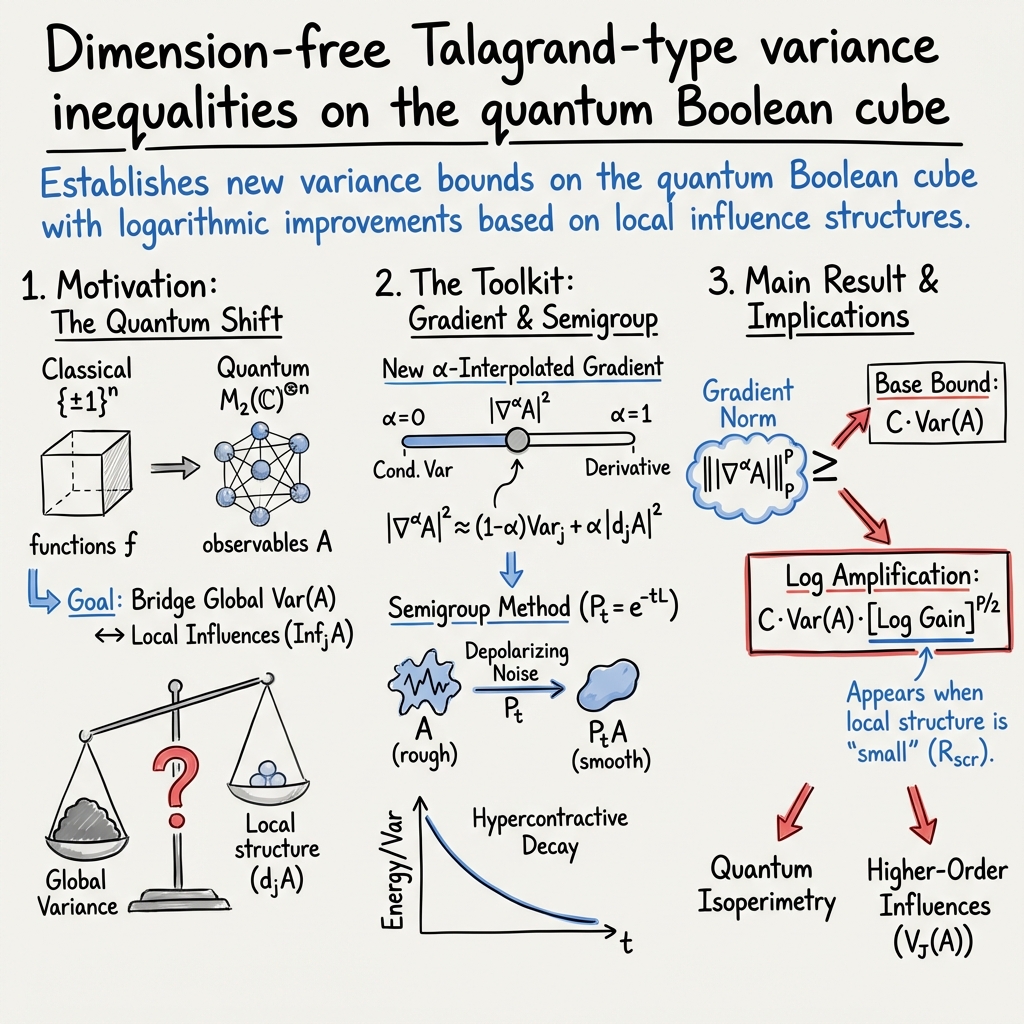
Abstract: We establish dimension-free Talagrand-type variance inequalities on the quantum Boolean cube $M_{2}(\mathbb C){\otimes n}$. Motivated by the splitting of the local carré du champ into a conditional-variance term and a pointwise-derivative term, we introduce an $α$-interpolated local gradient $|\nabla_jαA|$ that bridges $\mathrm{Var}j(A)$ and $|d_jA|{2}$. For $p\in[1,2],q\in[1,2)$ and $α\in[0,1]$, we prove a Talagrand-type inequality of the form $$|A|\infty{2-p}\,\bigl||\nablaαA|\bigr|_{p}{p}\ \gtrsim\mathrm{Var}(A)\cdot \max\left{1, \mathcal{R}(A,q){p/2}\right},$$ where $\mathcal{R}(A,q)$ is a logarithmic ratio quantifying how small either $A-τ(A)$ or the gradient vector $(d_jA)j$ is in $L{q}$ compared to $\mathrm{Var}(A){1/2}$. As consequences we derive a quantum Eldan--Gross inequality in terms of the squared $\ell_2$-mass of geometric influences, a quantum Cordero-Erausquin--Eskenazis $L{p}$-$L{q}$ inequality, and Talagrand-type $L{p}$-isoperimetric bounds. We further develop a high-order theory by introducing the local variance functional $$V_J(A)=\int_0\infty 2\mathrm{Inf}{2}{J}(P_tA) dt.$$ For $|J|=k$ we prove a local high-order Talagrand inequality relating $\mathrm{Inf}{p}_{J}[A]$ to $V_J(A)$, with a Talagrand-type logarithmic term when $\mathrm{Inf}{q}_{J}[A]$ is small. This yields $L{p}$-$L{q}$ influence inequalities and partial isoperimetric bounds for high-order influences. Our proofs are purely semigroup-based, relying on an improved Lipschitz smoothing estimate for $|\nablaαP_tA|$ obtained from a sharp noncommutative Khintchine inequality and hypercontractivity.
Paper Prompts
Sign up for free to create and run prompts on this paper using GPT-5.
Top Community Prompts
Explain it Like I'm 14
Overview
This paper studies how “global randomness” and “local sensitivity” are related in quantum systems made of many qubits. It builds quantum versions of famous inequalities by Talagrand (and others) that, in the classical world of bits, say: if a function varies a lot overall, then small local changes must affect it in a controlled way, and vice versa. The authors prove new, “dimension-free” quantum inequalities—meaning the bounds don’t get worse as you add more qubits—and they extend these ideas to higher-order effects where groups of qubits change together.
Key questions
The paper asks simple but deep questions, translated into quantum language:
- How does the overall variability of an observable on an n-qubit system (its variance) relate to how sensitive it is to changes in each qubit (its influences)?
- Can we get stronger, “Talagrand-type” bounds that include a helpful logarithmic bonus when certain quantities are small?
- Can we do this not just for single qubits, but also for sets of qubits changing together (high-order influences)?
- Can we keep these results “dimension-free,” so they don’t deteriorate as the number of qubits grows?
Methods and ideas
The authors work on the “quantum Boolean cube,” which is the space of all observables (matrices) on n qubits. Here are the key ideas, described in everyday terms:
- Bits vs. qubits: In the classical world, you flip bits. In the quantum world, you consider how changing or “tracing out” one qubit affects an observable. This sensitivity is called the influence of a qubit.
- Variance: This measures how much an observable deviates from its average value. Think of it as “overall randomness.”
- Influence: For qubit j, influence tracks how much the observable depends on that qubit. High influence means changing that qubit has a big effect.
- Noise flow (depolarizing semigroup): Imagine gradually blurring the system by adding noise over time. This process smooths the observable and lets you see how its variance and influences decay. Following this “flow” is called the semigroup method.
- Carré du champ split: A standard energy-like quantity splits nicely into two halves: a “conditional variance” (uncertainty left after you know everything except one qubit) and a “pointwise derivative” (direct sensitivity to that qubit). This motivates an “interpolated gradient” that blends both parts.
- Interpolated gradient: The authors define a new local gradient that mixes the conditional-variance part and the derivative part by a parameter α. This acts like a bridge between two ways to measure sensitivity.
- High-order influences: Instead of flipping just one qubit, they measure the sensitivity to flipping a whole set J of qubits together. They introduce a local variance functional V_J(A) to measure how much of the total variance comes specifically from modes involving J.
- Analytical tools: They use sharp matrix inequalities (noncommutative Khintchine), hypercontractivity (noise makes things more uniform), and improved smoothing estimates along the noise flow.
Main findings
The authors prove several core results, all dimension-free and in the quantum setting:
- A quantum Talagrand-type variance inequality: It links the overall variance to the size of the new interpolated gradient. You get a logarithmic bonus whenever either the centered observable or its gradient is small in “sub-L2” norms (think: measuring average size in a stricter way). This strengthens the basic Poincaré inequality (which only says variance is controlled by total influence) by adding the Talagrand-style log term.
- Quantum Eldan–Gross inequality: It shows that the total “gradient mass” can’t be too small if the variance is nontrivial, and it includes a logarithmic improvement depending on how the squared influences are distributed. This connects sensitivity and variance with a clean bonus factor.
- Quantum Cordero-Erausquin–Eskenazis inequality: It bounds how large the observable’s deviation from its mean can be (in an Lp sense) by its gradient, with a logarithmic correction of the optimal order p/2. This matches the spirit of a sharp classical inequality, adapted to quantum matrices.
- Quantum isoperimetric bounds: These say you can’t have both large variance and a tiny “boundary” (here measured by gradient). The result gives a clear lower bound on the gradient in terms of variance, again with a log term.
- High-order local Talagrand inequality: For any set J of k qubits, the influence of J is bounded below by a term that scales like k times a local variance V_J(A), plus a Talagrand-style logarithmic boost when a stricter norm of the influence is small. Summing these over all J yields quantum Talagrand Lp–Lq bounds for higher-order influences and partial isoperimetric results.
Put simply: the paper builds a robust toolkit showing that local sensitivity (first- and higher-order influences) and global variability (variance) are tightly connected in quantum systems, with extra logarithmic gains when certain local quantities are small.
Why it matters
- Understanding sensitivity: In quantum computing and information, it’s vital to know which qubits (or sets of qubits) really matter for an observable. These inequalities quantify that influence precisely.
- Stability and robustness: The log improvements mean that when local effects are small in certain norms, you get stronger global control. That’s useful for noise analysis, error bounds, and detecting “influential” qubits or coalitions.
- Dimension-free guarantees: The bounds don’t degrade as systems scale up. This is crucial for applications to many-qubit devices and for theoretical guarantees in high dimensions.
- Extending classical wisdom: Famous results from the classical cube (Talagrand, KKL, Eldan–Gross, CEE) now have clean quantum counterparts, including higher-order versions. This pushes forward the growing field of quantum Boolean analysis.
Key terms in plain words
- Qubit: The quantum version of a bit. It can be in a superposition, not just 0 or 1.
- Observable: A matrix that represents a measurable quantity of a quantum system.
- Variance: A measure of spread—how much a quantity varies around its average.
- Influence: How much changing a specific qubit affects the observable.
- Semigroup (noise flow): A mathematical way to “add noise over time” and watch quantities smooth out.
- Talagrand-type inequality: A strengthened inequality that relates global variability to local sensitivity, often with a helpful logarithmic factor.
- High-order influence: Sensitivity to changing a whole set of qubits together, not just one.
- Hypercontractivity: Noise makes functions more uniform and reduces peaks; a key tool for smoothing.
Knowledge Gaps
Knowledge gaps, limitations, and open questions
The following points summarize what remains unresolved or is only partially addressed in the paper, highlighting concrete directions for future research:
- L2 endpoint and super-L2 regime: All main inequalities are intrinsically sub-L2, with constants deteriorating as p→2 and no meaningful L2 endpoint. Can one establish Talagrand-type, Eldan–Gross-type, or isoperimetric inequalities at p=2 (and possibly p>2) in the quantum setting, or prove explicit obstructions?
- q→2 endpoint in Lp–Lq bounds: The quantum Cordero–Erausquin–Eskenazis inequality is proved only for 1≤q<2 and q≤p≤2, with constants vanishing as q→2. Is it possible to obtain a non-degenerate q=2 endpoint, or extend the result to the full classical range p∈(1,∞)?
- Sharpness of constants and decay rates: The improved gradient estimate yields decay Cα(t)≤e{-(2+2α)/(1+2α)t} (e.g., e{-3/2 t} at α=1/2), improving earlier bounds. Are these decay exponents optimal? If not, identify the best possible exponential rate and constants in all derived inequalities.
- Optimal choice of the interpolation parameter α: The paper introduces the α-interpolated gradient and provides comparison bounds, but does not determine the α that optimizes the variance lower bounds or logarithmic gains across applications. What α yields the strongest inequalities, and can α be tuned adaptively (e.g., data-driven on A) to improve constants?
- Extension beyond qubits (local dimension d>2): All results rely on Pauli matrices for M2 and the constant “3” in |d_jA|2≤3 Var_j(A). How do the inequalities generalize to M_d(ℂ){⊗n} (qudits), and can one obtain dimension-free (in n) inequalities with controlled dependence on local dimension d (e.g., replacing “3” by a sharp function of d2−1)?
- General quantum Markov semigroups: The proofs exploit the depolarizing semigroup’s tensor structure and tracial symmetry. Can the method extend to other quantum semigroups/channels (e.g., dephasing, amplitude damping, non-product or non-tracially symmetric semigroups), and what replacements of hypercontractivity and carré du champ are needed?
- Riesz transform theory and p>2 extensions: The local variance V_J(A) admits the representation via a J-Riesz transform, but the paper does not develop Lp-bounds for these transforms. Can noncommutative Riesz transform inequalities (e.g., à la Lust-Piquard/Junge–Mei) be integrated to push the results to p>2 or improve constants in the sub-L2 regime?
- High-order influence optimality: The local Talagrand inequality with V_J(A) features baseline k and exponential factors 2{(p−2)k}. Are these scales and constants sharp? Identify extremal or near-extremal examples for high-order inequalities and clarify whether alternative high-order notions (e.g., quantum analogues of Tal’s set-influence) yield stronger bounds.
- Structure and stability of extremizers: The paper proves inequalities but does not characterize extremizers or near-extremizers (as done in the classical case via pathwise methods). Which quantum observables saturate (or nearly saturate) these inequalities, and can one derive stability results that quantify proximity to extremal structure?
- Aggregation vs. locality for V_J(A): The sum over |J|=k yields lower bounds in terms of W{≥k}[A], but tight two-way comparisons between V_J(A), Inf_Jp[A], and Fourier weights are missing. Can one obtain sharp upper bounds, equivalences, or refined decompositions that improve local-to-global aggregation?
- Alternative influence notions and equivalences: Multiple non-equivalent classical definitions of high-order influence exist; the paper uses d_J-based influences. Develop and compare quantum analogues of other definitions (e.g., Tal’s influences of sets, conditional sensitivity metrics), and clarify when they are equivalent or yield stronger statements.
- Removing ∥A∥∞ constraints and scaling: Several inequalities require ∥A∥∞≤1 or carry ∥A∥∞{2−p} factors. Can one formulate versions that are homogeneous in A without explicit ∥A∥∞ dependence, or identify optimal scaling laws that avoid deterioration as p→2?
- Endpoint isoperimetry: The quantum Lp-isoperimetric bound has constants C_1(p)→0 as p→2. Is there a meaningful quantum L2 isoperimetric inequality (possibly in terms of geometric/functional quantities other than ∥|∇A|∥_2), or can one prove that such an endpoint is impossible?
- Beyond self-adjoint/unitary Hermitian observables: Some corollaries obtain uniform constants up to p=2 for unitary Hermitian A. Extend these improvements to more general classes (normal operators, non-self-adjoint observables), and understand precisely how operator structure affects constants.
- Methodological synthesis: The paper’s semigroup approach avoids random restriction techniques used in other quantum works. Can random restrictions and pathwise stochastic analysis be adapted to the qubit cube to strengthen constants, reach endpoints, or yield structural stability results?
- Applications in quantum information/computation: While motivated by influence theory, the paper does not develop applications to quantum threshold phenomena, noise sensitivity, property testing, or communication complexity. Identify concrete quantum tasks where these inequalities yield new bounds or algorithmic insights, and quantify their impact.
Glossary
- Bakry–Émery calculus: A framework linking Markov generators to curvature via the carré du champ operator, used to derive gradient and functional inequalities. "admits a noncommutative Bakry-- "" Emery calculus.
- CAR algebra: The C*-algebra generated by canonical anticommutation relations, modeling fermionic systems. "In a different noncommutative model (the CAR algebra),"
- Carré du champ: The quadratic form Γ associated with a Markov generator that measures “energy” or local gradient size. "The carr "" {e} du champ of the quantum semigroup is given by
- Conditional expectation: A trace-preserving projection onto a subalgebra, used to “trace out” subsystems. "the trace-preserving conditional expectation"
- Conditional variance: Operator-valued variance relative to a subalgebra, quantifying fluctuations conditioned on part of the system. "the (operator-valued) conditional variance is "
- Cordero-Erausquin–Eskenazis inequality: A sharp inequality relating norms and gradients with a logarithmic improvement. "Quantum Cordero-Erausquin--Eskenazis - inequality"
- Depolarizing semigroup: A quantum noise semigroup that drives states toward the maximally mixed (trace) state. "The natural noise operator is the depolarizing semigroup "
- Derivation: Here, the discrete derivative map defined by subtracting a conditional expectation. "the derivations "
- Dirichlet form: The energy form associated with a generator; controls variance via gradients/influences. "the Dirichlet form (equivalently, by the total -influence)"
- Eldan–Gross inequality: An inequality relating variance, gradient norms, and influence mass with a logarithmic gain. "Quantum Eldan--Gross inequality"
- Fourier–Pauli expansion: Expansion of an operator in the Pauli tensor-product basis, analogous to Fourier–Walsh. "admits a unique Fourier--Pauli expansion"
- Fourier weight: The sum of squared Fourier coefficients at a fixed level (degree) of the expansion. "the Fourier weight of at degree is"
- Geometric influence: The -influence; measures boundary size/sensitivity in product spaces. "The -influence is also called {\em the geometric influence}."
- High-order influence: Influence of a subset of coordinates, defined via higher-order derivatives . "high-order influences on the quantum Boolean cube"
- Hypercontractivity: A semigroup property mapping functions from to with after positive time. "which is hypercontractive"
- Idempotent: An operator satisfying ; here, discrete derivative projectors. "Each is an idempotent ()"
- Isoperimetric inequality: A bound relating variance (or measure) to boundary size; here in the quantum cube. "Quantum isoperimetric inequality"
- Kadison–Schwarz inequality: For a unital positive map φ, one has φ(a* a) ≥ φ(a*)φ(a); used for matrix inequalities. "Kadison--Schwarz inequality~\cite{S2013book}"
- Khintchine inequality: Bounds moments of (noncommutative) Rademacher-type sums; used for sharp smoothing. "from a sharp noncommutative Khintchine inequality and hypercontractivity."
- Noncommutative Hölder: Hölder’s inequality in Schatten (operator) spaces for matrix products and traces. "Noncommutative H\"older"
- Pauli basis: The tensor-product basis built from the Pauli matrices, forming an orthonormal basis of . "Pauli basis and Fourier--Pauli expansion."
- Pauli matrices: The standard 2×2 Hermitian unitaries σ0, σ1, σ2, σ3 generating the Pauli basis. "the Pauli matrices"
- Parseval’s identity: Equality asserting the norm equals the sum of squared Fourier coefficients. "Parseval's identity gives"
- Poincaré inequality: Variance controlled by the Dirichlet form or total influence (spectral gap). "Poincar "" e inequality (see e.g.~\cite[p.36]{Ryan2014book})
- Quantum Boolean cube: The noncommutative analogue of the discrete cube, realized as . "the quantum Boolean cube "
- Quantum Markov semigroup: A completely positive, trace-preserving semigroup describing quantum diffusion/noise. "tracially symmetric quantum Markov semigroup"
- Riesz transform: Gradient-like operator associated with the generator. "the -Riesz transform $R_J(A):= d_J \Lcal^{-1/2} (A-\tau(A))$"
- Schatten norm: Operator norms based on singular values with respect to the normalized trace. "equipped with the normalized trace and Schatten norms ."
- Talagrand-type inequality: Inequalities strengthening Poincaré by incorporating influences with logarithmic terms. "Talagrand-type inequality"
- Tensor product: The product structure used to build multi-qubit algebras and product semigroups. "the -fold tensor product of the one-qubit depolarizing semigroup"
- Tensorization: Lifting one-site estimates to product spaces, often yielding decay/smoothing. "and hence tensorization yields exponential decay of derivatives."
- Tracial state (normalized trace): The normalized trace functional τ used to define expectations and norms. "equipped with the normalized trace "
- Unital completely positive map: A completely positive map preserving the identity operator. "Equivalently, is unital completely positive"
- Variance decay: The decrease of variance along the semigroup flow, central to semigroup proofs. "via Variance Decay"
Practical Applications
Immediate Applications
Below are concrete, deployable applications that leverage the paper’s inequalities, semigroup method, and high-order influence framework. Each item includes relevant sectors, likely tools/workflows, and feasibility notes.
- Quantum circuit “influence profiling” for debugging and optimization
- Sector: Software + Quantum computing (NISQ)
- What: A compiler/simulator plugin that estimates single- and high-order influences (Infjp, InfJp) and produces an “influence heatmap” for a target observable A or cost function. Use the interpolated gradient norms |||∇αA|||p and the Eldan–Gross–type lower bounds to flag influential qubits/coalitions and prune negligible parts of a circuit.
- Tools/workflow: Classical shadows to estimate Pauli coefficients, then compute Var(A), Infjp, InfJp, and if feasible VJ(A); integrate into Qiskit/Cirq transpilers for gate pruning and layout selection.
- Assumptions/dependencies: Requires repeated measurement or shadow tomography; assumes depolarizing-like noise (or twirled noise) to align with the semigroup model; constants deteriorate as p,q→2; high-order estimators scale poorly with k unless sparsity is present.
- Resource-aware compilation and hardware mapping guided by influences
- Sector: Software + Hardware mapping
- What: Map high-influence qubits to the best-fidelity qubits (and couplers) on a device; schedule error mitigation and additional calibration effort on high-influence lines.
- Tools/workflow: Influence profiler output feeds a placement heuristic; dynamic remapping when the influence profile drifts.
- Assumptions/dependencies: Requires periodic re-estimation of influences; relies on backend calibration data; assumes influences correlate with performance loss under realistic noise.
- Targeted error mitigation and measurement budgeting
- Sector: Quantum computing (NISQ)
- What: Allocate measurement shots, readout mitigation, zero-noise extrapolation, and randomized compiling budget proportionally to Infj1 or to |||∇A|||p. Use logarithmic amplifications (Talagrand-type) to identify when small-Lq gradients trigger stronger guarantees on variance control.
- Tools/workflow: Adaptive shot allocation and mitigation planning driven by Infjp statistics; simple policy: if Infj1 is in the lowest quantile, cut mitigation there first.
- Assumptions/dependencies: Needs stable estimates of Infj1 (geometric influence); assumes the observable/cost A remains fixed during runs.
- Device benchmarking and drift detection via influence-based metrics
- Sector: Hardware benchmarking
- What: Define new metrics such as the “Eldan–Gross score” (lower bound on |||∇A|||p in terms of Var(A) and the ℓ2-mass of influences) and track them over time to detect drift or anomalous noise patterns.
- Tools/workflow: Periodic estimation of Var(A), ∑j Infj1, and ∑j Infj12; raise alerts if Talagrand/Eldan–Gross bounds shift unexpectedly.
- Assumptions/dependencies: Requires repeated experiments on the same target A; assumes device noise fluctuations manifest in influence profiles.
- Focused many-body experiments to localize k-qubit correlations
- Sector: Quantum simulation/condensed matter
- What: Use VJ(A) (local variance functional) and high-order influences to identify “coalitions” J that meaningfully drive the variance of observables, then focus tomography/witnesses on those J.
- Tools/workflow: Estimate InfJ2[P_tA] for a few t (emulate P_t with local depolarization or randomized twirling), approximate VJ(A) by numerical integration/summation, then target high-VJ(A) subsets for deeper probes.
- Assumptions/dependencies: Access to (or emulation of) local depolarizing channels; limited k (small subsets) for tractability; shadow-based estimation.
- Quantum isoperimetric bounds as sample-complexity heuristics
- Sector: Experiment design + Software
- What: Use the quantum Lp-isoperimetric inequality to set measurement budgets: nontrivial Var(A) implies a minimum “boundary size” (|||∇A|||pp) scaling like [ln(e/Var(A))]p/2, which can guide the number of shots needed to resolve effects.
- Tools/workflow: Pre-experiment calculation of lower bounds on gradients given a desired Var(A) to allocate measurement resources realistically.
- Assumptions/dependencies: Bounds are sharp in the sub-L2 regime (p<2) and degrade near p=2; assumes the depolarizing semigroup model approximates the relevant noise.
- Academic methodology and pedagogy
- Sector: Academia (math/CS/quantum info)
- What: Semigroup-based, dimension-free proofs and the α-interpolated gradient offer a streamlined route to quantum Talagrand-type results and their consequences. Immediate use in courses, research notes, and survey expositions.
- Tools/workflow: Lecture modules and problem sets on quantum Boolean analysis using the new smoothing estimate and high-order local variance functional.
- Assumptions/dependencies: None beyond standard prerequisites in noncommutative analysis.
- Standards discussions: influence-based benchmarks
- Sector: Policy/standards for quantum benchmarks
- What: Propose influence-profile metrics and Talagrand/Eldan–Gross–style summaries for device reporting alongside gate fidelity and unitarity.
- Tools/workflow: Draft benchmark specifications that define data collection and reporting for Infj1, ∑j Infj12, and VJ(A) for a canonical set of observables.
- Assumptions/dependencies: Community buy-in; reproducible measurement procedures across platforms.
Long-Term Applications
These directions are promising but need further algorithmic development, scalable estimation procedures, or theoretical extensions (e.g., to qudits, broader noise models, or p→2 endpoints).
- Quantum junta testing and structure learning for observables and circuits
- Sectors: Software, TCS, QML
- What: Algorithms that test whether A (or a circuit-induced observable) effectively depends on a small set of qubits J (a “quantum junta”), using Infjp and InfJp thresholds, and the local inequality relating InfJp[A] to VJ(A). Extend classical junta testers to the quantum Pauli/Fourier setting.
- Tools/products: “Quantum junta tester” library; integration with classical shadows to estimate high-order terms.
- Assumptions/dependencies: Efficient high-order influence estimation; sparsity of Fourier–Pauli spectrum; sampling complexity bounds in realistic noise.
- Training diagnostics and design for variational algorithms
- Sectors: QML/optimization
- What: Use Eldan–Gross-type lower bounds to certify non-vanishing gradients given a target variance (mitigating barren-plateau risks), and to reparameterize ansätze toward higher-influence structures. Apply Talagrand-type logarithmic gains to detect “gradient concentration” regimes that help guide optimizer settings.
- Tools/workflow: Plug-ins in training loops that monitor influence profiles and predicted gradient lower bounds; adaptive layer-wise learning rates/gate insertions on high-influence qubits.
- Assumptions/dependencies: Mapping between cost gradients and the paper’s ∇α operators requires modeling choices; influence estimates must be stable across training iterations.
- Hamiltonian and channel learning with high-order influence priors
- Sectors: Quantum system ID, many-body physics
- What: Exploit VJ(A) and InfJp constraints to prioritize learning k-local terms and to prune candidate interactions in sparse Hamiltonians/Lindbladians; use restricted Poincaré decay and Lp–Lq influence inequalities to bound search spaces and sample complexity.
- Tools/workflow: Hybrid classical–quantum routines that alternate between shadow-based estimation of influences and sparse regression on candidate Pauli terms.
- Assumptions/dependencies: Target models are approximately k-local; scalable estimation of VJ(A) for modest k; robustness to non-depolarizing noise.
- Influence-guided decoders and code design
- Sectors: Quantum error correction
- What: Incorporate influence profiles to prioritize syndrome bits/qubits and optimize decoder attention or scheduling; design codes or layouts where high-influence qubits receive additional protection or fault-tolerance resources.
- Tools/workflow: Influence-aware routing of syndrome extraction; adaptive weighting in belief propagation or neural decoders.
- Assumptions/dependencies: Empirical correlation between influence and logical error impact; online estimation feasibility during QEC cycles.
- Control of open quantum systems and dissipative state preparation
- Sectors: Quantum control
- What: Use the improved gradient smoothing estimate (Cα(t) decay) to tune Lindblad rates and sequence times for faster mixing on influential subspaces; analyze convergence guarantees with restricted Poincaré gaps at higher orders (k-dependent gaps).
- Tools/workflow: Controller synthesis that prioritizes channels acting on high-influence sites or coalitions J to accelerate desired variance decay.
- Assumptions/dependencies: Ability to engineer approximate depolarizing/twirled channels; extending guarantees beyond the depolarizing semigroup to general Lindbladians.
- Robust quantum communication and networking protocols
- Sectors: Quantum communication
- What: Model node/edge loss (or erasures) as partial traces and use Infjp and VJ(A) to quantify sensitivity; design protocols with low susceptibility to loss on non-critical nodes while ensuring sufficient variance for signal fidelity.
- Tools/workflow: Pre-deployment sensitivity analysis via influence profiles; redundancy allocation based on high-influence routes.
- Assumptions/dependencies: Network noise can be approximated in the paper’s framework; scalable estimation of influence in distributed settings.
- Certification of quantum advantage via isoperimetric/influence constraints
- Sectors: Foundations + Benchmarks
- What: Use quantum Lp-isoperimetric bounds and Eldan–Gross-type constraints to argue that certain observables or tasks necessarily incur large “boundary size” (gradient) incompatible with candidate classical surrogates, providing auxiliary evidence in advantage experiments.
- Tools/workflow: Auxiliary certification pipeline reporting lower bounds on |||∇A|||p given measured Var(A) and influence profiles.
- Assumptions/dependencies: Requires task-specific classical lower bounds and careful modeling; still exploratory.
- Library support and standard APIs for quantum Talagrand tooling
- Sectors: Software + Cloud platforms + Education
- What: A “quantum Talagrand toolbox” exposing APIs to compute/estimate Infjp, InfJp, VJ(A), W≥k[A], and to apply the paper’s inequalities as certifiers; integrated into cloud workflows for pre-experiment checks and post-run analysis.
- Tools/products: Open-source module with sampler backends (shadows, Pauli sampling), visualization, and report generation.
- Assumptions/dependencies: Community adoption; scalable implementations; curated default observables.
Notes on assumptions and dependencies common across applications
- Model and domain: Results are proved for n-qubit systems M2(C)⊗n with Schatten norms and the depolarizing semigroup; extensions to qudits or other Lindbladians would require new work.
- Parameter regime: The strongest statements are sub-L2 (p<2, q<2), and constants may deteriorate as p or q approach 2; endpoints generally need separate treatments.
- Estimation practicality: Direct computation of InfJp and VJ(A) is exponential in k in the worst case; practical deployment relies on sparsity, shadow tomography, randomized compiling/twirling, and careful experiment design.
- Noise alignment: Methods are cleanest when noise is (or is effectively) depolarizing via twirling; departures from this model may reduce the sharpness or validity of the guarantees.
- Computation vs. certification: Inequalities provide rigorous lower/upper bounds and certificates; turning them into efficient optimization procedures requires additional algorithm design and heuristics.
Collections
Sign up for free to add this paper to one or more collections.