Deep Delta Learning
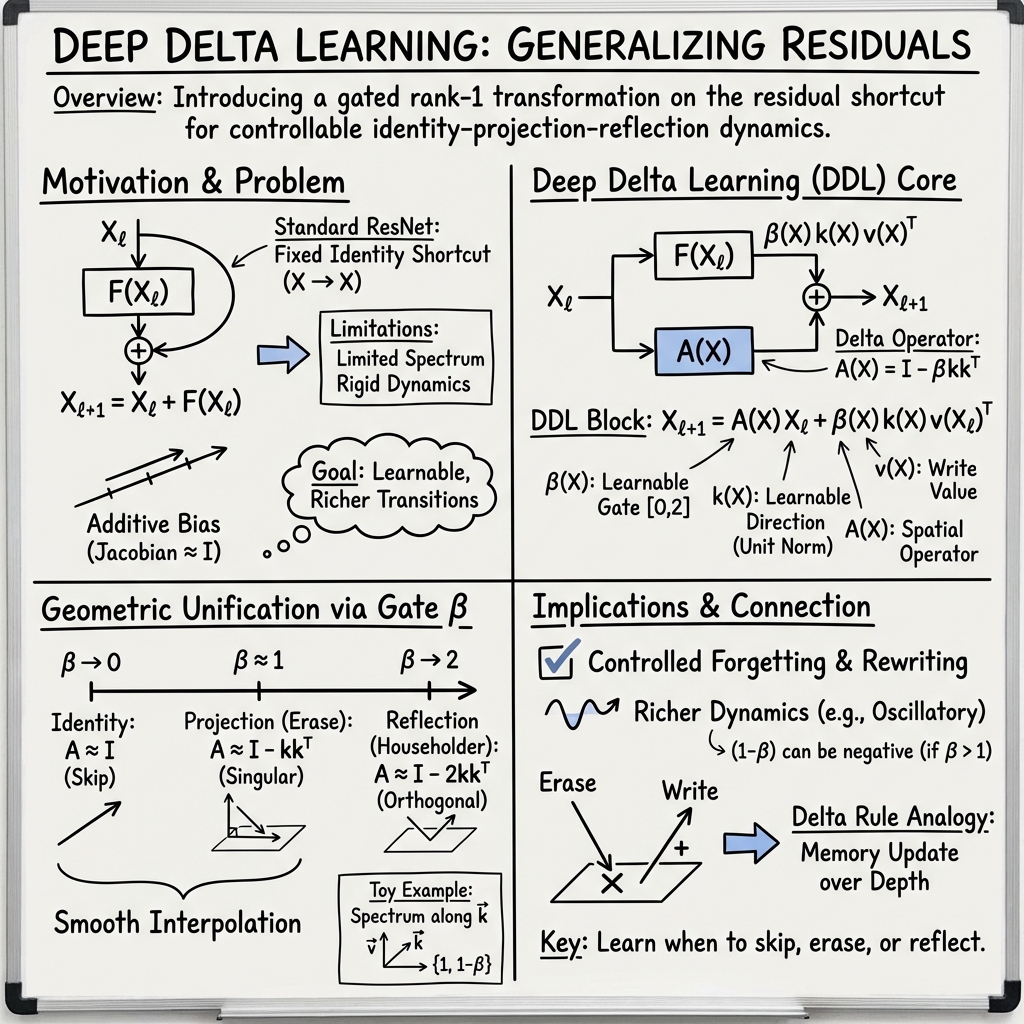
Abstract: The efficacy of deep residual networks is fundamentally predicated on the identity shortcut connection. While this mechanism effectively mitigates the vanishing gradient problem, it imposes a strictly additive inductive bias on feature transformations, thereby limiting the network's capacity to model complex state transitions. In this paper, we introduce Deep Delta Learning (DDL), a novel architecture that generalizes the standard residual connection by modulating the identity shortcut with a learnable, data-dependent geometric transformation. This transformation, termed the Delta Operator, constitutes a rank-1 perturbation of the identity matrix, parameterized by a reflection direction vector $\mathbf{k}(\mathbf{X})$ and a gating scalar $β(\mathbf{X})$. We provide a spectral analysis of this operator, demonstrating that the gate $β(\mathbf{X})$ enables dynamic interpolation between identity mapping, orthogonal projection, and geometric reflection. Furthermore, we restructure the residual update as a synchronous rank-1 injection, where the gate acts as a dynamic step size governing both the erasure of old information and the writing of new features. This unification empowers the network to explicitly control the spectrum of its layer-wise transition operator, enabling the modeling of complex, non-monotonic dynamics while preserving the stable training characteristics of gated residual architectures.
Paper Prompts
Sign up for free to create and run prompts on this paper using GPT-5.
Top Community Prompts
Explain it Like I'm 14
Deep Delta Learning — A Simple Explanation
1) What is this paper about?
This paper introduces a new way to build deep neural networks called Deep Delta Learning (DDL). It updates the popular ResNet idea by giving each layer a smarter shortcut path. Instead of always just adding new information to the old, DDL can choose to keep it, erase part of it, or even flip it, and then write in new information—on the fly—based on the input.
In short: it’s a smarter way for a network layer to decide what to remember, what to forget, and how to change.
2) What questions is the paper trying to answer?
The paper asks:
- Can we give deep networks a more flexible shortcut than “just add more stuff”?
- Can a layer control whether it keeps its current info, deletes part of it, or flips it, before writing new info?
- Can we do this while keeping training stable and easy, like regular ResNets?
3) How does it work? (Methods explained with analogies)
Think of each layer in a deep network as a notebook page where the model writes and updates notes (features).
Standard ResNet:
- The layer takes the old notes and simply adds new notes on top. This is like always writing more without erasing or editing.
Deep Delta Learning (DDL):
- The layer has three small tools, all learned from data:
- A direction arrow k(X): “Where should I edit?” (which part of the notes to focus on)
- A value v(X): “What new info do I want to write there?”
- A dial β(X): “How strongly should I edit?” (from 0 to 2)
Here’s the idea:
- Before adding new info, the layer can edit the old notes along one chosen direction (k).
- The dial β controls what kind of edit it is:
- β ≈ 0: do nothing (keep notes as they are).
- β ≈ 1: erase the part of the notes in the k direction (like projecting a shape’s shadow and removing one component).
- β ≈ 2: reflect/flip the notes in the k direction (like a mirror flip).
- After that, the layer writes new info along the same direction k, scaled by the same dial β.
Analogy:
- Imagine shining a flashlight (k) on your notes to highlight a single line.
- The dial (β) decides whether you:
- leave the line alone,
- erase that line,
- or flip it (turn positives into negatives).
- Then you write new content on that same line (v), with the same strength (β).
Under the hood:
- The math uses a simple geometric transform that only changes the notes along one direction (rank‑1 update). That keeps things efficient and stable.
- The paper analyzes the “spectrum” (how the transform stretches, shrinks, or flips directions) and shows that only the chosen direction k changes by an amount controlled by β. Everything else stays the same.
4) What did they find, and why is it important?
Key findings:
- One simple gate (the dial β) unifies three behaviors in the shortcut path:
- Identity (do nothing),
- Projection (erase along a direction),
- Reflection (flip along a direction).
- This gives layers precise control over what to forget and what to write, instead of always piling on more info. That helps avoid “residual buildup” (keeping unnecessary noise).
- The math shows exactly how the change works:
- Most directions stay unchanged,
- Only the chosen direction k is altered by an amount 1 − β.
- When β > 1, that direction flips sign (this lets the network model oscillations or opposing effects, which standard ResNets struggle with).
- The update matches a well-known “Delta Rule” idea used in fast memory models: erase a part of old memory and write new memory in a synchronized way, with β acting like a step size.
- It remains training-friendly like gated residual networks: you can smoothly start at identity (β near 0) and learn stronger edits as needed.
Why this matters:
- Many real-world patterns involve push–pull or back-and-forth behavior (like waves or oscillations). Standard ResNets don’t naturally model these because their shortcut always “adds.” DDL lets networks flip signs and cleanly overwrite parts of their state, making them more expressive without losing stability.
5) What’s the impact?
- Smarter layers: Networks can selectively forget, replace, or flip specific parts of their features, leading to cleaner, more controllable learning.
- Better dynamics: The ability to introduce negative effects (reflections) helps model complex behaviors like oscillations and non-monotonic changes.
- Broad use: This can benefit very deep models, sequence models, and systems that need memory-like updates (e.g., attention or stateful models).
- Practical promise: Because DDL is a small, simple change with clear math and stable behavior, it could be dropped into existing architectures to improve performance and interpretability of layer updates.
Overall, Deep Delta Learning gives neural networks a “precision eraser and pen” for their shortcut path, helping them learn richer patterns while staying easy to train.
Knowledge Gaps
Knowledge gaps, limitations, and open questions
Below is a concise, actionable list of what remains missing, uncertain, or unexplored in the paper.
- Empirical validation is absent: no experiments, benchmarks, or ablations demonstrating DDL’s accuracy, training stability, gradient behavior, or runtime vs. standard ResNets/Transformers and DeltaNet across tasks (e.g., ImageNet classification, language modeling, long-sequence tracking).
- Optimization stability near singularities and reflections is unaddressed: formal analysis or empirical evidence is needed for training behavior when (singular projection) and (reflection, sign inversion), including gradient norms, Jacobian spectra, and conditions preventing exploding/vanishing gradients.
- Initialization and training recipes are unspecified: how to initialize (and ), whether zero-initialization is used, and practical guidelines to avoid degenerate states (e.g., collapse or persistent singularity).
- Architectural integration details are missing: how to insert DDL blocks into common backbones (pre-/post-activation ResNets, CNNs, Transformers, RNNs), and how DDL interacts with normalization layers (BatchNorm/LayerNorm), residual scaling, and activation functions.
- Computational overhead and hardware efficiency are not quantified: per-layer FLOPs and memory of computing and , kernel fusion strategies, and the practical throughput/latency trade-offs on GPUs/TPUs vs. standard residual connections.
- Expressivity is limited to rank-1 perturbations: it is unclear how many DDL layers are needed to emulate richer linear transforms or dynamics; explore multi-rank variants (sums/products of Householder-like operators), multi-head formulations, and their theoretical/empirical trade-offs.
- Beta range restriction to is assumed but not justified experimentally: investigate whether allowing or (expansive dynamics) improves performance or stability, and compare parameterizations (e.g., tanh, softplus, unconstrained gating with regularization).
- Decoupling erasure and write gates is unexplored: assess variants with distinct gates for and (vs. shared ), and characterize their optimization dynamics and expressivity.
- Normalization of and the role of need rigorous treatment: provide implementation details and analyses for unit-norm enforcement, gradients through normalization, sensitivity to , and numerical stability when .
- ODE perspective lacks formal guarantees: analyze existence/uniqueness, stability, and discretization error for the induced dynamics ; relate to step-size control with convergence bounds.
- Invertibility and information loss are not characterized across depth: quantify when sequences of DDL layers remain (near-)invertible, the cumulative effect of projections on information preservation, and whether auxiliary skips are needed to prevent irreversible loss.
- Interaction with the value dimension is unclear: study how affects lifted operator orientation (determinant sign), feature coupling across columns, model capacity, and memory footprint; provide practical guidelines for choosing .
- Robustness and regularization are untested: evaluate adversarial robustness, noise sensitivity, and regularizers (e.g., sparsity on , orthogonality penalties, gate entropy penalties) to prevent trivial solutions or degenerate directions.
- Interpretability of learned geometry is not explored: develop diagnostics to visualize directions and dynamics across depth, quantify frequencies of identity/projection/reflection regimes, and relate them to task structure and performance.
- Gradient flow analysis is incomplete: bound singular values/Lipschitz constants of the block (including nonlinear branches generating ), and compare gradient propagation properties to standard residual and orthogonal/unitary networks.
- Practical training pathologies are not investigated: check for collapse to (identity), oscillatory instability when negative eigenvalues dominate, alignment with canonical bases causing element-wise gating, or ill-conditioned estimates.
- Compatibility with attention and multi-head mechanisms is unspecified: detail how to apply DDL in Transformer blocks (e.g., per-head ), and whether DDL competes with or complements attention-based state updates.
- Benchmark scenarios requiring negative eigenvalues are not demonstrated: design synthetic and real tasks (oscillatory systems, control, system identification, sequence tracking) to show when reflections or negative eigenvalues materially improve modeling vs. additive residuals.
- Generalization and sample efficiency impacts are unknown: provide theoretical and empirical analyses (e.g., margin/Rademacher complexity, bias-variance) to determine whether controlled forgetting/reflection improves generalization.
- Alternative formulations are unexplored: consider right-multiplication operators that act on , block-diagonal or low-rank mixtures, and learnable bases for (e.g., dictionary of directions) to enhance flexibility without excessive cost.
- Reproducibility details are missing: specify branch architectures for and the Linear layers, hyperparameters, initialization, training schedules for , and evaluation protocols to enable consistent replication of results once experiments are added.
Practical Applications
Immediate Applications
Below are actionable, sector-linked use cases that can be deployed with modest engineering effort, assuming access to the reference implementation and typical deep-learning tooling.
- Bold drop-in replacement for residual blocks in CNNs and MLPs for better feature hygiene and training stability: Replace standard ResNet-style identity shortcuts with the Delta Residual Block to enable controlled “erase-and-write” along learned directions, reducing residual accumulation and interference in very deep networks.
- Sector: Software/ML engineering; computer vision.
- Tools/products/workflows: A
DDLResidualBlockmodule in PyTorch/TensorFlow; “Delta-ResNet” backbones for image classification/detection; training recipes that log gate statistics and initialize β near 0–1. - Assumptions/dependencies: Availability of the GitHub implementation; k(X) normalization and a small ε for numerical stability; compatibility with batch norm/residual scaling; hyperparameter tuning to avoid instability when β→1 (singular projection).
- Sequence model enhancement via negative-eigenvalue transitions: Integrate DDL into RNN or Transformer residual paths to better capture oscillatory or oppositional patterns (enabled by β→2 reflections), improving modeling of cyclical dynamics.
- Sector: NLP, audio/speech, time-series analytics.
- Tools/products/workflows: “Delta-Transformer” residuals; language/audio models with DDL gating heads; evaluation pipelines that track reflection/projection events per layer.
- Assumptions/dependencies: Careful gate initialization and constraints (β∈[0,2]); potential interaction with attention/residual scaling; monitoring for orientation flips when d_v is odd and β>1.
- Memory-augmented, streaming inference with Delta-style updates: Use DDL’s depth-wise Delta Rule to align “forget” (projection) and “write” (rank-1 injection) in memory modules, reducing interference in linear-attention or DeltaNet-like architectures.
- Sector: Edge AI, real-time analytics, recommendation.
- Tools/products/workflows: A DDL-based memory cell for streaming models; lightweight rank-1 kernels; deployment in on-device inference stacks.
- Assumptions/dependencies: Efficient GPU/CPU kernels for rank-1 outer products; compatibility with existing attention implementations; gating regularization to prevent unbounded contractions.
- Targeted feature erasure for privacy and robustness: Apply β≈1 projection along learned k(X) to remove sensitive or spurious feature components before writing new information, supporting fairness or privacy filters at the representation level.
- Sector: Trustworthy AI, healthcare imaging, finance risk models.
- Tools/products/workflows: “Privacy-Projection Layer” preceding classifier heads; workflows for training k(X) to align with known sensitive directions; auditing dashboards that quantify erased subspaces.
- Assumptions/dependencies: Reliable supervision or attribution methods to discover sensitive directions; verification that projection does not degrade downstream task performance; legal compliance requires empirical guarantees beyond architectural intent.
- Continual and incremental learning with controlled forgetting: Use β≈1 to selectively forget outdated domain-specific features while injecting updated information, mitigating catastrophic interference during domain shifts.
- Sector: Industrial AI maintenance, autonomous systems, MLOps.
- Tools/products/workflows: DDL-enabled fine-tuning pipelines; scheduled β curricula (start near identity, move to projection for targeted layers); drift monitoring that triggers controlled erasure.
- Assumptions/dependencies: Procedures to estimate which subspaces to forget (adapters/feature attribution); robust validation on new domains; safe-guarding against overshooting (β too high) that could reflect and destabilize features.
- Spectral-control diagnostics for training and debugging: Monitor β distributions, effective eigenvalues {1,…,1,1−β}, and determinant 1−β across layers to detect saturation (identity), singular projection, or excessive reflection.
- Sector: ML tooling and observability.
- Tools/products/workflows: “Spectral Dashboard” plugin for TensorBoard/W&B; alerts when layers spend too long at β≈1 or β≈2; per-layer reports on feature coupling via k_i k_j.
- Assumptions/dependencies: Access to intermediate activations/statistics; small overhead acceptable in training; clear operational thresholds (e.g., acceptable β histograms per layer).
- Improved modeling of cyclical signals in applied forecasting: Use reflections (β→2) and anisotropic contractions to capture oscillations and mean-reversion in financial or physiological time-series.
- Sector: Finance (trading/risk), healthcare (ECG/EEG), IoT sensing.
- Tools/products/workflows: DDL-enhanced sequence regressors; pipelines that validate oscillation capture via spectral metrics; scenario tests for mean-reversion accuracy.
- Assumptions/dependencies: Sufficient sequence length and supervision; careful gate regularization to avoid over-reflection; domain-specific validation on cycle detection metrics.
- Edge-friendly rank-1 updates for resource-constrained deployment: Exploit the low-cost outer product k vT and broadcasted spatial operator A(X) to reduce compute and memory traffic in certain residual pathways.
- Sector: Mobile/embedded AI.
- Tools/products/workflows: DDL layers compiled with fused rank-1 kernels; quantization-aware training of gating and direction branches.
- Assumptions/dependencies: Kernel fusion and memory layout optimizations; profiling to ensure rank-1 path is actually cheaper than dense alternatives in the target hardware.
Long-Term Applications
The following opportunities are promising but require further research, scaling studies, or tooling/hardware development before broad adoption.
- Foundation-model backbones with spectral control: Build large Transformers that replace standard residuals with DDL to reduce interference at scale, potentially improving long-context reasoning and memory hygiene.
- Sector: General AI, LLMs, multimodal models.
- Tools/products/workflows: “Delta-Backbone” pretraining; β regularizers and layer-wise spectra shaping; curriculum schedules for identity→projection→reflection.
- Assumptions/dependencies: Empirical scaling laws; robust initialization/regularization strategies; hardware support for mixed precision and fused rank-1 ops; large-scale benchmarks to validate gains.
- Physics-informed and control-oriented networks: Use DDL’s controlled projections/reflections to model non-monotonic and oscillatory dynamics in physical systems and closed-loop controllers.
- Sector: Robotics, autonomy, scientific ML (PDEs, fluid dynamics).
- Tools/products/workflows: DDL-based simulators; controllers with “forget/reorient” subspace operations; hybrid models that align k(X) with known physical modes.
- Assumptions/dependencies: Integration with control-theoretic guarantees; safety validation for reflections; domain-informed priors to steer k(X) toward physically meaningful directions.
- Invertible and flow-based generative modeling via gated orthogonality: Exploit β∈{0,2} regimes (orthogonal shortcuts) to design near-invertible residual flows with tunable departures from strict orthogonality for expressivity.
- Sector: Generative modeling, density estimation, uncertainty quantification.
- Tools/products/workflows: DDL-Flow architectures; training schemes that constrain β to orthogonal regimes when needed; analysis tools for Jacobian determinants per layer.
- Assumptions/dependencies: Strong theoretical and empirical guarantees on invertibility and stability; efficient determinant/log-det computation in lifted spaces.
- Explainable and controllable representation editing: Interpret k(X) as data-dependent “feature directions” and β as a step size to enact counterfactual edits (erase, replace, reflect) in internal states for debugging or alignment.
- Sector: Explainable AI, model alignment, education.
- Tools/products/workflows: “Delta-Edit” tools to probe and edit layer states; attribution methods to tie k(X) to semantic features; interactive notebooks for teaching geometric residuals.
- Assumptions/dependencies: Reliable mapping between k(X) and human-interpretable concepts; safeguards to prevent harmful edits; standardized evaluation of edit efficacy.
- Privacy-preserving compliance (right-to-be-forgotten in models): Formalize and validate projection-based forgetting across layers to remove specific individuals’ or attributes’ influence from representations.
- Sector: Policy/regulation, privacy engineering.
- Tools/products/workflows: Auditable “forgetting operators” with certificates; compliance pipelines that document β/k(X) behavior; post-hoc erasure workflows for deployed models.
- Assumptions/dependencies: Provable guarantees that erased subspaces remove targeted information without leakage; regulatory acceptance; rigorous empirical audits.
- Automated spectral-shaping training curricula: Meta-learn β distributions and k(X) regularizers to optimize the spectrum per layer (e.g., encouraging contractions early, reflections mid-depth, identity late).
- Sector: AutoML, training optimization.
- Tools/products/workflows: Beta-scheduling policies; layer-wise spectrum targets; AutoML agents that tune geometric dynamics for task objectives.
- Assumptions/dependencies: Stable optimization of gates/directions; generalization across tasks; avoidance of degenerate regimes (e.g., persistent β≈1 singularities).
- Hardware and compiler support for rank-1 geometric updates: Develop specialized kernels that fuse projection, gating, and outer-product injection, and compilers that schedule these efficiently.
- Sector: AI hardware/software ecosystems.
- Tools/products/workflows: Vendor-backed libraries (CUDA/ROCm/oneDNN) with DDL primitives; graph compilers that recognize Delta blocks and optimize memory traffic.
- Assumptions/dependencies: Sufficient demand to justify kernel development; measurable throughput/latency gains over dense residuals; compatibility with quantization and sparsity.
- Robust domain adaptation pipelines with controlled subspace reorientation: Use reflections (β→2) to reorient features when moving between substantially different domains (e.g., simulated→real, hospital A→B).
- Sector: Healthcare imaging, autonomous driving, industrial inspection.
- Tools/products/workflows: “Reflect-to-adapt” schedules in fine-tuning; domain-shift detectors that trigger β adjustments; evaluation frameworks measuring subspace alignment.
- Assumptions/dependencies: Careful monitoring to prevent destabilization from negative eigenvalues; domain knowledge to guide k(X) selection; extensive validation on safety-critical tasks.
Glossary
- Additive inductive bias: A built-in preference in a model that favors additive updates to representations or dynamics. "it imposes a strictly additive inductive bias on feature transformations"
- Anisotropic contraction: A linear transformation that contracts space by different amounts along different directions. "For , $\Ab$ performs an anisotropic contraction along $\kb$ (and flips sign along $\kb$ when )."
- Delta Operator: A learnable, data-dependent rank-1 modification of the identity used to modulate residual connections. "This transformation, termed the Delta Operator, constitutes a rank-1 perturbation of the identity matrix"
- Delta Residual Block: A residual block that applies the Delta Operator with a learnable direction and gate to generalize standard residual connections. "We propose the Delta Residual Block, a multi-branch architecture that learns to apply a generalized Householder operator"
- Delta Rule: An update rule that adjusts memory or state based on the difference between a write signal and a projection of the current state. "This formulation exactly recovers the Delta Rule update utilized in fast associative memories and linear attention."
- Determinant: A scalar describing the volume scaling (and orientation flip when negative) of a linear transformation. "The determinant of the Delta Operator $\Ab(\Xb)$, acting on the spatial features $\RR^d$, is given by:"
- Dynamical systems: Systems characterized by state evolution over time or depth governed by differential or difference equations. "This viewpoint ties deep networks to dynamical systems"
- Eigenspace: The subspace spanned by all eigenvectors associated with a given eigenvalue. "the eigenspace $\kb^{\perp}$"
- Eigenvalue: A scalar λ such that applying a linear operator to an eigenvector scales it by λ. "Its spectrum consists of a single eigenvalue of "
- Eigensystem: The complete set of eigenvalues and corresponding eigenvectors of a linear operator. "We derive its complete eigensystem"
- Forward Euler: A first-order numerical method for discretizing ordinary differential equations using a single-step update. "You can view this as a forward Euler step (step size $1$) for the ODE $\dot{\Xb} = \Fb(\Xb)$."
- Householder matrix: An orthogonal, symmetric, and involutory matrix that reflects vectors across a hyperplane. "The Householder matrix is a cornerstone of numerical linear algebra and possesses several key properties"
- Householder reflection: The geometric operation implemented by a Householder matrix, reflecting vectors across a hyperplane. "We build our method upon the mathematical foundation of the Householder reflection"
- Hyperplane: A (d−1)-dimensional subspace in d-dimensional space serving as a reflection or projection boundary. "reflects any vector across the hyperplane with normal vector $\kb$."
- Identity mapping: A transformation that leaves its input unchanged. "Identity Mapping ($\beta(\Xb) \to 0$)"
- Involutory: A property of an operator that is its own inverse when applied twice. "involutory ($\Hb_{\kb}^2 = \Ib$)"
- Isomorphism: A structure-preserving correspondence between two systems, showing they are essentially the same in form. "We demonstrate that Deep Delta Learning is the depth-wise isomorphism of the DeltaNet recurrence."
- Jacobian: The matrix of first-order partial derivatives describing local linearization of a transformation. "The shortcut path keeps a fixed Jacobian equal to the identity operator."
- Left-multiplication semantics: A convention where linear operators act on matrices by multiplying on the left (affecting rows/features). "we present the DeltaNet update using left-multiplication semantics"
- Lipschitz constant: A bound on how much a function can stretch distances, important for stability and invertibility. "constrain the Lipschitz constant of $\Fb$ to ensure invertibility"
- Neural ODEs: Models that represent network layers as continuous-time dynamical systems governed by ODEs. "Neural ODEs model the continuous evolution of features."
- Normalizing flows: Invertible generative models constructed from sequences of invertible transformations. "useful for applications like normalizing flows."
- Orthogonal complement: The subspace consisting of all vectors perpendicular to a given vector or subspace. "The eigenspace for the eigenvalue is the orthogonal complement of $\kb$, denoted $\kb^{\perp}$"
- Orthogonal involution: An orthogonal operator that is its own inverse (a reflection). "becomes an orthogonal involution at (a Householder reflection)."
- Orthogonal projector: A linear operator that projects vectors onto a subspace with minimal distance, preserving orthogonality. "The operator $\Ab(\Xb)$ becomes $\Ib - \kb\kb^\top$, an orthogonal projector (rank ) onto the hyperplane $\kb^\perp$."
- Orientation: The handedness of a basis or transformation; flipping orientation indicates a reflection. "the global orientation of the lifted state space flips if and only if is odd."
- Rank-1 perturbation: A modification to a matrix by adding or subtracting an outer product of two vectors, changing rank by at most one. "constitutes a rank-1 perturbation of the identity matrix"
- Rank-1 update: An update to a matrix formed by an outer product of two vectors. "We modify the additive residual to be a rank-1 update aligned with the reflection vector $\kb$."
- Singular values: The non-negative square roots of eigenvalues of a matrix’s Gram matrix, measuring axis-wise scaling. "its singular values coincide with the absolute values of its eigenvalues."
- Spectrum: The set of eigenvalues of a linear operator. "The spectrum of $\Ab$, denoted $\sigma(\Ab)$, is:"
- Spectral decomposition: An analysis expressing a linear operator via its eigenvalues and eigenvectors. "Spectral Decomposition of the Delta Operator"
- Vectorization: The operation of stacking a matrix into a vector to analyze linear maps more conveniently. "Equivalently, under vectorization, the induced linear operator is $\Ib_{d_v}\otimes \Ab$."
- Volume-preserving: A property of a transformation that maintains volume (determinant magnitude 1). "the transformation is guaranteed to be orthogonal and spatially volume-preserving"
Collections
Sign up for free to add this paper to one or more collections.