- The paper introduces geometric extremal graphical models (GEGMs) that formalize extremal dependence via gauge functions on block graphs.
- It details an analytic factorization over cliques with recursive propagation of α- and β-coefficients to quantify conditional extremes.
- The framework enables likelihood-based inference and structure learning for high-dimensional extreme value modeling with practical risk assessment implications.
Geometric Extremal Graphical Models on Block Graphs: Theory and Propagation of Extremal Dependence
Introduction and Motivation
The paper introduces the theory of geometric extremal graphical models (GEGMs) for describing extremal dependence structures in high-dimensional multivariate extreme value analysis, with a particular focus on block graphs. The approach is predicated on the geometric limit set framework for light-tailed margins, which encodes extremal dependence via the gauge function of a high-dimensional compact set. In the context of graphical modeling, block graphs provide a tractable yet expressive subclass of decomposable graphs, leveraging single-node separators to facilitate analytic and computational tractability.
By defining GEGMs through the gauge function associated with scaled random vectors having exponential or Laplace margins, the authors unify geometric methods with probabilistic conditional independence as encoded in graphical models. This foundation enables both a rigorous treatment of extremal dependence propagation on block graphs and the quantification of dependence via extremal coefficients relevant to conditional extremes theory.
Geometric Representation of Extremes and Graphical Factorization
The geometric approach is formulated through the convergence of rescaled sample clouds toward a compact limit set G, characterized by a one-homogeneous gauge function g. This function encodes the multivariate extremal dependence in standardized margins, preserving copula invariance within the tail structure. Lower-dimensional marginalizations of g are defined through coordinatewise minimization, facilitating analytic expressions for conditional and marginal dependence.
For random vectors admitting a decomposable graphical structure, the gauge function admits an additive-multiplicative factorization over the cliques and separators of the block graph:
g(x)=C∈C∑gC(xC)−D∈D∑∣xD∣
Here, the cliques and separators respectively correspond to maximal connected subgraphs and their singleton intersections (Figure 1).
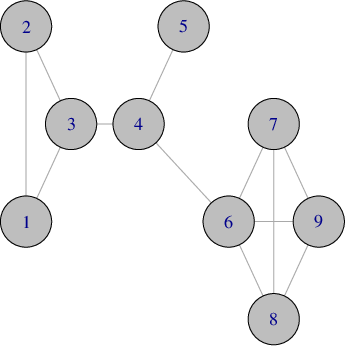
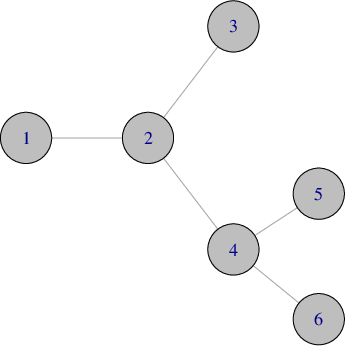

Figure 1: Examples of a block, tree, and chain graph typical of block-graph decomposability.
This block graph structure ensures that high-dimensional limit sets can be factored into analytically tractable lower-dimensional sets, solving a major impediment to general high-dimensional extreme value modeling.
Propagation of Conditional Extremes Dependence Coefficients
The α- and β-Coefficients: Definitions and Graphical Recursions
Central to the analysis are the conditional extremes coefficients, denoted αj∣i and βj∣i (or their analogues in the Laplace case). αj∣i encodes the limiting scale at which variable Xj responds to extremes in Xi, while βj∣i captures the regular variation scaling for normalization functions along paths in the graph.
A major theoretical result for block graphs is that the α-coefficient from node i to node j is given by the product of the local (edgewise) α's along the unique path connecting them:
αj∣i=e∈path(i→j)∏αe
This composition applies recursively, with path decomposition along the block-graph structure. Analogously, the behavior of the scale coefficient βj∣i is governed by a mixed product/maximum recursion involving the edge βs, which is significantly more subtle but precisely characterized via a path-based recurrence.
This recursive propagation is visualized in Figure 2, which shows extremal lines associated with α in Laplace margins for a block graph of moderate size, illustrating directional dependencies.
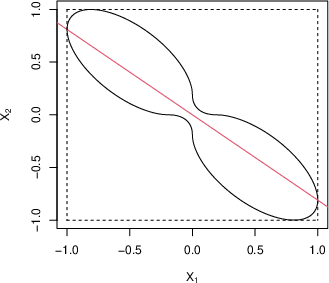
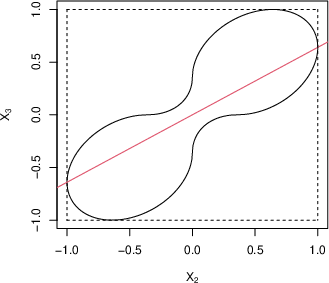
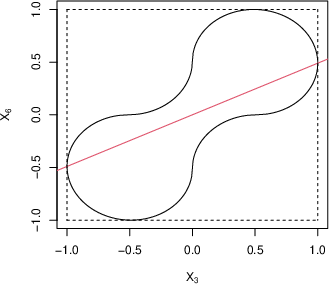
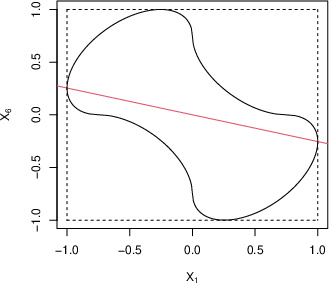
Figure 2: Bivariate limit sets and extremal directions with slopes given by α-coefficients in a Gaussian block graphical model with Laplace margins.
Analytical Structure and Explicit Examples
The paper provides detailed parametric and structural examples—including Gaussian, logistic, and max-stable cases—for both exponential and Laplace margins. It is shown, for instance, that in chains and trees with edgewise parametric gauge functions, marginal gauge functions along a path inherit dependence parameters via max and product operations according to the type of local association. Figure 3 demonstrates how pairwise and higher-order marginal limit sets encode the pathwise extremal dependencies.
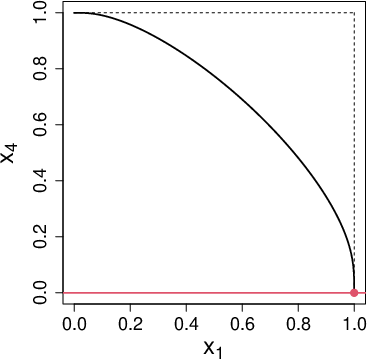
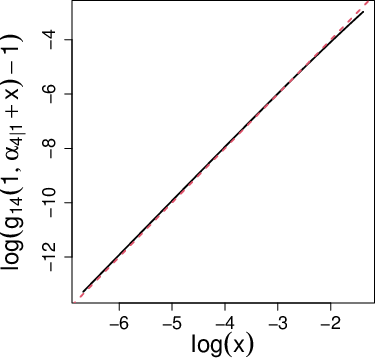
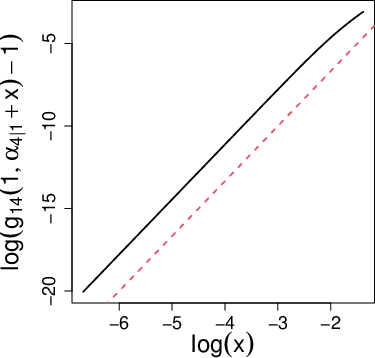
Figure 3: Marginal two-dimensional limit sets (gkl(xk,xl)=1) visualizing directionality and slope encodings of pathwise dependence.
The propagation rules are validated empirically via parametric and simulated illustrations, confirming that decay or persistence of extremal dependence along the graph closely follows the graph-theoretic structure and the form of local gauges.
Directional Joint Extremes and Extremal Connectivity
By leveraging the geometric structure, the paper formalizes the notion of joint extremes across variable subsets in terms of geometric extreme directions: a subset A is jointly extreme if the point with ones on A and non-extreme values elsewhere lies on the boundary of the limit set, i.e., g(zA)=1 for an appropriate zA.
A key structural result is that in block graphs, joint extremes between non-adjacent cliques are only possible if the separator variables are simultaneously extreme. This property is intrinsic to the factorization structure and has direct implications for the sparsity and learning of extremal graphical models.
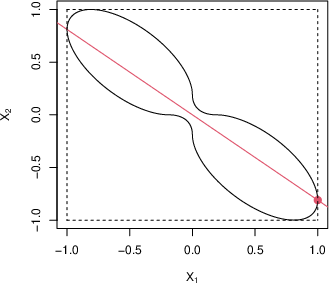
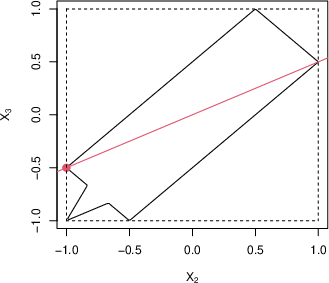
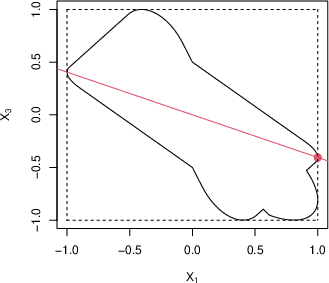
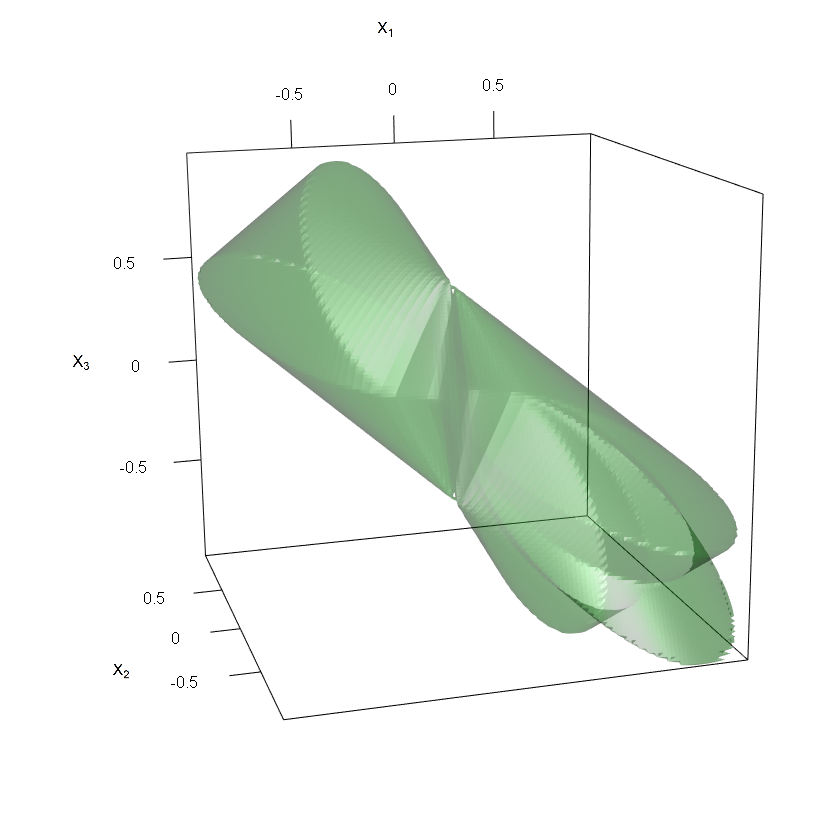
Figure 4: Three-dimensional limit set for a chain model, showcasing how geometric extreme directions correspond to boundary contacts on the limit set.
The relationship between α-coefficients and geometric extreme directions is clarified: αj∣i=1 signals that Xi and Xj can be simultaneously extreme, and the cross-clique propagation of these directions is controlled by the graph topology.
Block Graph Models for Joint Asymptotic Dependence
In the special case where all edges exhibit maximal dependence (i.e., all local α's equal 1), the model reduces to full asymptotic dependence, and the global joint extremes coincide with those found in classical exponent measure representations. The authors perform a detailed analysis of how classical bivariate and higher-dimensional gauge functions—such as those from the logistic and inverted logistic family—compose along trees, yielding explicit forms for marginal gauges at arbitrary distances and quantifying decay of dependence (Figure 5).
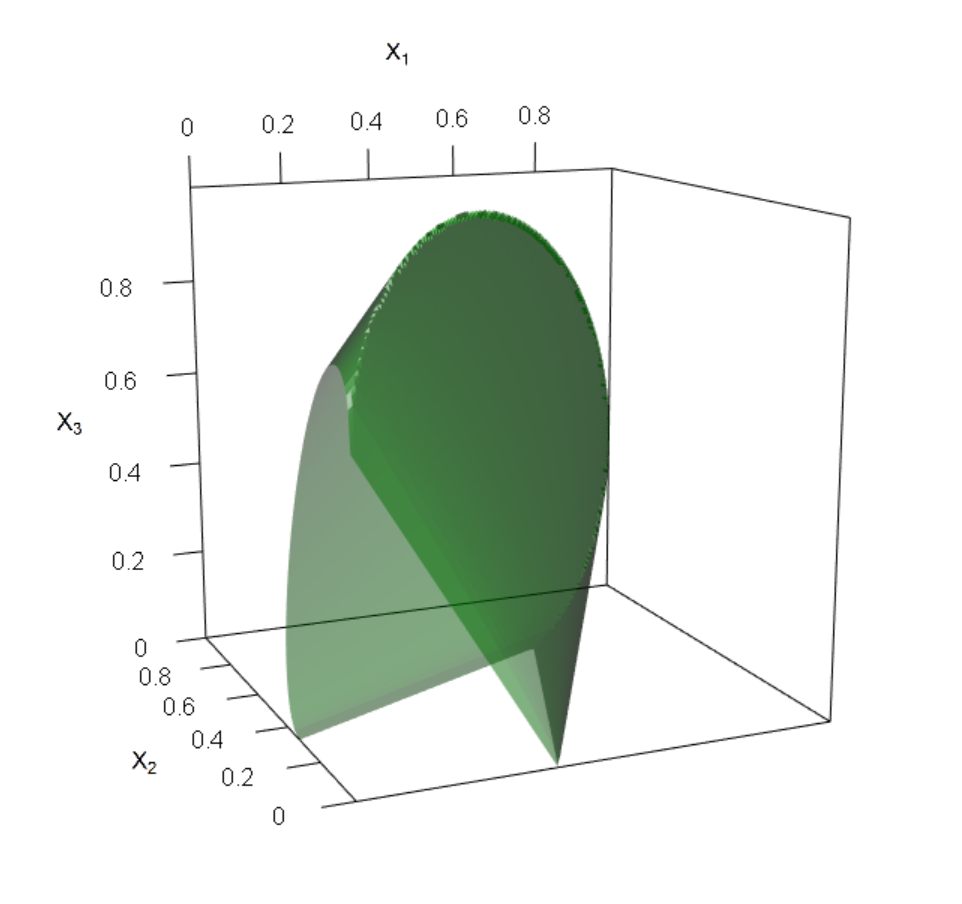
Figure 5: Limit set structure g(x1,x2,x3)=1 for a chain model combining logistic and Gaussian gauge functions.
Implications, Statistical Inference, and Future Directions
The theory developed establishes a comprehensive foundation for high-dimensional modeling and inference of extremes with complex and possibly sparse dependence. Practically, the block graph structure provides an immediate template for likelihood-based inference using geometric limit set models: only the clique-level gauge functions are required, with global consistency ensured by the geometric factorization.
The explicit pathwise propagation of dependence coefficients enables interpretable analysis of high-dimensional system risk, signal attenuation (or persistence), and explainable dependence patterns, potentially facilitating variable selection and structure learning in extremal settings.
The theoretical results supply direct guidance for constructing flexible yet consistent parametric and nonparametric models for multivariate extremes. Inference for GEGMs can be performed via empirical estimation of gauge functions and conditional extreme coefficients, following the statistical modeling blueprint set out in recent geometric approaches to extremes.
The framework extends seamlessly to Laplace margins and to graphs with more complex separator structures (beyond block graphs), although much of the current analysis leverages the block structure for analytic simplicity.
Future research will focus on:
- Statistical learning: Estimation and structure selection for GEGMs in high dimensions, including regularization and compatibility constraints for clique gauges.
- Extension to non-block graphs: Investigation of consistency, compatibility, and extremal propagation in non-block (general decomposable or even non-decomposable) graphs.
- Broader applications: Application to spatial extremes, time series extremes, and network-based extremes with heterogeneous dependence regimes.
Conclusion
The geometric extremal graphical models introduced delineate a rigorous, unified framework for extremal dependence in high dimensions, with propagation laws for dependence coefficients explicitly determined by the block-graph topology. The gauge-based factorization and its consequences for dependence attenuation, joint extremal connectivity, and statistical modeling represent substantial advances for the theory and practical inference of multivariate extremes in complex systems.
Key reference: "Geometric extremal graphical models and coefficients of extremal dependence on block graphs" (2601.00239).

