- The paper presents SAGA, a bi-level agentic architecture that dynamically evolves objectives to overcome reward hacking and improve candidate validity.
- SAGA outperforms baselines in multiple domains, achieving over 90% success rates and discovering novel structures not found by static methods.
- The framework enables varying degrees of autonomy, from human-assisted to fully autonomous, ensuring scalable and practical scientific discovery.
Autonomous Goal-Evolving Agents for Accelerated Scientific Discovery
Introduction
"Accelerating Scientific Discovery with Autonomous Goal-evolving Agents" (2512.21782) presents a paradigm shift in design automation for scientific research. The prevalent framework for ML-accelerated scientific discovery builds on optimizing fixed, human-specified objectives. However, in practical settings ranging from medicinal chemistry to materials engineering, these objectives are inherently imperfect proxies; static specification invites reward hacking and leads to solutions that satisfy the computational metric while violating core scientific desiderata. This work proposes a generalist agentic architecture, termed Scientific Autonomous Goal-evolving Agent (SAGA), which automates not only candidate solution generation but also dynamic, iterative evolution of the objective functions themselves.
Architectural Overview
SAGA is architectured as a bi-level agentic framework. The outer loop contains LLM-driven agent modules responsible for iterative analysis, proposal, and implementation of new objectives, while the inner loop optimizes candidate solutions with respect to the current objective set using any compatible optimization backend (default: LLM-based evolutionary algorithms). The outer loop consists of four roles: Planner (objective proposal), Implementer (scoring function synthesis), Optimizer (candidate generation/evaluation), and Analyzer (progress analysis and feedback).
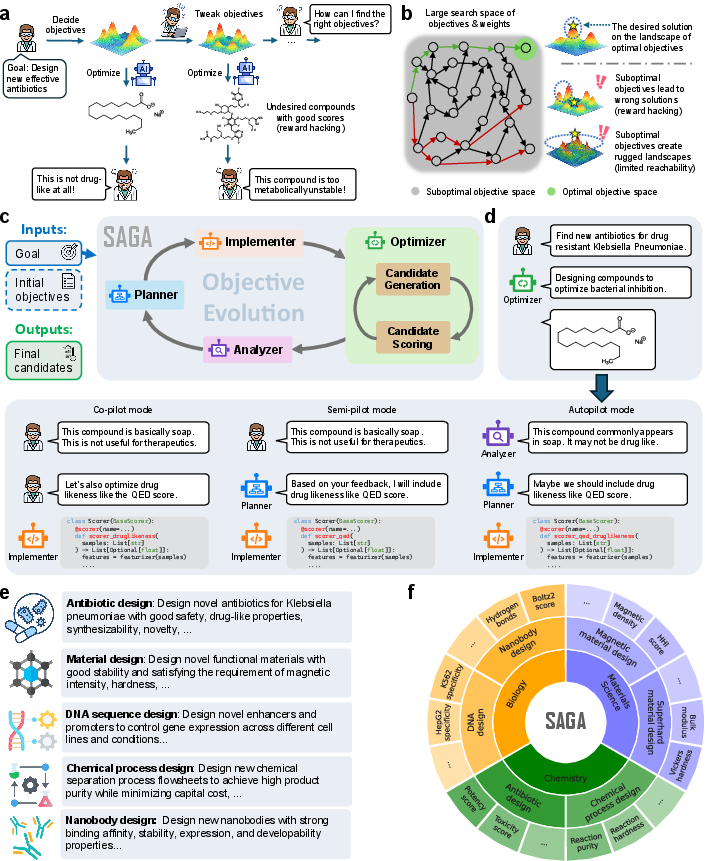
Figure 1: SAGA’s framework decomposes discovery into iterative objective evolution and candidate optimization, supporting multiple domains and levels of autonomy.
A central design innovation is user-controllable degrees of autonomy, spanning Co-pilot (human-in-the-loop for planning and analysis), Semi-pilot (human oversight only at analysis), and Autopilot (fully autonomous). This hierarchy enables both expert steering during initial exploration and scalable, hands-off experimentation once priors are codified.
Antibiotic Design: Avoiding Reward Hacking
The challenge of antibiotics generation against Klebsiella pneumoniae illustrates the vulnerability of static objectives: prior LLM and RL-driven methods often maximize activity at the cost of synthesizability or drug-likeness, leading to candidates unlikely to survive practical filter cascades. Using only core biological objectives and minimal constraints, SAGA dynamically augments its objectives based on intermediate population analysis, e.g., by auto-discovering and deploying QED, synthetic accessibility, and motif filters, without user prompt engineering.
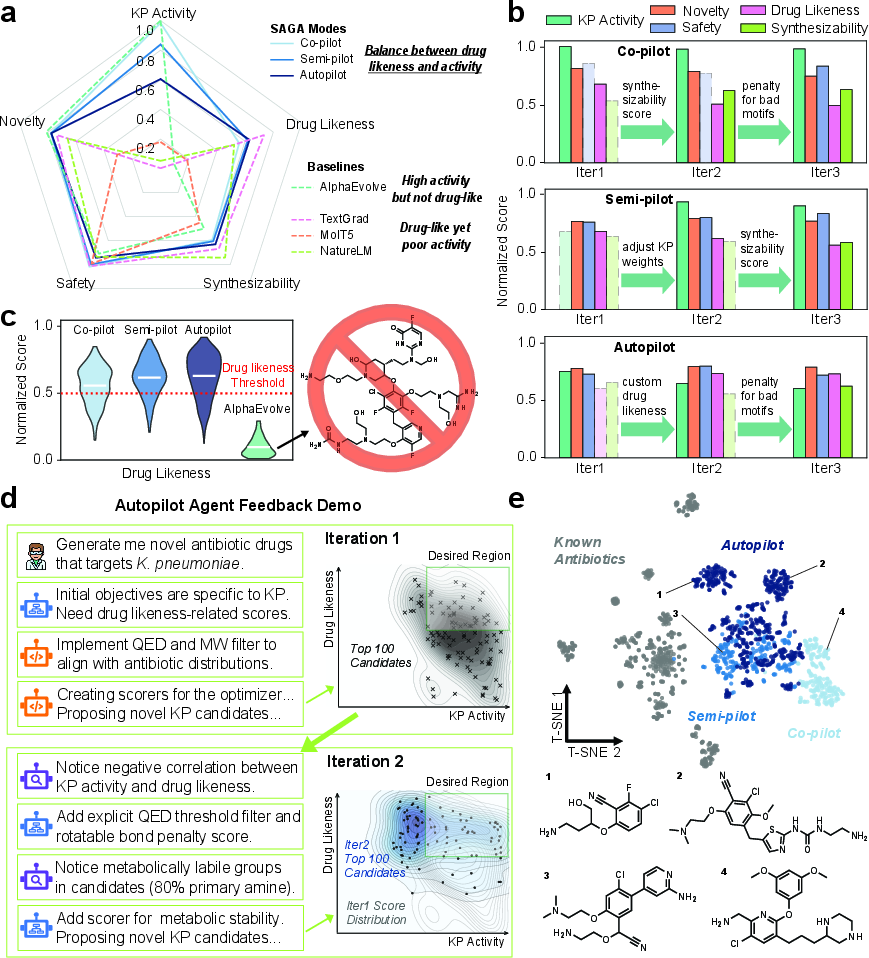
Figure 2: SAGA’s agents produce candidates balancing drug-likeness, synthesizability, and high biological activity, whereas static baselines such as AlphaEvolve exhibit critical misalignment.
Key empirical findings:
- SAGA modes (across autonomy spectrum) yield candidate sets where ≥90% surpass all practical evaluation thresholds (activity, QED, SA)—an improvement of 30–60% over LLM and RL baselines.
- AlphaEvolve, lacking objective evolution, produces molecules with high predicted activity but catastrophic drop in drug-likeness and synthesizability scores.
- Agent-generated candidates occupy novel scaffold space, as confirmed by t-SNE embeddings vis-à-vis the known antibiotic manifold.
Inorganic Materials Design: Multi-Objective Optimization
Inverse materials design typically entails multi-objective optimization with entangled, often contradictory property desiderata, e.g., maximizing magnetic density while minimizing supply chain risk (quantified by HHI). SAGA, using iterative planner and analysis loops, not only improves mean property scores but also discovers novel stable crystal structures not reachable by fixed-objective generative baselines.
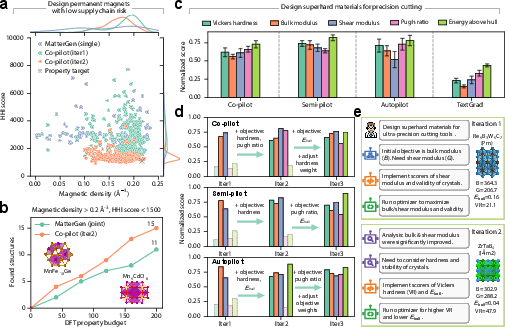
Figure 3: Iterative SAGA cycles produce distributions concentrated near high magnetic density and low HHI, outperforming MatterGen in stable/novel crystal yield per DFT evaluation.
Quantitative results:
- SAGA reliably identifies >15 stable, novel structures within 200 DFT calculations, exceeding MatterGen’s output for both property targets.
- In superhard material generation, planner modules adaptively introduce or reweight objectives (e.g., Vickers hardness, elastic modulus, energy above hull) as dictated by analysis feedback, resulting in consistently superior performance across all evaluation metrics compared to both LLM optimization and diffusion-based models.
Functional DNA Sequence Design: Satisfying Biological Constraints
Regulatory element engineering (enhancer/promoter design) is a task where maximizing a sequence-level oracle (e.g., predicted MPRA activity) often produces biologically implausible or unstable candidates. SAGA applies systematic objective evolution, integrating or auto-discovering additional constraints such as motif enrichment and sequence stability penalties only when empirical deficits are detected during analysis.
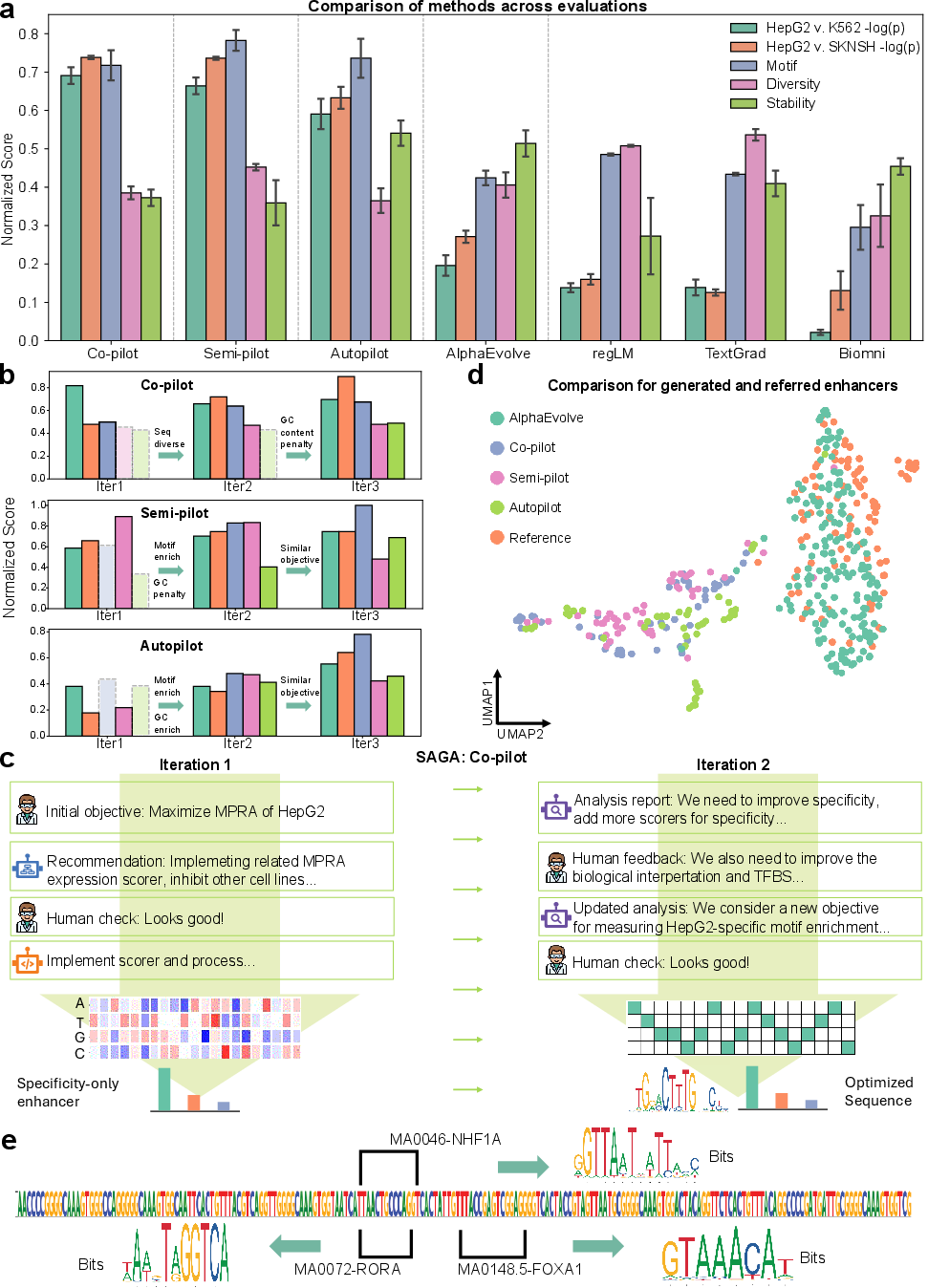
Figure 4: SAGA outperforms static baselines in all held-out enhancer design metrics, including MPRA specificity, biologically relevant motif enrichment, diversity, and stability.
Numerical improvements are pronounced:
- SAGA exceeds baselines by up to 48% in cell-type-specific MPRA activity and over 47% in motif enrichment.
- Agent analysis reports trigger iterative addition of stability constraints and motif coverage objectives, producing candidates simultaneously optimized for statistical, biological, and practical metrics.
- Sequence embedding visualizations (UMAP/t-SNE) confirm greater novelty and diversity relative to prior generators.
Chemical Process Design: Closing the Loop with RL
LLM- and RL-enabled autonomous flowsheet design faces analogous reward hacking issues: maximizing product purity alone incentivizes unnecessary unit operations and inefficient processes. SAGA’s analyzer identifies such pathological solutions, recommending the dynamic introduction of objectives penalizing complexity and inefficient material flow, then harmonizes trade-offs via reweighting in subsequent iterations.
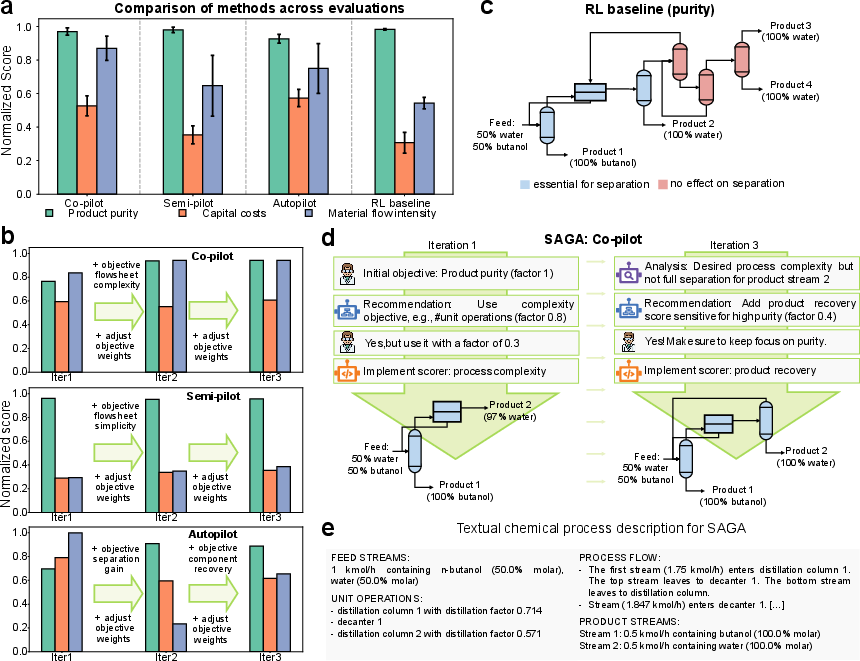
Figure 5: SAGA’s iterative outer loop elevates flowsheet evaluation metrics and automates human-expert refinement by suggesting objectives addressing practical process design limitations.
Implications and Limitations
SAGA establishes a formalism where scientific discovery workflows are truly closed-loop—objectives and constraints themselves are not statically specified but are subject to empirical and analytic scrutiny, mirroring expert workflows. This results in higher validity, practicality, and novelty across chemical, biological, and engineering domains.
Significant claims:
- SAGA consistently achieves higher pass rates across standard and domain-specific benchmarks than existing state-of-the-art agents.
- The outer loop’s objective evolution mitigates reward specification hacking, a major failure mode observed in prior LLM/RL-only architectures.
Limitations:
- SAGA relies on computationally implementable objectives or proxies. In domains where evaluation requires wet-lab feedback or human judgment, extensions to in-the-loop or hybridized pipelines are required.
- Discoverability is limited by the design-space priors; future work includes autonomous augmentation of the design space itself.
Conclusion
SAGA formalizes and realizes a bi-level agentic methodology for candidate generation and objective co-evolution. Across representative tasks, it outperforms fixed-objective frameworks, producing solutions meeting multi-faceted, domain-specific evaluation pipelines. This architecture offers a practical pathway toward autonomous, robust, and interpretable generalist AI scientists, potentially redefining design workflows across diverse scientific fields.

