All-optical control and multiplexed readout of multiple superconducting qubits
Abstract: Superconducting quantum circuits operate at millikelvin temperatures, typically requiring independent microwave cables for each qubit for connecting room-temperature control and readout electronics. However, scaling to large-scale processors hosting hundreds of qubits faces a severe input/output (I/O) bottleneck, as the dense cable arrays impose prohibitive constraints on physical footprint, thermal load, wiring complexity, and cost. Here we demonstrate a complete optical I/O architecture for superconducting quantum circuits, in which all control and readout signals are transmitted exclusively via optical photons. Employing a broadband traveling-wave Brillouin microwave-to-optical transducer, we achieve simultaneous frequency-multiplexed optical readout of two qubits. Combined with fiber-integrated photodiode arrays for control signal delivery, this closed-loop optical I/O introduces no measurable degradation to qubit coherence times, with an optically driven single-qubit gate fidelity showing only a 0.19% reduction relative to standard microwave operation. These results establish optical interconnects as a viable path toward large-scale superconducting quantum processors, and open the possibility of networking multiple superconducting quantum computers housed in separate dilution refrigerators through a centralized room-temperature control infrastructure.
Paper Prompts
Sign up for free to create and run prompts on this paper using GPT-5.
Top Community Prompts
Explain it Like I'm 14
Plain-language summary of “All-optical control and multiplexed readout of multiple superconducting qubits”
Overview
This paper shows a new way to control and read data from quantum computer chips made of superconducting qubits using only light sent through thin optical fibers, instead of thick microwave cables. The team built and tested a full “closed loop” where light carries the signals both into the fridge (to control the qubits) and back out (to read their states). It worked well, didn’t harm the qubits, and could make it much easier to build bigger, more connected quantum computers.
What questions did the researchers try to answer?
The paper focuses on three simple questions:
- Can we replace many bulky microwave cables with just a few optical fibers and still control and read qubits reliably?
- Can one optical device read multiple qubits at the same time (so it scales to bigger systems)?
- Does sending light into the quantum fridge hurt qubit performance (like their lifetimes or gate accuracy)?
How did they do it? (Methods explained simply)
Think of signals as different “languages”:
- Qubits inside a super-cold fridge “speak” microwave.
- Long-distance communication works best in “light” (optical fibers).
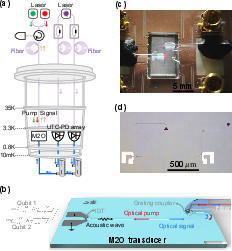
The team used two special chips that act like translators:
- Optical-to-microwave control (downlink)
- A cryogenic photodiode turns a light signal from outside the fridge into a microwave signal inside the fridge.
- This lets them send precise qubit control pulses down a single fiber.
- Analogy: It’s like shining a flashlight with a pattern that a tiny solar panel converts into a radio signal for the qubit.
- Microwave-to-optical readout (uplink)
- A traveling-wave Brillouin transducer turns microwave signals from the qubits into light that travels back through the fiber.
- How it works in everyday terms:
- First, microwaves shake a tiny “sound wave” in the chip (like ripples).
- Then, a strong laser “listens” to those ripples and shifts some of its light into a new color (this is Brillouin scattering).
- That new light carries the qubit’s information out of the fridge.
- “Traveling-wave” means it works over a continuous range of frequencies, like a highway, instead of narrow single lanes. This is important because it allows many qubits to share the same device by tuning different “channels.”
Multiplexing (reading multiple qubits)
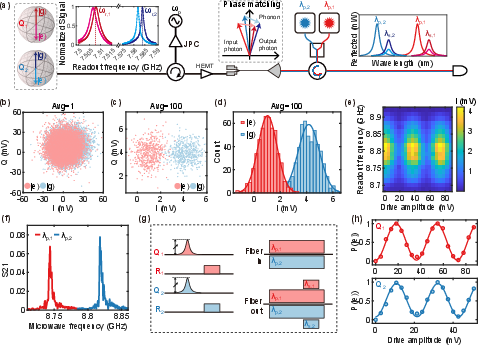
- They used different laser colors (wavelengths) so one chip could handle multiple microwave frequencies at once. Think “different radio stations” carried on different colors of light.
- For their setup, they also used a device (a Josephson parametric converter) to shift the qubit readout frequencies into the transducer’s sweet spot. Future versions can skip this with better matching.
Signal detection
- Outside the fridge, they measured the light using a method called heterodyne detection. Simple analogy: it’s like listening to two singers at once and hearing the “beat” between them, which tells you the signal’s strength and phase.
Main findings and why they matter
Here are the key results they demonstrated:
- Complete all-optical loop: Both control and readout were carried entirely by light through fibers. No long microwave cables needed.
- Multiple-qubit readout with one device: They read two qubits at the same time using one transducer by sending in two laser colors. This shows a path to scaling up.
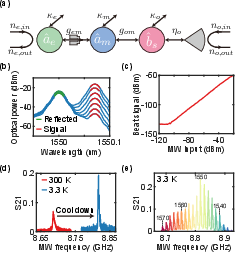
- Big bandwidth: The microwave-to-optical transducer worked over more than 200 MHz of bandwidth. In practice, that means one device can support many frequency channels and many qubits.
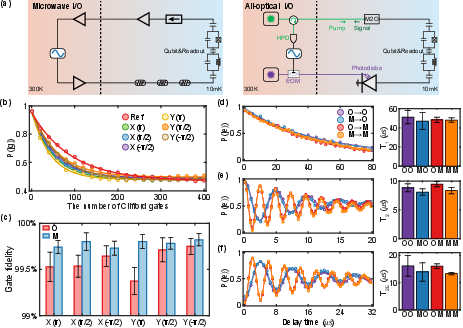
- High-quality control: Optical control achieved about 99.5% single-qubit gate fidelity, only ~0.19% lower than standard microwave control. That’s a very small difference.
- No extra “damage” to qubits: Important measures of qubit health (like T1, T2, and echo times) stayed essentially the same whether they used microwave cables or optical fibers, even with light shining in continuously. This means the optical hardware doesn’t ruin the delicate quantum states.
Why this is important:
- Microwave cables are thick, take up space, conduct heat, and become a huge wiring problem when you try to connect hundreds of qubits. Optical fibers are thin, carry almost no heat, and can carry many signals at once. Switching to light helps solve the “I/O bottleneck” that makes scaling difficult.
- It opens the door to connecting several quantum fridges to a single room-temperature control station, or even linking different quantum computers together.
What could this lead to? (Implications)
- Bigger systems with fewer wires: With improved transducer efficiency and on-chip photonics (like compact multi-color laser sources and optical filters), one fiber and one transducer could handle readout for many qubits—potentially 100 or more—while using reasonable cooling power.
- Better networking: If future versions reach high efficiency with very low added noise, the same devices could send quantum information (not just classical data) over optical fibers. That could allow entangling qubits in different fridges and building quantum networks.
- Beyond superconducting qubits: Any cryogenic quantum device that struggles with wiring and heat could benefit from this optical I/O approach.
In short, this paper shows that controlling and reading superconducting qubits entirely with light is practical, gentle on the qubits, and a promising path to larger, more connected quantum computers.
Knowledge Gaps
Knowledge gaps, limitations, and open questions
Below is a concise, actionable list of what remains missing, uncertain, or unexplored in the paper’s all-optical I/O architecture for superconducting qubits:
- End-to-end readout performance is not quantified at the single-shot level:
- No report of single-shot readout fidelity, assignment error, or measurement quantum efficiency.
- Readout relies on long pulses (~10 µs) and substantial averaging (e.g., 100 repeats for single-qubit discrimination; 5×10⁴ for Rabi), far from typical <300 ns, single-shot QEC-compatible readout.
- Full noise characterization of the M2O link is absent:
- No measurement of added noise (in photons) of the transducer, system noise temperature, or optical ASE contributions from the EDFA in the heterodyne chain.
- No assessment of measurement-induced dephasing attributable to the transducer and pumps.
- Transduction efficiency remains orders of magnitude too low for quantum-level operation:
- Reported M2O efficiency at 3.3 K is ~2.5×10⁻⁶/W (per pump power), versus targeted ≥10-2/W for quantum networking and high-SNR readout.
- Lacks a quantitative roadmap (power vs. channel count vs. noise) to reach the stated 10-2/W with traveling-wave cavity enhancements.
- Scaling beyond two multiplexed readout channels is not demonstrated or stress-tested:
- No characterization of inter-channel crosstalk, intermodulation products, pump depletion, or mixing when many optical pumps (WDM) are present simultaneously.
- No analysis of channel isolation, dynamic range, and spurious tones as the number of readout channels scales to tens or more.
- Frequency-bridging via a JPC adds complexity and potential noise:
- The need to upconvert readout frequencies with a JPC indicates bandwidth/center-frequency mismatches; the impact of the JPC’s pump tones, dynamic range, and added noise on multi-qubit operation remains uncharacterized.
- A concrete path to remove the JPC (e.g., by matching transducer passband to readout resonators) is not experimentally validated.
- Limited readout bandwidth in practice:
- While >200 MHz tunability is shown (via pump wavelength sweep), the per-channel instantaneous 3 dB bandwidth at 3.3 K is ~0.88 MHz; the implications for fast, high-SNR, wideband readout are not analyzed.
- Flatness of the IQ transfer function, group delay variation, and phase linearity across the 200 MHz span are unmeasured.
- Thermal-load and heating effects at scale are not quantified:
- Operation uses ~100 mW optical pump per channel at 3.3 K; no detailed thermal budget, scattering loss analysis, or heat-leak mapping to the mK stage.
- No direct measurements of pump-induced quasiparticles, parity-switching rates, or residual heating under sustained multi-pump operation.
- “No measurable coherence degradation” is shown only in a limited regime:
- Coherence tests (T1, T2, T2E) were performed on a single qubit and under a small number of channels; the robustness under many simultaneous pumps and long-duration operation is unknown.
- Impact on idle qubits and multi-qubit crosstalk during parallel optical readout/control is unreported.
- Latency and feedback-readiness are uncharacterized:
- No measurements of end-to-end control/readout latency (including ~30 m fiber, O/E and M2O conversions, and digital processing), nor demonstrations of real-time feedback tasks (e.g., active reset, mid-circuit measurements, QEC cycles).
- Optical control path noise and stability are not assessed:
- The amplitude/phase noise transfer from lasers/EOM to UTC photodiodes and its impact on gate errors is not quantified.
- Long-term stability of EOM bias, UTC linearity, and calibration drift over hours/days and thermal cycles is not reported.
- Residual microwave cabling remains at the coldest stage:
- The architecture still uses ~1 m microwave cables between 3.3 K interfaces and mK qubits; a plan to eliminate these (e.g., by integrating transducers/photodiodes at mK) and the associated thermal/power implications is not provided.
- Polarization management and packaging reliability are unaddressed:
- Sensitivity of grating couplers to polarization and fiber polarization drift in a cryostat is not evaluated.
- Long-term reliability of fiber alignment and cryo-compatible adhesives under repeated thermal cycles is not reported.
- Optical pump management and WDM complexity at scale:
- No detailed design for on-chip multi-wavelength generation, routing, filtering, and stabilization (e.g., microcombs, AWGs) with quantified pump power per channel, isolation, and control overhead.
- Requirements for pump wavelength/phase stabilization and servo bandwidths to maintain phase-matching over time are not specified.
- Quantum-limited readout compatibility is unclear:
- Integration with JPAs/JPCs for quantum-limited amplification in the presence of the M2O link is not demonstrated; total measurement efficiency and back-action are unmeasured.
- EDFA-induced ASE and filtering strategies appropriate for quantum-limited operation are not discussed.
- Anti-Stokes operation and directionality/isolation:
- Although Stokes/anti-Stokes operation is mentioned, a systematic study of directionality, isolation needs, and back-conversion risks (optical or microwave domain) is missing.
- Device-to-device variability and calibration overhead:
- Variations in center frequency and bandwidth from room temperature to 3.3 K (e.g., 131.56 MHz shift) suggest nontrivial calibration; stability over time, thermal hysteresis, and re-tuning procedures are not characterized.
- Impact on fast two-qubit gates and simultaneous control:
- Only single-qubit randomized benchmarking is shown; effects on two-qubit gate fidelities, simultaneous multi-qubit control, and control crosstalk via the optical downlink are not evaluated.
- Optical back-reflections and stray light:
- Potential back-reflections in fibers/couplers and stray light coupling into sensitive microwave stages (leading to dephasing or quasiparticle generation) are not measured or mitigated.
- System-level loss budget and reliability:
- Loss and SNR budgets (fiber, connectors, couplers, waveguides) and their contributions to readout infidelity and power requirements are not provided.
- Mean time between failures, aging under high optical power, and radiation/laser damage in LN waveguides and UTC photodiodes at cryo are unreported.
- Networking aspects remain speculative:
- While long-distance optical fibers are used (~30 m), synchronization across multiple refrigerators, phase noise over kilometers, clock distribution, and inter-fridge latency/jitter are not measured or demonstrated.
Practical Applications
Immediate Applications
These applications can be deployed with existing components and demonstrated performance in the paper (closed-loop optical I/O; 200 MHz readout bandwidth; 99.59% single-qubit gate fidelity under optical drive; no measurable coherence degradation).
- Optical I/O retrofits for 10–100 qubit superconducting processors (Sector: quantum hardware, lab operations)
- Use case: Replace many microwave coax lines with a few optical fibers for control and readout in existing dilution refrigerators to reduce thermal load, wiring complexity, and physical footprint.
- Tools/products/workflows: Cryo-packaged UTC photodiode modules (downlink), traveling-wave Brillouin M2O transducer module (uplink), optical fiber feedthroughs/patching, EOM-based RF-over-fiber control racks.
- Assumptions/dependencies: 3–4 K stage mounting; short (<1 m) microwave jumpers to mK stage; optical pump powers on the order of 100 mW handled thermally; HEMT amplifier at 3–4 K; potential JPC frequency bridging until transducer center frequency is matched to resonators.
- Frequency-division multiplexed optical readout over a single link (Sector: quantum hardware, test/measurement)
- Use case: Multi-qubit dispersive readout via a single M2O transducer by WDM pumping (demonstrated dual-channel; >200 MHz microwave coverage suggests ≈40 channels at 5 MHz spacing).
- Tools/products/workflows: Dual/multi-wavelength pumps, WDM couplers, automated calibration for pump–channel mapping, optical heterodyne readout software.
- Assumptions/dependencies: Current cryogenic transduction efficiency ≈2.5×10⁻⁶/W requires HEMT gain and measurement averaging; cross-talk managed by frequency planning; stability of pump wavelengths and phase.
- Centralized room-temperature control racks connected to multiple fridges via fiber (Sector: facility/infrastructure)
- Use case: Route control/readout signals across a lab or building with negligible attenuation using optical fibers; reduce per-fridge RF hardware duplication.
- Tools/products/workflows: Optical distribution (WDM), fiber timing/phase stabilization, facility fiber patch panels, monitoring.
- Assumptions/dependencies: Phase-locked optical/RF synthesis; low-drift fiber links; inter-fridge synchronization software.
- Reduced thermal load and build complexity in dilution refrigerators (Sector: operations/cost)
- Use case: Free cryogenic cooling budget by removing dozens of coaxial cables and attenuators; accelerate wiring, bring-up, and maintenance.
- Tools/products/workflows: Fiber thermal anchoring, light-tight packaging, optical power budgeting, assembly SOPs.
- Assumptions/dependencies: Proper thermalization of photonic modules at 3–4 K; management of stray light to mK stage; optical pump heat not exceeding cooling capacity.
- Optical heterodyne metrology for cryogenic microwave devices (Sector: test and measurement)
- Use case: Characterize resonators, parametric amplifiers, and other cryogenic microwave components via optical upconversion and room-temperature photonics.
- Tools/products/workflows: Brillouin M2O transducer, EDFA-assisted heterodyne detection, automated spectral/VNA workflows.
- Assumptions/dependencies: Frequency matching (or bridging) between device under test and transducer; calibration of absolute conversion gain.
- Education and training in quantum photonic interconnects (Sector: education)
- Use case: Lab courses and training modules on optical control/readout of cryogenic quantum devices.
- Tools/products/workflows: Teaching kits with small optical I/O stacks, safety protocols for lasers, curriculum on FDM/WDM and microwave–optical conversion.
- Assumptions/dependencies: Access to safe laser sources and protective infrastructure; stable demo devices.
- Supply chain and service offerings for cryo-compatible photonics (Sector: photonics/quantum supply chain)
- Use case: Commercialize cryo-rated UTC photodiodes, Brillouin M2O transducers, fiber feedthroughs, and control software for wavelength mapping and calibration.
- Tools/products/workflows: Pre-packaged cryogenic photonic modules, vendor qualification, long-term reliability testing.
- Assumptions/dependencies: Manufacturability at scale, packaging robustness, reproducible performance at cryogenic temperatures.
- Early standardization and lab safety policies for optical I/O in cryogenics (Sector: policy/standards)
- Use case: Draft guidance on connectorization, EMC/EMI, thermal anchoring, and laser safety for optical links in dilution refrigerators; procurement and compliance specs for public labs.
- Tools/products/workflows: Best-practice documents, standards working groups, certification checklists.
- Assumptions/dependencies: Community/industry alignment; compatibility with existing cryostat vendors and safety regulations.
Long-Term Applications
These applications require higher conversion efficiency, lower added noise, integrated photonic WDM, and/or additional engineering for scale and reliability.
- Thousand-qubit-class optical interconnects for superconducting processors (Sector: quantum hardware, cloud)
- Use case: Scale readout and control to hundreds of qubits per fridge using a handful of fibers; ≈100 channels per transducer/fiber at 4 K with projected efficiency improvements.
- Tools/products/workflows: Traveling-wave cavity-enhanced Brillouin transducers (target ≈10⁻²/W), on-chip microcomb sources, arrayed-waveguide gratings, integrated modulators, thermal/power budgeting tools, channel planning software.
- Assumptions/dependencies: Conversion efficiency and low added noise achieved; 4 K cooling power ≈1 W per module; robust WDM stability and low inter-channel cross-talk.
- Modular multi-fridge quantum data centers with centralized control (Sector: infrastructure/cloud)
- Use case: Network multiple dilution refrigerators in one facility via fiber “backplanes,” sharing high-end control/laser racks and streamlining maintenance.
- Tools/products/workflows: Phase-stabilized optical distribution networks, fiber patching/monitoring, redundancy management, orchestration software for shared resources.
- Assumptions/dependencies: Long-term phase/timing stability; fault tolerance and hot-swapping; facility-scale fiber management.
- Quantum networking between superconducting processors over telecom fiber (Sector: quantum communications)
- Use case: Remote entanglement distribution, teleportation, and distributed error correction between superconducting nodes via coherent microwave–optical transduction.
- Tools/products/workflows: Bidirectional M2O/O2M with high efficiency and near-quantum-limited noise, single-photon detectors, time/frequency synchronization over fiber, networked QEC protocols.
- Assumptions/dependencies: Efficiency ≥10⁻²–10⁻¹ with low added noise; loss-managed links; phase stabilization; integration with entanglement generation/swap workflows.
- Cross-platform cryogenic optical I/O (Sector: semiconductors/sensing/astrophysics)
- Use case: Optical control/readout for other cryogenic quantum platforms (e.g., semiconductor spin qubits, quantum dots) and cryogenic sensors (TES, MKIDs), creating a unified photonic backplane across modalities.
- Tools/products/workflows: Device-specific frequency interfaces (IDT design, impedance matching), tailored WDM plans, noise budget modeling per modality.
- Assumptions/dependencies: Compatibility of frequencies and bandwidths; device-level tolerance to optical presence; manageable added noise.
- Energy and sustainability improvements in quantum facilities (Sector: energy/infrastructure)
- Use case: Lower thermal load per qubit by eliminating many coaxial attenuators/cables, enabling smaller refrigerators or more qubits per fridge; reduce helium usage and facility power.
- Tools/products/workflows: High-efficiency transduction (reduced pump power), improved thermal anchoring of fibers, facility-level energy monitoring.
- Assumptions/dependencies: Significant efficiency gains (transducer and photonic integration); effective mitigation of stray light heat loads.
- Integrated “optical I/O blade” at 3–4 K for cryostats (Sector: hardware products)
- Use case: A standardized photonic-electronic module providing WDM pumps, UTC PD arrays, M2O transducers, HEMT amps, and diagnostics as a drop-in I/O backplane for fridges.
- Tools/products/workflows: Rugged cryogenic photonics packaging, self-calibration and health monitoring, vendor-neutral interfaces to mK devices.
- Assumptions/dependencies: Long-term reliability at cryo; manufacturability; serviceability.
- Automation of wavelength/frequency planning and drift compensation (Sector: software/DevOps for QPUs)
- Use case: Software-defined control/readout planes that auto-assign channels, track drift, and optimize SNR for dozens–hundreds of optical channels per fridge.
- Tools/products/workflows: Real-time telemetry from optical taps, ML-driven calibration, APIs integrated with quantum control stacks and schedulers.
- Assumptions/dependencies: Sufficient in-line diagnostics; standardized control interfaces; robust telemetry.
- Telecom and RF-over-fiber spinouts (Sector: telecom/defense/space)
- Use case: Adapt traveling-wave Brillouin transducers as low-noise RF-to-optical links for specialized cryogenic radio astronomy frontends or secure RF distribution.
- Tools/products/workflows: Frequency-range-optimized transducers, rugged packaging, environmental hardening.
- Assumptions/dependencies: Targeted frequency bands and noise figures achievable; market fit and certification.
- Indirect daily-life impact via scalable cloud quantum computing
- Use case: Improved reliability and scale of cloud-accessible quantum processors accelerates progress in materials discovery, logistics optimization, and drug design.
- Tools/products/workflows: Data-center-grade optical interconnects for QPUs, robust operation under error-corrected regimes.
- Assumptions/dependencies: Successful scaling with error correction; integration into industrial application pipelines.
Glossary
- Acousto-optic modulators: Devices that use sound waves to modulate light, enabling on-chip wavelength control and multiplexing. "such as microcomb sources, arrayed waveguide grating, and integrated acousto-optic or electro-optic modulators."
- Anti-Stokes processes: Brillouin or Raman scattering events where photons gain energy by annihilating phonons, producing a higher-frequency sideband. "our device supports both Stokes and anti-Stokes processes simply by reversing the pump incidence direction through different grating coupler ports"
- Arrayed waveguide grating: An integrated photonic device that separates or combines multiple wavelengths for multiplexing. "such as microcomb sources, arrayed waveguide grating, and integrated acousto-optic or electro-optic modulators."
- Beam-splitter-like Hamiltonian: An interaction model that linearly couples two bosonic modes, analogous to a beam splitter in optics. "The piezoelectric interaction via the IDT is described by a beam-splitter-like Hamiltonian"
- Beat note: The RF signal produced at the difference frequency when two optical fields interfere on a photodetector. "This beat note, recorded by a microwave spectrum analyzer, provides stable and reproducible measurement of the converted optical signal power."
- Brillouin scattering: A nonlinear interaction where light couples to acoustic phonons, creating frequency-shifted Stokes or anti-Stokes sidebands. "the Brillouin scattering process is governed by the optomechanical Hamiltonian"
- Dilution refrigerator: A cryogenic system that reaches millikelvin temperatures for superconducting circuits. "Within a single dilution refrigerator, the dense array of coaxial cables imposes severe constraints on the number of individually addressable qubits"
- Dispersive readout regime: A measurement method where the qubit state shifts the resonator frequency without energy exchange, encoding information in probe amplitude/phase. "In the dispersive readout regime, each qubit induces a state-dependent shift to the readout cavity"
- Electro-optic modulator (EOM): A device that modulates an optical carrier using an applied electric field. "control signals are applied onto an optical carrier via a room-temperature electro-optic modulator (EOM)"
- Erbium-Doped Fiber Amplifier (EDFA): A fiber-based optical amplifier operating in the telecom band to boost optical signals. "The reflected light is amplified to 5 dBm using an Erbium-Doped Fiber Amplifier (EDFA) before detection by a high-speed photodetector (HPD)"
- Frequency-division multiplexing: Sending multiple signals simultaneously by assigning distinct frequency channels. "we implement frequency-division multiplexing by driving the transducer with two distinct optical pump tones"
- Grating coupler: A photonic structure that couples light between optical fibers and on-chip waveguides. "The optical fiber end is located above the grating coupler (red)."
- Hahn-echo coherence time (T2E): The decoherence timescale measured with a Hahn-echo sequence that refocuses static noise. "Hahn-echo coherence time "
- High-electron-mobility-transistor (HEMT) amplifier: A low-noise cryogenic microwave amplifier using high-mobility semiconductor channels. "Additionally, a high-electron-mobility-transistor (HEMT) amplifier at 3.3 K provides gain"
- Heterodyne detection: Detection technique that mixes a signal with a local oscillator to produce an intermediate-frequency beat signal. "we also employ a heterodyne detection scheme to resolve the weak optical signals."
- Interdigital transducer (IDT): A piezoelectric electrode structure that converts microwaves into traveling acoustic waves. "an interdigital transducer (IDT) converts incoming microwave photons into traveling acoustic phonons via the piezoelectric effect"
- Josephson junctions: Superconducting tunnel junctions that form the nonlinear element of superconducting qubits. "quantum bits based on Josephson junctions"
- Josephson parametric converter (JPC): A nonlinear superconducting device used for frequency conversion and amplification via parametric pumping. "we employ a flux-pumped Josephson parametric converter (JPC) to upconvert the readout tones"
- Lithium niobate ridge waveguide: A guided-wave structure on LiNbO3 supporting optical and acoustic modes for transduction. "via the piezoelectric effect in a lithium niobate ridge waveguide on a sapphire substrate."
- Microwave-to-optical (M2O) transducer: A device that coherently converts microwave signals into optical sidebands. "coherent microwave-to-optical (M2O) transducers exploiting electro-optic, optomechanical, and piezo-optomechanical interactions"
- Optomechanical Hamiltonian: The interaction Hamiltonian describing coupling between optical and mechanical modes. "the Brillouin scattering process is governed by the optomechanical Hamiltonian"
- Phase-matching condition: The momentum/energy conservation requirement enabling efficient nonlinear wave interactions. "By fulfilling the phase-matching condition for the Stokes/anti-Stokes processes"
- Piezo-optomechanical interactions: Combined piezoelectric and optomechanical coupling that links electrical, mechanical, and optical domains. "exploiting electro-optic, optomechanical, and piezo-optomechanical interactions"
- Piezoelectric effect: The conversion between electrical signals and mechanical strain or phonons in piezo materials. "via the piezoelectric effect in a lithium niobate ridge waveguide"
- Randomized benchmarking (RB): A protocol to estimate average gate fidelity using random sequences and decay analysis. "We validate the control fidelity using single-qubit randomized benchmarking (RB)."
- Ramsey dephasing time (T2): The qubit dephasing timescale measured via a Ramsey interference experiment. "Ramsey dephasing time , and Hahn-echo coherence time "
- Rabi oscillations: Coherent oscillations of qubit populations under resonant driving. "we measure Rabi oscillations by varying the amplitude of a resonant drive pulse"
- S21 scattering coefficient: The forward transmission parameter in network analysis indicating conversion/transmission gain. "the microwave-optical scattering coefficients (S21) measured at room temperature (300 K) and cryogenic temperature (3.3 K)"
- Stokes regime: The Brillouin process producing a lower-frequency (red-shifted) optical sideband. "In this work, we operate in the Stokes regime"
- Telecom C-band: The optical wavelength range (~1530–1565 nm) widely used in fiber communications. "by sweeping the optical pump wavelength across the telecom C-band"
- Traveling-wave cavities: Resonant structures that enhance interactions while supporting propagating modes over extended lengths. "the transduction efficiency can be further boosted by incorporating traveling-wave cavities"
- Uni-traveling-carrier (UTC) photodiode: A high-speed photodiode architecture where only electrons traverse the device to deliver broad bandwidth. "uni-traveling-carrier (UTC) photodiode arrays"
- Vector network analyzer (VNA): An instrument that measures scattering parameters across frequency. "The frequency response of the device is further characterized using a vector network analyzer (VNA)."
Collections
Sign up for free to add this paper to one or more collections.

