- The paper introduces a hybrid-Hill estimator that merges block maxima and peaks-over-threshold methods to reduce bias in extreme value analysis.
- It demonstrates reduced mean squared error and robust asymptotic properties through extensive simulation on Pareto-distributed data.
- The approach offers flexible and practical extreme value estimation for complex environmental and financial datasets.
A Hybrid-Hill Estimator Enabled by Heavy-Tailed Block Maxima
Introduction
Extreme value theory (EVT) traditionally divides into two predominant methodologies for estimating extreme value parameters: the block maxima (BM) method and the peaks-over-threshold (POT) method. While the BM approach aggregates data within fixed-length intervals, often disregarding sub-maximal observations, the POT strategy focuses on exceedances over predefined high thresholds. The former is historically rooted in hydrology, exemplified by Gumbel's early work, whereas the latter has gained favor due to its perceived efficiency in utilizing all available data (2512.19338).
The paper under discussion presents a novel hybrid estimator that synthesizes these two historically distinct methods. By leveraging heavy-tailed distributions, this hybrid-Hill estimator provides a unified, semi-parametric framework for extreme value analysis that gracefully de-emphasizes the dependence on block size selection, thus addressing a notable pitfall in BM methodology (2512.19338).
Methodology
The hybrid-Hill estimator aims to estimate the extreme value index γ, an indicator of tail heaviness, using both BM and POT approaches. The BM method typically divides data into non-overlapping blocks, analyzing only block maxima, while potentially neglecting useful data and amplifying variance. In contrast, POT can be seen as a limiting case of BM with block size m=1, focusing on more data-intensive threshold exceedances.
This hybrid method combines the block maxima with a generalized depiction of the peaks-over-threshold framework, centering estimation efforts on significant block maxima for effective statistical inference without firm block size constraints. This approach fosters a broader, semi-parametric examination of extremes, potentially surpassing the constraints imposed by traditional methodologies (2512.19338).
Key Findings
The introduction of a hybrid-Hill estimator portrays promising potential in reducing bias and achieving consistency when compared to conventional maximum likelihood estimation (MLE). The hybrid approach mitigates some inefficiencies of BM by integrating information from various-sized blocks (Figure 1).
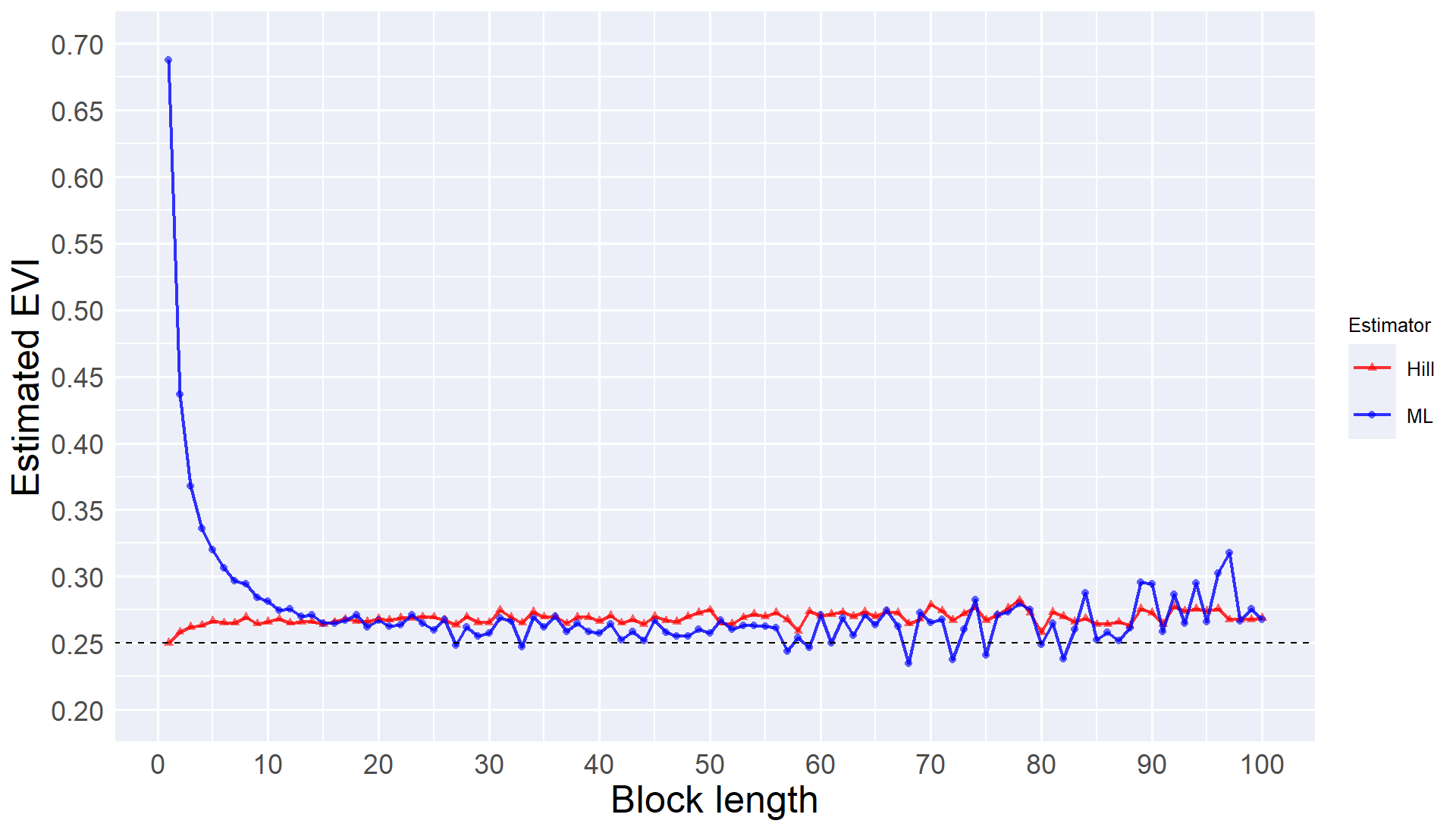
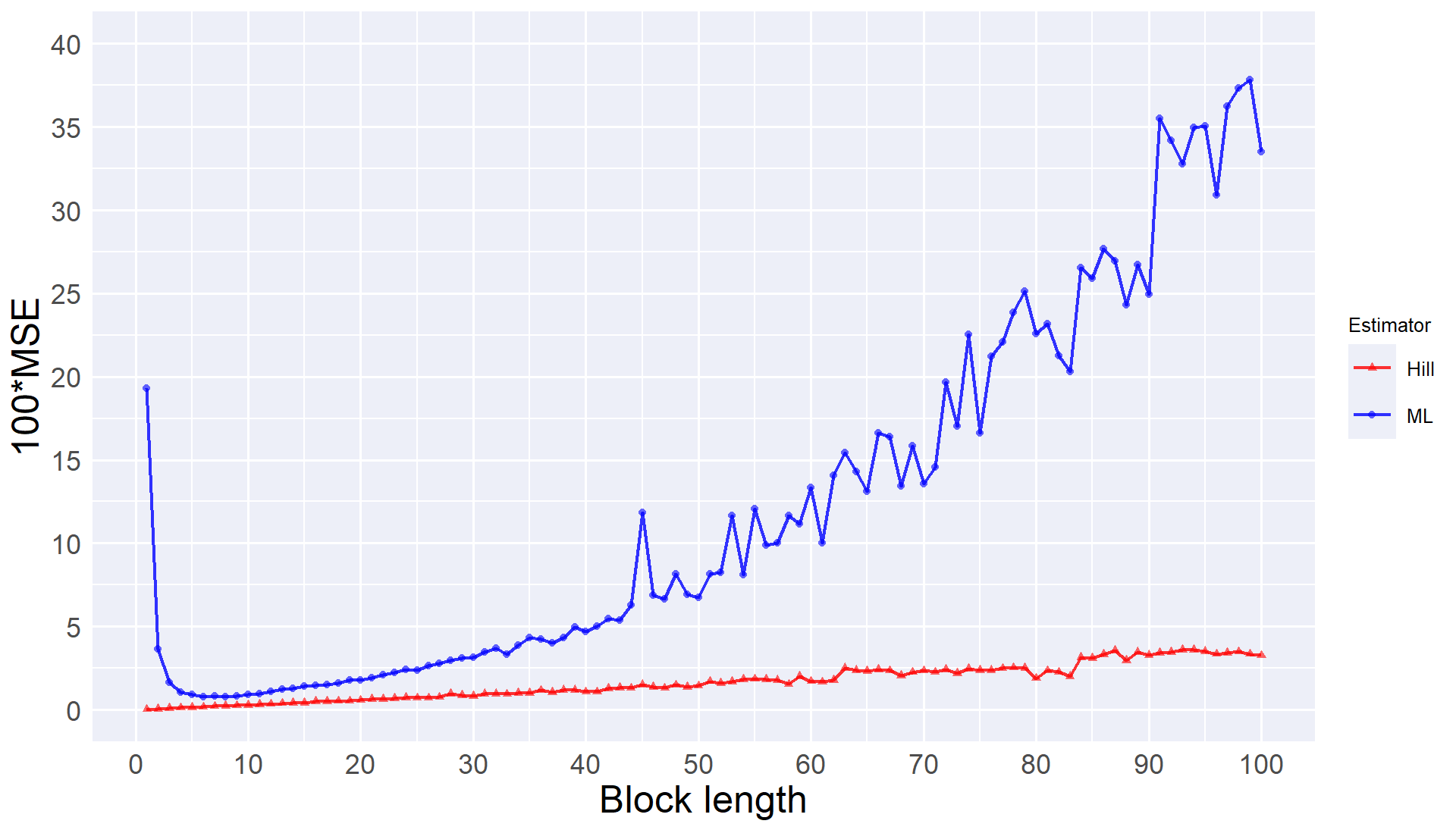
Figure 1: Average estimates of both hybrid-Hill and GEV-maximum likelihood estimates and their respective empirical mean squared errors (MSE), plotted against the block size m=1,…,100.Simulationsconsistof1000replicatesofasampleofn=10,000i.i.d.observationstakenfromaParetodistributionwithextremevalueindex\gamma =1/4.</p></p><h3class=′paper−heading′id=′robustness−and−flexibility′>RobustnessandFlexibility</h3><p>Theproposaladvocatesfortheassimilationoflargeblockmaxima,which,whilepotentiallyfewerinnumber,allowtheresultinginferencestoremainrobusttochangesinblocksize.Thus,theapproachcansignificantlyenhancetheestimationof\gamma$ by focusing on appropriate data segments, adeptly supplementing traditional methods that might suffer under rigid block constraints or POT threshold selections (2512.19338).
Asymptotic Properties
The hybrid-Hill estimator demonstrates desirable asymptotic properties, including reduced-bias estimates under certain conditions. The adaption of Hill's estimator, typically applied in POT contexts, into this hybrid form, aligns with uniformly asymptotic normality, further validating the robustness of the hybrid estimation approach. It offers practical utility beyond theoretical appeal by minimizing variance and bias over flexible block and threshold configurations.
Implications and Future Directions
Practically, the hybrid-Hill estimator could redefine extreme value analysis by enabling more nuanced analyses of environmental or financial extremes under varying observational frequencies. Its inherent flexibility empowers practitioners to elect methodological components best suited to specific datasets without stringent adherence to conventional BM or POT strategies.
Theoretical extensions of this work could include further refinement of second-order properties for bias correction, accommodating non-i.i.d. data, or exploring its application within multidimensional extreme value models. Future research may also aim to integrate this methodology within machine learning frameworks for broader relevance across diverse scientific domains (2512.19338).
Conclusion
The hybrid-Hill estimator offers a sophisticated and versatile alternative for extreme value estimation, harmoniously integrating block maxima and peaks-over-threshold methodologies. It expands the toolkit available to statisticians and researchers dealing with extreme value problems, promoting effectiveness and adaptability to the increasingly complex data structures encountered in modern analyses (2512.19338).