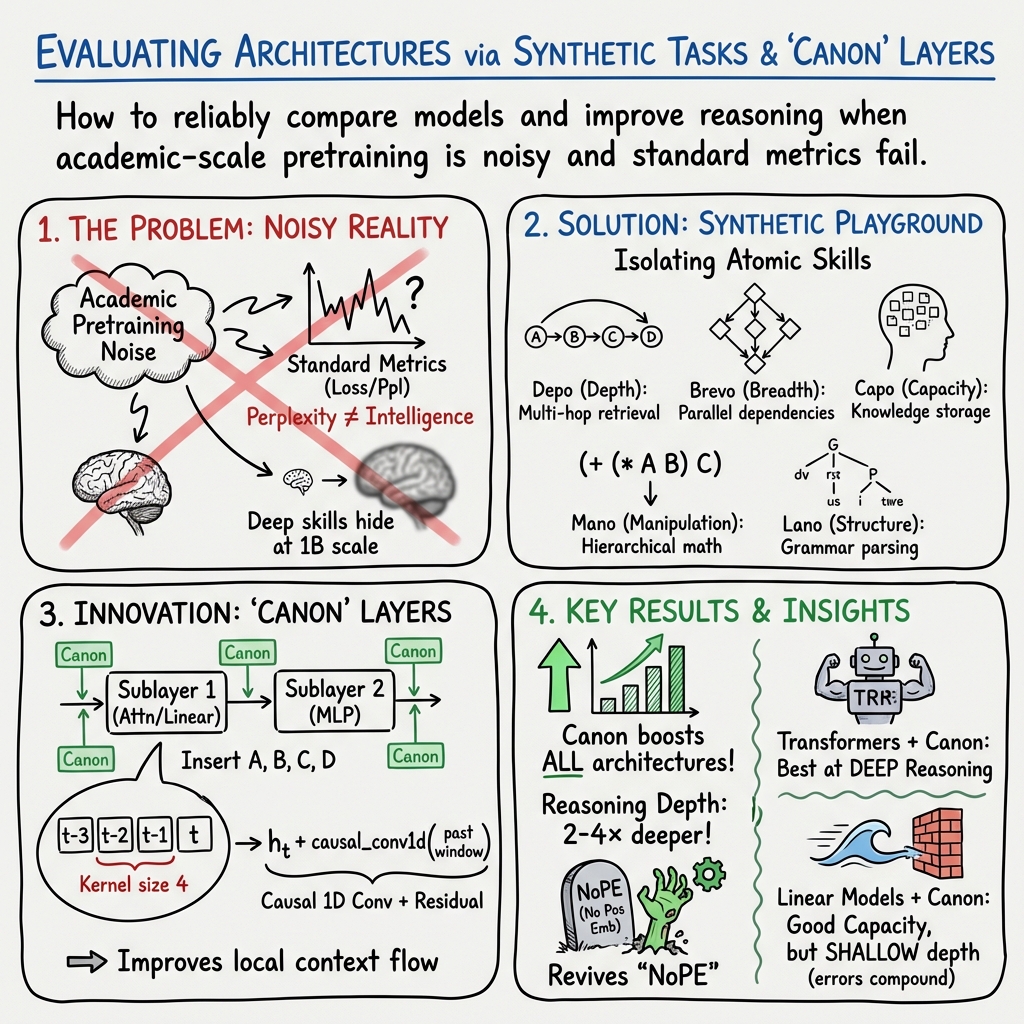
- The paper introduces Canon layers as a universal innovation that efficiently mixes token information and boosts multi-hop reasoning by up to 400%.
- Empirical results highlight improvements of 200-400% in reasoning depth and 30% in reasoning breadth and knowledge manipulation across diverse architectures.
- The study demonstrates that Canon layers can be seamlessly integrated into Transformers, linear attention, and state-space models, reducing reliance on positional encodings.
Physics of LLMs: Architecture Design and Canon Layers
Introduction and Motivation
This work, "Physics of LLMs: Part 4.1, Architecture Design and the Magic of Canon Layers" (2512.17351), addresses the critical challenge of reliably comparing neural LLM architectures under academic-scale pretraining regimes. Standard metrics such as cross-entropy and perplexity fail to reflect nuanced reasoning and compositional abilities, particularly at modest parameter or data scales where emergent capabilities do not reliably manifest due to noise, randomness, and grokking phenomena. The author introduces a rigorously controlled synthetic pretraining framework that decomposes intelligence into atomic components (reasoning depth, breadth, knowledge capacity/manipulation, and structural language reasoning) and enables isolation of intrinsic architectural biases with infinite high-quality data, circumventing confounds endemic to natural data distributions.
Canon Layers: Concept and Implementation
The central architectural innovation of the paper is the "Canon layer," a lightweight horizontal information mixing primitive designed to augment vertical residual links and enable efficient token-to-token information propagation within and across blocks. Canon layers apply trainable causal 1d convolutions (kernel size 4) with residual connections at multiple standard positions: pre-attention (A), inside attention (B), pre-MLP (C), and inside MLP (D). This construct generalizes and formalizes scattered conv1d-like operations previously introduced in architectures such as Mamba, GLA, and Primer, but establishes their role as a universal, architecture-independent mechanism for strengthening local context flow.
Empirical Results and Claims
- Reasoning Depth and Breadth: In controlled synthetic multi-hop reasoning tasks (Depo/Brevo), inserting Canon layers increases Transformer reasoning depth by 2× (from 4-hop to 8-hop) and breadth by 30%, enabling models to solve recursively composed reasoning challenges well beyond naive attention baselines.
- Knowledge Manipulation and Storage: In knowledge tasks (Capo/Mano), Canon layers recover knowledge manipulation length (+30%) and partially mitigate the capacity penalty introduced by gated MLP or MoE designs (recovering roughly half of the bit-per-param loss induced by slow convergence).
- Architectural Universality and Robustness: Canon layers universally enhance performance across Transformers, linear attention models (GLA), state-space models (Mamba2), and GDN. Ablation studies confirm that horizontal mixing is not tied to attention layers nor MLP—they contribute cumulatively and can be added independently at various positions, with residualness crucial for stabilization. Nonlinear activations post-Canon yield negligible benefit.
- Positional Encoding Interactions: Canon layers enable NoPE (no positional embedding) architectures to match or exceed RoPE (+Canon) on reasoning tasks, outperforming ALiBi and H-Alibi fixes, and facilitate drastic reduction in RoPE reliance (down to 1/4 dimensions or less), with improved length generalization.
- Linear Model Insights: In architectures such as Mamba2, most of the empirical gains are attributed to internal Canon-like conv1d layers rather than the theoretical state-space machinery. Removing conv1d reduces Mamba2 to match GLA-level performance.
Synthetic Pretraining Task Design
The synthetic playground comprises five atomic tasks:
- Depo: k-hop internal reasoning over random permutations, testing scalable multi-step inference.
- Brevo: Recursive DAG dependency resolution, assessing breadth of simultaneous reasoning.
- Capo: Fact storage via undertrained synthetic biography exposure, measuring bit-per-param knowledge retention.
- Mano: Modular arithmetic expressions, probing deep hierarchical manipulation of stored factual tables.
- Lano: Generation of context-free grammar sequences, testing recursion and global structural ambiguity resolution.
These tasks eschew shallow memorization or spurious length generalization, adhere to nontrivial complexity, and model mental (system 1) inference, offering high-fidelity insights into architecture strengths and training dynamics.
Experimental Methodology and Key Numerical Findings
Architectural comparisons are standardized across parameterization, exposure counts, and initialization. Strong numerical results include:
- Canon layers improve 200–400% in multi-hop reasoning depth and up to 30% in breadth and manipulative length.
- Full Canon layer augmentation allows GLA to surpass Mamba2 on reasoning benchmarks despite Mamba2's theoretical capacity.
- Knowledge tasks reveal ∼40% higher factual capacity in linear models, but Transformers equipped with Canon outperform by $2$–4× in reasoning depth and structured language tasks.
- At 1.3B/100B academic scale, all models fail 2-hop reasoning even on 100-token contexts; improvements predicted by synthetic benchmarks are only partially realized due to insufficient pipeline quality and emergent ability thresholds.
Theoretical and Practical Implications
The work reveals architectural gaps unresolvable by increased memory alone: linear models' limitations in reasoning depth stem from accumulated compression/retrieval errors, not memory bottlenecks. Canon-augmented Transformer–linear hybrids present a concrete solution pathway, merging the memory efficiency of linear/state-space architectures with deep reasoning capabilities.
By decoupling architectural assessment from dataset randomness, the synthetic playground potentially predicts performance at scale, as training pipelines mature through refined data curation and RL-driven post-training (GRPO, PPO). Canon layers join the class of minimal, broadly applicable enhancements (cf. residual connections, LoRA) that fundamentally shift reasoning and generalization boundaries.
Speculation and Future Work
Future avenues suggested include:
- Canonicalization of dynamic horizontal mixing (adaptive, gated or cross-layer Canon layers) and exploration of wider integration patterns.
- Systematic extension to emergent and hybrid architectures under large-scale pretraining, to confirm synthetic predictions and refine architectural scaling laws.
- Expansion and formalization of atomic synthetic tasks targeting further facets of intelligence, enabling fine-grained architectural probing and interpretability.
- Open-sourcing the synthetic playground for community-driven reproducible architecture research.
Conclusion
"Physics of LLMs: Part 4.1, Architecture Design and the Magic of Canon Layers" (2512.17351) establishes Canon layers as a universal, lightweight, architecture-agnostic primitive for improving horizontal context flow. Extensive synthetic and real-world experiments demonstrate their robust ability to elevate reasoning and memory performance, revive previously weak designs, and partially decouple architectural trade-offs from pipeline or scaling artifacts. These results inform both practical deployment and theoretical progress, signaling a reevaluation of linear model innovations and a shift toward principled, component-based architecture science. The methodology provides a rigorous blueprint for future systematic neural architecture comparison, scalable validation, and informed innovation.