- The paper demonstrates that lightweight interventions, including non-historical feature residualization, MMD-based score regularization, and manifold mixup, effectively mitigate cold-start bias.
- The methodology increases reliance on content signals and augments embedding representations while incurring minimal computational overhead.
- Online experiments show roughly a 10% lift in fresh content engagement, benefiting cold users and long-tail items without impacting overall performance.
Cost-Efficient Mitigation of Cold-Start Bias in Large-Scale Recommendation: Insights from Pinterest
Overview and Motivations
The paper "Warmer for Less: A Cost-Efficient Strategy for Cold-Start Recommendations at Pinterest" (2512.17277) addresses the cold-start (CS) recommendation problem at industrial scale. Pinterest's recommender system, serving over 570 million users, faces significant operational challenges due to the extreme long-tail nature of its item corpus and the paucity of historical engagement for fresh items. The authors provide a systematic root-cause analysis, focusing on computational constraints, dependence on historical features, prediction score bias against cold items, and data sparsity. Their framework addresses each of these challenges through targeted interventions with minimal parameter and infrastructure overhead.
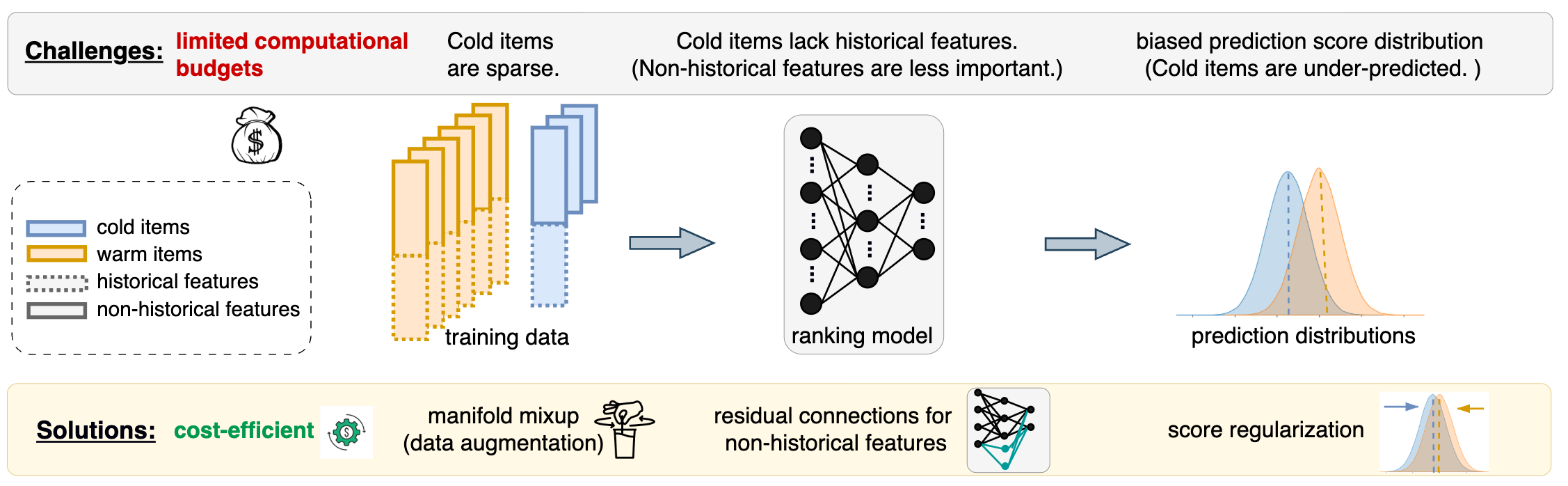
Figure 1: Key challenges in cold-start (CS) recommendation and the targeted solutions proposed in this framework.
Root-Cause Analysis of Cold-Start Failure Modes
The initial empirical investigation quantifies and visualizes the extent of the cold-start problem. Offline analyses demonstrate three salient phenomena:
- Feature Importance Dominance: Historical features overwhelmingly contribute to PR-AUC, with their ablation resulting in much steeper metric degradation compared to non-historical features. Gradient analyses further show that model updates are heavily skewed toward historical inputs, suppressing learning from non-historical features.
- Prediction Bias: The model exhibits systematic bias, consistently assigning lower scores to cold items compared to warm ones, irrespective of true relevance. This score gap directly induces serving bias and under-representation of fresh content in recommendations.
- Sparsity-Driven Generalization Deficit: Cold items suffer both in training and online serving due to their sparse label coverage, leading to defective generalization and poor embedding space utilization.
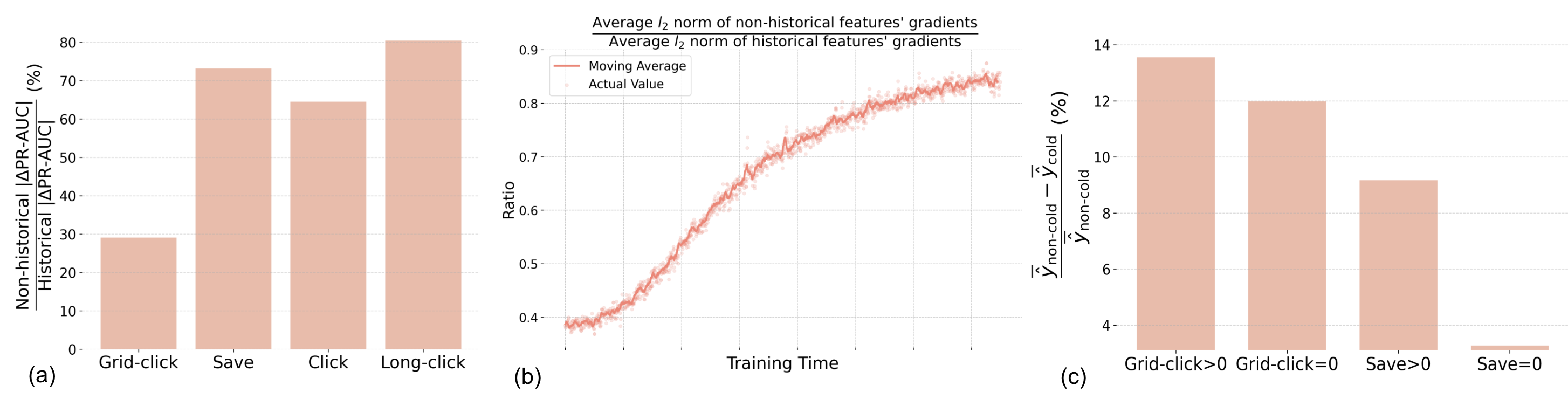
Figure 2: Left: ΔPR-AUC ratio when ablating historical vs non-historical features; Center: Gradient norm ratio indicating update dominance by historical features; Right: Distributional score bias with systematic under-scoring of cold items.
Methods: Lightweight Interventions for Industrial Deployment
Non-Historical Feature Residualization
A skip connection is introduced from non-historical features directly to the final prediction MLP, bypassing the interaction module. Unlike two-tower architectures, this yields negligible (<5%) increase in parameter count with no auxiliary heads or multi-tower synchronization required. The intervention is validated to elevate both feature importance and gradient magnitude for non-historical features, as evidenced in ablation studies, resulting in increased reliance on content and attribute-based signals for CS items.
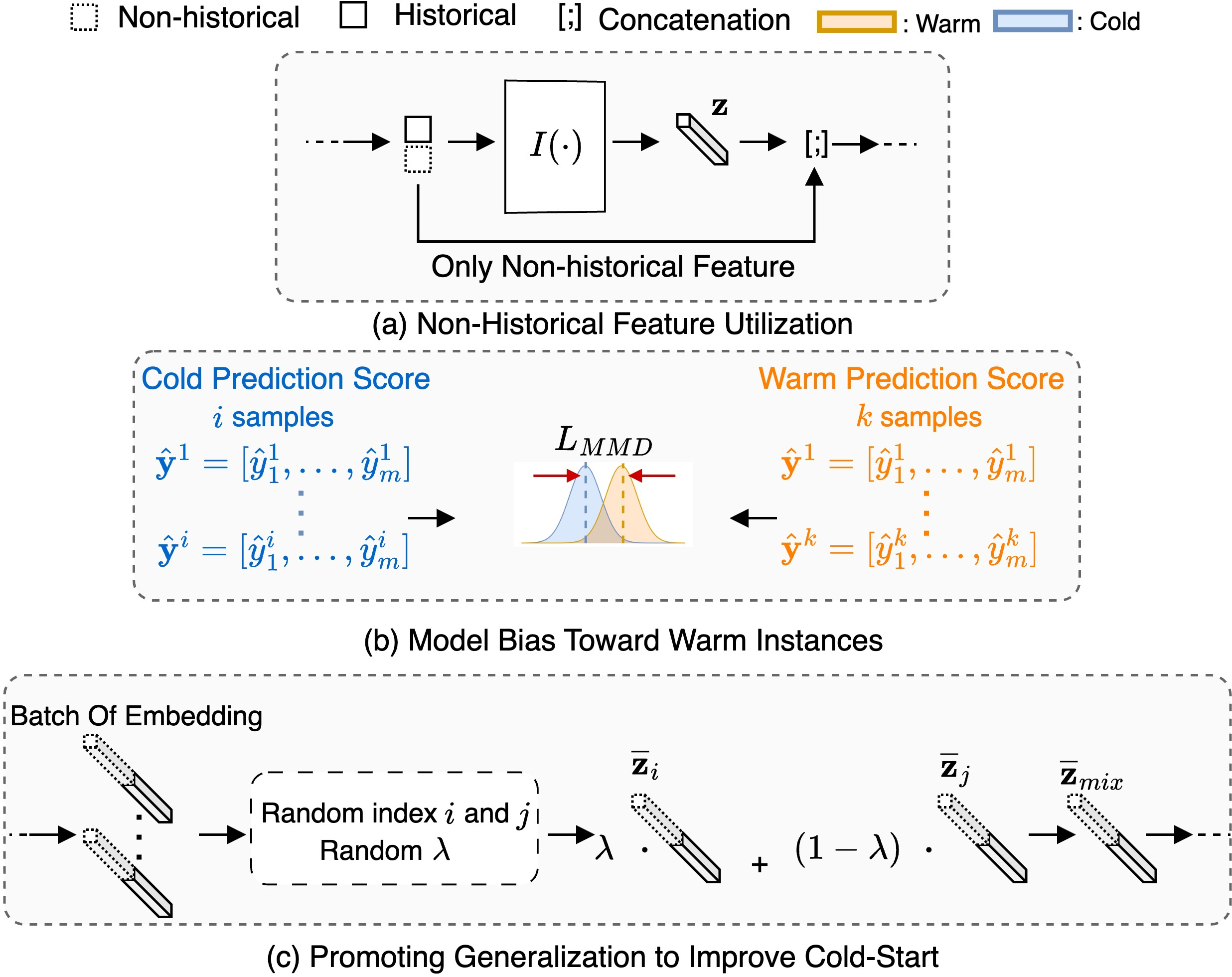
Figure 3: (a) Residual connection design for non-historical features; (b) Debiasing loss for CS prediction score alignment; (c) Manifold mixup procedure for embedding augmentation.
Score Regularization via Maximum Mean Discrepancy
The framework debiases CS scoring by imposing an MMD-based regularization on the score distributions of warm and cold instances. This directly penalizes excessive separation between CS and non-CS item prediction distributions, without requiring additional sampling or architectural changes. Empirical loss estimation operates on mini-batch statistics.
Manifold Mixup for Embedding Augmentation
The manifold mixup technique is leveraged to augment sparse training signals by interpolating embeddings and labels within mini-batches. This constrains the representation space and enforces linear behavior between samples, creating higher-rank, smoother embedding manifolds. Unlike traditional data augmentation, this method is data-agnostic and incurs negligible compute overhead.
Production Environment and Deployment
The system is evaluated within the Pinterest Related Pins production surface, responsible for roughly half of the platform’s recommendation traffic. The ranking model utilizes rich feature sets, multi-task objectives, and transformer-based user sequence encoders.

Figure 4: Pinterest Related Pins surface, comprising query Pin and grid view of recommended Pins.
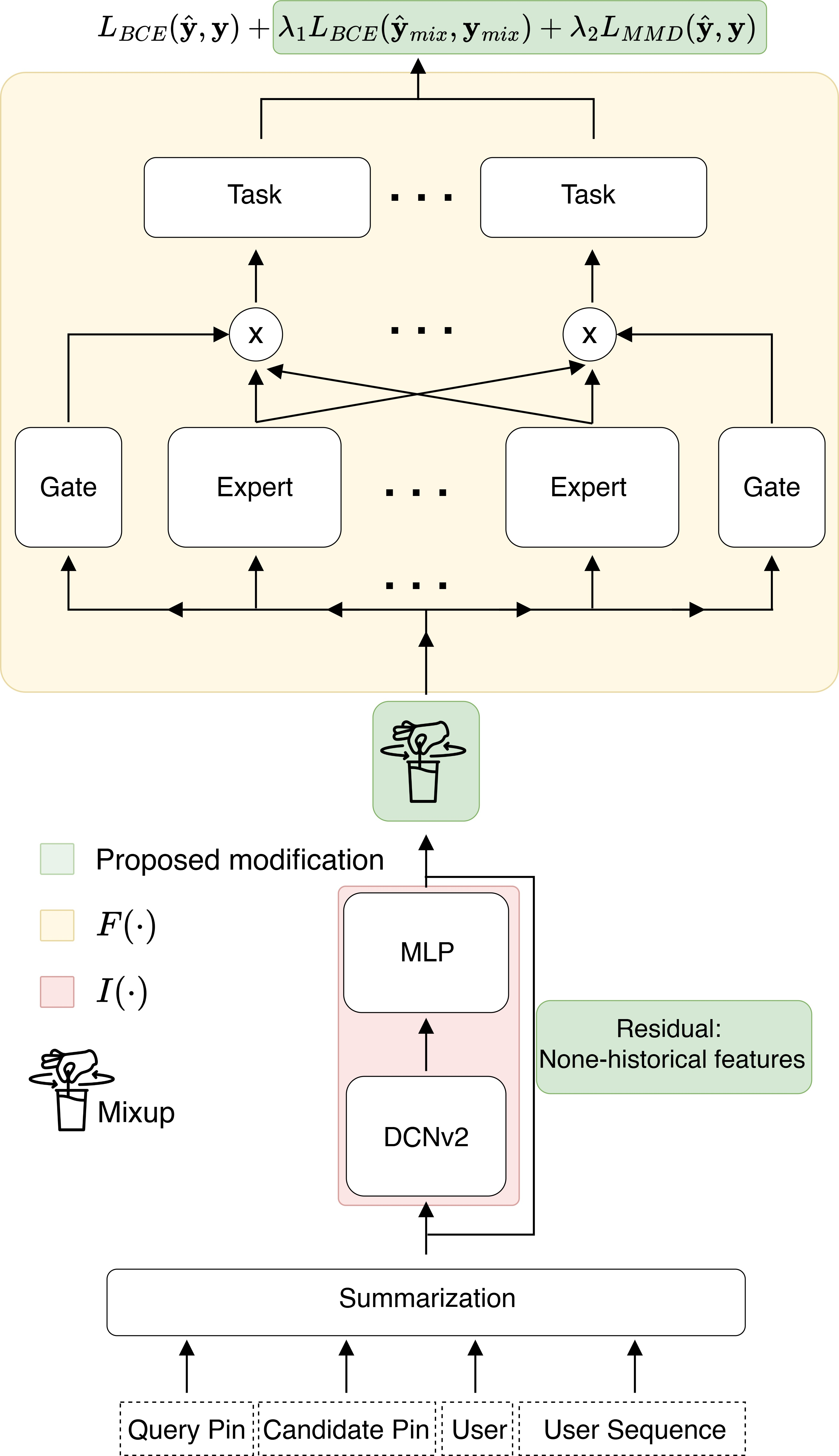
Figure 5: Multi-task Ranking Model Architecture for the Related Pins recommender system.
Evaluation is performed both offline (Hits@3 on fresh Pins and all Pins) and via online A/B tests. Metrics are reported both for the overall population and subgroups (cold users, long-tail items, lower-ranked positions).
Empirical Results
Offline Validation
All proposed components—Residual connection, ScoreReg, and Mixup—resulted in marked improvements for fresh Pins engagement. In particular, ScoreReg and Mixup are cost-neutral, while the residual connection increases model size minimally. Combinatorial stacking of all three techniques accumulates gains without detrimental tradeoffs for non-CS items.
Mechanistic Analyses
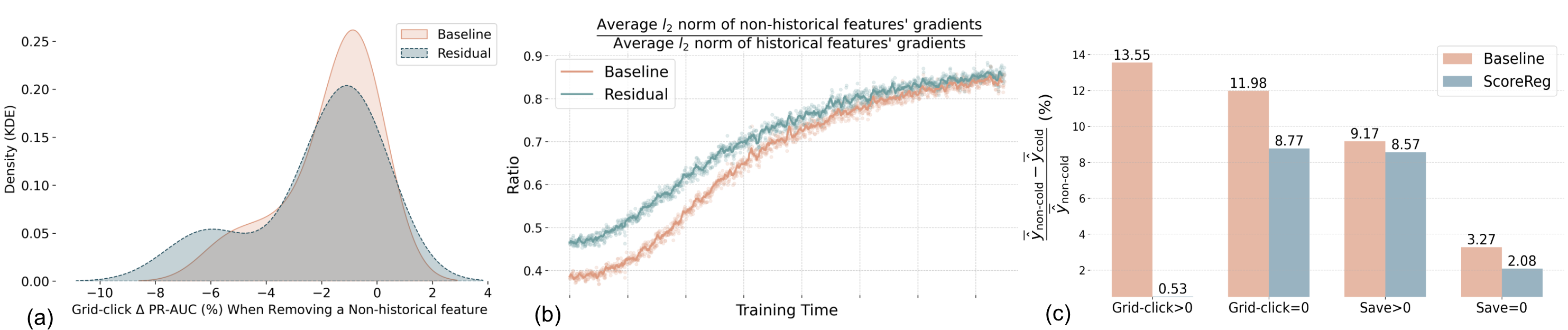
Figure 6: (a) PR-AUC drop distribution indicating elevated non-historical feature importance under the residual design; (b) Gradient norm ratio increased by residualization; (c) ScoreReg narrows positive/negative prediction gap between cold and warm items.
Embedding space analyses via PCA demonstrate that mixup training leads to less constrained, higher-rank representations. This flattening is associated with improved generalization, consistent with theoretical predictions regarding implicit regularization and shortcut avoidance.
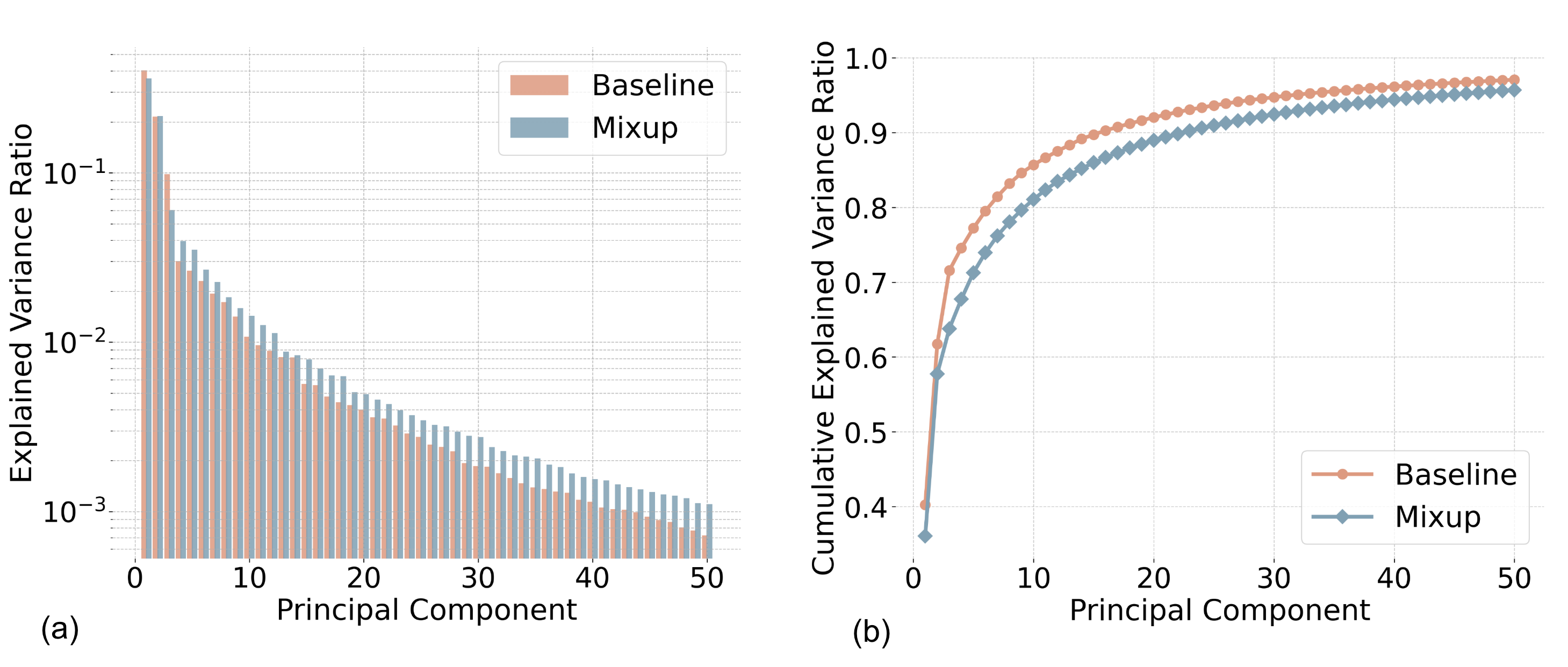
Figure 7: PCA-based analysis of embedding space utilization with mixup augmentation, showing greater variance retention and distributed representation.
Online Metrics
Online A/B tests show substantial (~10%) lift in fresh content engagement with neutral or improved metrics on overall traffic. Notably, unique fresh Pins with high engagement are significantly increased. Cold users—those with low activity—benefit from increased successful session counts, grid-clicks, and saves, indicating improved coverage and feedback loop reinforcement.
Mixup specifically demonstrates effectiveness for long-tail, lower-ranked recommendations, with statistically significant gains for Pins beyond position 25, highlighting reduced position bias and improved rank sensitivity.
Theoretical and Practical Implications
This research disproves the necessity of heavy model augmentations (e.g., dual-tower architectures or costly distillation schemes) for effective CS remediation. The minimal, plug-and-play interventions developed here generalize across models and production environments, offering neutral or positive tradeoffs in computational cost. The embedding-level augmentation and regularization perspective aligns with recent advances in representation learning, domain generalization, and information bottleneck theory, suggesting that future RecSys architectures should emphasize regularized, high-rank embedding spaces and balanced feature update mechanisms.
Continued research could focus on:
- Extending manifold mixup and residual designs to multi-modal and cross-domain settings.
- Dynamic adjustment of regularization strength based on real-time data drift and temporal item popularity.
- Integrating contextual uncertainty and causal counterfactual reasoning for further debiasing and robustness.
Conclusion
The presented cost-efficient strategy for cold-start ranking at Pinterest demonstrates robust improvements in fresh content engagement and coverage without increasing infrastructure burden. Systematic root-cause analysis, lightweight architectural adjustments, and embedding space regularization provide a practical methodology for real-world recommendation deployments. These results advance the state-of-the-art in scalable CS recommendation and set a precedent for future industrial RecSys research prioritizing both efficiency and fairness.

