- The paper proposes a chirp-based delay-Doppler QAM modulation scheme that embeds data in radar sensing parameters, boosting bit rate by up to 14 bits/symbol.
- The paper employs an EKF-based tracking method for high-resolution 5D state estimation, enabling simultaneous radar and communication functionalities.
- The paper demonstrates robust performance in multi-vehicle scenarios through dual-compensation demodulation and extensive simulations with realistic mmWave automotive parameters.
Chirp Delay-Doppler Domain Modulation Based Joint Communication and Radar for Autonomous Vehicles
Introduction
This paper presents a sensing-centric joint communication and millimeter-wave (mmWave) radar paradigm specifically designed to support collaboration between intelligent autonomous vehicles. The central innovation is a chirp waveform-based delay-Doppler quadrature amplitude modulation (DD-QAM) scheme that simultaneously modulates information across delay, Doppler, and amplitude domains, supporting both radar functionality and data communication. Additionally, the authors propose an extended Kalman filter (EKF)-based parameter estimation method for high-accuracy 5D sensing and a dual-compensation-based demodulation and tracking scheme for passive vehicles, ensuring communication functions do not impair the core radar capabilities.
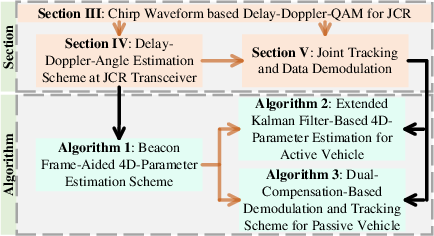
Figure 1: System and algorithmic organization, highlighting the proposed DD-QAM modulation and joint communication-radar process.
Chirp-Based Delay-Doppler-QAM Modulation
The core waveform innovation utilizes chirp signals, modulating data in the delay, Doppler, and amplitude domains within a single frame—this is the DD-QAM scheme. Each autonomous vehicle operates as either an active vehicle (AV), which transmits chirps modulated with control information, or a passive vehicle (PV), which senses and demodulates incoming signals. The key differentiator from prior SCD-based JCR and LoRa-derived approaches is that data is directly embedded in the radar sensing parameters, enabling seamless and simultaneous communications and sensing.
The authors detail the signal model for both single-input single-output (SISO) and multipath MIMO channels. The chirp's constant modulus and Doppler tolerance are leveraged for efficient analog domain interference suppression and analog separation of interleaved signals via time-frequency (TF) resource allocation.
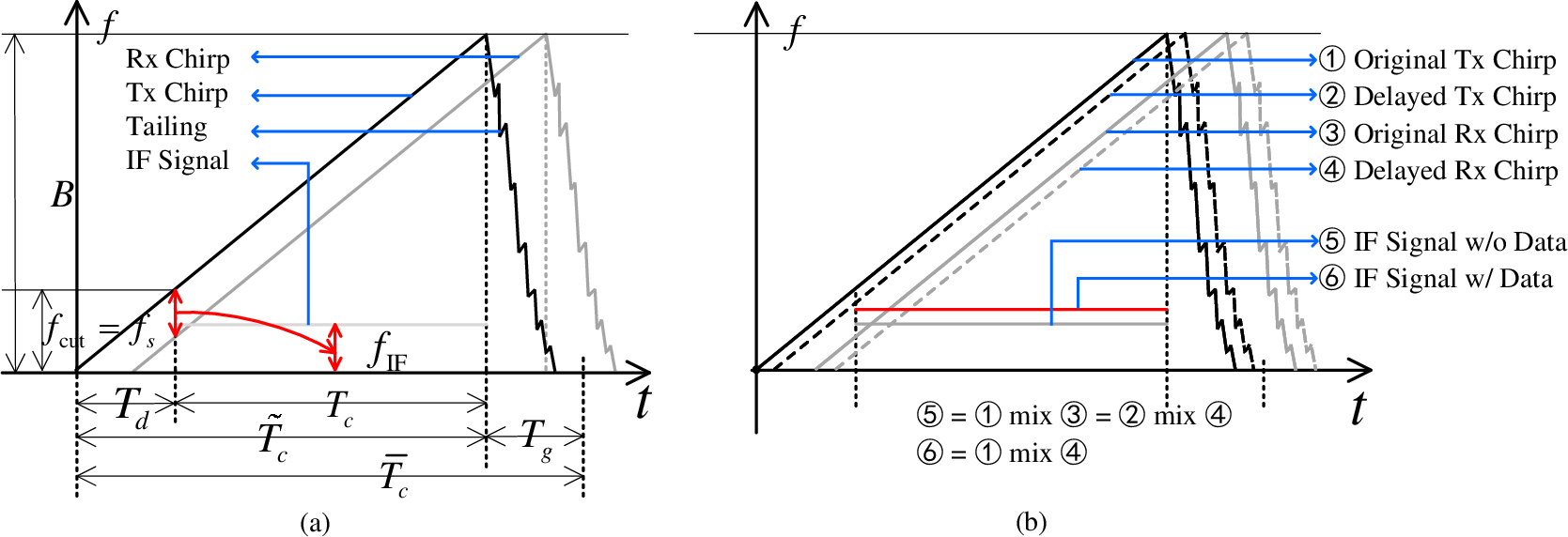
Figure 2: Time-frequency diagram of the modulated chirp, illustrating delay and Doppler data embedding and the dechirp process.
Data modulation can be performed either in a Doppler-division multiplexed (DDM) or time-division multiplexed (TDM) configuration. DDM enables waveform orthogonality for antenna distinction, while beacon frames resolve maximum velocity limitations, supporting unambiguous high-velocity target estimation.
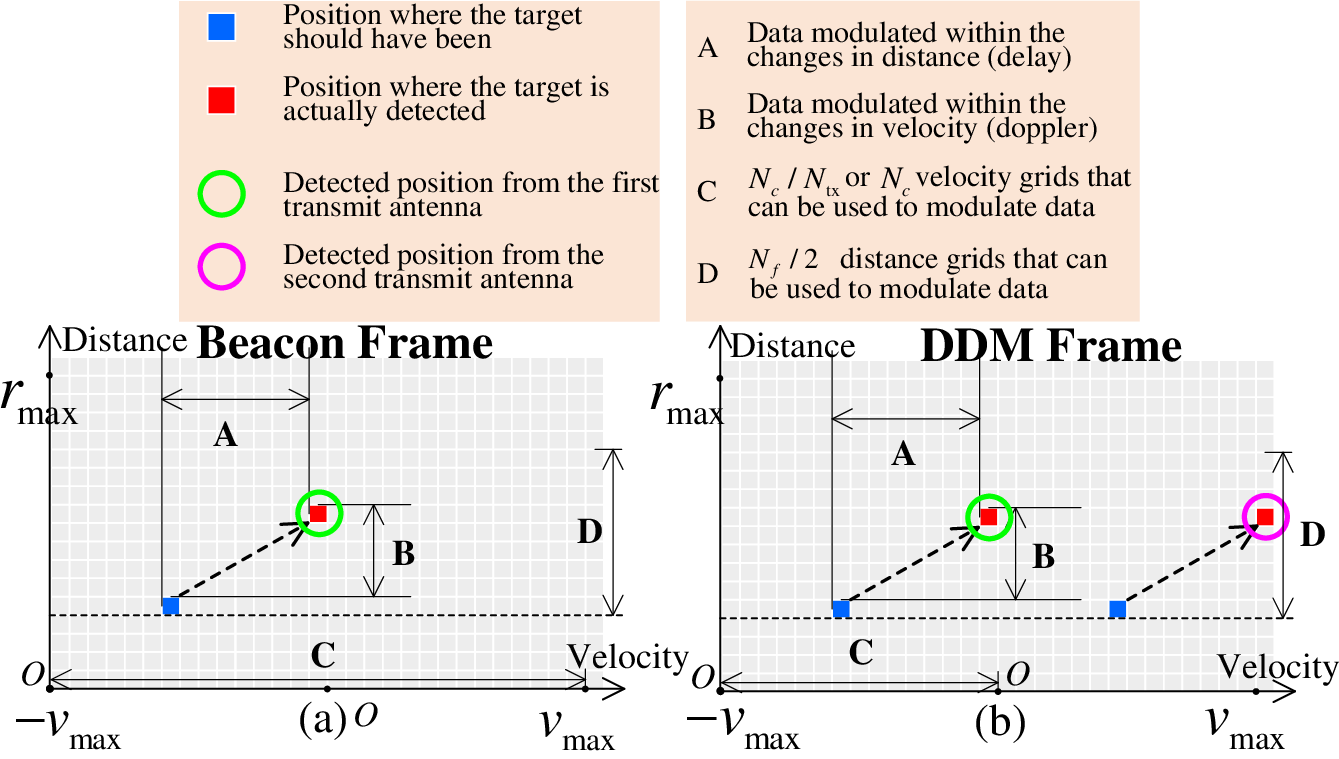
Figure 3: Schematic of DD-QAM data modulation: (a) beacon frame, (b) DDM frame, showing modulation across distance, velocity, and complex amplitude.
Beacon Frame-Aided High-Dimensional Sensing
Parameter estimation on the AV exploits both beacon and DDM frames. The beacon frame provides unique target association in the range-Doppler map (RDM), while the subsequent DDM frame leverages transmit array aperture for angular and velocity estimation. The algorithm uses spectrum leakage effects as redundant measurements for averaging, achieving high-resolution, quasi-off-grid sensing of 4D target parameters (distance, radial/radial velocity, AoA, EoA).
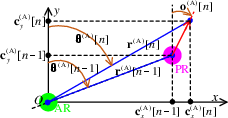
Figure 4: Geometric relationships and key kinematic parameters between vehicles, crucial for 5D (distance, radial/tangential velocity, azimuth, elevation) state estimation.
The step from quasi-off-grid to dynamic off-grid estimation is realized through EKF tracking by fusing prior state, predicted movement, and per-frame measurements. This allows the AV to extract not only traditional 4D radar results (range, Doppler, azimuth, elevation) but also orientation and tangential velocity, which are unobservable in classic radar without added sensors.
Dual-Compensation Demodulation and Tracking
For passive vehicles, a dual-compensation-based algorithm demodulates the embedded data and simultaneously tracks the AV's states. The demodulation process compares predicted and observed RDM parameters to extract modulated information, then compensates the residual to recover target kinematic states for continued tracking. The dual-compensation procedure ensures integrity of both communication and sensing without cross-function degradation.
Achievable Rate Analysis
The achievable rate of DD-QAM is quantified by reformulating the system in matrix form and deriving the mutual information, explicitly accounting for the sparse nature of the DD-QAM signaling and the grid-restricted modulation domains (delay, Doppler, QAM order). Both DDM and TDM approaches are benchmarked, demonstrating that the addition of delay and Doppler domain modulation substantially boosts the bit rate (by up to 14 bits/symbol in DDM)—critical for low-latency vehicle coordination messages.
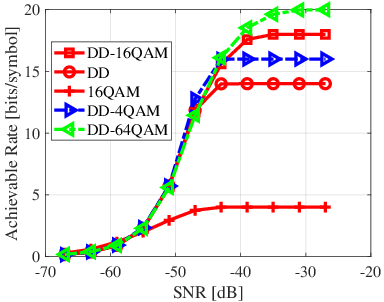
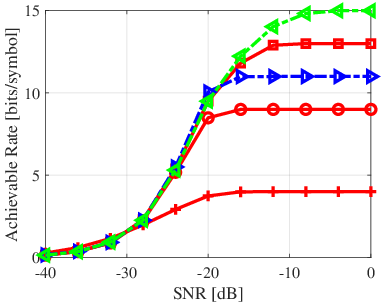
Figure 5: Achievable rates for DD-QAM using both DDM (a) and TDM (b), highlighting gains from delay/Doppler domain data modulation.
Numerical Evaluations
Extensive simulations with realistic automotive radar parameters (80 GHz, 640 MHz bandwidth, multi-antenna arrays) confirm the performance advantages of the proposed method.
- Parameter Estimation: The AV achieves high-precision distance, radial-velocity, and angle estimates. Off-grid accuracy is obtained by spectrum leakage averaging and EKF fusion, outperforming conventional on-grid or discrete estimation.
- Data Demodulation: The PV reliably demodulates the information modulated in delay, Doppler, and amplitude provided detection is achieved, with symbol error rates tightly coupled to detection probability.
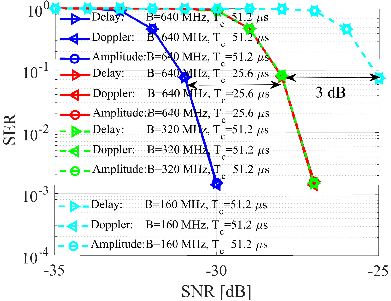
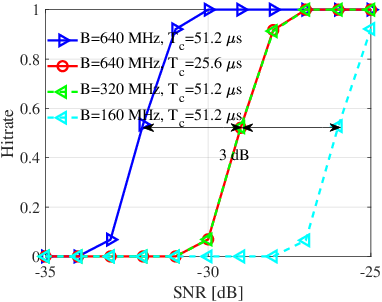
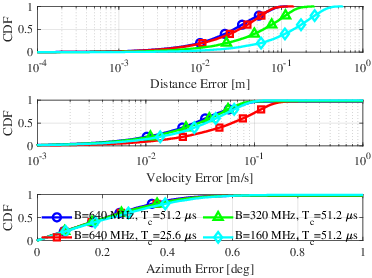
Figure 6: (a) SER for the PV, (b) hitrate, and (c) CDF for estimation performance under varying SNR, bandwidth, and sampling time.
- Modulation Order and Baseline Comparisons: SER worsens with higher QAM order, but detection and parameter estimation remain robust. Compared with FRaC (FMCW-based JCR with index modulation), DD-QAM with TDM achieves superior demodulation rates and is notably less sensitive to phase ambiguity and channel prediction errors.
- Multi-Target Tracking: AVs can simultaneously track multiple vehicles and dynamically update all kinematic parameters. The error convergence and continuity of orientation and lateral velocity tracking illustrate the advantage of embedding temporal models in sensing.
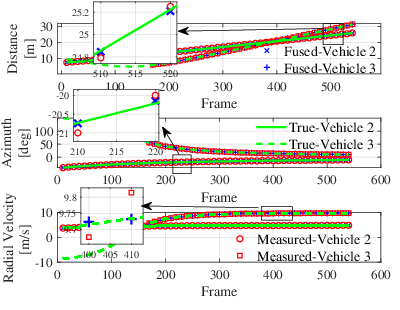
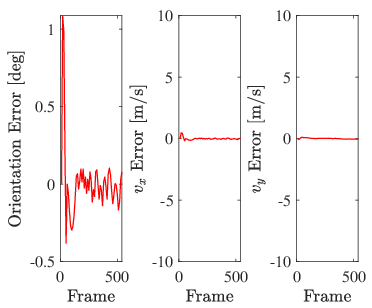
Figure 7: Vehicle-to-vehicle tracking—distance, azimuth, radial velocity—demonstrating seamless target handover and continuous off-grid estimation.
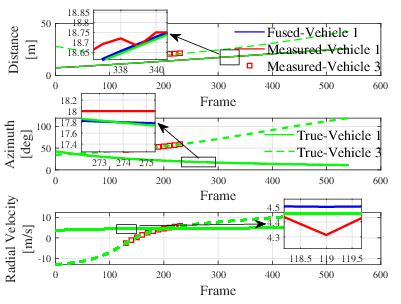
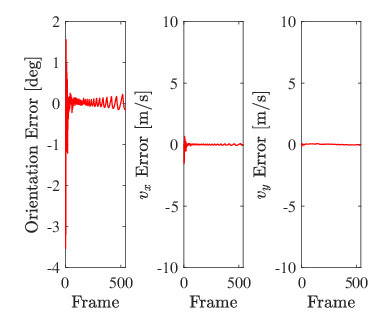
Figure 8: PV's perspective tracking of AV and third vehicles, showing analogous estimation performance and effective use of temporal information for demodulation.
Discussion and Implications
The approach brings forth a set of formal claims, some of which diverge from existing practice:
- Embedding communications into radar’s inherent parameters is shown to be feasible without impacting the core radar performance, and with rates that can scale favorably with sensor parameters (notably, the number of chirps per frame and effective bandwidth).
- EKF-based tracking leverages the physical temporal dynamics, providing higher-dimensional state estimation (including orientation and tangential velocity) using the standard mmWave radar hardware.
- The full separation and reusability of TF resources, enabled by chirp mixing and analog filtering, allows high-density multi-vehicle operation with low interference.
- The practical complexity is dominated by well-known FFT and CFAR-style algorithms, making the proposed scheme attractive for real-world implementation, as evidenced by reproducible code provided by the authors.
Future research should examine channel agnostic approaches to compensate for non-ideal hardware and consider more generalized mobility and non-line-of-sight conditions. The modulation alphabet design for the DD-QAM (delay-Doppler) domain and error correction integration remain open theoretical problems. Scaling collaborative vehicular ISAC to urban environments with severe multipath and interference scenarios is also a key direction.
Conclusion
This work proposes a novel ISAC paradigm using DD-QAM chirp waveforms for joint communication and radar in autonomous vehicles, supporting high-rate low-complexity data embedding in sensing parameters. The EKF-based 5D estimation and dual-compensation demodulation enable continuous high-resolution tracking and robust communications without hardware augmentation. The supporting theoretical analysis, practical algorithm design, and extensive system-level simulations substantiate the efficacy of the approach and provide a foundation for future JCR system development.