- The paper demonstrates that RRR identifies low-dimensional communication subspaces within high-dimensional neural data.
- It details methodological improvements including ridge regularization and full-covariance estimation to enhance performance in noisy conditions.
- Novel alignment indices quantify inter-regional communication, providing actionable metrics to interpret neural interactions.
Reduced Rank Regression for Neural Communication: A Technical Analysis
Introduction
The paper "Reduced rank regression for neural communication: a tutorial for neuroscientists" (2512.12467) provides an in-depth tutorial on reduced rank regression (RRR) and its applications in modeling low-dimensional communication subspaces between neural populations. The manuscript focuses on mathematical foundations, practical considerations, extensions for regularization and noise structure, and introduces novel metrics for quantifying communication alignment between brain regions. Theoretical exposition is paired with illustrative simulations and re-analysis of multi-region primate recordings.
Mathematical Foundations
RRR is posed as a method for estimating a low-rank linear mapping from a high-dimensional input population (xt∈Rm) to an output population (yt∈Rn) under a classical linear-Gaussian model. The learning objective is to minimize squared prediction error subject to a constraint rank(W)≤r, where W is the mapping matrix. The tutorial delineates RRR's derivation relative to alternative linear methods—namely, ordinary least squares (OLS), principal component regression (PCR), and canonical correlation analysis (CCA)—and further clarifies why the optimal low-rank approximation via SVD of the OLS weights is not in general equivalent to RRR. The paper presents a clear conceptualization of communication subspaces, communicating axes, and private dimensions, parameterized by the columns of low-rank factors U (input axis) and V (output axis).
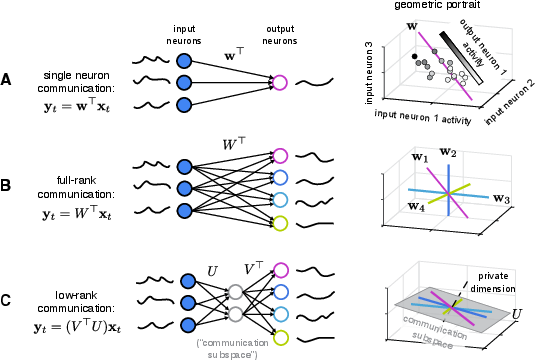
Figure 1: Schematic visualizing full-rank versus low-rank communication and the geometric intuition behind subspace-constrained transfer between input and output neural populations.
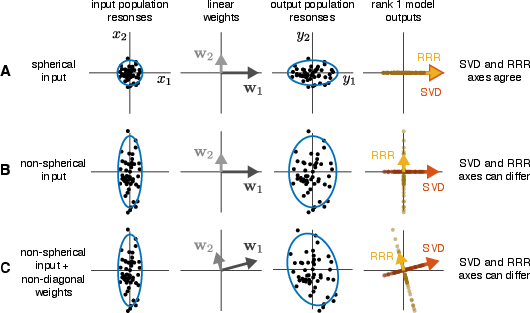
Figure 2: Demonstration of how RRR and SVD yield divergent low-rank estimates depending on input distribution anisotropy and the underlying communication geometry.
RRR estimation proceeds by projecting the OLS weights onto a subspace selected via eigen-decomposition of the predicted outputs, thereby identifying communication channels that maximize explained variance in the output. This is contrasted to SVD, which prioritizes fidelity to the original mapping matrix, rather than maximizing predictive performance.
Methodological Extensions
Ridge Regularization
The authors extend RRR by incorporating an L2 penalty on the weight matrix, yielding a "ridge-RRR" estimator. Regularization is critical in high-dimensional, low-sample, or low SNR regimes. The estimator modifies each step of RRR by replacing the analytic OLS weights with ridge-penalized equivalents, and eigen-decomposition is performed on the appropriately regularized predictions. Cross-validation is advocated for optimal ridge penalty selection.
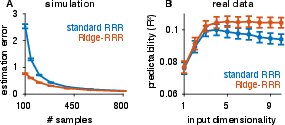
Figure 3: Comparative error curves for standard versus ridge-regularized RRR across varying sample sizes, showing pronounced error reduction for ridge-RRR in low-sample/high-dimensional contexts.
Empirical simulations demonstrate substantial improvement in weight recovery with ridge regularization, both in synthetic data and real non-human primate V1–V2 datasets.
Non-Spherical Noise (Full-Covariance RRR)
To address heteroscedasticity and noise correlations across outputs, a "full-covariance" RRR generalizes the noise model to include an arbitrary output covariance Σ. The estimator iteratively alternates between communication subspace inference and noise covariance estimation. This method offers pronounced gains in scenarios where neural noise is highly anisotropic or correlated.
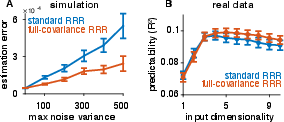
Figure 4: Performance of standard versus full-covariance RRR across increasing response noise anisotropy; accounting for full covariance structure notably improves estimation under strong nonsphericity.
Alignment Metrics Between Communication and Population Activity
Recognizing that the alignment between estimated communication channels and dominant neural activity axes is foundational for interpreting inter-area interactions, the paper introduces several alignment indices:
- Input Alignment Index quantifies if the communication subspace is aligned or anti-aligned with principal components of input activity. The index is normalized to [0,1] depending on whether the leading singular vectors project onto largest or smallest-variance modes.
- Output Alignment Index measures the spread of communicated variance across output principal components, effectively identifying whether inter-regional transfer primarily engages dominant or minor modes.
- Communication Fraction captures the proportion of total output variance explainable by the inferred communication channel.
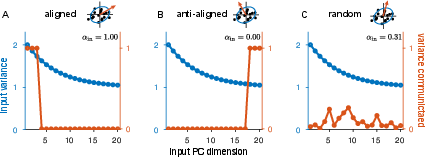
Figure 5: Differential profiles of input variance and communicated variance for scenarios where communication axes are aligned, anti-aligned, or randomly oriented relative to input principal components.
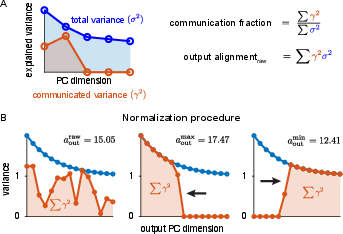
Figure 6: Illustration of communication fraction and output alignment index, with communicated variance mapped against output variance to classify aligned versus anti-aligned transfer.
These indices are critical for disentangling biologically meaningful communication from activity intrinsic to the source or receiver population subspaces.
Practical Considerations and Interpretation
The application of RRR to neural data necessitates principled preprocessing, such as optimal binning, careful mean centering (especially regarding peri-stimulus designs), and cross-validated rank selection. Rank selection heuristics or cross-validation enhance interpretability and generalization. The authors stress that RRR, by construction, identifies statistical dependencies—often termed "communication subspaces"—but cannot, absent intervention or causal manipulations, resolve the direction or pathway of information flow. As such, optimal experimental and analytical design should accompany RRR-based studies.
Theoretical and Practical Implications
The manuscript’s extensions—ridge regularization and full-covariance noise modeling—substantially broaden the applicability of RRR to challenging experimental regimes where neural data are noisy and high-dimensional. Quantitative alignment indices facilitate a more granular characterization of the relationship between communication channels and endogenous neural execution space and highlight when common dimensionality reduction approaches (e.g., PCR) are insufficient. Theoretically, the work foregrounds the difference between predictive modeling objectives and matrix approximation, emphasizing the role of input covariances in shaping optimal mappings.
Future AI and neuroscience could benefit from several directions suggested: multi-region RRR models to capture distributed communication, nonlinear/free-form extensions (incorporating deep learning or kernel-based methods), and integration of cell-type or genetic markers for richer mapping of communication axes. These avenues point towards unsupervised or semi-supervised frameworks capable of resolving complex, nonlinear, and context-dependent neural interactions.
Conclusion
This tutorial compiles a comprehensive and rigorous framework for RRR in neuroscience, clarifying mathematical foundations, providing extensions for more realistic noise and regularization, and equipping researchers with quantitative indices for interpreting low-rank neural communication. The provided software further lowers the barrier to routine and reproducible application. While emphasizing the advantages of RRR, the limitations concerning causality and pairwise modeling are candidly discussed, offering a roadmap for necessary methodological advances in the systematic study of neural circuits.

