- The paper establishes that generic congruence yields a unique canonical form while *congruence generates exactly ⌊n/2⌋+1 distinct bundles under perturbations.
- It employs detailed perturbation analysis, orbit stratification, and palindromic pencil eigenstructure to derive the canonical block decompositions.
- The findings impact the classification of bilinear and sesquilinear forms and inform robust, structure-preserving algorithms in numerical linear algebra.
Overview and Motivation
This work rigorously addresses the problem of characterizing generic canonical forms for congruence and ∗congruence equivalence of complex n×n matrices. Specifically, it determines which canonical forms, under small perturbations or in the topological sense of open and dense subsets, are "generic" for these equivalence relations. This is directly linked to the classification of complex bilinear and sesquilinear forms, as congruence and ∗congruence yield canonical matrix representatives for these structures. The results reveal a pronounced dichotomy: while congruence admits a unique generic canonical form, ∗congruence generically yields ⌊n/2⌋+1 distinct canonical structures. This distinction is established through a deep analysis of canonical form theory, stratification by orbit and bundle closure, and connections with the eigenstructure of palindromic pencils.
Formal Definitions and Theoretical Context
Given A,B∈Cn×n, congruence (⊤) and ∗congruence (∗) are defined via P⋆AP=B for invertible P, where ⋆ denotes transpose or conjugate transpose. The congruence canonical form (CFC) and ∗congruence canonical form (∗CFC), detailed in Horn and Sergeichuk [hs06], decompose a matrix as a direct sum of three canonical block types: Type 0 (nilpotent Jordan blocks), Type I (Γk and scalar multiples), and Type II (H2k(μ)). Type II blocks encode nontrivial parameters μ subject to different constraints for congruence versus ∗congruence (e.g., ∣μ∣>1 for ∗congruence, μ=0,(−1)k+1 for congruence).
Bundles are introduced to stratify matrix space beyond the orbit (i.e., equivalence class) level: a bundle consists of all matrices whose canonical form blocks are the same up to the choice of parameters, with dimension constraints imposed to ensure local structural constancy. The bundle closures in the classical or Euclidean topology are central objects for "genericity".
Main Results: Structural Dichotomy
Unique Generic Congruence Bundle
The central result for congruence is the identification of a single open and dense bundle, whose closure encompasses all of Cn×n. The generic congruence canonical form is fully characterized: for even n, it consists of n/2 distinct 2×2 Type II blocks with parameter ∣μ∣>1 or μ on the unit semicircle eiθ, 0<θ<π; for odd n, it is the same with an additional 1×1 identity block.
This structural rigidity is established by direct analysis of the closure relations of congruence bundles, manipulation of canonical forms under direct sum and continuity, and explicit perturbation arguments showing all other matrix types degenerate to this structure under sufficiently small perturbations. The corresponding open set is shown to be topologically generic.
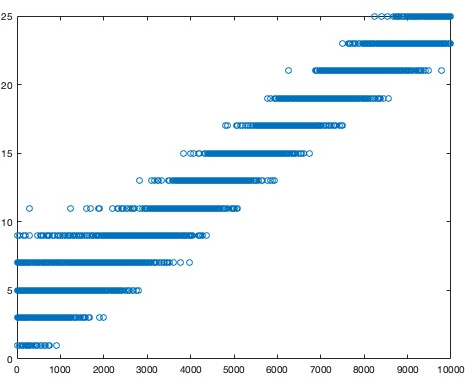
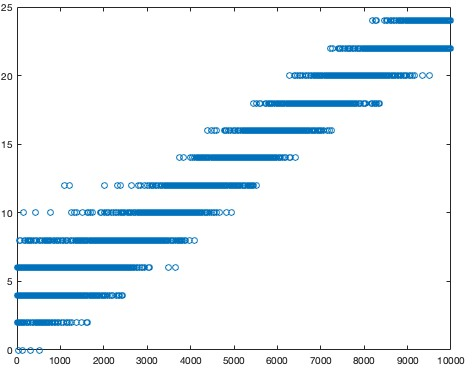
Figure 1: Number of unit eigenvalues of pencils A+A∗ for random A of size $24$ and $25$, highlighting that only a single generic structure arises in the congruence case.
⌊n/2⌋+1 Generic ∗Congruence Bundles
For ∗congruence, the situation is fundamentally different. Here, there are ⌊n/2⌋+1 structurally distinct open, dense bundles, each corresponding to a canonical form containing ℓ 2×2 Type II blocks (with ∣μ∣>1, all distinct) and n−2ℓ 1×1 Type I blocks with distinct unimodular parameters. Each bundle's closure is disjoint from the others, and their union is all of matrix space. These are the only codimension-zero ∗congruence bundles, as confirmed by explicit codimension calculations.
The proof involves careful manipulation of parameter spaces for block types, continuity of canonical form assignment under small perturbations, and analysis of the eigenvalue distributions of associated ∗-palindromic pencils. Crucially, while in the congruence case all blocks coalesce generically to the Type II form, here the balance between Type I and Type II blocks is not perturbable: each generic bundle is stable and separated from the others by the topological structure of the constraints on the parameters.
Connections with Matrix Pencil Theory
A key technical device throughout the paper involves palindromic pencils of the form A+λA⋆, whose eigenstructure closely reflects the block structure of canonical forms under congruence and ∗congruence. In particular, the number of unit-magnitude eigenvalues (modulus $1$) in the palindromic pencil correlates with the number of size $1$ Type I blocks in the canonical forms. For congruence, generically this number is either $0$ (even n) or $1$ (odd n). For ∗congruence, any even (for n even) or odd (for n odd) number of such eigenvalues between $0$ and n can occur, matching exactly the ⌊n/2⌋+1 bundle decomposition.
Numerical Confirmation
Extensive simulations with random matrices confirm the theoretical predictions. For ∗-palindromic pencils of even order, all even numbers of unit-magnitude eigenvalues occur, while for odd order all odd numbers do so, with frequencies matching the combinatorial counts predicted by the structure of the generic ∗congruence bundles.
Figure 1: Number of unit eigenvalues, as a function of index, strongly reflects the stratification by generic ∗congruence bundles.
Implications and Future Directions
The results have significant implications for the study of bilinear and sesquilinear forms, as they precisely characterize their generic classification complexity over C. The dichotomy in the number of generic forms points to fundamentally different geometry underlying congruence versus ∗congruence equivalence relations, a fact that manifests in the stability of spectral properties of palindromic pencils as well as in the algebraic structures of orbits and bundles.
Practically, these findings yield sharp expectations for how canonical structures behave under perturbation and can inform algorithmic approaches for structure-preserving linear algebra—in particular, computation and perturbation analysis for palindromic matrix pencils. The stratification provided can be immediately used in random matrix studies, structure prediction, and in the design of robust matrix algorithms that adapt to the bundle decomposition.
Future work should extend the methodologies presented here to real-field analogues, other involutions or adjunctions, and to more general *-semilinear and multilinear form classification problems. The interplay with invariant theory, algebraic group actions, and geometric representation theory also warrants deeper exploration, especially regarding measures and probabilities of different bundle types in random matrix theory.
Conclusion
This work establishes the unique generic congruence bundle and the ⌊n/2⌋+1 generic ∗congruence bundles in Cn×n, resolving a long-standing question regarding the stratification of canonical forms under congruence-type equivalence. The results illuminate the topological and geometric underpinnings of matrix structure under symmetry and adjunction and provide a rigorous foundation for further work in classification and perturbation of linear and sesquilinear forms.

