- The paper presents a novel series expansion technique that transforms nonlinear PDEs into a sequence of linear problems using a homotopy parameter.
- It rigorously proves convergence and demonstrates a refeeding strategy that effectively controls truncation errors during long-term simulations.
- The approach is extended to p-Laplacian equations, suggesting broad applicability and potential integration with quantum-assisted computational methods.
Robust Series Expansion for Nonlinear Advection-Diffusion Equations
Introduction and Motivation
This work addresses the computational complexity of nonlinear advection-diffusion partial differential equations (PDEs), typical in fluid mechanics, transport, and a broad swath of applied sciences. Such equations, in general, do not possess analytic solutions, and conventional numerical solvers—direct numerical simulation (DNS) via finite-difference or finite-element techniques—can be prohibitively expensive, especially in turbulent or highly nonlinear regimes. The series expansion approach developed here offers an alternative: a hierarchical reduction of the nonlinear PDE into a sequence of coupled linear PDEs via a homotopy parameter δ that interpolates between the linear and fully nonlinear equations. This method generalizes the Carleman and homotopy analysis approaches, but with rigorous convergence results and significant design freedom in the choice of deformation.
A key application focus is on the hierarchy for classic Burgers’ equation and generalized p-Laplacian operators. The approach naturally dovetails with state-of-the-art spectral methods and supports efficient implementation for long-time integration through an iterative procedure termed "refeeding," in which the sum at a given truncation order is used as the new initial condition. This yields convergence well beyond the naive regime.
The central construct is introducing a deformation parameter δ that morphs the nonlinear term into its linearized counterpart. For the Burgers’ equation example (nonlinear advection with linear diffusion), the homotopy equation becomes
∂tu+(1−δ)v∂xu+δu∂xu−ν∂x2u=f
with δ=0 yielding the linear advection-diffusion case and δ=1 yielding full Burgers’ dynamics. The solution u(t,x;δ) is then expanded in a Taylor series in δ, which is proven to have infinite radius of convergence for the linear homotopy.
The resulting hierarchy for the expansion coefficients un forms a set of forced, linear PDEs where the forcing at each order depends only on solutions at strictly lower order. For Burgers’ equation, the first few orders are:
∂tu0+v∂xu0−ν∂x2u0=f ∂tu1+v∂xu1−ν∂x2u1=(v−u0)∂xu0 ...
This pattern generalizes both to arbitrary advection nonlinearities and to strongly nonlinear diffusion, including the p-Laplacian.
Analyticity and Convergence: Burgers’ Equation
The primary theoretical result is a rigorous proof, via the Cole-Hopf transform, of infinite convergence radius for the δ-series for the specific "linear homotopy" deformation of Burgers’ equation for arbitrary L1-integrable initial conditions. This shows the expansion is non-perturbative—there is no requirement for small nonlinearity.
Numerical results for the Burgers’ fundamental solution (evolved delta function) show excellent agreement between the analytic result and finite-order truncations of the series; decreasing the advection speed parameter v relative to the diffusion constant accelerates convergence and stabilizes error growth. However, absent refeeding, the number of terms required for fixed error grows with simulation time, limiting efficiency for long-term integration.
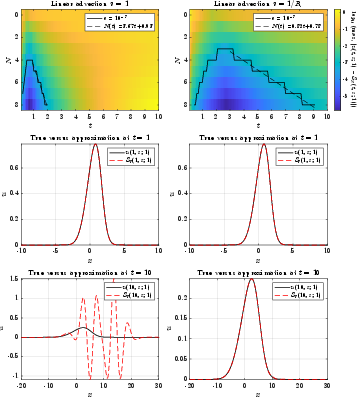
Figure 1: Maximum error across space between the exact and truncated series solutions for the Burgers' fundamental solution, as a function of series order and time, at two values of advection velocity v.
Periodic boundary conditions with smooth, non-singular initial conditions show similar rapid convergence for moderate time before saturation, and error growth for long times at fixed truncation.
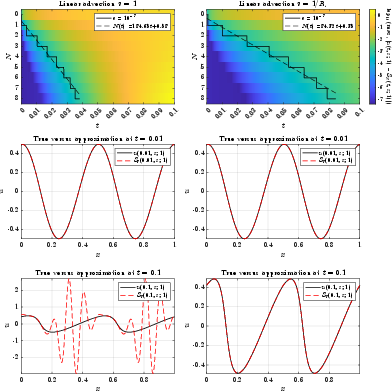
Figure 2: Series convergence for periodic Burgers' equation with a cosine-squared initial condition; left: v=1, right: v=1/Re, showing maximum error as a function of time and series order.
Refeeding Strategy
"Refeeding"—using the truncated sum at a given time as the new initial condition for a fresh expansion—circumvents error accumulation and allows stable long-time evolution with very low expansion order at each step. The refeeding strategy leverages linearity and is essentially a composition in time of the analytic expansions.
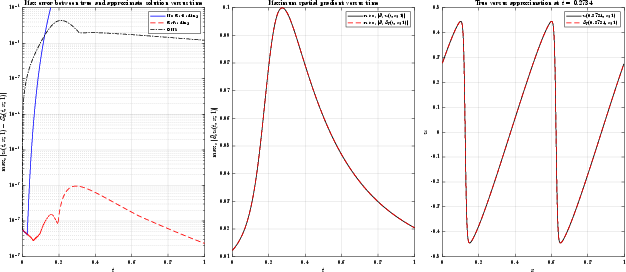
Figure 3: Error comparison for the series method with and without refeeding for periodic Burgers' equation; left: error growth with time, showing dramatic error suppression via refeeding.
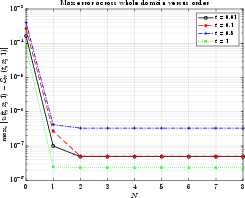
Figure 4: Rapid convergence of the series expansion for periodic Burgers' equation with refeeding, as measured by maximum spatial error vs. order at multiple time slices.
Application to Nonlinear Turbulence
The methodology enables a spectral-resolution study of forced Burgers’ turbulence, demonstrating correct turbulent scaling (E(k)∼k−2) in the inertial range in the steady state using only a small number of series terms per refeeding interval.
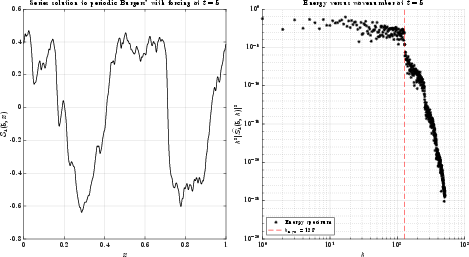
Figure 5: Turbulent steady-state in forced periodic Burgers' equation; left: solution profile, right: energy spectrum reveals correct inertial scaling.
Extension: Nonlinear Diffusion and p-Laplacian
The technique generalizes to arbitrary nonlinear diffusion equations, focusing on the p-Laplacian evolution and Dirichlet problems:
∂tu=∇⋅(∣∇u∣p−2∇u)
Two series schemes are analyzed: the "ordinary" (expansion around p=2) and the "dual" (via the Hölder conjugate), enabling analytic expansions for regimes where p−2 is not small. The corresponding hierarchies remain linear, with inhomogeneities determined from lower orders.
Direct comparison to known exact solutions for the fundamental p-Laplacian solution and Dirichlet problems in one and two dimensions confirms convergence in a wide range of p, with the ordinary series optimal for p<2 and the dual superior for p>2. Error plateaus emerge in the presence of grid discretization limits, but the series themselves converge exponentially fast with order until this regime.
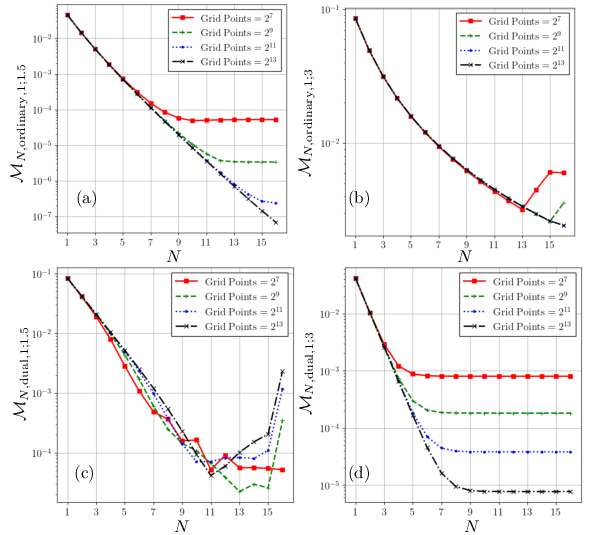
Figure 6: L1-norm error for the partial sums of the p-Laplacian Dirichlet problem as a function of order and grid size, for various p values and ordinary (top) and dual (bottom) series.
Practical and Theoretical Implications
This formalism permits transformational reductions in computational cost by delegating the hard nonlinear PDE to a sequence of forced linear solves, which can often leverage highly optimized numerical routines—spectral methods, fast Poisson solvers—drastically reducing runtime and complexity.
Crucially, the series hierarchical structure matches the linearity required by quantum computational schemes for solving PDEs, such as HHL-type or variational quantum algorithms. Thus, this formalism establishes a rigorous bridge between nonlinear PDE physics and quantum-assisted computation.
The refeeding strategy, in particular, realizes long-time integrability with only a handful of terms per time slice, further underscoring practical viability for simulation and analysis tasks. The method is extensible to higher dimensions, mixed advection-diffusion nonlinearities, and even systems of coupled PDEs.
Conclusion
The robust series expansion approach introduced here constitutes a rigorous, non-perturbative framework for treating nonlinear advection-diffusion PDEs by recasting them as infinite hierarchies of linear PDEs, with explicit proofs of analyticity and convergence for important classes. The method enables stable and efficient computation well beyond the perturbative regime, with refeeding greatly broadening its utility for long-time simulation. The reduction to linear problems opens the prospect for hybrid quantum-classical or fully quantum implementations, making the method a candidate for next-generation scientific computing in fluid dynamics, transport, and beyond.