Bridge2AI Recommendations for AI-Ready Genomic Data
Abstract: Rapid advancements in technology have led to an increased use of AI technologies in medicine and bioinformatics research. In anticipation of this, the National Institutes of Health (NIH) assembled the Bridge to Artificial Intelligence (Bridge2AI) consortium to coordinate development of AI-ready datasets that can be leveraged by AI models to address grand challenges in human health and disease. The widespread availability of genome sequencing technologies for biomedical research presents a key data type for informing AI models, necessitating that genomics data sets are AI-ready. To this end, the Genomic Information Standards Team (GIST) of the Bridge2AI Standards Working Group has documented a set of recommendations for maintaining AI-ready genomics datasets. In this report, we describe recommendations for the collection, storage, identification, and proper use of genomics datasets to enable them to be considered AI-ready and thus drive new insights in medicine through AI and machine learning applications.
Paper Prompts
Sign up for free to create and run prompts on this paper using GPT-5.
Top Community Prompts
Explain it Like I'm 14
Overview: What this paper is about
This paper gives clear, practical advice for making DNA data ready for AI. Think of DNA data like a giant book made of letters (A, C, G, T). AI can learn amazing things from this book, but only if the pages are clearly labeled, organized, and complete. The authors, part of an NIH project called Bridge2AI, explain what extra information (called metadata) needs to be saved with DNA data so AI can use it safely, fairly, and correctly.
Goals and questions the paper answers
The paper set out to answer a few simple questions:
- What information should always be saved with DNA data so AI can understand and trust it?
- How should DNA data be stored so computers can easily read and re-use it?
- What quality checks are needed so we know the data isn’t misleading?
- Which common standards and file types should everyone use so data from different labs works together?
How the authors approached the problem
Instead of running a lab experiment, the authors created a practical rulebook based on community standards and real-world experience. Here’s their approach in everyday terms:
- They treated metadata like the labels on a box, the recipe card for a dish, and the map legend for a chart—without those, you can’t use what’s inside safely or correctly.
- They compared existing standards (like FAIR, GA4GH, and others) and combined them into a clear checklist for DNA projects.
- They included a real example from autism research to show what goes wrong when key details are missing and how adding the right metadata fixes the problem.
Simple explanations of a few technical ideas:
- Metadata: The who/what/where/when/how about the data. Like a product label and user manual combined.
- Reference genome: A standard “map” of human DNA used to line up and compare new DNA reads.
- Alignment: Placing short DNA reads onto the reference map, like lining up puzzle pieces to a picture on the box.
- Coverage/depth: How many times each letter in the DNA was read. More reads = more confidence, like double-checking your homework.
- Unique molecular identifiers (UMIs): Little unique “stickers” on DNA pieces that help spot duplicates and reduce errors.
- BED file: A simple list of which parts of the genome a test tried to read, helpful for targeted tests.
- Variant calls (VCF/gVCF): A list of differences from the reference genome—like noting spelling changes from the standard text.
- VRS (Variation Representation Specification): A shared “language” for describing variants so different tools and databases understand the same thing.
- Hash/digest (like sha512t24u): A digital fingerprint for a sequence so you can be sure you’re talking about the exact same reference file.
What the paper recommends and why it matters
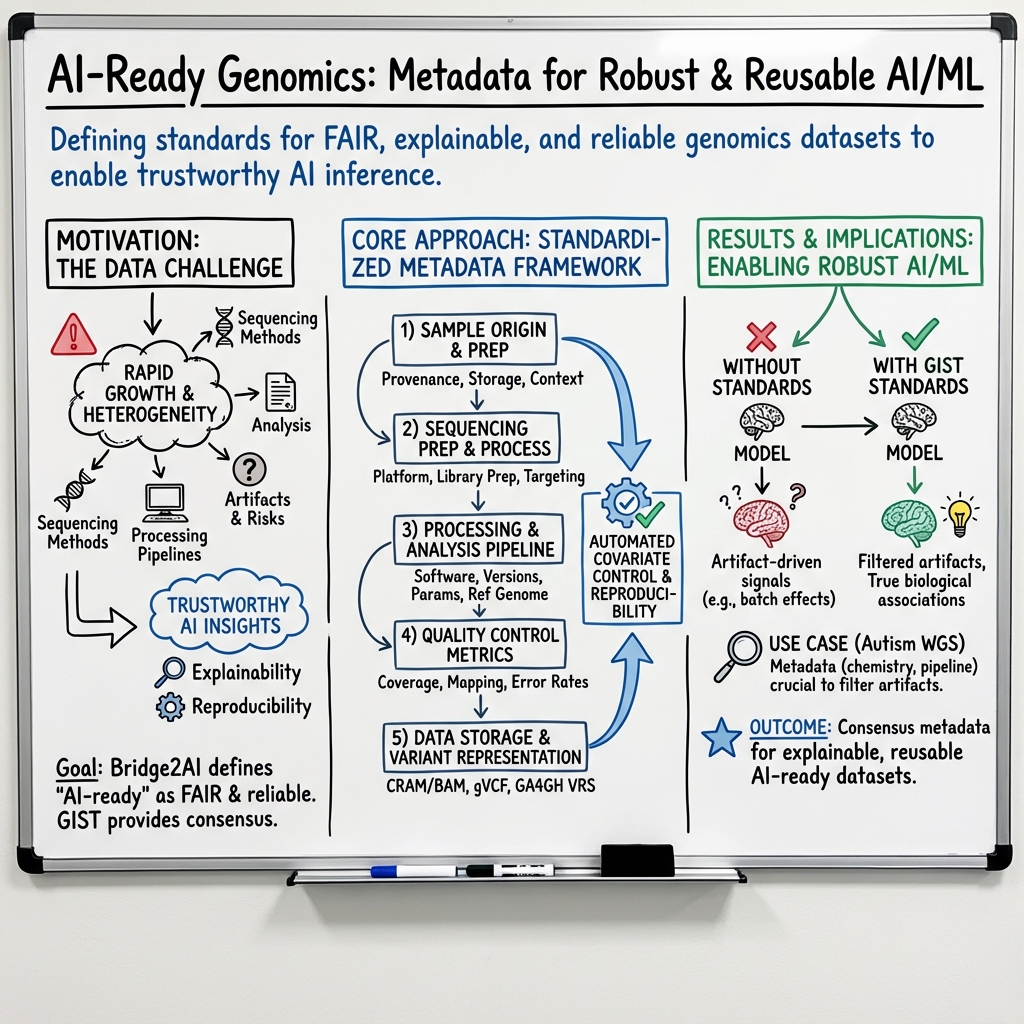
The authors outline what to capture and how to store it so DNA data becomes “AI-ready”—that is, FAIR, reliable, well-defined, and easy for computers to use. In simple terms, they want you to always include a clear label, a recipe, a quality check, and the right file format.
To make it easy to follow, here are the key types of information the paper says to include. This list is meant to be a quick checklist, not a deep dive:
- Dataset basics: What each file contains, when it was made, how it was processed, where it was processed, and a contact email.
- Sample details: Where and when the sample was taken, how it was stored (fresh, frozen, or chemical preservative), the type of sample (blood, saliva, tissue), diagnosis, and whether it’s normal or tumor. For human samples, include sex assigned at birth, genetic ancestry, and health traits if allowed.
- Sequencing setup: How the DNA library was prepared, which machine and model were used, the method (whole genome, exome, panel), whether UMIs were used, run IDs, and the date/place of sequencing. If the test targeted certain regions, include a BED file listing them.
- Data processing “recipe”: Which analyses were performed, every software tool and its version, all the settings used (including random seeds), any algorithm changes, the exact reference genome (name, version, and source link), and stable sequence IDs or digests. Include details about the computing environment and hardware if possible.
- Quality checks: Mapping quality, depth of coverage (ideally after removing duplicates), percent of target bases with enough coverage (for exome/panel tests), error rates, GC content, breadth of coverage, and known chromosomal sex if applicable.
- File formats: Save reads and alignments in standard formats (FASTQ for raw reads; BAM/CRAM for aligned reads—CRAM is preferred for compact storage with sequences and qualities). Store variants in VCF/gVCF (version 4.2 or 4.3 preferred). Use GA4GH VRS to describe variants consistently; include VRS identifiers if possible. GFF can be used for annotated features.
Why this matters: With these details, AI systems—and humans—can spot biases, repeat analyses, combine data from different places, and trust the results. Without them, AI might learn from the wrong signals.
A real example: autism genetics
Two centers sequenced DNA to study autism. They used different:
- Sample sources (more blood in one place, more saliva in the other),
- Sequencing chemistries and machines,
- Software pipelines.
The first AI model didn’t know these details. It found patterns that looked meaningful but actually came from technical differences (like saliva vs. blood), not biology. After adding complete metadata into a second model, those fake signals disappeared, and the model found better, real gene–trait links that could help patient care. Lesson: metadata turns “noisy” data into trustworthy discoveries.
Main takeaways
- AI-ready DNA data needs rich, standardized metadata. Think: a clear label, a full recipe, and strong quality checks.
- Store data in common, well-documented formats so different computers and labs can use it.
- Record exact software versions, parameters, reference genomes, and even computing hardware to make results reproducible.
- Use community standards like FAIR and GA4GH’s VRS so everyone speaks the same “data language.”
- Good metadata prevents AI from chasing artifacts and helps it find real biology that can improve health care.
What this means for the future
If labs follow these recommendations, AI will learn from cleaner, clearer DNA data. That means:
- Faster, more reliable discoveries,
- Better sharing and combining of data across hospitals and research centers,
- Stronger foundations for precision medicine—treatments tailored to a person’s genes.
The authors note their guide focuses mainly on “small variants” (like single-letter changes and short insertions/deletions), but many ideas apply more broadly. As more projects use these standards, AI in genomics will become more trustworthy, fair, and impactful.
Knowledge Gaps
Knowledge gaps, limitations, and open questions
The paper leaves several areas unresolved; the following gaps can guide future work.
- Scope limited primarily to small variant detection; no concrete guidance for structural variants (SVs), copy-number variants (CNVs), repeat expansions, mitochondrial variation, or mobile element insertions (recommended formats, QC metrics, normalization practices, and VRS mappings are unspecified).
- No recommendations for long-read sequencing metadata (e.g., flow cell and chemistry versions, basecaller model and parameters, read-length distributions, modification calls like 5mC) or associated QC thresholds.
- Absence of guidance for RNA-seq, single-cell genomics, multi-omics (proteomics, metabolomics, epigenomics), and methylation sequencing, including modality-specific metadata, file formats, and cross-modality integration strategies.
- Missing concrete, machine-actionable “AI-readiness” checklist, schema, and validator (e.g., JSON/YAML schema with cardinalities, controlled vocabularies, required vs. optional fields, and automated completeness checks).
- No normative QC pass/fail thresholds (e.g., coverage minima, percent targets above depth, error rates, contamination limits) or recommended truth sets/controls (e.g., GIAB samples) to standardize acceptance.
- Variant-level QC metrics are under-specified (e.g., allele balance, strand bias, mapping quality distributions, read position bias, somatic/germline purity adjustments, tumor-normal pair concordance).
- Lack of explicit guidance for phasing and haplotype representation (file formats, metadata for phasing algorithms, block definitions, and integration with VRS haplotypes).
- No recommendations for joint calling and cohort-level data (e.g., storing genotype likelihoods, multi-sample gVCF conventions, cohort-level QC metrics, and batch-aware aggregation strategies).
- Confounder and batch-effect handling is not operationalized (e.g., which technical covariates to encode, recommended statistical/ML adjustment methods, and batch diagnostics to run across centers).
- Metadata for somatic analyses is incomplete (e.g., tumor purity estimates, cellularity, matched-normal metadata, ploidy/copy-number metadata, clonality metrics, and tumor-specific QC).
- Missing practical guidance on harmonizing targeted capture metadata (e.g., kit identifiers, BED region versioning, off-target metrics, and centralized registry of capture designs).
- No instructions for capturing critical instrument-level details (e.g., firmware/driver versions, flow cell IDs, reagent lot numbers, lane/run barcodes, and instrument calibration logs).
- UMI and barcode handling lacks depth (e.g., collision rates, barcode correction methods, index hopping assessments, and sample-swap detection workflows).
- Reference genome management remains underspecified (e.g., alt loci/decoys usage, patch version lifecycles, liftover procedures, normalization/left-alignment rules, and pangenome/graph genomes).
- Adoption and interoperability of sequence digests (sha512t24u) is assumed but not operationalized (e.g., refget endpoints, embedding digests in CRAM/VCF headers, and cross-resource resolution).
- Computational accessibility is not concretely defined (e.g., GA4GH DRS/htsget/WES integration, API endpoints, access performance SLAs, and cloud-optimized data packaging).
- Reproducibility and environment capture need stronger prescriptions (e.g., standardized container images, workflow languages like WDL/CWL/Nextflow, hardware/driver specifications, random seed recording, and determinism testing).
- Privacy, de-identification, and data governance are out of scope but crucial (e.g., DUO/Consent Codes encoding, HIPAA/GDPR compliance patterns, controlled-access workflows, and reidentification risk assessment).
- No strategy for provenance and versioning of metadata itself (e.g., ontology term version pinning, URI persistence, change logs, and dataset release notes).
- Ontology crosswalks and term normalization are not provided (e.g., mapping across EDAM, EFO, NCIT, SO, MIXS, and FAIR Genomes; recommended canonical term sets and synonym handling).
- Lacks guidance for fairness, bias, and representation (e.g., standardized encoding of ancestry, sex assigned at birth vs. gender, demographic balance targets, and bias audits in AI training).
- No recommended dataset partitioning for AI (e.g., multi-center train/validation/test splits, leakage prevention, temporal splits, and strategies for dataset shift detection and monitoring).
- Absent metrics or scoring system to quantify “AI-readiness” and track improvement over time (e.g., a graded rubric with reproducibility, accessibility, and completeness scores).
- No plan for ongoing sustainability (e.g., long-term archiving, reference remapping policies, data migration across formats, and cost/effort guidance for maintainers).
- Cross-species and non-human genomes are not addressed (e.g., microbial/viral metadata differences, polyploid organisms, and metagenomic samples).
- Lack of concrete examples (sample metadata files, minimal viable AI-ready dataset, and validated templates) to help implementers operationalize the recommendations.
- The autism use case is illustrative but underspecified for replication (e.g., model architectures, datasets, confounder encoding, artifact removal procedures, and generalization tests to other diseases).
Practical Applications
Immediate Applications
The following applications can be deployed now using the paper’s recommendations and existing standards, tools, and workflows.
- Clinical genomics labs (healthcare): operationalize the metadata checklist across sample collection, library prep, sequencing, and bioinformatics processing to reduce AI confounding and improve reproducibility.
- Tools/workflows: LIMS templates aligned to FAIR Genomes/EDAM/NCIT/EFO; standardized intake forms capturing storage conditions, dates/locations, biospecimen type, clinical diagnosis, pathological state; de-identified sample IDs; ontology mapping services (OLS4/Ontobee).
- Assumptions/dependencies: staff training; IRB-approved consent language for sex assigned at birth, genetic ancestry, phenotypes; EHR-LIMS integration; privacy safeguards for sensitive metadata.
- Sequencing centers (healthcare, biotech): mandate inclusion of sequencing preparation metadata and QC metrics in data releases.
- Tools/workflows: capture UMIs/barcodes; publish BED files for targeted panels; log platform and instrument model, run IDs, sequencing date/location; generate base-call/read mapping quality, depth of coverage, error summaries, GC content, breadth of coverage, genotypic sex; CRAM with reads+alignments preferred.
- Assumptions/dependencies: pipeline updates for CRAM/BAM/FASTQ/FASTA/gVCF v4.2+ (prefer 4.3); storage/compute provisioning; downstream compatibility with CRAM.
- Bioinformatics teams (software, academia): standardize pipeline provenance for explainability and reuse.
- Tools/workflows: record analyses performed, software and versions, parameters and random seeds, algorithm modifications; provide lockfiles; specify reference genome (e.g., GRCh38 with source pointer), include URL-safe
sha512t24udigests and refget IDs; containerize workflows (Docker/Singularity); use Nextflow/Snakemake/CWL; produce dataset README files. - Assumptions/dependencies: organizational buy-in; dev effort to refactor pipelines; consistent environment capture.
- Tools/workflows: record analyses performed, software and versions, parameters and random seeds, algorithm modifications; provide lockfiles; specify reference genome (e.g., GRCh38 with source pointer), include URL-safe
- Variant representation interoperability (software, healthcare): adopt GA4GH VRS for semantically precise and globally identifiable variant data.
- Tools/workflows: integrate VRS-Python to generate VRS objects and identifiers from VCF/gVCF; include variant quality, total/read support counts, genotype quality; use GA4GH-compatible formats (VCF 4.3 preferred).
- Assumptions/dependencies: adoption across reporting systems; compatibility mapping between existing variant databases and VRS.
- AI model developers (software, academia): build metadata-aware training/evaluation pipelines that explicitly control for covariates highlighted in the autism use case.
- Tools/workflows: confounder detection and adjustment (e.g., sample source, chemistry, instrument, coverage); feature stores that ingest metadata; model cards documenting metadata use; data validators that block training on ill-described datasets.
- Assumptions/dependencies: robust metadata availability; governance to enforce validation gates; access to QC metrics alongside sequence data.
- Clinical reporting and decision support (healthcare): embed QC and VRS identifiers into clinician-facing variant reports to improve trust and actionability.
- Tools/workflows: report coverage at variant loci (e.g., 30x thresholds), read support counts,
PASS/FAILflags; display VRS IDs as stable cross-system keys; auto-flag low-quality regions or off-target calls using BED intervals. - Assumptions/dependencies: regulatory acceptance; clinician training to interpret QC metrics; EHR integration.
- Tools/workflows: report coverage at variant loci (e.g., 30x thresholds), read support counts,
- Data repositories and consortia (policy, academia): update submission policies to require AI-ready metadata and provide validation services.
- Tools/workflows: schema-based validators for Tables 1–6 fields; enforcement of CRAM/gVCF/VRS compatibility; automatic README generation; consent/data use permission tagging; “AI-ready” dataset badges.
- Assumptions/dependencies: governance and funding; submitter compliance; sustainable storage for rich metadata.
- Targeted sequencing kit vendors (biotech): ship panel definitions and enrichment metadata with products to streamline downstream AI readiness.
- Tools/workflows: provide BED interval files; document enrichment kit methods; publish expected coverage and error profiles; disclose UMIs/barcode schemes.
- Assumptions/dependencies: vendor willingness; alignment with GA4GH/Bridge2AI guidance.
- Hospital biobanks (healthcare): refine sample storage SOPs to capture preservation methods and provenance that affect downstream AI quality.
- Tools/workflows: barcode tracking for storage conditions (fresh/flash frozen/FFPE), collection/preparation dates/locations; automatic linkage to biospecimen type and pathological state; de-identification pipelines.
- Assumptions/dependencies: change management; IRB approvals; system interoperability.
- Academic training programs (education): incorporate the autism genotype–phenotype use case to teach metadata’s role in avoiding artifacts.
- Tools/workflows: course modules; reproducible labs using gVCF/CRAM/VRS; checklists for metadata completeness and QC thresholds.
- Assumptions/dependencies: access to de-identified example datasets; faculty expertise.
- Quality assurance and compliance (healthcare, biotech): internal audit checklists for “AI-ready genomics” compliance.
- Tools/workflows: gaited release processes that verify metadata fields, QC metrics, and VRS conversion; evidence/provenance graph capture (FAIRSCAPE).
- Assumptions/dependencies: audit capacity; integration with existing QA systems.
Long-Term Applications
The following applications require further research, scaling, cross-institutional adoption, or regulatory development before widespread deployment.
- “AI-ready genomics” certification and accreditation (policy, healthcare, biotech): establish national/international standards and audit programs for dataset quality and AI-readiness.
- Tools/products: certification frameworks; standardized “AI nutrition labels” for datasets; third-party auditors.
- Assumptions/dependencies: consensus across NIH/GA4GH/regulators; funding; global alignment.
- Federated learning for genomics with standardized metadata (software, healthcare, academia): enable cross-center AI without data movement, leveraging VRS and harmonized QC.
- Tools/workflows: secure federated training; privacy-preserving analytics; cross-site metadata harmonization services.
- Assumptions/dependencies: legal data-sharing frameworks; consistent consent terms; robust network and compute.
- Metadata-aware clinical AI decision support at point-of-care (healthcare): real-time adjustment of risk scores and variant interpretation based on sample prep and sequencing context.
- Tools/products: CDS modules that ingest QC and provenance; automated re-sequencing recommendations when coverage/QC thresholds not met; explanation interfaces for clinicians.
- Assumptions/dependencies: regulatory clearance; model generalizability; integration with LIS/EHR.
- Commercial LIMS/ELN platforms with Bridge2AI compliance modes (software, biotech): turnkey systems that enforce metadata capture and FAIR/GA4GH standards.
- Tools/products: packaged pipelines; ontology-backed data models; runtime validators; refget integration; VRS conversion APIs.
- Assumptions/dependencies: market adoption; vendor ecosystems; interoperability standards.
- Regulatory adoption by FDA/EMA for NGS diagnostics (policy): require VRS identifiers, reference digests, and minimum QC/coverage reporting in submissions.
- Tools/workflows: regulatory submission templates; conformance test suites; standardized QC thresholds.
- Assumptions/dependencies: policy cycles; stakeholder feedback; demonstrated clinical utility.
- Retrofitting legacy datasets (academia, repositories): automated inference and curation to recover missing metadata and convert to VRS-compatible representations.
- Tools/workflows: ML-based metadata inference (e.g., sample source, chemistry, ploidy); semi-automated curation pipelines; batch conversion to CRAM/gVCF/VRS.
- Assumptions/dependencies: method accuracy; curator capacity; funding for large-scale remediation.
- Repository-level provenance graphs and acceptance gates (software, academia): integrate evidence graphs and strict validators into submission workflows to prevent artifact-prone datasets.
- Tools/workflows: FAIRSCAPE-like provenance capture; policy-enforced validators; dashboards for dataset FAIR/AI-readiness scores.
- Assumptions/dependencies: platform engineering; community buy-in; cost.
- Consumer genomics portals with transparent QC and consent metadata (daily life, healthcare): empower individuals with interpretable quality indicators and data-use controls.
- Tools/products: patient dashboards showing coverage, variant confidence, sample source effects; consent managers; educational content on FFPE vs. blood/saliva impacts.
- Assumptions/dependencies: literacy/UX design; privacy protections; clinical validation.
- Cross-vendor instrument interoperability (biotech, software): standardized run-level metadata APIs and logs across 2-channel/4-channel chemistries to minimize technical artifacts.
- Tools/workflows: vendor-neutral schemas; SDKs; compliance tests; machine-readable run manifests.
- Assumptions/dependencies: vendor cooperation; incentives; backward compatibility.
- Foundation models for genomics trained on AI-ready data (academia, software): pretrain large models on harmonized gVCF+VRS corpora to advance variant interpretation and phenotype prediction.
- Tools/workflows: scalable data loaders for CRAM/gVCF/VRS; confounder-robust pretraining strategies; evaluation benchmarks.
- Assumptions/dependencies: compute resources; curated multi-center datasets; governance for model sharing.
- Real-time sequencing QC orchestration (biotech, healthcare): automated dashboards that monitor recommended metrics and dynamically adjust runs or flag failures.
- Tools/workflows: streaming QC pipelines; run controllers integrated with sequencer APIs; alerting systems linked to coverage thresholds and error rates.
- Assumptions/dependencies: hardware API access; reliability testing; operational readiness.
- Workforce development and microcredentials for genomic data stewardship (education, policy): formalize training on AI-readiness, metadata standards, and reproducible analytics.
- Tools/workflows: curricula, certifications, continuing education programs; competency assessments.
- Assumptions/dependencies: accreditation bodies; institutional support; incentives for adoption.
Glossary
- AI-ready dataset: A dataset prepared to be explainable, reusable, and computationally accessible for AI/ML; typically aligned with FAIR and reliability standards. "AI-ready datasets are those that are FAIR, fully reliable, robustly defined, and computationally accessible1."
- Annotated gVCF: A gVCF file that includes additional annotations describing variants and non-variant regions. "For example, if that dataset contains an annotated gVCF, this file should clearly explain what each column header means and the intended format and content of data in that column."
- BAM: Binary Alignment/Map format for storing sequencing reads aligned to a reference genome. "Appropriate file formats to store genome sequences include FASTQ (reads only), BAM (reads with alignments), and CRAM (compressed reads with alignments)."
- Base call quality: A score indicating the confidence in each nucleotide read during sequencing. "Data that has been aligned should include base call and read mapping quality, paired read data (as applicable) and depth of coverage scores (Table 4)."
- BED file: Browser Extensible Data format used to define genomic intervals (e.g., capture regions). "If targeted panel or exome sequencing was performed, a browser extensible data (BED) file15 should be provided that supplies the profiled regions/locations"
- Biospecimen: The biological material (e.g., tissue, blood, cell culture) from which genomic data are generated. "biospecimen type (e.g., tissue or cell culture)"
- Breadth of coverage: The proportion of the target genome or region that is covered by sequencing reads at any depth. "Other quality metrics that should be provided include 1) error rate summary, 2) sequenced GC content, 3) breadth of coverage (for alignment data), and 4) chromosomal ploidy, if known (including sex chromosomes)."
- BWA-MEM: A widely used algorithm for aligning sequencing reads to a reference genome. "Different software pipelines were used for alignment and variant calling across centers, introducing variability in data processing: BWA-MEM and GATK at B1, and DRAGMAP and DRAGEN at B2."
- Chromatin profiling: An analysis that characterizes the state and structure of chromatin across the genome. "Data producers must include the analyses performed (e.g., phased genotyping, chromatin profiling, clonal variant calling)"
- Chromosomal ploidy: The number of sets of chromosomes present in a cell. "Other quality metrics that should be provided include 1) error rate summary, 2) sequenced GC content, 3) breadth of coverage (for alignment data), and 4) chromosomal ploidy, if known (including sex chromosomes)."
- Clonal variant calling: Identifying genetic variants associated with specific subclones within a heterogeneous sample. "Data producers must include the analyses performed (e.g., phased genotyping, chromatin profiling, clonal variant calling)"
- CRAM: A compressed format for storing aligned sequencing reads, reducing file size compared to BAM. "we recommend that sequence read and alignment data always be stored together in CRAM files (Table 5)."
- DELIN sequences: Deletion-insertion sequence variants where bases are both deleted and inserted at a locus. "It highlighted how the associations identified in the first model were predominantly linked to technical variables such as DELIN sequences, homopolymers, and center-specific SNVs rather than true genotype-phenotype correlations."
- Depth of coverage: The number of sequencing reads overlapping a given position or region, often reported as mean coverage or “x”. "Data that has been aligned should include base call and read mapping quality, paired read data (as applicable) and depth of coverage scores (Table 4)."
- DRAGEN: A hardware-accelerated platform for genomic analysis, including alignment and variant calling. "Different software pipelines were used for alignment and variant calling across centers, introducing variability in data processing: BWA-MEM and GATK at B1, and DRAGMAP and DRAGEN at B2."
- DRAGMAP: An aligner for mapping sequencing reads to a reference genome. "Different software pipelines were used for alignment and variant calling across centers, introducing variability in data processing: BWA-MEM and GATK at B1, and DRAGMAP and DRAGEN at B2."
- EDAM: An ontology for bioinformatics concepts, including data, operations, topics, and formats. "A more detailed list of possible metadata to ensure findable, accessible, interoperable, and reusable (FAIR) genomes can be found at FAIR Genomes, EDAM, MIXS GSC, Sequence Ontology, EFO, and NCIT"
- EFO: Experimental Factor Ontology, used to describe experimental variables and metadata. "A more detailed list of possible metadata to ensure findable, accessible, interoperable, and reusable (FAIR) genomes can be found at FAIR Genomes, EDAM, MIXS GSC, Sequence Ontology, EFO, and NCIT"
- Enrichment kit: A toolkit used to capture specific genomic regions (e.g., exome or panels) for sequencing. "Enrichment kits used for targeted sequencing experiments operate by different methods that should be described."
- Exome capture: A method to selectively sequence the protein-coding regions (exons) of the genome. "This includes capturing the library preparation and sequencing process (e.g., exome capture methods and PCR amplification)"
- FAIR: Principles ensuring data are Findable, Accessible, Interoperable, and Reusable. "A more detailed list of possible metadata to ensure findable, accessible, interoperable, and reusable (FAIR) genomes can be found at FAIR Genomes, EDAM, MIXS GSC, Sequence Ontology, EFO, and NCIT"
- FASTA: A text format for representing nucleotide or amino acid sequences. "FASTA"
- FASTQ: A text format for storing sequencing reads with per-base quality scores. "Appropriate file formats to store genome sequences include FASTQ (reads only), BAM (reads with alignments), and CRAM (compressed reads with alignments)."
- FPGA: Field-Programmable Gate Array; a reconfigurable hardware device used in some genomic processing pipelines. "Specifications for hardware (e.g., GPU or FPGA) and the analysis environment used during the pipeline are recommended to be included"
- Formalin-fixed paraffin-embedded (FFPE): A tissue preservation method that can degrade DNA and affect sequencing quality. "e.g., if samples were fresh, flash frozen, or stored in formalin-fixed paraffin-embedded blocks."
- GA4GH: Global Alliance for Genomics and Health, which develops genomics standards (e.g., VCF, VRS). "As highlighted in the NHGRI FAIR Data Workshop, for semantically precise representation of variant data for use by AI systems, we recommend the use of data standards compatible with the GA4GH Variation Representation Specification (VRS)17."
- GATK: Genome Analysis Toolkit, a software suite for variant discovery in high-throughput sequencing data. "Different software pipelines were used for alignment and variant calling across centers, introducing variability in data processing: BWA-MEM and GATK at B1, and DRAGMAP and DRAGEN at B2."
- GC content: The proportion of guanine and cytosine nucleotides in a sequence, used as a quality metric. "Other quality metrics that should be provided include 1) error rate summary, 2) sequenced GC content, 3) breadth of coverage (for alignment data), and 4) chromosomal ploidy, if known (including sex chromosomes)."
- GFF3: Generic Feature Format version 3, used for genomic feature annotations. "Users may also include other downstream formats, such as GFF3 for annotated data."
- gVCF: Genomic VCF; a variant call format that includes non-variant regions to represent coverage and genotype confidence. "For storing small variant (e.g., SNVs and indels) data from large-scale sequencing studies, we recommend these data are stored as gVCF files"
- GRCh38: A major human reference genome assembly used for alignment. "If the data has been aligned to a reference genome (e.g., GRCh38)"
- GSSO: Gender, Sex, and Sexual Orientation Ontology used for metadata standardization. "Standards Legend: 1. FAIR Genomes 2. EDAM 3. MIxS GSC 4. Sequence Ontology 5. EFO 6. NCIT 7. GSSO"
- GPU: Graphics Processing Unit; used to accelerate computational tasks in genomic pipelines. "Specifications for hardware (e.g., GPU or FPGA) and the analysis environment used during the pipeline are recommended to be included"
- Homopolymers: Stretches of identical nucleotides that can be error-prone in sequencing. "It highlighted how the associations identified in the first model were predominantly linked to technical variables such as DELIN sequences, homopolymers, and center-specific SNVs rather than true genotype-phenotype correlations."
- Indels: Small insertions and deletions in the genome. "For storing small variant (e.g., SNVs and indels) data from large-scale sequencing studies, we recommend these data are stored as gVCF files"
- Lockfile: A file capturing exact versions and the computational environment of software to ensure reproducibility. "Pipeline information should include the software used throughout the pipeline including the computational environment and version of the software (lockfile) with parameters used (including random seeds)"
- MIxS GSC: Minimum Information about any (x) Sequence by the Genomic Standards Consortium. "A more detailed list of possible metadata to ensure findable, accessible, interoperable, and reusable (FAIR) genomes can be found at FAIR Genomes, EDAM, MIXS GSC, Sequence Ontology, EFO, and NCIT"
- NCIT: NCI Thesaurus, an ontology for cancer and biomedical terminology. "A more detailed list of possible metadata to ensure findable, accessible, interoperable, and reusable (FAIR) genomes can be found at FAIR Genomes, EDAM, MIXS GSC, Sequence Ontology, EFO, and NCIT"
- Paired read data: Sequencing reads generated in pairs (paired-end), providing more accurate alignment and variant calling. "Data that has been aligned should include base call and read mapping quality, paired read data (as applicable) and depth of coverage scores (Table 4)."
- PCR amplification: Polymerase Chain Reaction used to amplify DNA prior to sequencing. "This includes capturing the library preparation and sequencing process (e.g., exome capture methods and PCR amplification)"
- Phased genotyping: Determining which variants are on the same chromosome (haplotype), improving interpretability of genetic data. "Data producers must include the analyses performed (e.g., phased genotyping, chromatin profiling, clonal variant calling)"
- Read mapping quality: A score indicating confidence in the placement of a read on the reference genome. "Data that has been aligned should include base call and read mapping quality, paired read data (as applicable) and depth of coverage scores (Table 4)."
- Reference genome: A standardized genome sequence used as the alignment target. "If the data has been aligned to a reference genome (e.g., GRCh38), this must be included along with the reference version (e.g,. GCF_000001405.40) and pointer to the source of the reference genome."
- SAM: Sequence Alignment/Map, a text-based format for aligned reads (the uncompressed counterpart to BAM). "CRAM/BAM/SAM"
- Sequence digest: A hash-based identifier for a sequence, enabling consistent identification across resources. "Standard sequence digest approaches should be used to create identifiers for sequences, and digests should be stored in databases and file headers when used to produce file contents."
- Sequence Ontology: An ontology for describing genome annotations and sequence features. "A more detailed list of possible metadata to ensure findable, accessible, interoperable, and reusable (FAIR) genomes can be found at FAIR Genomes, EDAM, MIXS GSC, Sequence Ontology, EFO, and NCIT"
- Sequenced GC content: The GC proportion measured in the sequenced data; used as a quality metric. "Other quality metrics that should be provided include 1) error rate summary, 2) sequenced GC content, 3) breadth of coverage (for alignment data), and 4) chromosomal ploidy, if known (including sex chromosomes)."
- Sequencing instrument model: The specific model of the machine used for sequencing. "Metadata must also include information on the sequencing platform and instrument model, sequence pool and run identifiers, and the date and location each sample was sequenced."
- Sequencing platform: The make or technology of the sequencer (e.g., Illumina, PacBio). "Metadata must also include information on the sequencing platform and instrument model, sequence pool and run identifiers, and the date and location each sample was sequenced."
- Sequence pool and run identifiers: Metadata identifying pooled samples and specific sequencing runs. "Metadata must also include information on the sequencing platform and instrument model, sequence pool and run identifiers, and the date and location each sample was sequenced."
- SNV: Single Nucleotide Variant; a change in a single base in the genome. "For storing small variant (e.g., SNVs and indels) data from large-scale sequencing studies, we recommend these data are stored as gVCF files"
- Targeted capture: A sequencing approach focusing on predefined genomic regions (e.g., panels, exomes). "if the experiment is a targeted capture, the quality control data should also capture the percent of target bases with suitable coverage (e.g., 30x depth)"
- Targeted panel: A predefined set of genomic regions selected for sequencing. "If targeted panel or exome sequencing was performed, a browser extensible data (BED) file15 should be provided"
- Unique Molecular Identifiers (UMIs): Short synthetic sequences attached to DNA fragments to distinguish original molecules and reduce PCR bias. "Data producers should note what barcodes, unique molecular identifiers, and other synthetic sequences were used in this experiment"
- URL-safe sha512t24u: A truncated, URL-safe SHA-512 digest used to uniquely identify reference sequences. "We recommend that URL-safe sha512t24u16,17 reference sequence digests be used for this purpose."
- VCF: Variant Call Format, the standard file format for storing genetic variants. "based on the GA4GH Variant Call Format (VCF) (at least version 4.2), with version 4.3 preferred."
- VRS: Variation Representation Specification; a GA4GH standard for precise, computable variant representation and identifiers. "we recommend the use of data standards compatible with the GA4GH Variation Representation Specification (VRS)17."
- VRS-Python: A software library implementing VRS to make variant data compatible and interoperable. "For pipelines using the GA4GH VCF file format, these files can be readily made VRS-compatible using the VRS-Python software stack."
- VRS Variant Object Data: Structured data elements (e.g., Location, State) representing variants under VRS. "VRS Variant Object Data <VRS Location / VRS State>"
Collections
Sign up for free to add this paper to one or more collections.

