- The paper establishes a deterministic framework that maps memory-based quantum feedback onto a hybrid Lindbladian master equation, enabling exact full counting statistics analysis.
- It demonstrates how feedback control converts quantum jump records into enhanced system performance, as seen in feedback cooling and three-level maser applications.
- The approach bridges non-Markovian dynamics to a Markovian representation, facilitating both analytical and numerical studies of thermodynamic observables.
Introduction
The paper "Deterministic Equations for Feedback Control of Open Quantum Systems III: Full counting statistics for jump-based feedback" (2512.11078) establishes a unified formalism for quantum feedback protocols based on the storage of quantum-jump records. The authors present a framework that deterministically describes the evolution, counting statistics, and thermodynamic properties of open quantum systems under feedback conditioned on the last detected quantum jump channel. The main innovation is a Lindblad-type master equation operating in an extended (hybrid) classical-quantum space, enabling non-Markovian feedback dynamics to be mapped onto a Markovian evolution in an enlarged state space.
Deterministic Dynamics of Memory-Based Quantum Feedback
Traditional feedback strategies in open quantum systems, such as those pioneered by Wiseman [PhysRevA.49.2133], focus on instantaneous feedback actions conditioned solely on the most recent measurement outcome without any explicit memory. In contrast, the formalism advanced here incorporates a dynamical classical memory kt that tracks the last detected jump channel. The system's evolution is governed by a trajectory-dependent Hamiltonian H(kt) and set of jump operators {Lq(kt)}, generating a non-Markovian process at the level of the unconditional system state.
This non-Markovianity is circumvented by formulating a set of deterministic equations for the "memory-resolved" conditional states ϱt(k), encoding both the quantum subsystem and the classical jump memory. Collectively, these states define a hybrid density operator ρsm(t) acting on the tensor product Hs⊗Hcl. The dynamics of ρsm(t) are given by a Lindblad master equation with extended Hamiltonian and dissipators that address both system and memory transitions.
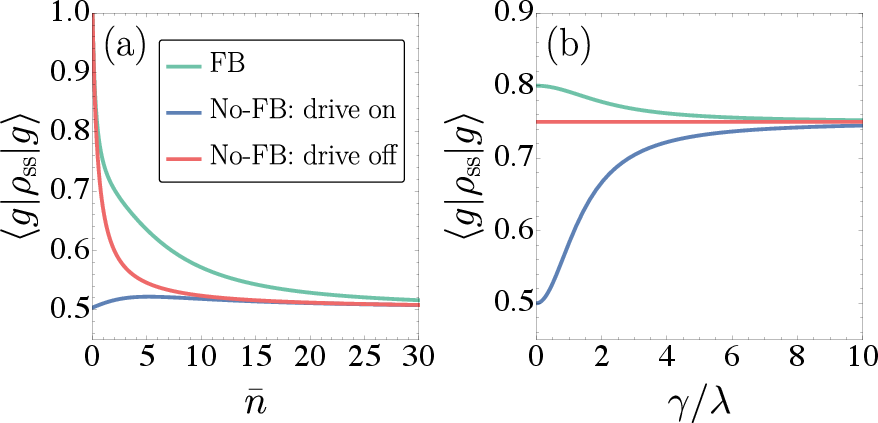
Figure 1: Schematic representation of a hybrid classical-quantum evolution. The jump memory stores the last detected channel and steers the feedback action.
The explicit generator for the hybrid dynamics is
∂tρsm(t)=−i[H,ρsm(t)]+k,q∑D[Lk,q]ρsm(t)
where
H=k∑H(k)⊗∣k⟩⟨k∣
and
Lk,q=Lk(q)⊗∣k⟩⟨q∣.
This construction ensures that feedback based on arbitrary causal classical memories can be analyzed within a standard Markovian framework, at the cost of an enlarged state space. The computational complexity thereby grows linearly in the number of memory states, but the deterministic nature of the equations enables exact characterization of stationary and dynamical properties.
Full Counting Statistics in the Presence of Feedback
Full counting statistics (FCS) is the machinery used to characterize, in detail, the stochastic charge H(kt)0—the weighted number of quantum jumps detected during the evolution. The hybrid formalism enables the computation of not only the moments but also the full distribution of observables of the form
H(kt)1
with H(kt)2 the number of detections in channel H(kt)3 and H(kt)4 the associated weights (corresponding, e.g., to entropy, energy, or work increments).
Importantly, by mapping the feedback process to the hybrid Lindblad generator, one can directly apply FCS techniques to obtain time-dependent and stationary cumulants, power spectra, and correlation functions. In particular, the average current, noise, and higher order correlations of H(kt)5 (as well as the entire distribution via generating functions) can be computed from the steady-state solution of the hybrid master equation.
The approach naturally interfaces with modern stochastic thermodynamics, where feedback control and information-to-work conversion are central. The deterministic equations derived provide direct access to thermodynamic quantities such as entropy production, work extraction, and their fluctuating properties.
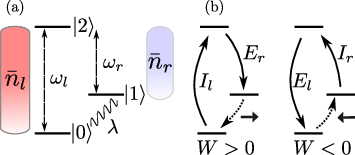
Figure 2: Illustration of memory-resolved conditional states and their coupling through feedback-dependent quantum jump channels.
Examples: Feedback Cooling and Quantum Thermal Machines
The formalism is illustrated first with a driven two-level system (qubit) under feedback that conditionally toggles an external drive based on the last detected emission or absorption event. The memory-based protocol enhances ground-state population beyond the scenario where the drive is always on/off, thereby enabling efficient quantum feedback cooling.
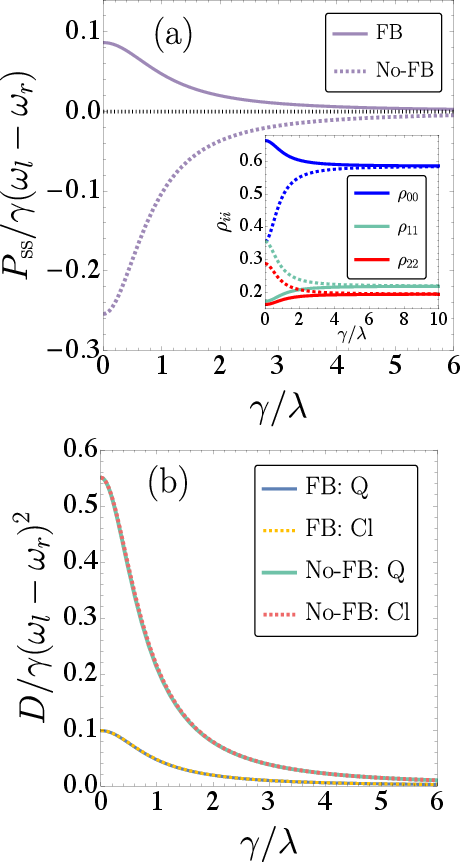
Figure 3: Steady-state ground-state occupation as a function of feedback protocol and bath temperature, demonstrating enhanced cooling.
The key application is to a three-level maser operating between two thermal baths. A jump-based feedback scheme enables selection of dynamical cycles so that only engine-like (work-generating) cycles occur, regardless of the thermal gradient. This manipulation is not possible in conventional protocols lacking memory. The authors provide analytic and numerical evidence for the enhanced steady-state work current and altered noise characteristics under such feedback.
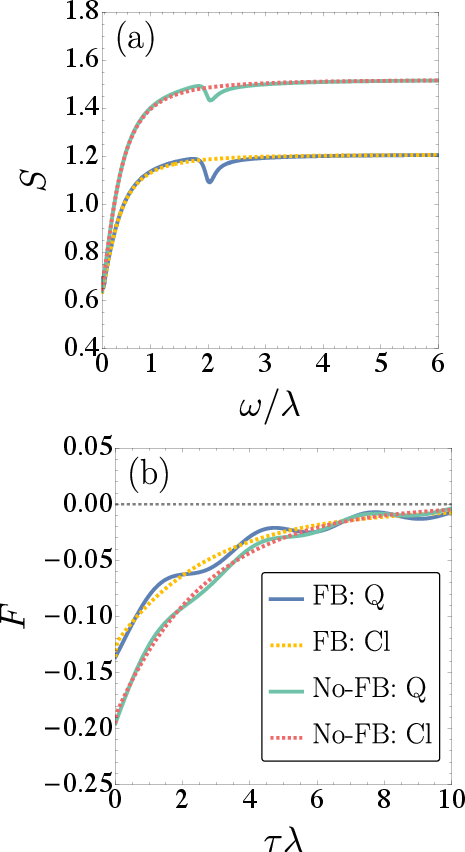
Figure 4: (a) Average power and noise (fluctuations) for a three-level maser under feedback control; feedback maintains positive power and reduces noise even in regimes of reversed thermal bias.
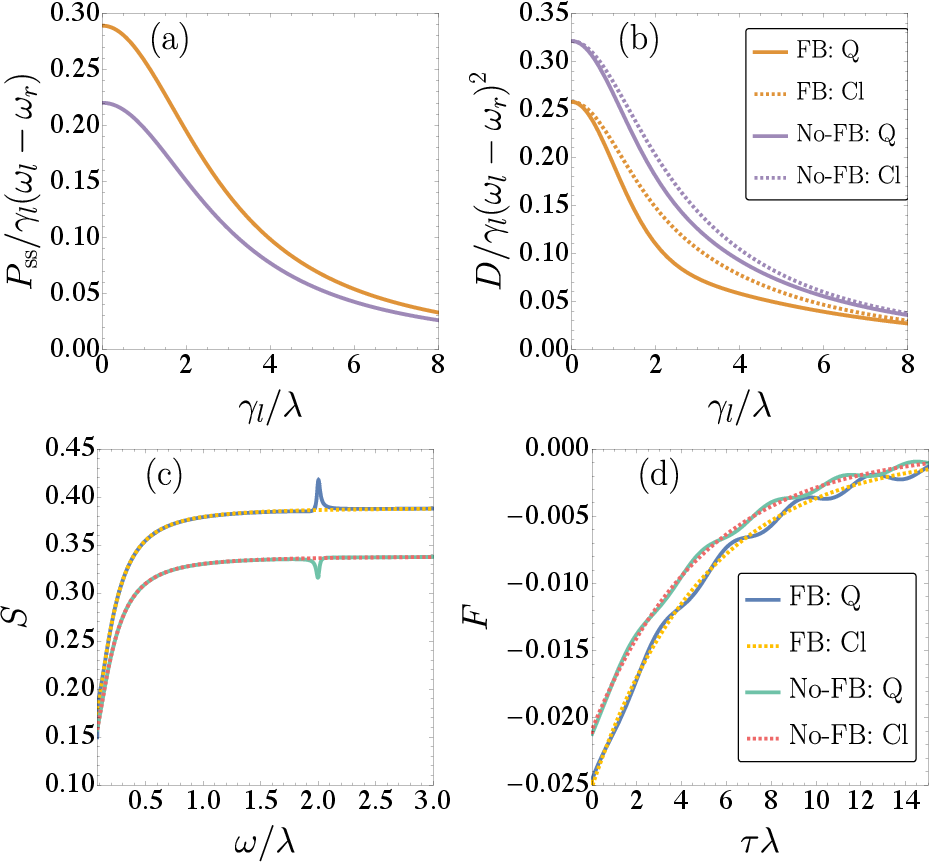
Figure 5: Power spectrum and two-point current correlation functions of the stochastic work showing feedback-induced suppression of fluctuations and structure at system energy gaps.
The results confirm that information extracted from jump detections can be systematically converted into work, establishing a direct link between measurement-based feedback protocols and thermodynamic functionality analogous to Maxwell demon scenarios.
The formalism subsumes previous instantaneous, memoryless feedback master equations as a special case. When the feedback action depends only on the current jump and not on memory, the generator reduces to the forms previously considered in quantum feedback control literature. The key extension here is the explicit, deterministic inclusion of causal (potentially multi-step) memory functions, which allow for experimentally relevant protocols where feedback is executed at arbitrary times rather than immediately post-jump.
This deterministic hybrid-space representation also yields efficient numerical schemes, in contrast to stochastic trajectory averaging required for direct simulation of quantum trajectories, especially when feedback is involved.
Implications and Future Directions
The hybrid Lindbladian approach for feedback unlocks new applications, including optimal control, quantum thermodynamic cycle selection, and entropy production statistics in memory-augmented settings. Practically, it enables the synthesis of non-trivial feedback protocols in quantum-dot, superconducting qubit, or optomechanical systems, as already evidenced by experimental efforts referenced in the paper [PhysRevLett.117.206803, PhysRevApplied.23.044063, Minev2019CatchingReverseQuantumJump].
On the theoretical side, the algorithmic possibility of mapping complex non-Markovian measurement-based control protocols onto extended Markovian evolutions opens avenues for generalization: more intricate memories (beyond last jump), time-continuous control, or adaptive protocols based on entire trajectory statistics. Further integration with quantum information-theoretic measures—such as mutual information between system and memory—becomes possible in this deterministic framework.
Conclusion
This paper establishes a rigorous deterministic method for the analysis of jump-based feedback protocols in open quantum systems, showing that general memory-augmented feedback is equivalent to Lindbladian evolution in a hybrid classical-quantum space. As a result, full counting statistics—including all time-dependent and stationary observables—becomes accessible for systems under realistic feedback scenarios. These results reinforce the interplay between continuous measurement, information processing, and control in quantum thermodynamics, and offer concrete analytic and computational tools for both foundational studies and experimental implementations.
(2512.11078)

