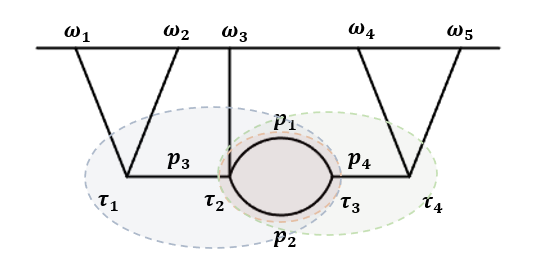
- The paper shows that diagrammatic rules capture singularities in one-loop cosmological correlators with non-local inverse-Laplacian interactions in slow-roll inflation.
- It employs the Schwinger-Keldysh formalism along with dimensional and cutoff regularization to reveal universal branch cut structures and precise pole positions.
- The study demonstrates that the leading total energy singularity corresponds to flat-space scattering amplitudes, reinforcing the connection between dS and Minkowski results.
Singularities in Cosmological Loop Correlators with Non-Local Interactions: Analytic Structure and Flat Space Correspondence
Introduction
The study addresses the analytic structure of cosmological correlators at one-loop in slow-roll inflation, explicitly incorporating non-local interactions arising from the ADM formalism via inverse-Laplacian operators. These non-localities naturally emerge when solving and substituting the Hamiltonian and momentum constraints in single-field inflation, introducing angularly nontrivial and momentum-dependent vertices in the cubic and quartic actions. The principal technical achievement is the extension and rigorous cross-verification of diagrammatic rules previously formulated for local (polynomial or derivative) interactions to this higher-complexity, non-local framework. Furthermore, the work explores the connection between one-loop, inflationary correlator singularities and their flat-space scattering amplitude counterparts, clarifying the interplay between dS-specific analytic features and their Minkowski-space analogs or lack thereof.
The inclusion of non-local operators in the cosmological perturbation theory, specifically inverse-Laplacians such as ∂−2 acting on combinations like ζ˙, complicates loop integral evaluation, leading to intricate angular dependence in vertex factors. These complications are not merely technical curiosities; realistic inflationary models, when canonically quantized via the ADM decomposition, naturally induce such non-local structures in the effective action, especially when enforcing constraint equations to higher perturbative order.
The computation proceeds via the Schwinger-Keldysh (in-in) formalism, summing over all possible time-ordered and anti-time-ordered diagrams. Notably, the external energies in the correlator are analytically continued off-shell, facilitating the identification and classification of the entire singularity structure (poles and branch cuts) without explicit full-loop integral evaluation—a crucial utility of the diagrammatic rules.
Two regulatory frameworks are systematically implemented: dimensional regularization and physical cutoff regularization. The former maintains explicit control over divergences arising from both the measure and mode function expansion in d=3+δ, while the latter, although restricted to d=3, allows tractable completion of otherwise intractable angular integrals due to the structure of the non-local vertices, offering a robust cross-verification mechanism.
Explicit One-Loop Computations: Bispectrum with Non-Local Vertices
The work provides an exhaustive enumeration and computation of all non-redundant Wick contractions in the one-loop bispectrum with both cubic and quartic non-local vertices, as prescribed by the effective action.
For representative diagrams (see below), analytic expressions for the renormalized bispectrum are furnished. The results unambiguously reveal that the full set of pole and branch cut structures are precisely predicted by the diagrammatic rules established for local interactions, thereby demonstrating their universality in the presence of inverse-Laplacian non-localities. Specifically, the analytic structure always contains branch points at the sums of the exchanged internal momenta and the external energies injected into the graph at specific subgraphs, as encoded by the positions of the logarithms in the final expressions.
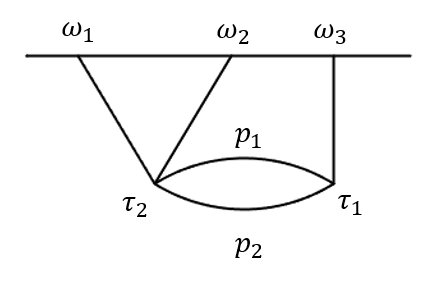
Figure 1: Bispectrum at one-loop with insertions of non-local cubic and quartic interaction vertices.
The procedures are verified in both regularization schemes, with the divergent and logarithmic terms matching as expected while highlighting scheme-dependent subtleties in the treatment of de Sitter–specific branch cuts.
Analytic Structure: Universality of Diagrammatic Rules and New Features
The principal outcome is the affirmation that the positions of singularities in the one-loop bispectrum—including those arising from non-local (inverse-Laplacian) operators—are correctly captured by the same diagrammatic subgraph-based construction as in the local case. This is substantiated by explicit computation in a wide variety of contraction topologies.
The combined set of poles and branch cuts, extracted without explicit integration of the full internal momenta, always organize into scale-invariant (dilatation-invariant) logarithms:
- Branch cuts of the form log(s+ω3), log(s+ω12) (or analogous combinations, with s the exchanged momentum and ω the injected energies) persist as the essential analytic features even with non-local interactions.
- Total energy branch cuts—that is, logarithms of ωT (total energy)—arise universally, but their coefficients and finite remnants can depend nontrivially on the regularization scheme (see discussion after Eq. (D_2) and related text).
The analytic structure thus exhibits a universality, driven by the symmetry of the de Sitter background and its associated constraints, with non-localities in the action changing the combinatorics of contraction contributions but not introducing qualitatively new singularities.
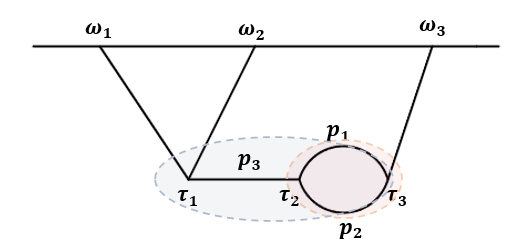
Figure 2: 1-loop bispectrum with three cubic (and potentially non-local) vertex insertions, showing the complexity managed by diagrammatic rule application.
A central technical advance is the generalization and explicit verification that the leading singularity (highest-order pole) of the one-loop cosmological correlator in the ωT→0 (total energy vanishing) limit matches the flat-space scattering amplitude for the corresponding process, even after performing full loop integration and for non-local interaction vertices.
Further, the study demonstrates that correlation function singularities associated with loop subgraphs, as well as left and right subgraphs (defined precisely in terms of the Feynman diagram topology, see supporting appendices), always correspond to visible analytic features (branch points) in the final result. These can be read off without laborious explicit integration, highlighting the significant practical power of the diagrammatic rule approach for future applications in higher loops and more involved topologies.
Implications and Future Directions
From the perspective of cosmological effective field theory, the formalism demonstrated here legitimizes the use of diagrammatic rules for analytic structure prediction in loop correlators, even in the fully realistic scenario where non-localities are present. This provides a computationally viable approach for organizing and anticipating singularity features in calculations relevant to primordial non-Gaussianity or the perturbativity of inflationary correlators.
The clarified connection between loop-corrected de Sitter correlators and flat space amplitudes sharpens notions of unitarity, locality, and causality in time-dependent backgrounds, offering a robust cross-check on the methodology of cosmological perturbation theory at quantum loop level. The non-existence of additional, non-cancellable branch cuts from non-local vertices supports the view that locality, in the effective action sense, is reflected in the analytic structure only after summing all relevant contributions induced by constraint enforcement.
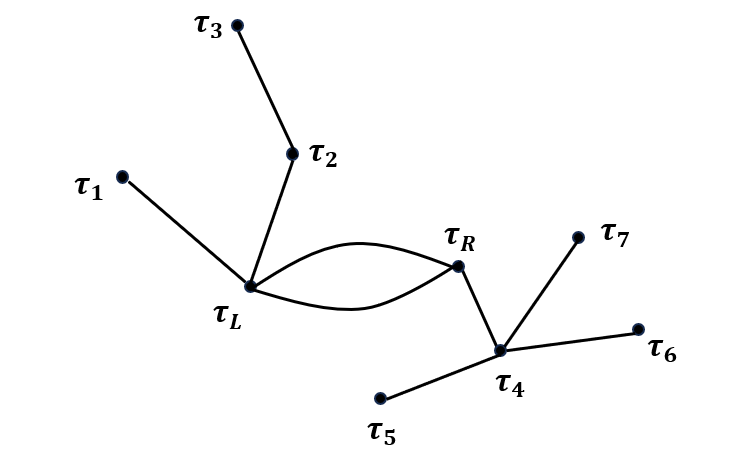
Figure 4: Generic structure of loop and external energy flows in a diagram, with subgraphs identified for singularity extraction.
The work leaves open critical questions for further exploration:
- The explicit renormalization of late time divergences arising in cutoff regularization.
- Extension to massive, spinning, or multi-field scenarios, which are known to generate qualitatively richer wavefunction analytic structures.
- Generalization to higher-loop corrections, where subgraph nesting and combinatorics grow super-exponentially and may test the current rules.
- Investigation of partial-energy flat space limits and their potential to distinguish between physical and dS-specific analytic phenomena.
Conclusion
The study delivers a thorough technical analysis of the analytic structure of one-loop cosmological correlators with non-local interactions. It is shown that the diagrammatic subgraph-based rules for identifying poles and branch cuts are robust to the presence of non-local (inverse-Laplacian) vertices. Additionally, explicit demonstration is given that the leading singularity in the total energy limit always matches the S-matrix element of the corresponding flat-space process, cementing the connection between curved and flat background quantum field theoretic predictions. These results serve as a formal anchor for ongoing and future work aimed at higher order computations and the comprehensive classification of inflationary non-Gaussianity beyond tree level.
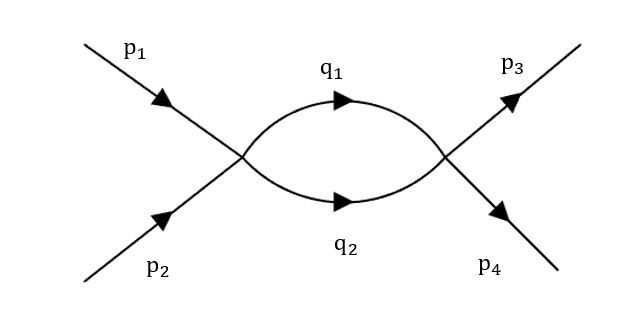
Figure 5: Standard 2→2 scattering diagram in ϕ4 theory, illustrating matching to the flat-space amplitude in the total energy vanishing limit.
References
The above summary and discussion are entirely based on (2512.11040).