- The paper introduces a novel quantitative measure of effective field theory complexity using effective o-minimality in Seiberg-Witten theory.
- The paper demonstrates that duality frame switching is essential, as a single global frame leads to infinite complexity, while a cell decomposition approach yields a finite global minimal complexity of 54.
- The paper establishes that only EFTs with finite complexity can consistently couple to quantum gravity, offering a quantitative criterion for swampland constraints.
Complexity in Effective Field Theories via Seiberg-Witten Theory
Introduction: Finite Complexity and Effective o-Minimal Structures
This paper advances the quantitative study of effective field theory (EFT) complexity by introducing explicit measures, rooted in the mathematics of effective o-minimality, and deploying them in a concrete physical setting: the N=2 SU(2) Seiberg-Witten (SW) theory. The work operationalizes the notion that physically consistent quantum field theories (QFTs) should permit finite, well-controlled descriptions. O-minimal structures, particularly their effective and sharp variants, provide the needed mathematical formalism for quantifying geometric and logical complexity in field theory moduli spaces.
Effective o-minimality assigns a numerical "format" F to definable functions or sets, quantifying information content such as the number of functional components, logical operations, or parameters required for specification. Binyamini’s development of Log-Noetherian (LN) and Pfaffian-extended LN o-minimal structures RLN,PF is central, as these are rich enough to encompass period integrals of algebraic varieties (such as those appearing in SW theory) yet admit explicit, computable complexities.
Mathematical Framework: Tameness, Effective o-Minimality, and Complexity
The paper reviews and builds upon the following mathematical infrastructure:
- O-minimal Structures and Tameness: O-minimality formalizes the notion of "tame" geometric sets—those whose structure precludes pathological intricacy, such as infinitely nested components or oscillations. Tameness is the foundation for assigning any meaningful notion of complexity.
- Effective and Sharp o-Minimality: These refinements incorporate quantitative complexity measures (F or a tuple (F,D)), tracking the combinatoric and geometric information required to specify sets and functions.
- Log-Noetherian and Pfaffian Functions: Log-Noetherian functions, constructed via differential equations on special domains (cells of points, discs, annuli, etc.), serve as the atomic building blocks for effective descriptions. Pfaffian closure allows for the inclusion of more general (even unbounded) functions.
- Cell Decomposition: The geometric domain (e.g., a moduli space) is covered by a finite number of cells adapted to the singularity structure, within each of which the local physical description remains tame and the complexity is quantifiable.
The key outcome is that the global complexity of effective data remains finite only if duality frames are switched between certain patches: a single global frame would, due to divergent behaviors near singularities, encode infinite complexity.
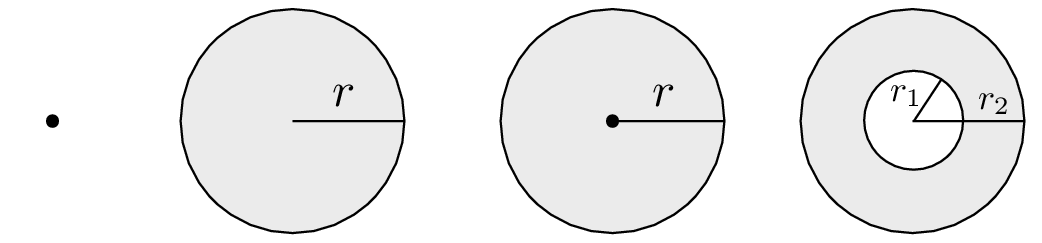
Figure 1: Basic building blocks (cells) for LN-functions: point, disc D(r), punctured disc D∘(r), annulus A(r1,r2).
Elliptic Curves, Period Maps, and Cell Decomposition
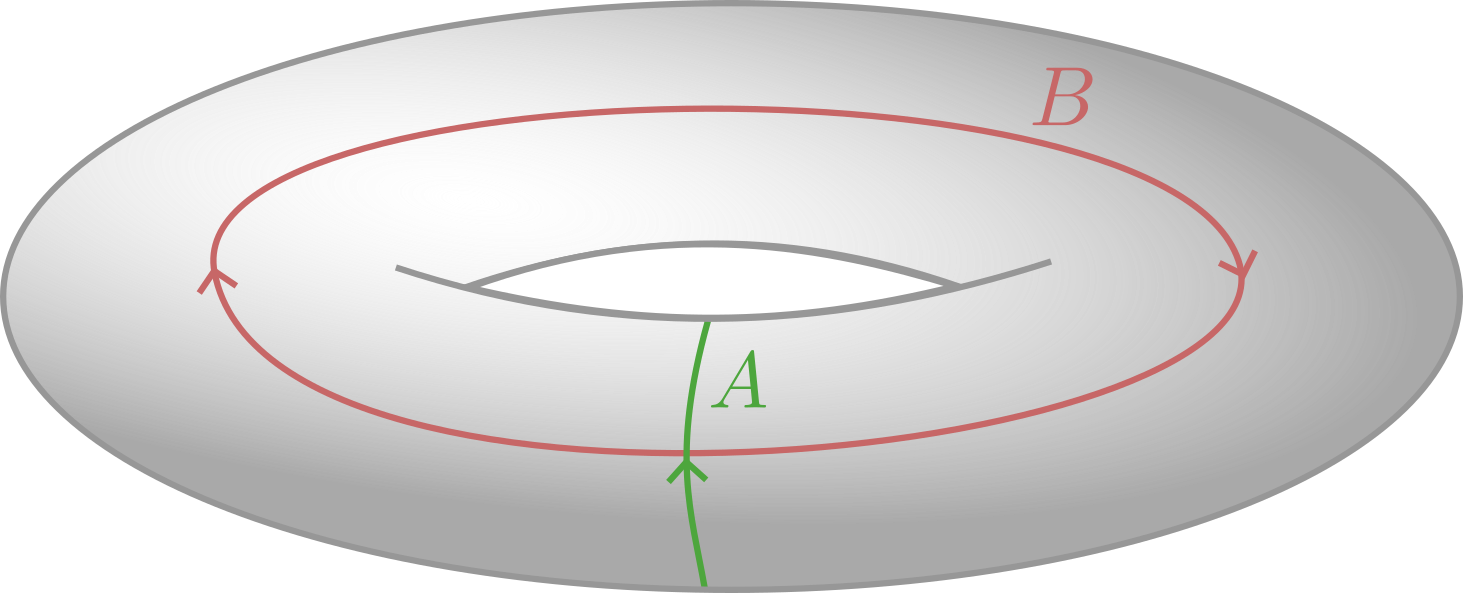
SW theory encodes its low-energy effective coupling, BPS spectrum, and moduli geometry in terms of periods of an auxiliary family of elliptic curves, viewed as maps from the quantum moduli space (the u-plane) into the period domain. The approach hinges on:
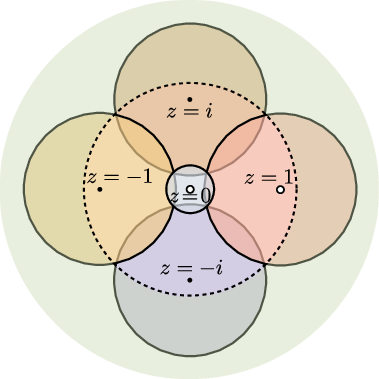
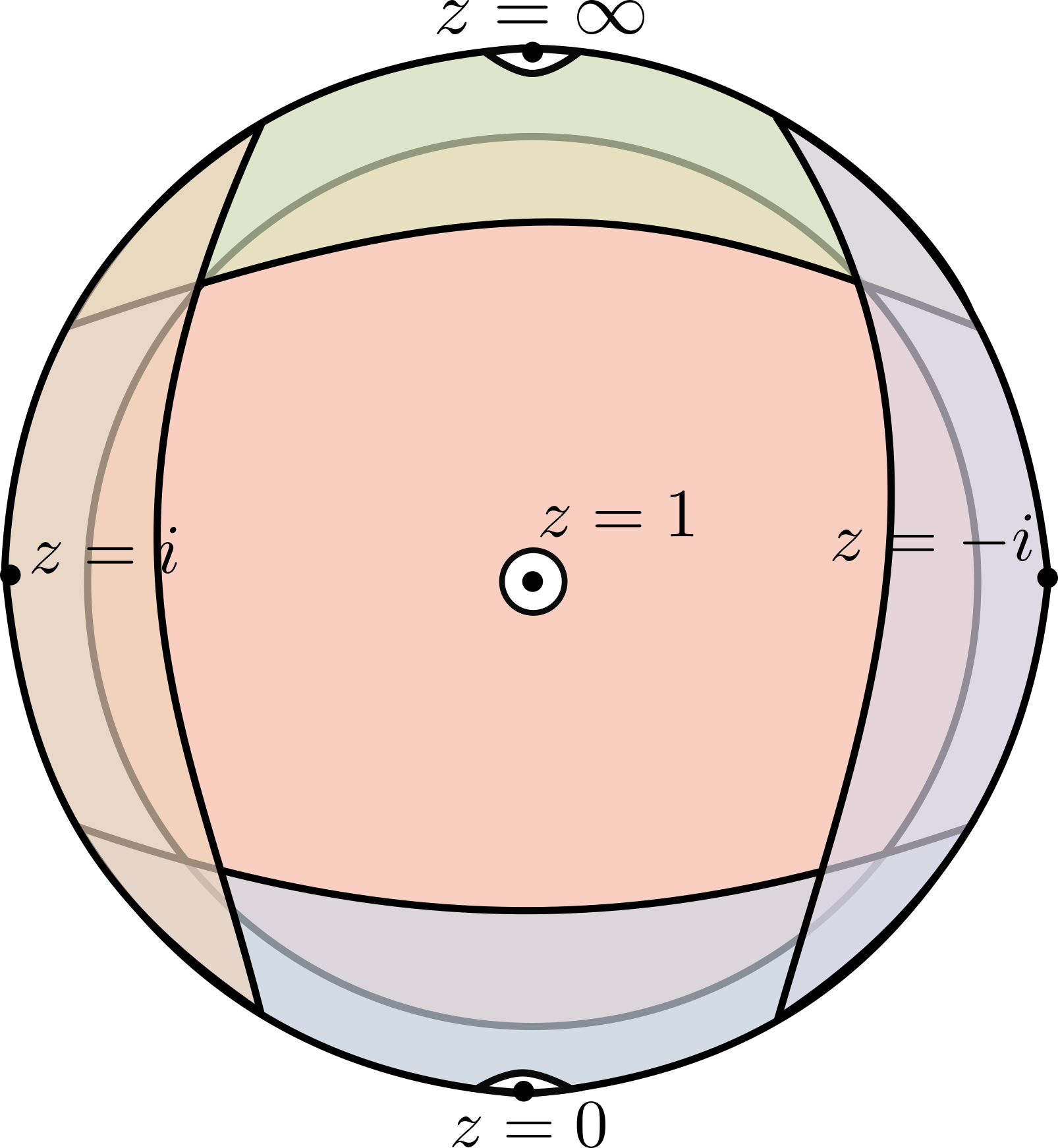
Figure 3: The covering of the thrice-punctured Riemann sphere P1∖{0,1,∞} visualized as colored open sets, each corresponding to an LN cell.
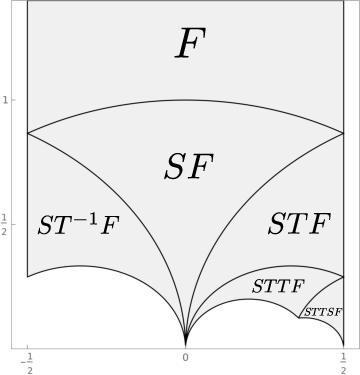
Figure 4: Partial tessellation of the upper half-plane using images of the SL(2,Z) fundamental domain, reflecting modding out by the duality monodromy group.
Complexity Calculation for the Seiberg-Witten Coupling
The effective SW coupling τ(u) is equated to the period map, recast as a function whose complexity is evaluated patch-wise:
- Local Complexity: In each patch, the period function (solution to the Picard-Fuchs equation) is split into a holomorphic (LN) part and a multivalued logarithmic or power-like part (handled via the Pfaffian extension). For singular patches, local coordinates and duality frames are chosen to ensure all functions remain bounded on their domains.
- Supremum and Pole Avoidance: The complexity format F depends on the supremum of relevant functions within each cell; as a cell expands to include another singularity, this supremum—and consequently the complexity—diverges.
- Composition and Optimization: The total global complexity is computed by optimally covering the moduli space and summing patch complexities, including the necessary logical operations (conjunctions, quantifiers) required to specify the full period map modulo duality.
Numerically, the global minimal complexity for the SW effective coupling is quoted as F(τ)=54, based on an explicit optimization over the cell radii (see Figure 5 below). The calculation demonstrates both the methodology and feasibility for complexity quantification in realistic EFTs.

Figure 6: Depiction of the moduli space M covered by 6 LN cells, with EFT validity regions indicated.
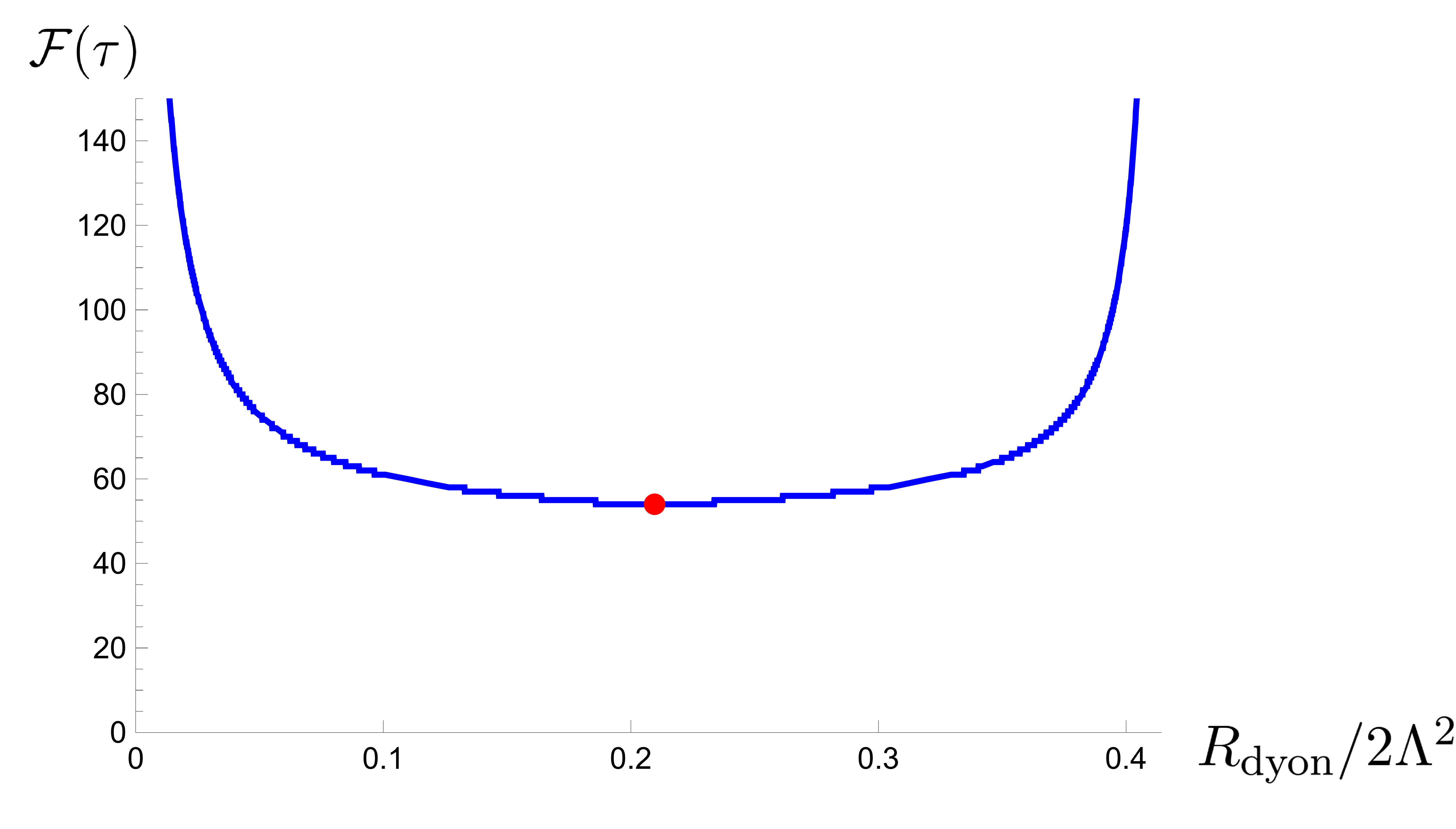
Figure 5: Representation of the τ format function across different cell radii, illustrating the location of minimal total complexity.
Implications and Theoretical Significance
This analysis supports several important theoretical implications:
- Necessity of Dualities: The need to switch between electric, magnetic, and dyonic frames is not merely incidental but essential for ensuring the finiteness of the global complexity. Attempts to extend a single patch globally without changing duality frame always result in divergence.
- Swampland Constraints: The paper proposes that only those EFTs admitting finite complexity in the o-minimal sense are eligible for consistent coupling to quantum gravity, thus offering a quantitative criterion aligned with the Swampland program.
- Universality and Generalization: While demonstrated on SW theory, the approach extends naturally to higher-rank gauge group cases (where complexity grows with rank and number of periods), as well as to the geometry of Calabi-Yau compactifications and string theory more generally.
- Future Directions: Accurate complexity measures may forge links between landscape/swampland finiteness, duality webs, and Hodge-theoretic boundary classification, providing new tools for classifying consistent EFTs.
Conclusion
This work rigorously quantifies the complexity of effective field theories, using Seiberg-Witten theory as a case study, through the formalism of effective o-minimality. The principal result—the finite, computable complexity of the effective coupling—arises only due to the structural necessity of dualities and localized patch descriptions. This constitutes a precise, technical realization of the heuristic expectation that physically meaningful theories must be finitely describable, and sets the groundwork for both broader EFT landscape classifications and further refinements in complexity-oriented quantum gravity constraints.