- The paper demonstrates that nonlinear backreaction of a massless vector field triggers rapid ergoregion instability in rotating boson stars, ultimately leading to gravitational collapse.
- It employs fully coupled Einstein-Klein-Gordon-Maxwell equations to simulate turbulent energy cascades and oscillatory ejection cycles that underlie burst-like radiation emission.
- The analysis identifies distinctive gravitational wave and vector burst signatures that could serve as observable markers differentiating collapsing boson stars from black hole mimickers.
Nonlinear Evolution of the Ergoregion Instability in Rotating Boson Stars
Introduction and Motivation
The study explores the full nonlinear progression of the ergoregion instability in horizonless ultracompact objects, with an emphasis on rapidly spinning boson stars (BSs). While the theoretical existence and linear instability of ergoregions in horizonless spacetimes have been well-established in previous works, the nonlinear evolution and ultimate fate of these instabilities remained open. This work applies fully coupled numerical relativity to evolve the Einstein-Klein-Gordon-Maxwell system in axisymmetry, tracking the backreaction of a growing massless vector field mode that seeds the ergoregion instability in a spinning BS through to violent nonlinear phases and eventual gravitational collapse.
The ergoregion—defined as the region where the asymptotically timelike Killing field becomes spacelike and negative energy states are accessible—enables unbounded amplification of perturbations since, in the absence of an event horizon, negative energy modes cannot be absorbed. Unlike the situation for spinning black holes, this can lead to run-away instabilities rather than simple spin-down via superradiance. This research addresses the nonlinear development, turbulent dynamics, radiation emission, and end-state of the instability, with implications for the viability of black hole mimickers and potential observational signatures.
Theoretical Framework and Setup
The analysis employs an interacting system of a complex scalar field with self-interaction (constituting the rotating BS) and a massless complex vector field (the instability probe). The metric and matter evolution is governed by the Lagrangian:
L=16πR−4∣F∣2−∣∂Φ∣2−μ2∣Φ∣2(1−σ22∣Φ∣2)2.
Spinning BSs considered have substantial compactness (C∼0.46), support stable and unstable equatorial as well as polar light rings, and exhibit toroidal scalar field distributions. The study excites the dominant m=1 unstable vector field mode within this background, initializing with varying amplitudes, and imposes axisymmetry to isolate the instability's development.
Figure 1 quantifies the family of unstable vector field modes across the BS sequence, tracking both real frequency (ωR) and imaginary growth rates (ωI).
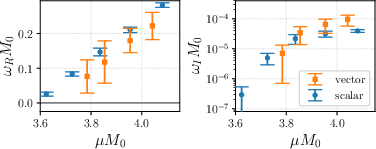
Figure 1: Linear frequencies ωR and growth rates ωI for m=1 massless vector field configurations along the BS solution family.
Linear and Weakly Nonlinear Instability Growth
The system commences in the linear regime with the massless vector field growing exponentially due to the ergoregion instability. As the instability amplifies, backreaction enhances both the frequency and growth rate, with a documented nonlinear correction that accelerates the transition out of the linear regime. The instability rate undergoes a correction scaling with the probe's angular momentum (JA), yielding a phenomenological relation ωINL∼ωI(1−114JA/J0) in the weakly nonlinear range.
Figure 2 presents the time evolution of the vector field's angular momentum for different initial amplitudes, capturing the rapid growth, nonlinear turnover, and ejection phases.
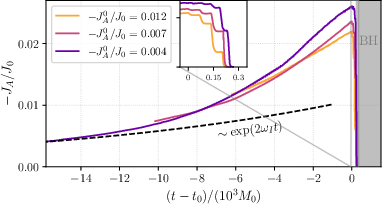
Figure 2: Temporal evolution of the probe field's angular momentum JA for three distinct initial amplitudes, aligned at the nonlinear turnover time t0.
Nonlinear Phase: Ejection, Oscillations, and Collapse
Upon reaching critical amplitude, nonlinearities dominate, resulting in the following sequence:
- Oscillatory Ejections: The BS undergoes strong radial oscillations, facilitating repeated ejection ("bursts") of the ergoregion-unstable field. These are associated with rapid, step-like reductions in ∣JA∣ over ∼200M0 timescales.
- Breakdown of Null Trapping: The periodic ejection corresponds to the collapse and reformation of light rings, modulating the trapping potential for quasi-bound modes.
These dynamics are visualized through the angular momentum density snapshots in Figure 3, showing the localization of the unstable field in the ergoregion, the buildup of small-scale features during the turbulent phase, and the collapse of the BS to a rapidly spinning black hole (JBH/MBH2≈0.95).
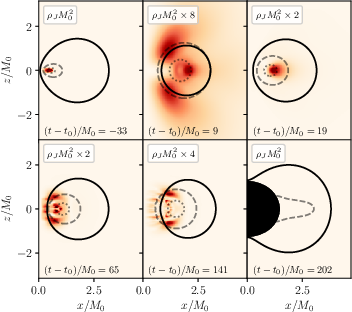
Figure 3: Snapshots of the angular momentum density ρJ during the strongly nonlinear regime, illustrating initial confinement, nonlinear ejection cycles, and post-collapse structure.
Light Ring Structure
The BS hosts both polar and equatorial light rings, characteristic of ultracompact objects with ergoregions. Figure 4 delineates the light ring radii, effective potentials for null geodesics, and the coordinate extension of the ergoregion, confirming the existence of both stable and unstable trapping regions crucial for the instability mechanism.
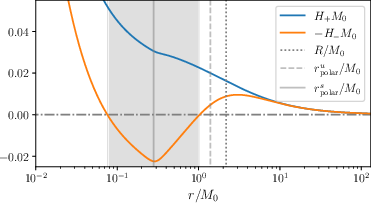
Figure 4: Radial structure of light rings and ergoregion extent in the BS background.
Burst Emission and Turbulence
Gravitational and vector radiation are dominantly emitted in burst-like events, synchronized with ejection episodes and the excitation of star oscillations. These bursts grow in amplitude and their spectral properties, most notably frequency and decay rates, converge towards the quasinormal mode spectrum of a Kerr black hole matching the final remnant's spin. This is substantiated by the close agreement with Kerr QNM data up to at least ℓ=7.
Figure 5 illustrates the sequence of GW and vector bursts (left panel) and their polar mode content (right panel), highlighting the turbulent amplification of higher-ℓ vector modes.
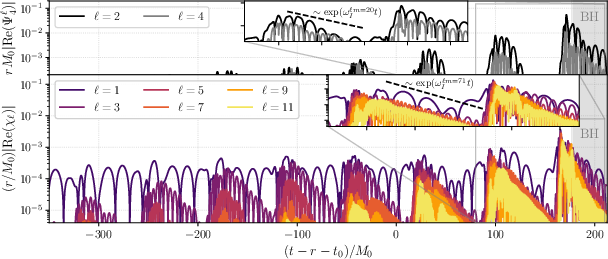
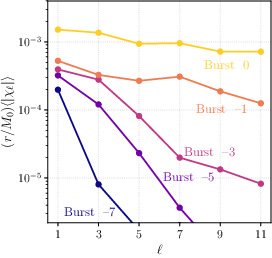
Figure 5: (left) GW and vector emission for multiple polar modes, with bursts marking nonlinear eruptions; (right) Spectral decomposition of the massless vector emission during bursts, demonstrating direct turbulent cascade to high-ℓ.
The massless vector field undergoes a direct turbulent cascade during the strongly nonlinear phase: energy is transferred rapidly from the dominant ℓ=1 mode to higher-order modes, generating nearly flat spectra in later bursts. This turbulence is not observed in GW emission, consistent with the negligible energy in higher curvature invariants.
Convergence, Constraint Preservation, and Extraction Robustness
Comprehensive convergence tests and constraint violation monitoring confirm the physical accuracy of the results, especially during the highly nonlinear and collapse phases. Quantities such as the integrated Einstein constraints and vector constraints scale appropriately with amplitude and resolution, affirming that the instabilities observed are not spurious numerical artifacts.
Figure 6 provides extended evidence of angular momentum evolution and constraint tracking across resolutions.
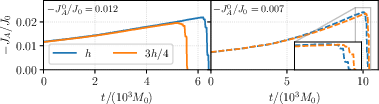
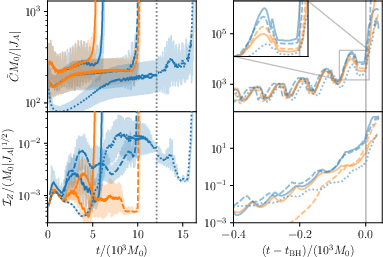
Figure 6: Impact of resolution and initial amplitude on JA evolution and normalized constraint violations, before and after horizon formation.
Implications and Outlook
The main theoretical implication is that ergoregion instabilities in highly compact, rotating horizonless objects generically drive them towards greater compactness and prompt gravitational collapse rather than saturate benignly or eject significant angular momentum. Nonlinear couplings lead only to weak parametric amplification of vector field turbulence, relevant primarily in the radiation sector and not for the bulk spacetime evolution.
This scenario holds robustly even with conserved matter charge and when the only coupling to the unstable field is gravitational. Prospects for stabilization via strong nonlinear saturation mechanisms seem limited, suggesting the gravitational collapse is the generic endpoint for ultracompact ergostars. If these mechanisms remain dominant beyond axisymmetry and in matter models where the U(1) charge is approximately conserved, it undermines the viability of black hole mimickers such as ultracompact horizonless stars.
On the observational side, the distinctive sequence of GW and EM bursts—particularly the alignment of burst frequencies and decay rates with those of the expected black hole remnant, and the lack of significant mode coupling outside the polar sector—may serve as clear signatures for the formation process of black holes from horizonless progenitors. The burst-like GW activity mimics features termed "echoes," albeit with fundamentally different origins and spectral complexity.
Conclusion
This research provides a comprehensive nonlinear account of ergoregion instability in rotating boson stars with massless vector field perturbations. Strong nonlinear backreaction enhances instability, induces turbulent energy cascades, and leads rapidly to black hole formation, with characteristic GW and vector burst emissions whose spectral content encodes both the turbulent dynamics and the birth of the event horizon. These results place strong theoretical limits on the persistence of ultracompact horizonless objects and delineate observable signatures of their collapse. Future research directions include the extension to non-axisymmetric gravitational instabilities and matter models lacking robust charge conservation, testing the universality of the collapse end-state.