- The paper introduces novel quantitative sampling methods linking scattered field data with the Radon transform to recover biharmonic sources.
- It derives explicit inversion formulas and indicator functions to reconstruct both the source support and internal profiles, even with sparse sensor data.
- Numerical experiments confirm the techniques’ robustness to noise and data sparsity, offering enhanced reconstruction accuracy over traditional methods.
Introduction and Problem Statement
This paper introduces a set of quantitative sampling methods for reconstructing extended sources governed by the biharmonic wave equation using multi-frequency scattered field data. The problem is motivated by practical applications such as acoustic, electromagnetic, and elastic wave imaging, where extended source identification is critical but remains under-explored in the context of biharmonic waves. The considered mathematical model describes source-driven vibrations in infinitely thin elastic plates, leading to unique challenges including the presence of non-radiating sources and reduced uniqueness guarantees from single-frequency data.
The paper tackles two principal inverse source problems:
- IP(1): Recovery of the spatially extended real-valued source function S(x) from multi-frequency scattered fields us measured on a single circle, using only us(x,k) and not requiring spatial derivatives or Laplacian data.
- IP(2): Identification of the source support Ω from multi-frequency scattered fields measured at finitely many (possibly sparse) sensor locations, with only us(x,k) available.
A central innovation is the exploitation of the relationship between scattered field measurements and the Radon transform of the source, providing both uniqueness results and direct inversion algorithms based on indicator functions.
The cornerstone of the analysis is the derivation of explicit formulas linking the scattered field data to the Radon-type transform over circular paths. The biharmonic equation is considered in R2:
Δ2us(x,k)−k4us(x,k)=S(x),x∈R2,
where the physical measurement is the out-of-plane displacement us resulting from the compactly-supported source S.
By employing the analytic dependence of us(x,k) on the frequency k, the authors establish that the following quantity,
Ix(r):=∫0+∞8k3rℑ(us(x,k))J0(kr)dk,
recovers the Radon transform of S on circles centered at x. This leads directly to an explicit inversion formula for S(z), reconstructed from measurements on ∂BR(0) without Laplacian or normal derivative data. This formula, denoted IS(z), integrates over all measurement angles and reconstructs the source at any z∈BR(0), thus providing the constructive proof of uniqueness for IP(1).
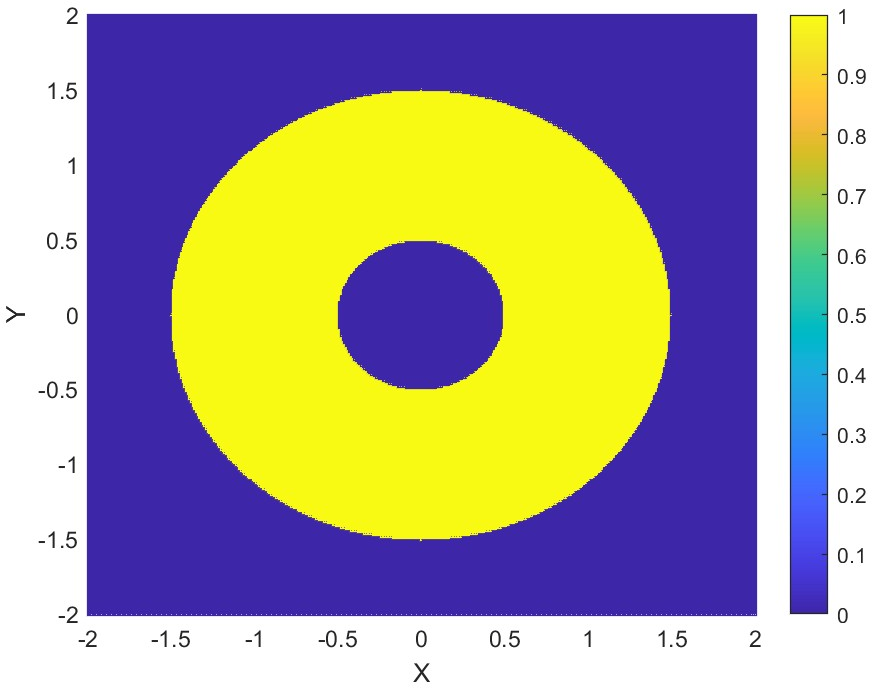
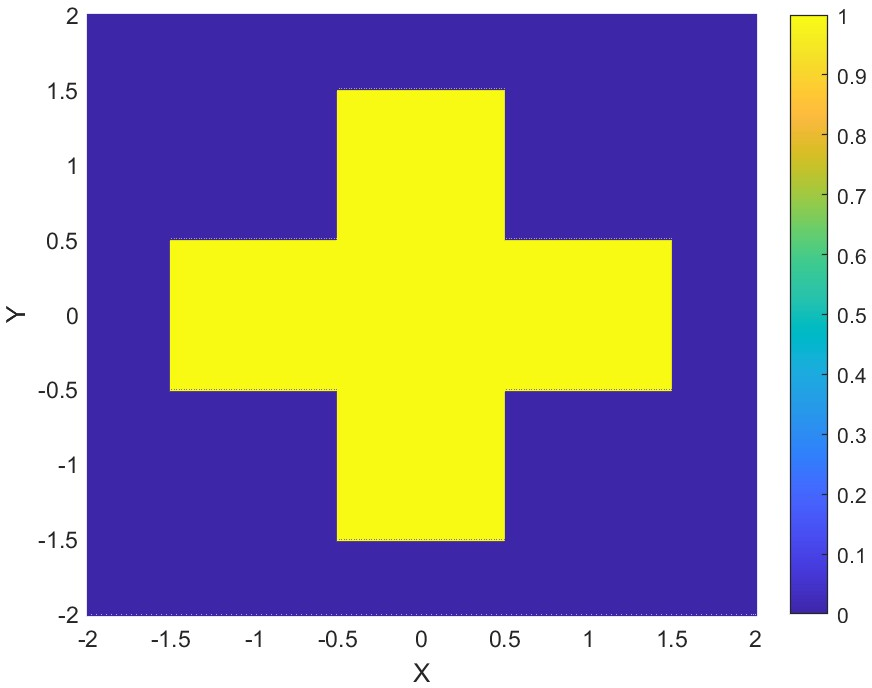
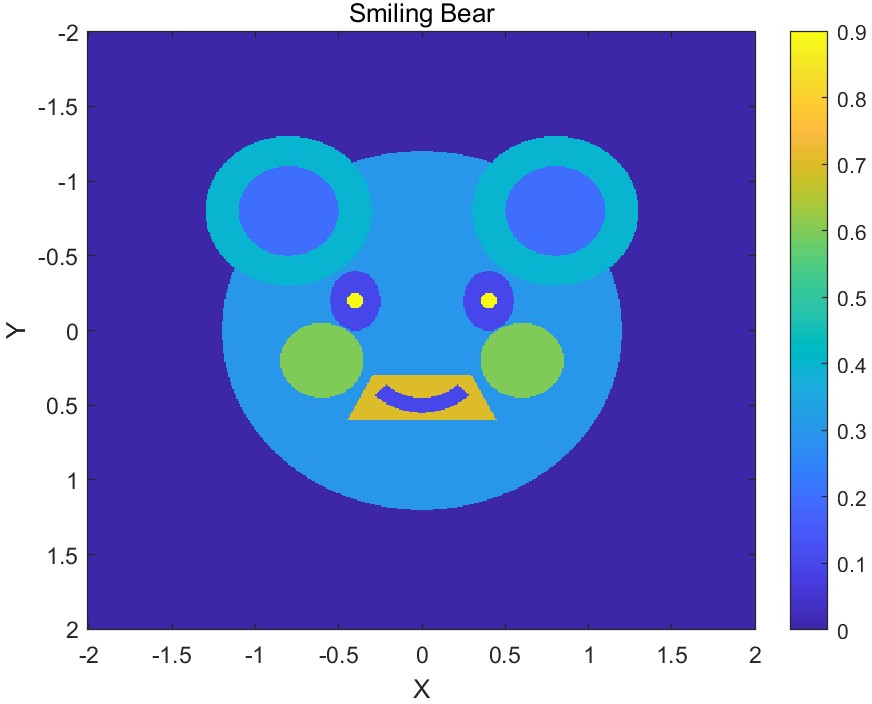
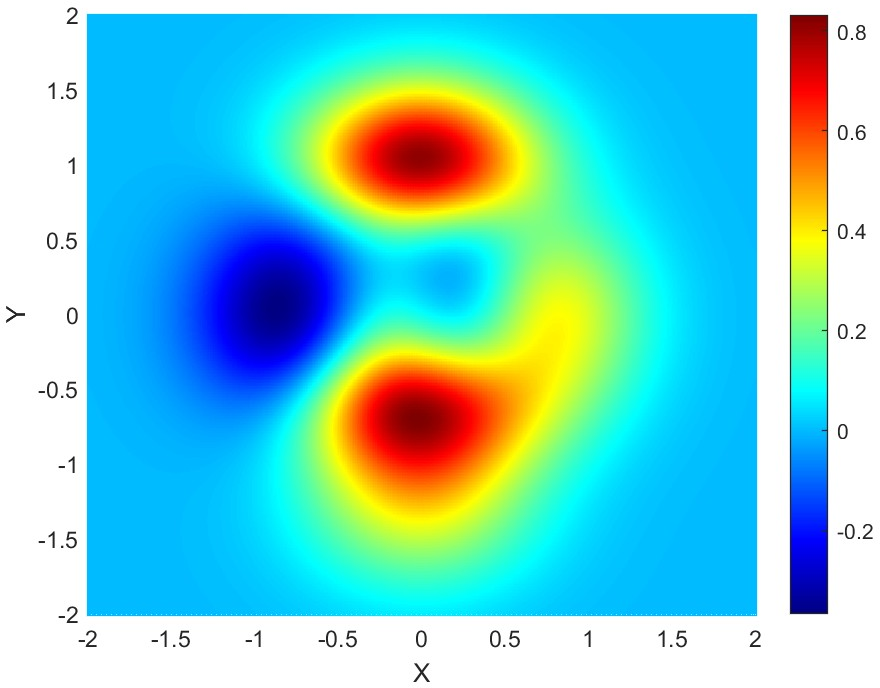
Figure 1: True source configurations considered for reconstruction, including annular, polygonal, non-simply connected, and smooth sources.
When additional Laplacian measurements Δus are available, a further simplification is derived, leading to a computationally efficient double-integral formula (the IS(2) indicator). This provides superior computational and accuracy properties, particularly in the presence of noisy data.
Uniqueness, Sparse Sensing, and Geometric Characterization
The second part of the theoretical contribution concerns the uniqueness and identification of the source support using only sparse sensor data (IP(2)). The authors analyze the singularity structure of an indicator function derived from derivatives of the Radon data, showing that the support boundary ∂Ω induces jump discontinuities (bounded or unbounded, depending on geometry) in these indicator functions, even when only a finite set of sensors is available.
Through systematic geometric analysis, the authors derive explicit lower bounds on the sensor count required for unique determination in various cases:
- For M annular components, L>16M−8 suffices.
- For polygons with N vertices, L>4N−2 guarantees uniqueness of all vertices, with edge recovery handled subsequently.
Key technical insight is that, unlike the Helmholtz or far-field setting, the near-field biharmonic data allows more robust detection of singularities, yielding enhanced accuracy for support localisation, especially of polygonal and composite geometries.
(Figures 1–4)
Figure 2: Schematic—Radon integration geometry for annular sources (Case 1).
Figure 3: Schematic—Edge tangency and sensor domain for polygonal support (Case 2).
Figure 4: Schematic—Vertex singularity geometry for polygonal sources (Case 3).
Figure 5: Schematic—Special vertex/edge tangency phenomena (Case 4).
Quantitative Sampling Methods and Algorithms
Three main indicator functions are developed and implemented:
- I∂Ω: Support boundary indicator suitable for sparse sensor data, exploiting jump singularities in the Radon transform as functions of radius.
- IS(1): Explicit indicator reconstructing the source function solely from us(x,k), using only circular integrals.
- IS(2): Double-integral formula using both us and Δus data, enhancing accuracy and speed.
The sampling algorithms are robust to noise, computationally efficient, and flexible with respect to sparse and irregular sensor placement.
Numerical Validation
Extensive experiments are carried out, including nontrivial configurations such as:
- Annular, polygonal (cross-shaped), non-simply connected ("smiling bear"-shaped), and smooth sources.
For all geometries, the proposed indicators robustly localize both support and internal source values, with pronounced improvement for cases where more measurements, tighter frequency sampling, or sensor array density is increased. The influence of the Gibbs phenomenon on boundary errors is noted, especially for sharp geometries and limited frequency bandwidth.
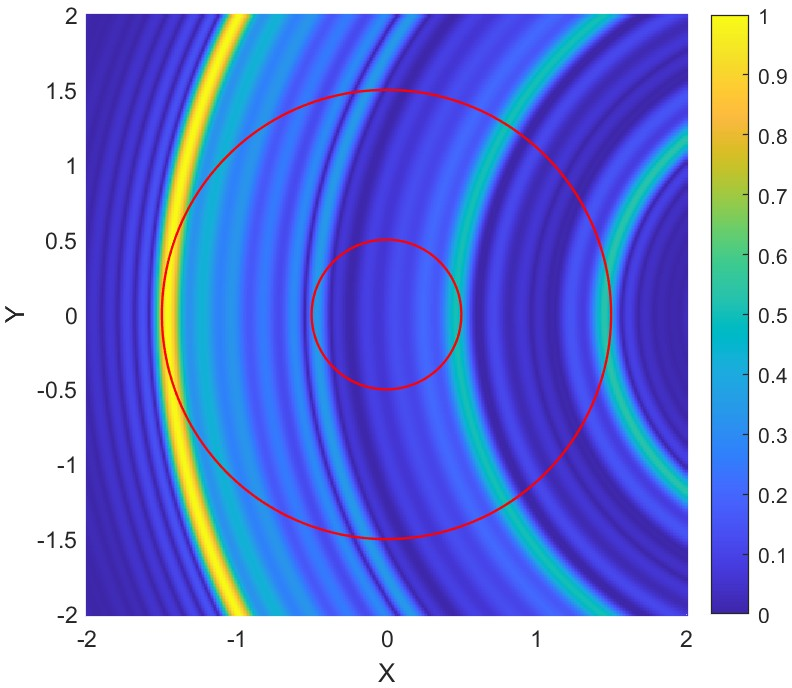
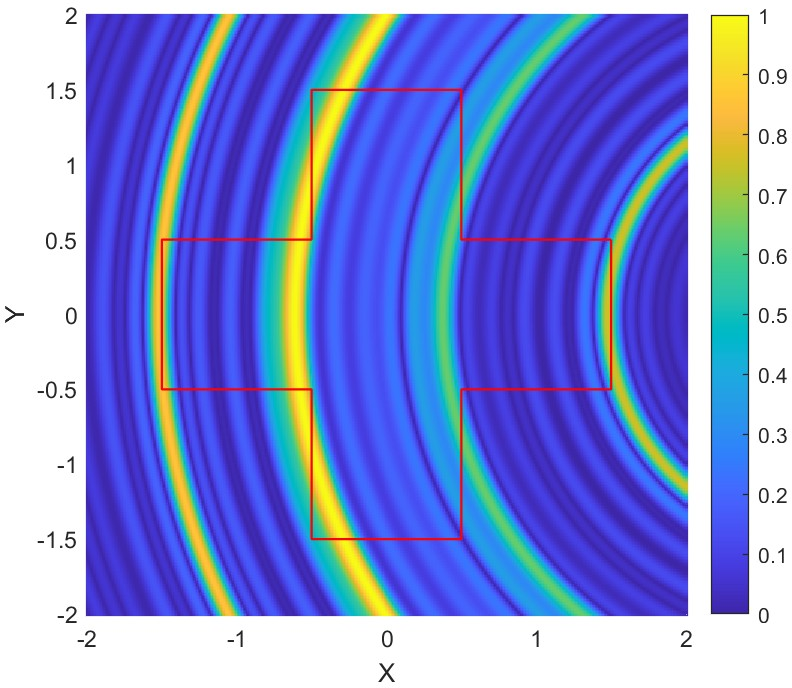
Figure 6: Reconstructions of the support set by plotting IΩ, illustrating accurate recovery with increasing number of sensors.
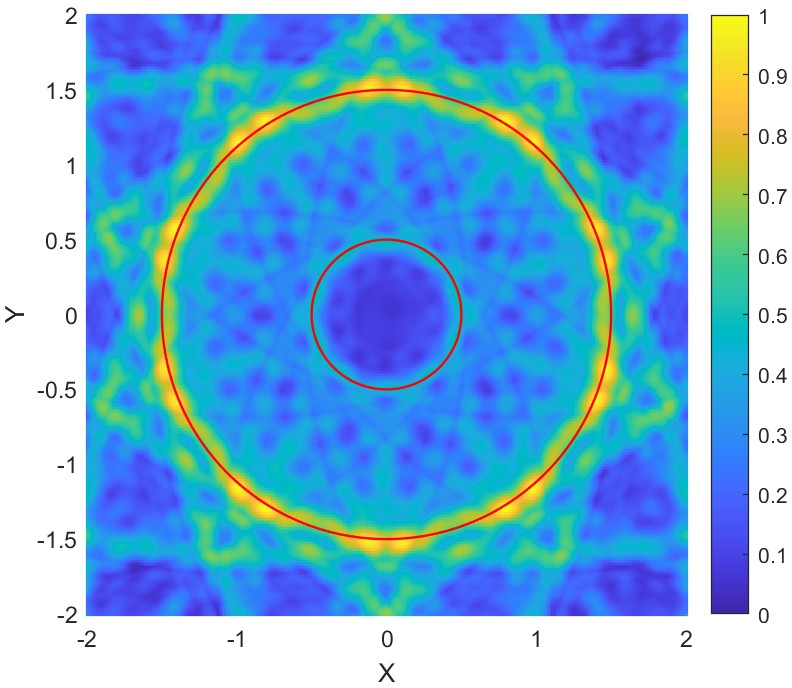
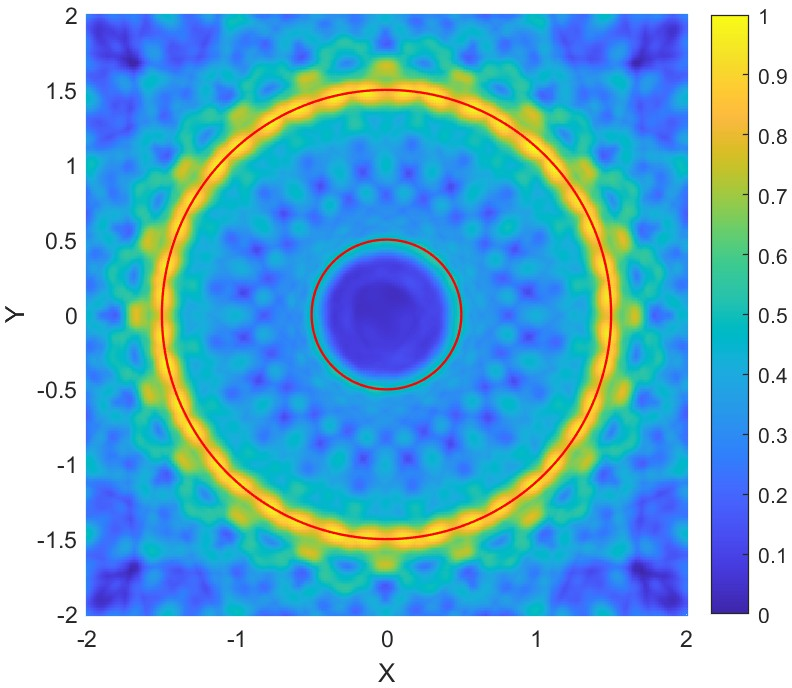
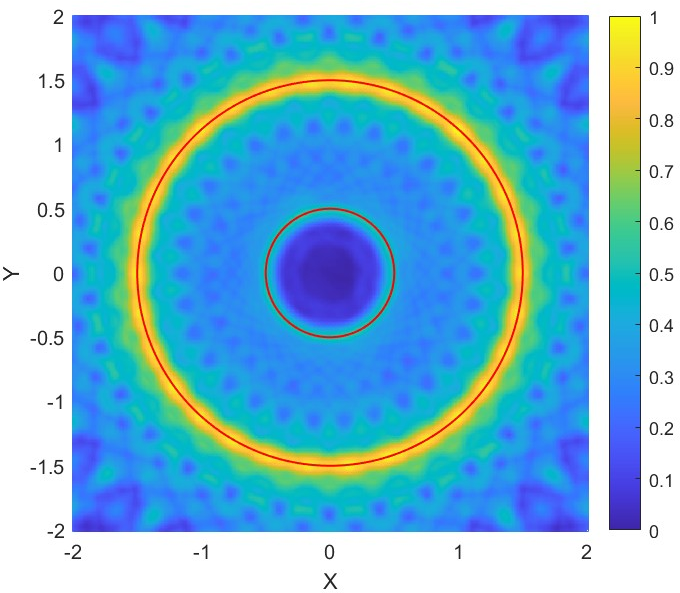
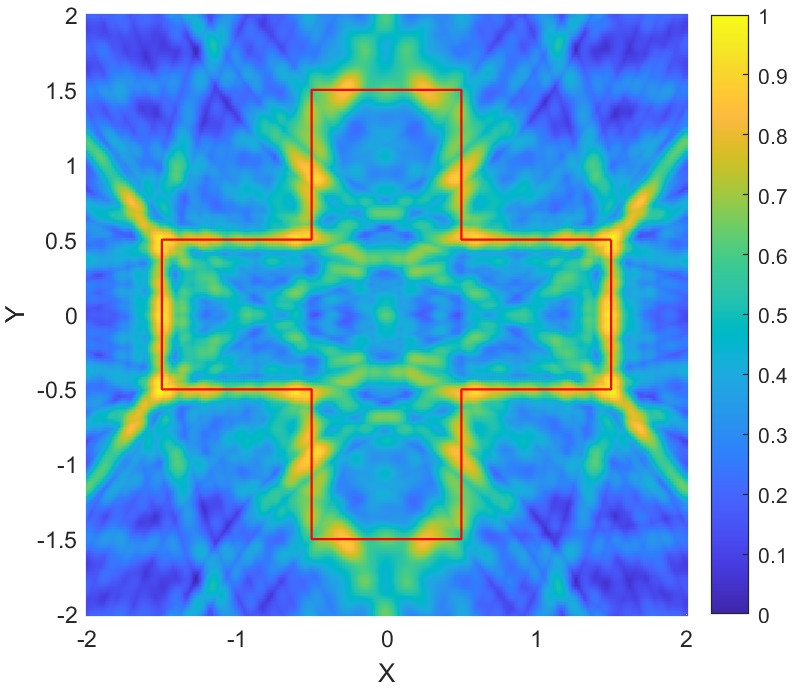
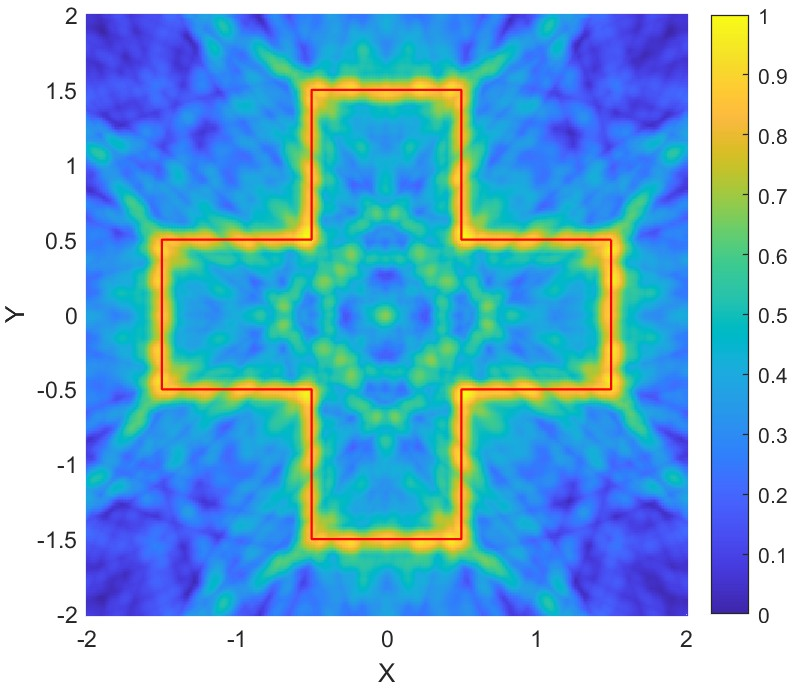
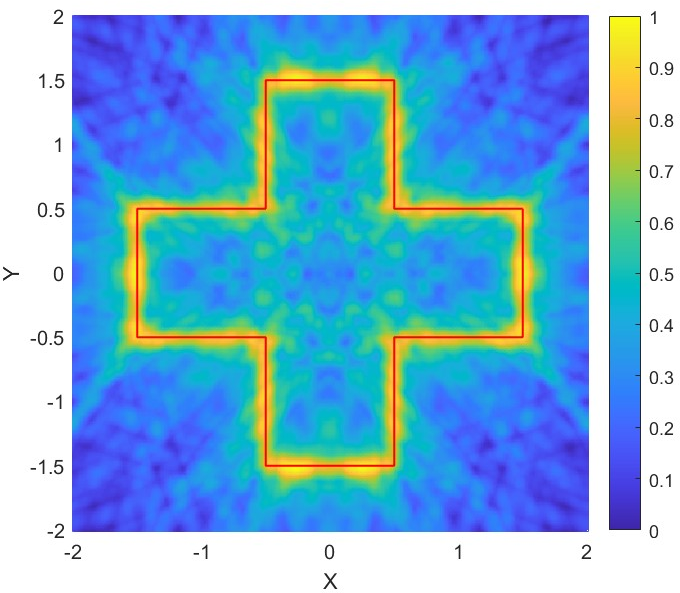
Figure 7: Improvement in support localization quality as L increases, with both inner and outer boundaries sharply defined.
(Figures 8–11)
Figures 8–9: Recovery of annular sources using I(1) and I(2). Higher L reduces artifacts and localizes boundary errors.
Figures 10–11: Polygonal source function reconstructions. I(2) outperforms I(1) in region fidelity and error reduction.
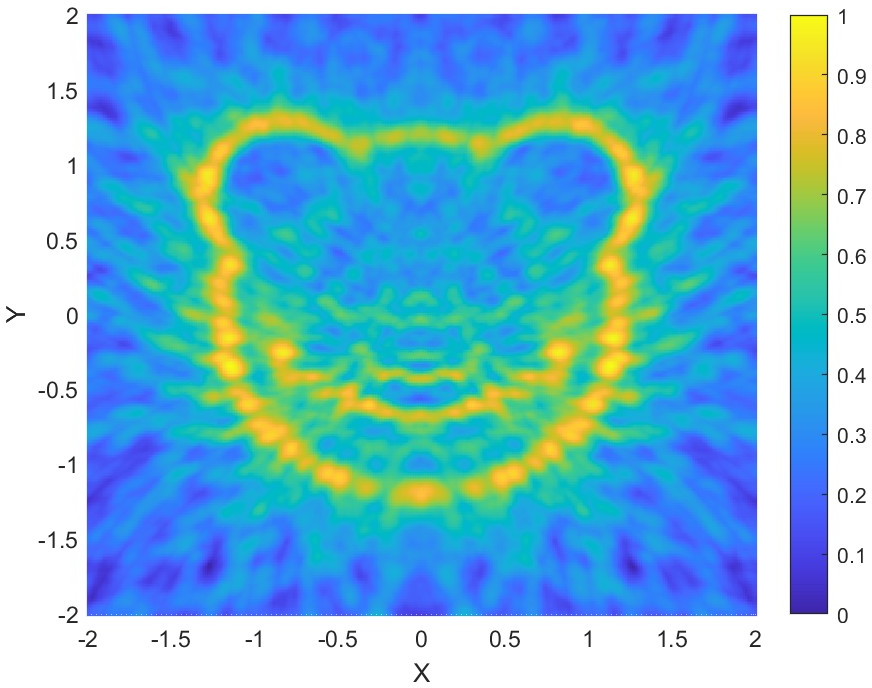
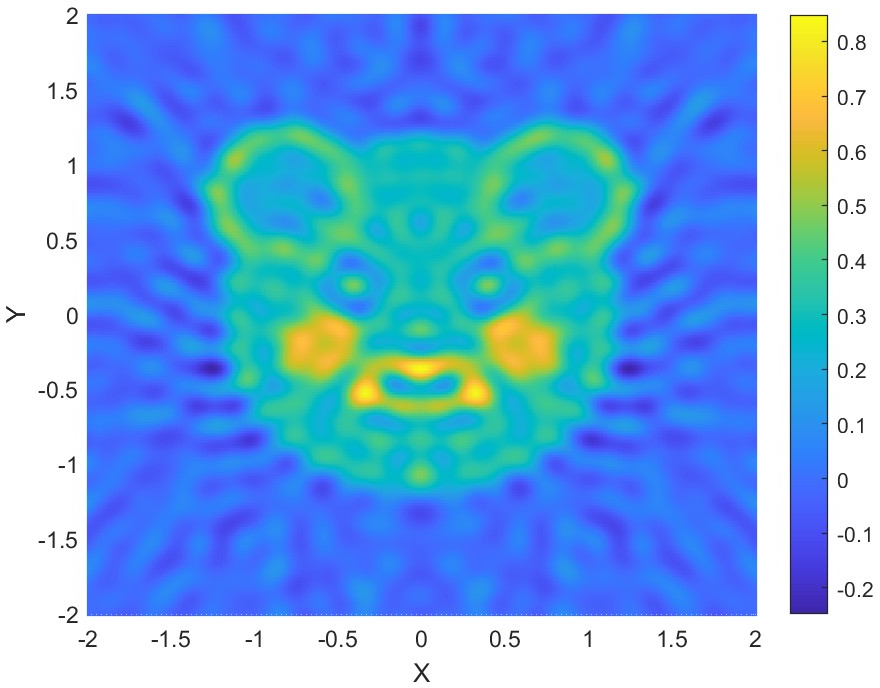
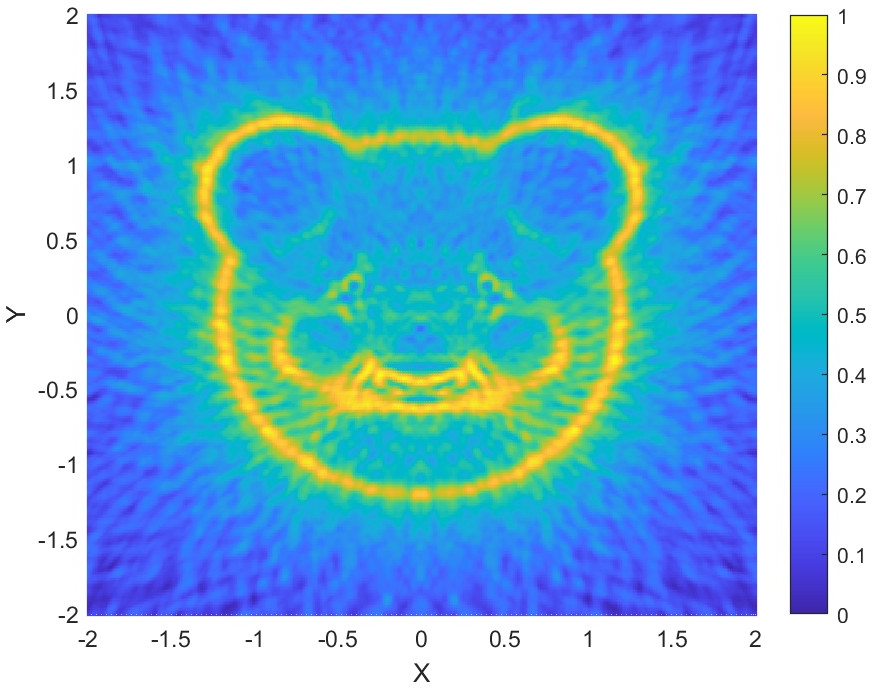
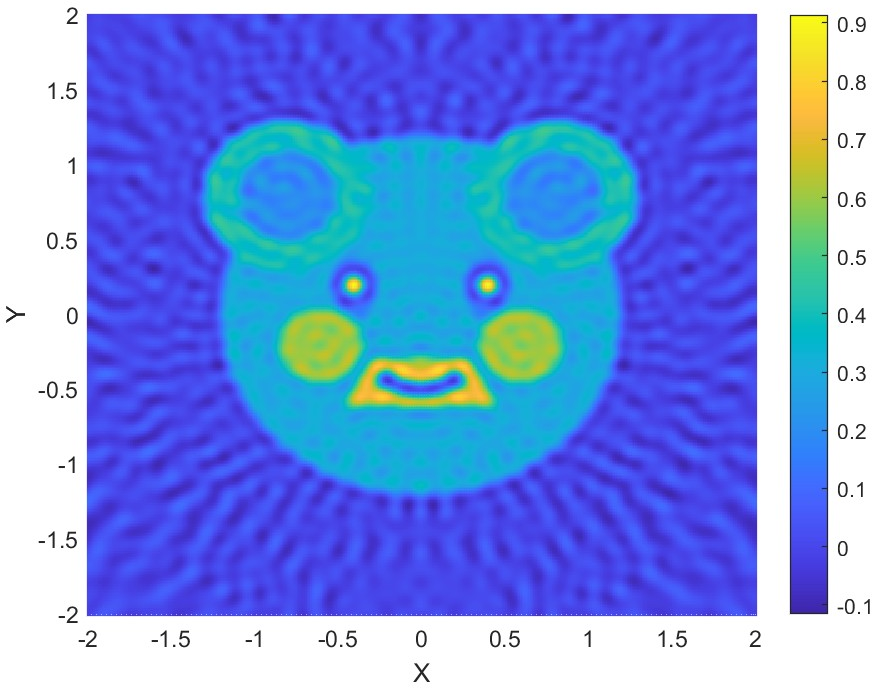
Figure 8: Reconstructions of the "smiling bear" with all three indicators. I(1) and I(2) capture both topology and internal contrasts, boundary-only indicator captures gross features.
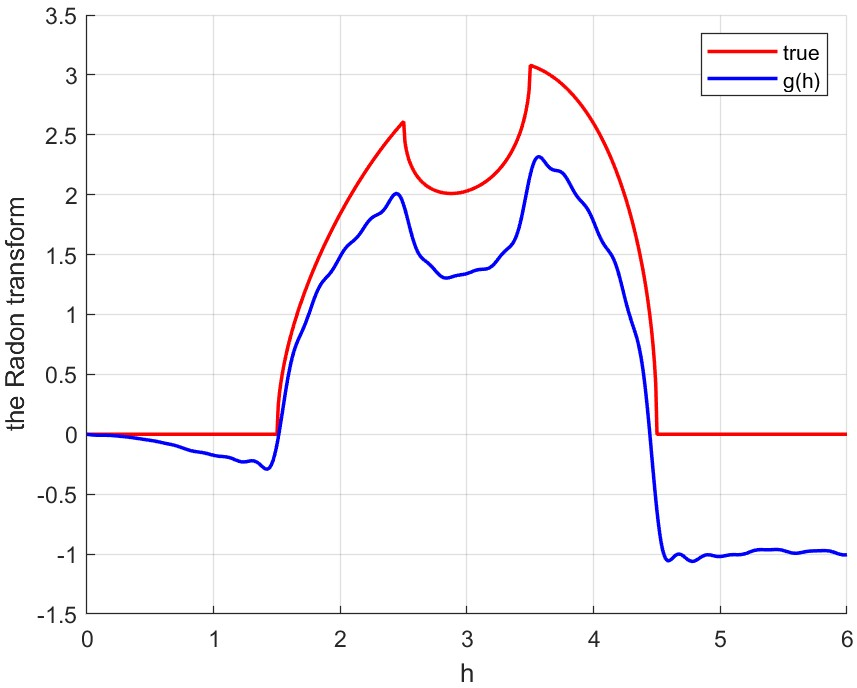
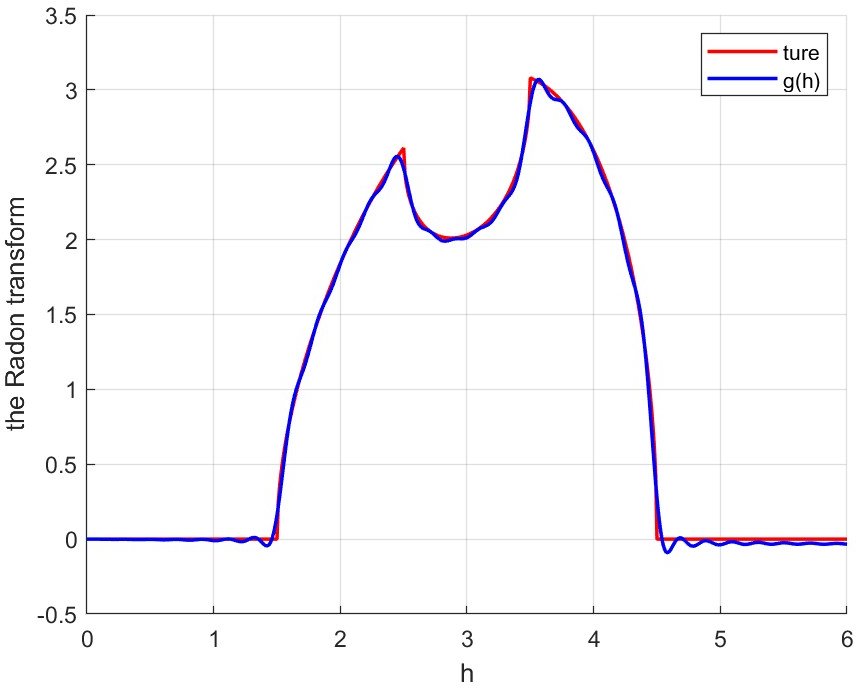
Figure 9: Comparison between exact Radon transform and numerical approximation via scattered field integration, showing error propagation and the effect of increased frequency sampling resolution.
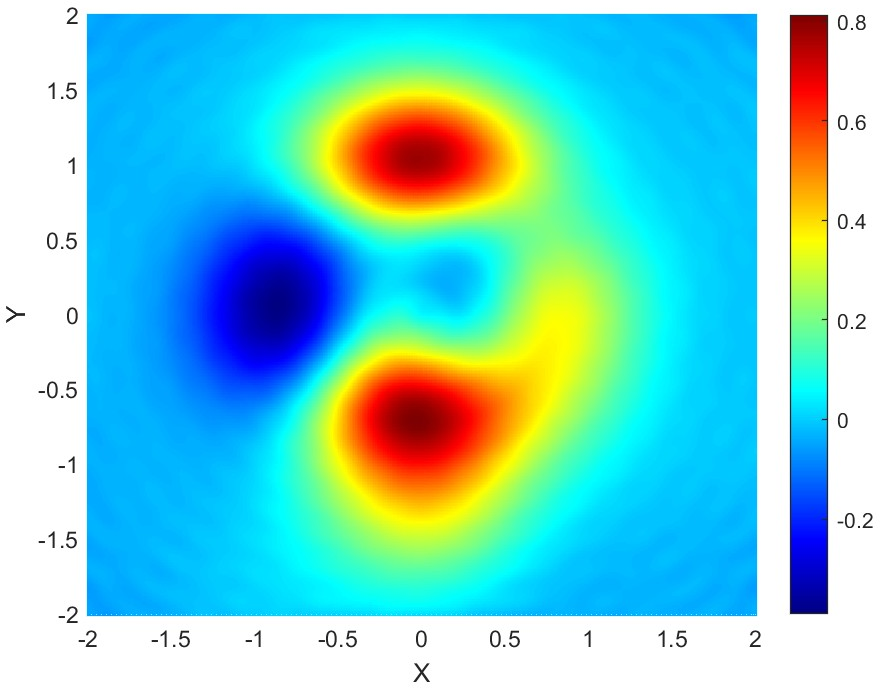
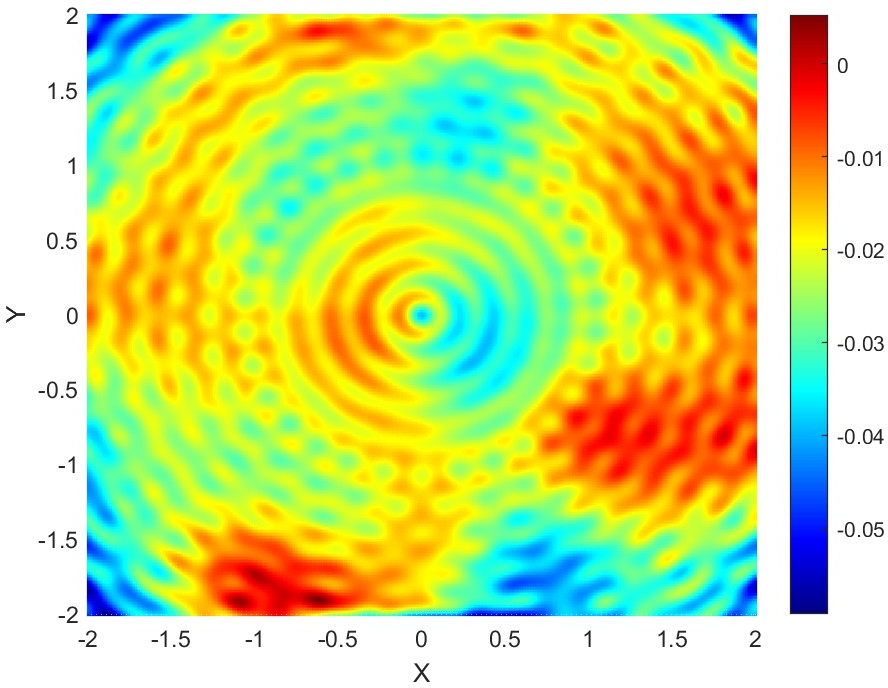
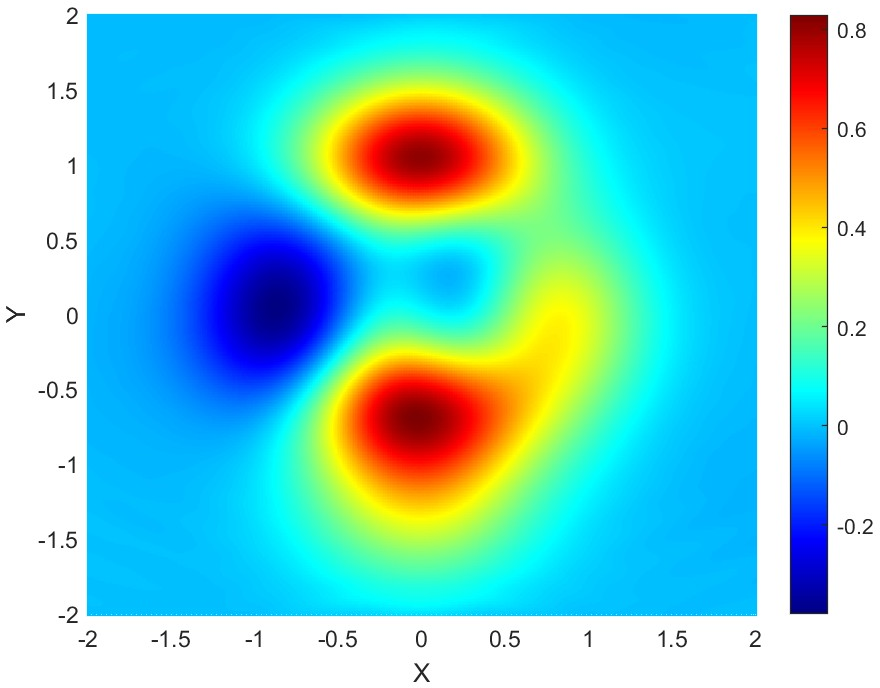
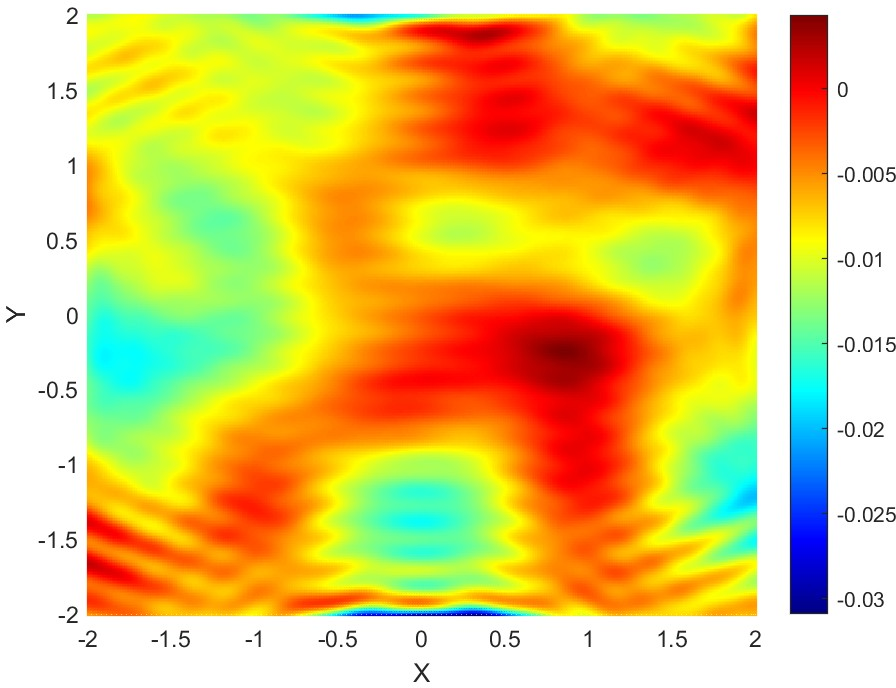
Figure 10: Recovery of a smooth source, demonstrating robustness of both I(1) and I(2) to high-frequency content and noise.
Relative error analysis (see Table 1) confirms that I(2) consistently delivers improved quantitative accuracy compared to I(1), especially as the frequency step dk decreases. Notably, stable reconstructions are achieved even with 20% relative noise contamination.
Implications and Future Directions
The established methods provide a direct quantitative route for reconstructing both the support and internal profile of spatially extended sources in biharmonic scattering, with provable uniqueness guarantees and transparent connections to geometric transforms of the source. These features render the methods practically attractive for applications where derivative or high-order measurement data is either inaccessible or prohibitively expensive.
Theoretically, the approach opens avenues for further research on general (possibly non-polygonal) domains, as the extension to complex-valued sources and broader geometries remains analytically intricate. Additionally, the observed stability of the indicators with sparse data and significant noise levels invites the development of hyper-efficient, real-time inversion algorithms for next-generation imaging platforms.
Conclusion
This paper systematically establishes, both theoretically and numerically, that multi-frequency near-field scattered field measurements encode sufficient information for unique and stable reconstruction of spatially extended biharmonic sources, provided sensor and frequency density satisfy explicit bounds. The novel indicator functions link measured fields to geometric transforms, enabling direct support and function reconstruction at high resolution, even under data sparsity and noise. These techniques are poised to substantially impact computational inverse source problems in elastic plate imaging and related high-order PDE inverse problems (2512.10332).