- The paper presents a novel observable, v0(pT), that links radial flow fluctuations across soft, mid, and hard momentum domains in the QGP.
- It employs modal analysis by diagonalizing the covariance matrix to separate collective and partonic dynamics using eigenvalue ratios.
- Experimental feasibility is demonstrated with standard correlation methods, enabling constraints on microscopic QGP properties across momentum scales.
Dynamical Correlations Across Momentum Scales in the QGP
Motivation and Context
Probing the Quark-Gluon Plasma (QGP) in ultra-relativistic heavy-ion collisions demands a unified account of dynamical phenomena that span soft (collective, low-pT), intermediate ("coalescence"), and hard (jet quenching) transverse momentum regimes. While hydrodynamic collectivity and jet quenching have traditionally been treated as distinct, physical coupling is inevitable. Direct quantification of cross-scale correlations is therefore required to constrain the microscopic nature and emergent collectivity of the QGP.
This work introduces an experimentally realizable framework centered on the pT-differential radial-flow fluctuation observable v0(pT), connecting event-by-event fluctuations across momentum scales, and establishes a modal analysis—diagonalizing the covariance structure—to expose the cross-talk between collective and partonic dynamics (2512.10265).
Theoretical Framework and Observable Construction
The inclusive particle spectrum in heavy-ion collisions is decomposed as
n(pT)=nsoft(pT)+nmid(pT)+nhard(pT),
with each component associated with a phenomenologically distinct production mechanism: hydrodynamic emission, quark coalescence, and jet fragmentation, respectively. Fluctuations of the parameters of these sectors (via a correlated Gaussian ensemble) encode eventwise dynamical variation.
The primary observable, v0(pT), is defined as
v0(pT)=⟨n(pT)⟩σ[⟨pT⟩]ref⟨δn(pT)δ[⟨pT⟩]ref⟩,
where "ref" denotes a reference particle sample in a disjoint pseudorapidity window, suppressing nonflow. v0(pT) thus measures the covariance of fluctuations in the yield at momentum pT with global event structure, normalized to suppress trivial multiplicity effects. This observable is specifically sensitive to (1) radial-flow and spectrum-shape fluctuations, (2) decorrelation between modes, and (3) the presence of anti-correlated ("quenching") effects.
A systematic, stepwise activation of component-mode fluctuations elucidates the distinct phenomenological signatures in v0(pT).
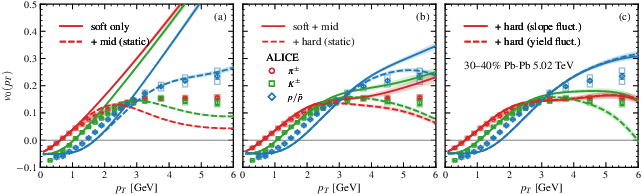
Figure 1: Sequential construction of v0(pT) for pT0, pT1, and pT2 reveals the cumulative impact of soft, mid, and hard-sector fluctuations and their coherence/anti-coherence with the reference event variable.
Phenomenology of pT3 and Species Sensitivity
With only soft-sector fluctuations, pT4 rises monotonically with pT5, reflecting coherence with the thermalized eventwise background. Adding a static mid-pT6 component primarily yields dilution, manifesting as a flattening of pT7. When mid-pT8 fluctuations are activated, pT9 develops a plateau, especially in v0(pT)0 GeV—a direct signature of partial coherence: the coalescence region carries residual collective flow correlations but is semi-independent.
Hard-sector fluctuations introduce anti-correlated structure. When the hard component fluctuates in amplitude (yield modulation), v0(pT)1 for kaons exhibits a pronounced downturn in v0(pT)2 GeV, while slope modulation generates a flatter, more uniform suppression at high v0(pT)3. The species ordering (v0(pT)4), and the v0(pT)5flatness for protons, reflect the relative dominance of each sector in the total yield: for kaons, soft, mid, and hard components contribute comparably, while for protons, dominance of the soft mode preserves coherence.
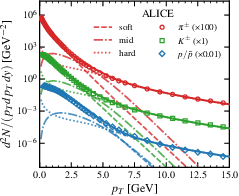
Figure 2: Decomposition of inclusive v0(pT)6 spectra for v0(pT)7, v0(pT)8, and v0(pT)9 displays the overlapping soft (blast-wave), mid (coalescence), and hard (fragment fragmentation) components.
This rise–plateau–downturn structure in n(pT)=nsoft(pT)+nmid(pT)+nhard(pT),0 traces directly to the transition from single-mode collectivity to multi-modal dynamical response, with anti-correlation emerging as the signature of QGP response to hard-parton energy loss.
Modal Structure: Covariance Matrix Diagnostics
To quantify the effective dimensionality of fluctuations, the reference-aligned covariance matrix,
n(pT)=nsoft(pT)+nmid(pT)+nhard(pT),1
is diagonalized. For a purely collective response, n(pT)=nsoft(pT)+nmid(pT)+nhard(pT),2 is nearly rank-1; deviations (factorization breaking) indicate new semi-independent fluctuation modes.
The factorization ratio
n(pT)=nsoft(pT)+nmid(pT)+nhard(pT),3
and the subleading-to-leading eigenvalue ratio n(pT)=nsoft(pT)+nmid(pT)+nhard(pT),4, serve as diagnostics.
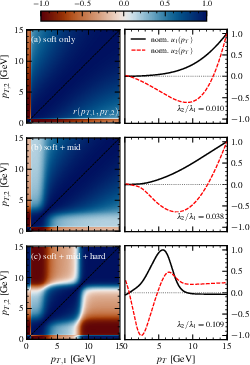
Figure 3: Evolution of the reference-aligned covariance matrix structure for pions: two-bin factorization ratio n(pT)=nsoft(pT)+nmid(pT)+nhard(pT),5 (left panels) and normalized eigenvectors n(pT)=nsoft(pT)+nmid(pT)+nhard(pT),6 and eigenvalue ratio n(pT)=nsoft(pT)+nmid(pT)+nhard(pT),7 (right panels) as soft, mid, and hard-sector fluctuations are sequentially introduced.
The results demonstrate that:
- For soft-only fluctuations, n(pT)=nsoft(pT)+nmid(pT)+nhard(pT),8 and n(pT)=nsoft(pT)+nmid(pT)+nhard(pT),9: a single coherent fluctuation mode.
- Mid-v0(pT)0 fluctuations introduce significant factorization breaking at v0(pT)1 GeV and grow v0(pT)2 to v0(pT)30.04: evidence for a second mode associated with coalescence.
- Hard-sector fluctuations yield strong anti-correlations (negative v0(pT)4) between low and high v0(pT)5 and v0(pT)6, indicating robust, nearly independent fluctuation drivers.
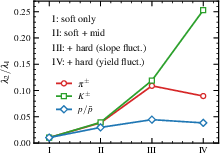
Figure 4: Systematic growth in v0(pT)7 for v0(pT)8, v0(pT)9, v0(pT)=⟨n(pT)⟩σ[⟨pT⟩]ref⟨δn(pT)δ[⟨pT⟩]ref⟩,0 reflects the modal hierarchy and sensitivity to mid- and hard-momentum sector mixing for each hadron species.
Crucially, kaons exhibit a pronounced enhancement of v0(pT)=⟨n(pT)⟩σ[⟨pT⟩]ref⟨δn(pT)δ[⟨pT⟩]ref⟩,1 in the region where soft, mid, and hard components all contribute, making v0(pT)=⟨n(pT)⟩σ[⟨pT⟩]ref⟨δn(pT)δ[⟨pT⟩]ref⟩,2 the optimal probe of cross-scale decorrelation. The eigenvalue ratio thus functions as an order parameter for the onset of multi-modal dynamics.
Experimental Feasibility and Implications
The framework is directly accessible within current experimental capabilities: v0(pT)=⟨n(pT)⟩σ[⟨pT⟩]ref⟨δn(pT)δ[⟨pT⟩]ref⟩,3 and the components of v0(pT)=⟨n(pT)⟩σ[⟨pT⟩]ref⟨δn(pT)δ[⟨pT⟩]ref⟩,4 can be measured with standard correlation and subevent methods, extending to v0(pT)=⟨n(pT)⟩σ[⟨pT⟩]ref⟨δn(pT)δ[⟨pT⟩]ref⟩,5 GeV in high-statistics LHC datasets. The most pronounced mode-dependent differences appear in the intermediate region v0(pT)=⟨n(pT)⟩σ[⟨pT⟩]ref⟨δn(pT)δ[⟨pT⟩]ref⟩,6 GeV, enabling discrimination of mechanisms and quantifying the onset of hard-sector decorrelation, particularly for kaons.
The modal analysis also provides a language for systematic studies across system size, collision energy, and beam species. Theoretically, the growth of v0(pT)=⟨n(pT)⟩σ[⟨pT⟩]ref⟨δn(pT)δ[⟨pT⟩]ref⟩,7 can be mapped to the effective number of independent dynamical drivers—a quantitative bridge to first-principles modeling and Bayesian inference of QGP properties.
Conclusion
This work establishes v0(pT)=⟨n(pT)⟩σ[⟨pT⟩]ref⟨δn(pT)δ[⟨pT⟩]ref⟩,8 and the reference-aligned covariance modal decomposition as powerful, experimentally viable observables for resolving the complex interplay of soft, coalescence, and jet-quenching dynamics in the QGP. The formalism unifies collective-to-partonic transitions under the language of fluctuation modes, providing both an interpretable and model-agnostic connection between data and microscopic theory.
Future progress will involve:
- Applying these diagnostics to perform quantitative comparisons to hydrodynamics, recombination, and jet quenching models under different physical assumptions.
- Extension to differential observables categorized by event-shape selections, system size, and collision energy.
- Bayesian extraction of cross-scale correlation topology as experimental precision increases.
The approach outlined systematically exposes how the QGP organizes and links dynamical responses across the full momentum spectrum, marking substantive progress towards decoding its emergent, many-body structure.