Published 11 Dec 2025 in quant-ph | (2512.10247v1)
Abstract: We introduce a simple protocol for measuring properties of a gapped ground state with essentially no disturbance to the state. The required Hamiltonian evolution time scales inversely with the spectral gap and target precision (up to logarithmic factors), which is optimal. For local observables on geometrically local systems, the protocol only requires Hamiltonian evolution on a quasi-local patch of inverse-gap radius. Our results show that gapped ground states are algorithmically readable from a single copy without a recovery or rewinding procedure, which may drastically reduce tomography overhead in certain quantum simulation tasks.
The paper proposes a catalytic tomography protocol that enables nondestructive measurement of gapped quantum ground states using auxiliary filtered operators.
It achieves optimal scaling with Hamiltonian evolution time O(1/(Δε)) and leverages quasi-local dynamics to keep resource requirements independent of system size.
The method uses phase estimation and LCU block-encoding to extract expectation values with minimal disturbance, facilitating efficient quantum simulations.
Catalytic Tomography of Gapped Quantum Ground States
Introduction and Motivation
Quantum tomography traditionally demands multiple copies of a quantum state due to the destructive nature of measurements, as mandated by the Born rule and the no-cloning theorem. For ground state tomography in quantum simulation, the exponential overhead associated with preparing multiple ground state copies severely impedes scalability. This burden is exacerbated in the context of many-body physics and quantum chemistry, where each state preparation can be computationally expensive. Unlike classical approaches, where observables can be efficiently calculated from a persistent memory representation (e.g., tensor networks, DMRG), quantum protocols have faced fundamental limitations related to measurement-induced state collapse. Previous strategies circumvented this by restoration or rewinding, but incurred unfavorable scaling in both precision and disturbance parameters.
Catalytic Tomography Protocol
The paper "Catalytic Tomography of Ground States" (2512.10247) proposes a novel protocol for measuring physical properties of gapped quantum ground states with practically no disturbance to the state. The protocol leverages the following key theoretical advancements:
Catalysis: The ground state remains essentially undisturbed throughout the measurement.
Optimal Scaling: Hamiltonian evolution time scales as O(1/(Δϵ)) (up to logarithmic terms) in spectral gap Δ and target precision ϵ, which is known to be optimal.
Quasi-locality: For local observables in geometrically local Hamiltonians, the protocol only engages a quasi-local patch of inverse-gap radius, yielding resource requirements independent of system size.
Measurement Strategy: Filtered Operators
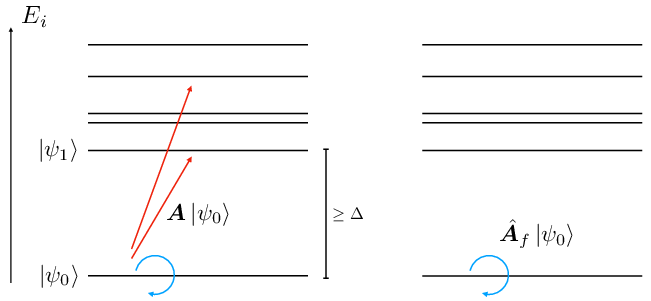
The core innovation rests on constructing auxiliary filtered operators A^f via controlled Heisenberg evolution and energy filtering. Given a spectral gap Δ for the ground state ∣ψ0⟩ and observable A, the authors deploy a filtering technique using a suitable function f(t) to suppress transitions to excited states. Formally, they construct
A^f=2π1∫−∞∞eiHtAe−iHtf(t)dt
with f chosen (e.g., Gaussian or bump functions) to localize the operator in both energy and time. The effect is a block-diagonalization in the ground space—transitions to excited states are exponentially suppressed relative to the gap.
This approach renders the expectation value ⟨ψ0∣A∣ψ0⟩ directly measurable via phase estimation of A^f, with leakage controlled to arbitrarily low levels according to choice of f and integration time T.
Figure 1: Acting with A on ∣ψ0⟩ populates excited states (left); the filtered operator A^f (right) suppresses such transitions, catalytically protecting the ground state.
Algorithmic Implementation and Scaling
The main algorithm precisely estimates the ground state expectation with evolution time scaling as O(log(1/δ)log(1/ϵ)/(Δϵ)) for confidence 1−δ and trace-distance error δ. For block-encoded observables, the number of required queries is O(log(1/δ)/ϵ). This matches rigorous lower bounds for single-copy tomography under black-box Hamiltonian simulation [(2512.10247), scharnhorst2025optimal].
Moreover, when H and A are spatially local, the Heisenberg dynamics can be truncated to a region of size O((log(1/δ)+log(1/ϵ))/Δ) due to Lieb-Robinson bounds, making the protocol quasi-local. The resulting error from spatial truncation decays factorially outside the interaction lightcone.
Technical Highlights
Filters: Both Gaussian and compactly supported bump functions are analyzed; the latter allows exact block-diagonalization, while the former provides exponential suppression as e−Δ2/2σ2.
LCU Block-Encoding: Implementation details leverage Linear Combination of Unitaries (LCU) for block-encoding A^f, using a discretized Riemann sum and state-preparation of f amplitudes.
Phase Estimation: High-confidence phase estimation efficiently extracts the expectation value from A^f applied to the ground state.
Optimality: Lower bounds prove that no protocol can achieve better scaling in 1/(Δϵ) evolution time for single-copy readout.
Correlation Length: For quantum spin models such as TFIM, the locality required is linked to the correlation length, which diverges as 1/Δ near the critical point.
(Figure 2)
Figure 2: Circuit schematic for block-encoding A^f via LCU, combining state preparation for f, controlled Hamiltonian evolutions, and block-encoding of A.
Practical and Theoretical Implications
This protocol fundamentally alters the tomography cost landscape for ground state simulation. It enables efficient, nondestructive and quasi-local measurement, drastically reducing the need for repeated state preparation. For quantum algorithms targeting many-body systems, chemistry, and condensed matter, catalytic tomography could become pivotal for extracting observables and validating simulation outcomes.
Theoretically, the protocol suggests that ground states of local and gapped Hamiltonians can be read out as if they were classical memories for a restricted set of observables. This may tighten connections to classical simulation methods (tensor networks, DFT) and propel quantum computational advantage in regimes where classical tomography costs are otherwise prohibitive.
Furthermore, the authors speculate that combining catalytic tomography with gradient-based multi-observable readout [huggins2022nearly] could accelerate estimation for m observables to O~(m/(Δϵ)) total evolution time, a potential direction for large-scale quantum simulation and chemistry applications.
Future Directions in Quantum Tomography and Simulation
Open questions remain regarding extensions to degenerate ground spaces, topologically ordered phases, and dynamics at criticality where the gap vanishes. Bridging the catalytic tomography property of pure states with the local Markov property of mixed states (quantum Gibbs states) may unveil further algorithmic reductions in tomography and sampling costs [kato2025clustering, chen2025quantum, bergamaschi2025structural].
From an experimental standpoint, the realization of catalytic tomography protocols depends on the efficiency of block-encoding Hamiltonian dynamics, fault tolerance, and precision phase estimation in near-term quantum hardware.
Conclusion
The catalytic tomography protocol establishes that gapped ground states of local Hamiltonians are algorithmically readable with minimal state disturbance and optimal resource scaling. By leveraging filtered operators and Heisenberg-limited evolution, the protocol bridges a longstanding gap between quantum measurement and practical simulation. This development is expected to influence quantum algorithm design for physical simulations, and may stimulate further exploration of quantum memory and information extraction in many-body systems.
“Emergent Mind helps me see which AI papers have caught fire online.”
Philip
Creator, AI Explained on YouTube
Sign up for free to explore the frontiers of research
Discover trending papers, chat with arXiv, and track the latest research shaping the future of science and technology.Discover trending papers, chat with arXiv, and more.