- The paper introduces a novel model combining Einstein-Hayward regularization with solitonic scalar and nonlinear electromagnetic fields to construct horizonless star configurations.
- It demonstrates how variations in magnetic charge, scalar self-coupling, and the cosmological constant delineate regimes between extended boson stars and frozen, ultracompact states with sharply confined fields.
- The effective potential analysis reveals multiple light ring branches, highlighting implications for gravitational wave echoes and lensing signatures in these ultracompact objects.
Solitonic Hayward-Boson Stars and Frozen States in Anti-de Sitter Spacetime
Theoretical Construction of SHBSs in AdS
This work presents a detailed study of Solitonic Hayward-Boson Stars (SHBSs) in Anti-de Sitter (AdS) spacetime, a configuration that merges the Einstein-Hayward model describing regular black holes with a complex scalar field featuring a soliton-type potential. The model incorporates nonlinear electromagnetic fields parameterized by a magnetic charge q, scalar field self-interaction controlled by the coupling η, and a negative cosmological constant Λ.
The field equations result from variation of the total action, which includes gravity, nonlinear electromagnetic dynamics, and a complex scalar with the non-topological soliton potential. The static spherically symmetric ansatz for the metric and matter fields yields a set of coupled, nonlinear ordinary differential equations. The critical innovation is the exploration of parameter regimes allowing for "frozen" horizonless structures, where the spacetime closely approaches, but does not form, an event horizon.
AdS boundary conditions are imposed, and solutions are computed using compactified coordinates and finite element discretization with high accuracy.
Existence and Classification of SHBS Solutions
The study distinguishes two physically distinct regimes for SHBSs. If the magnetic charge is below a critical threshold qc, the configuration resembles known boson star solutions, limited by spiral structures in the ADM mass–frequency diagram, with ω (the oscillation frequency of the scalar field) bounded away from zero. In this regime, the mass and Noether charge display characteristic maxima and spiral patterns, and the scalar field is spatially extended with smooth decay—a typical feature of horizonless solitonic objects.
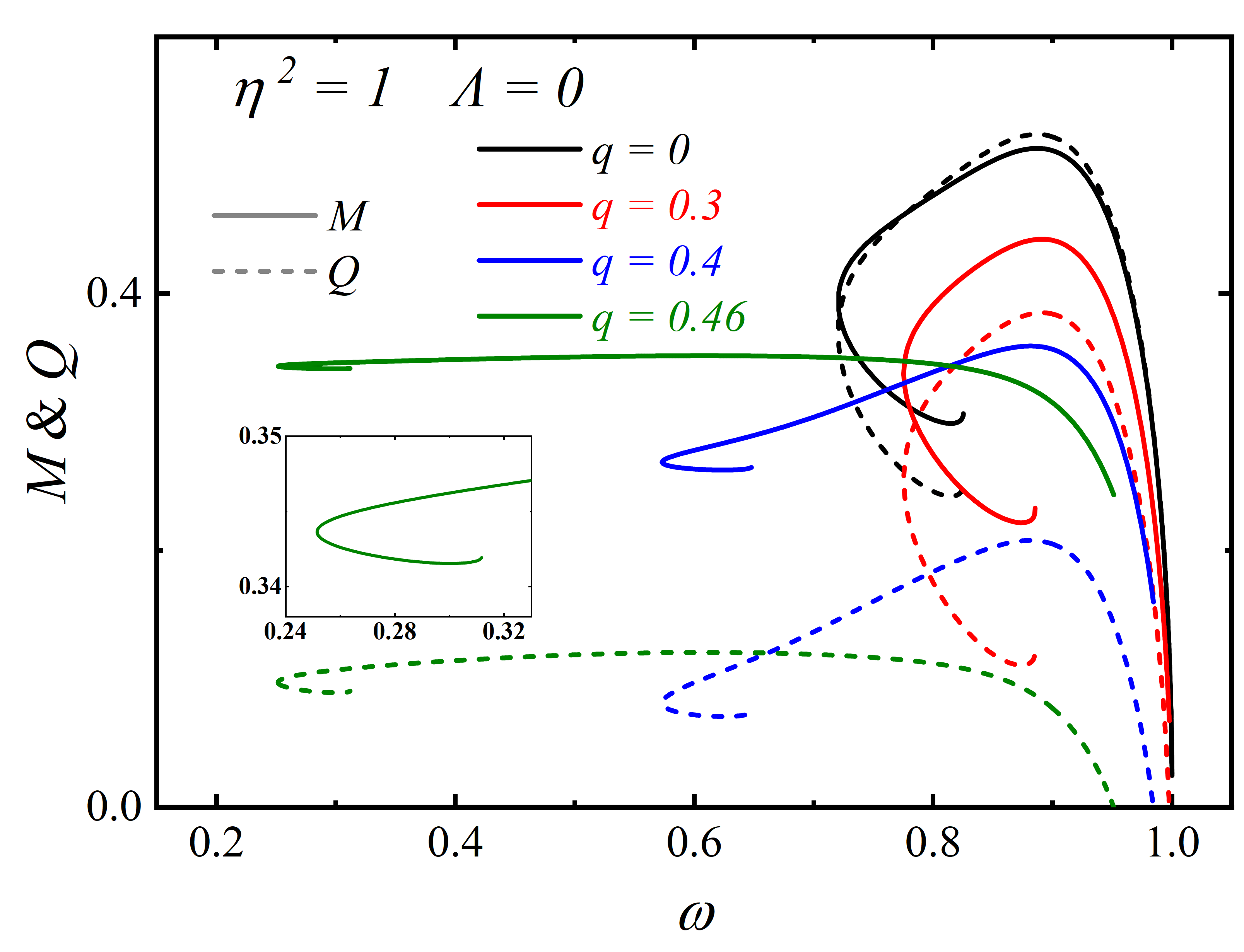
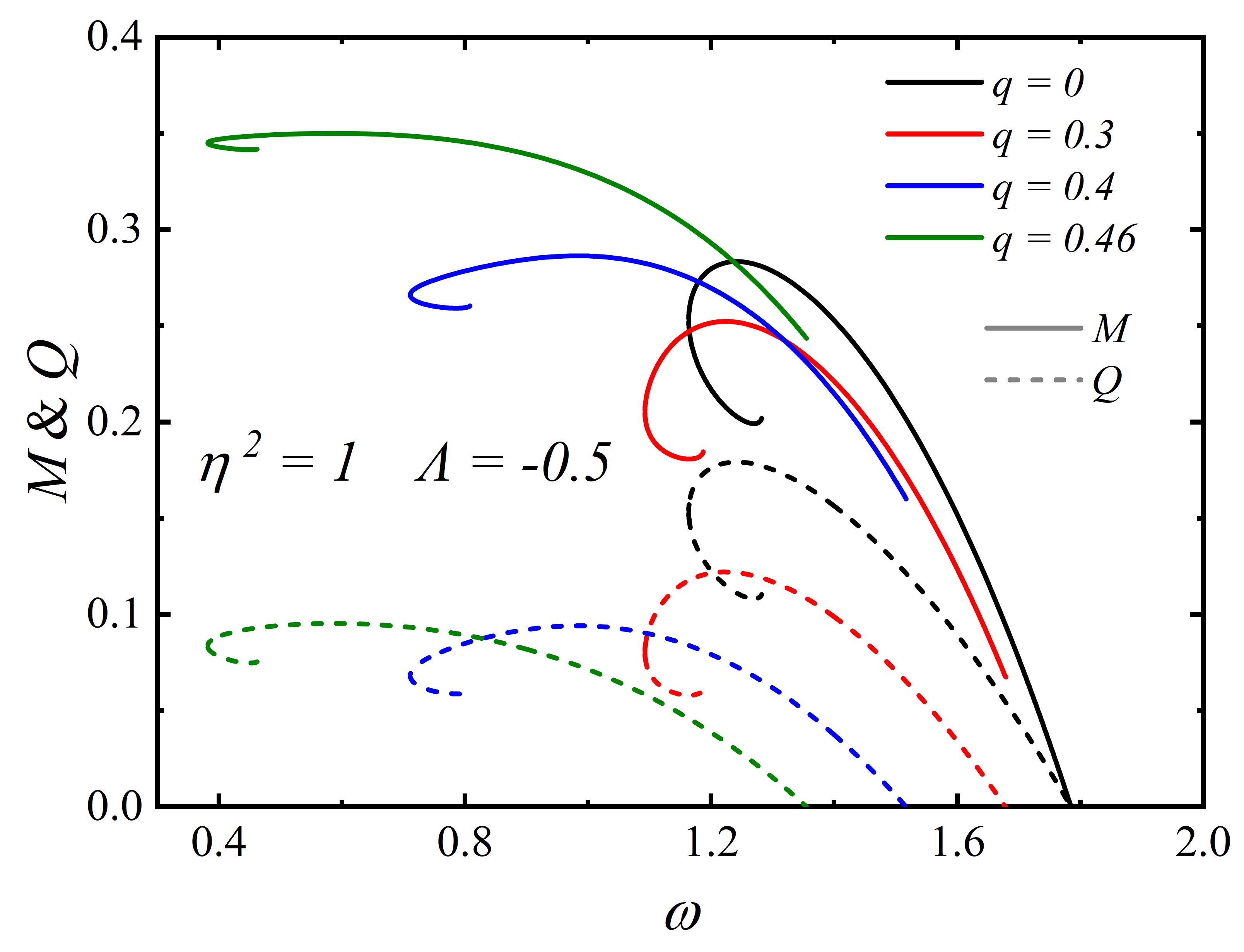
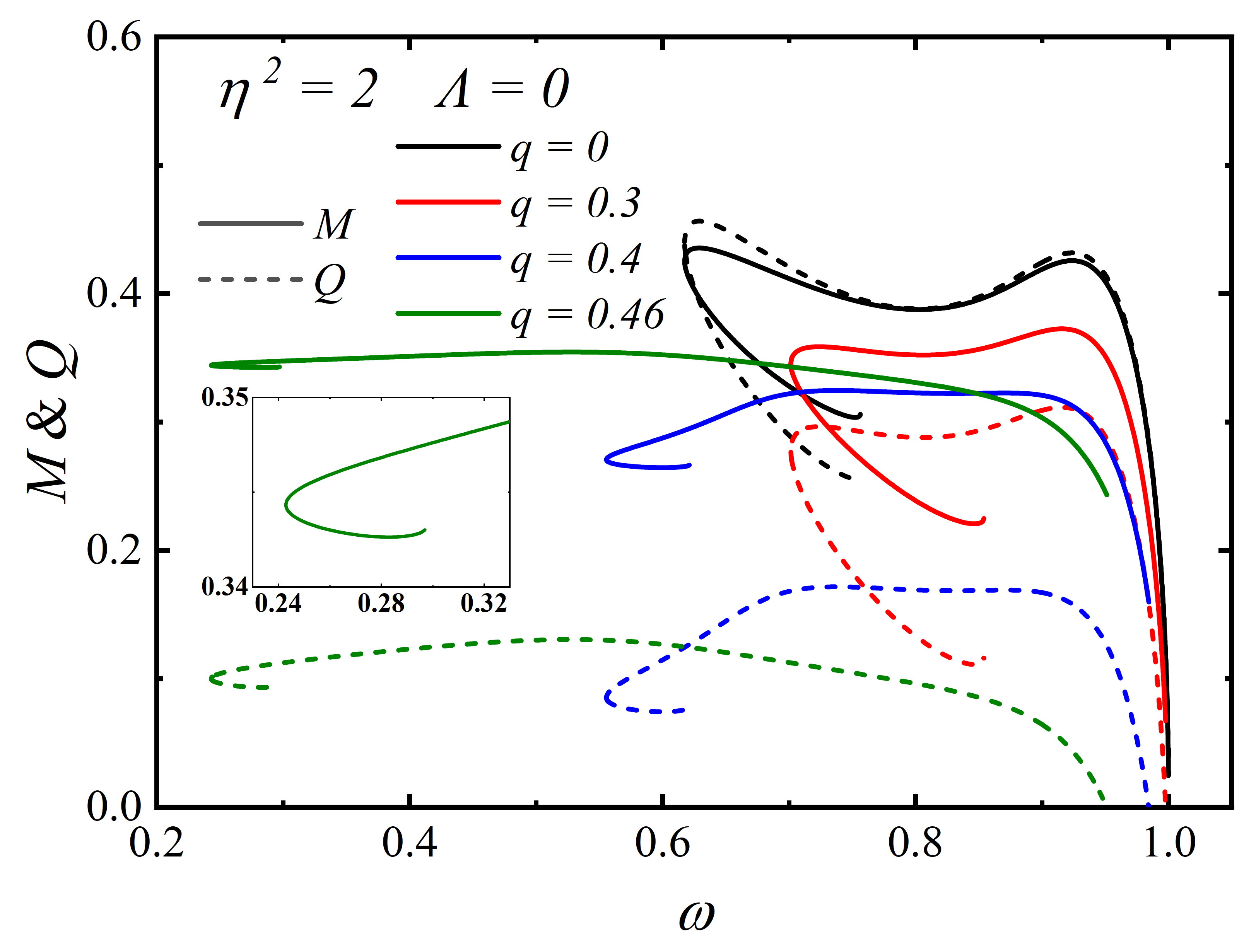
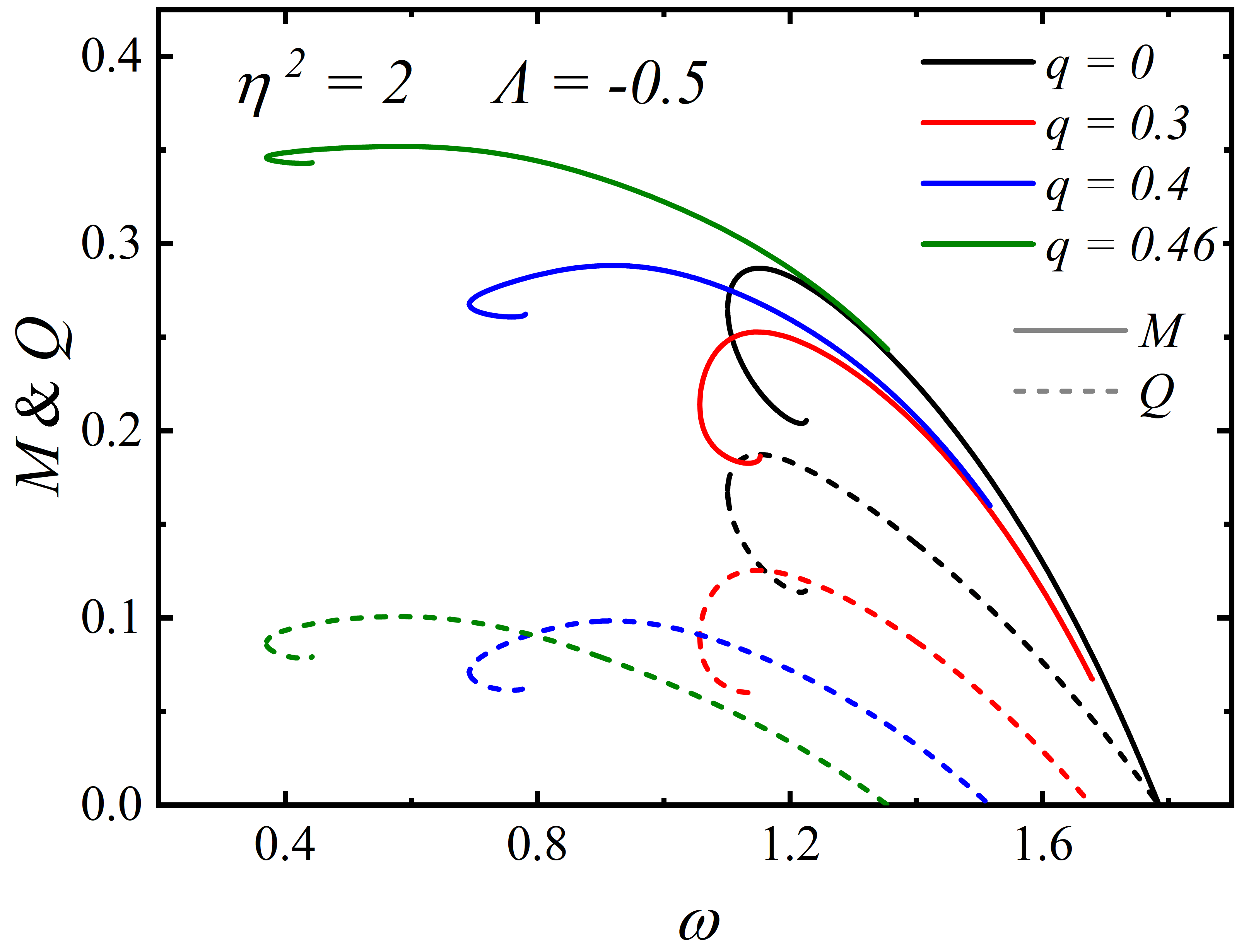
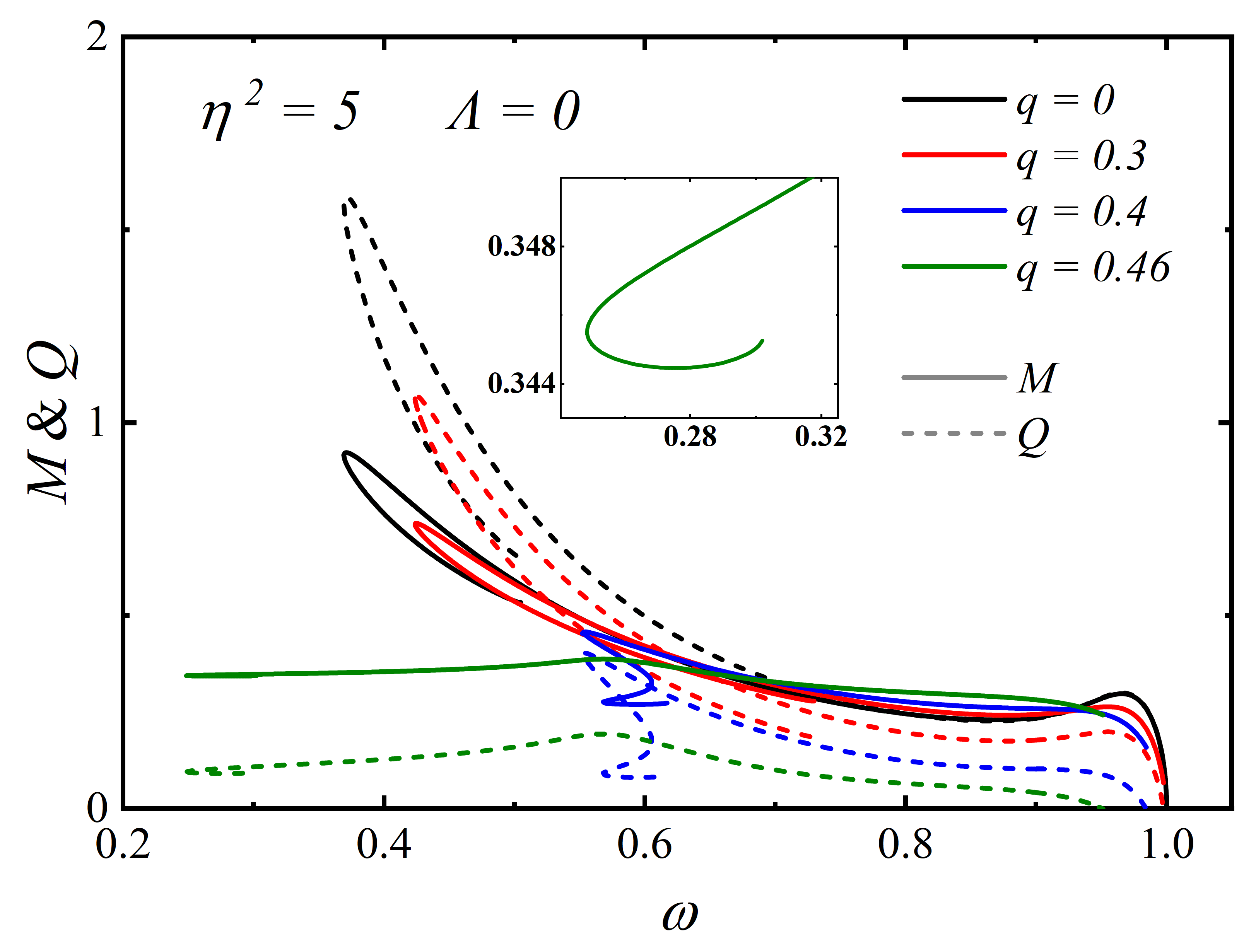
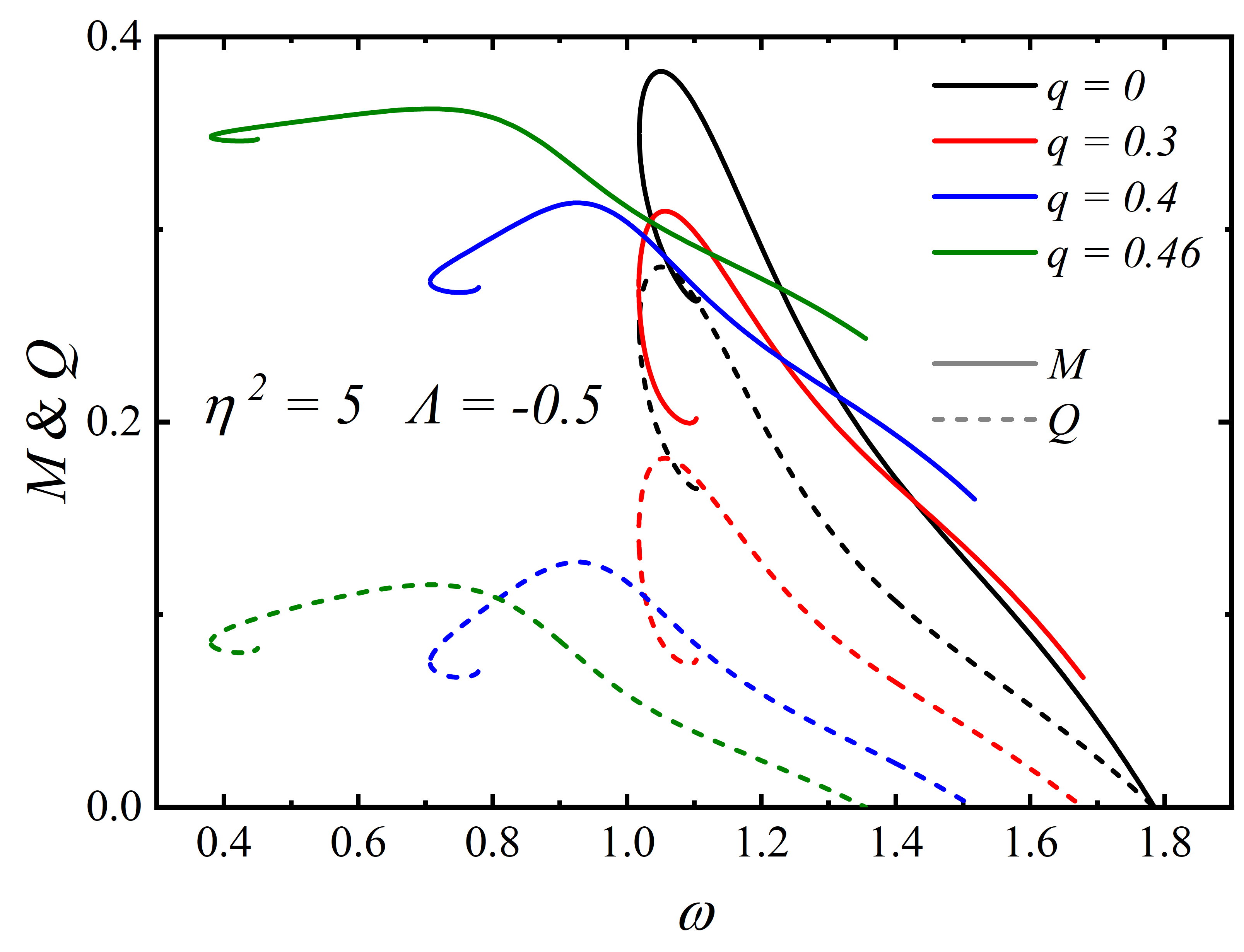
Figure 1: The ADM mass M and Noether charge Q as functions of scalar field frequency ω with q<qc for various self-couplings η in Minkowski (left) and AdS (right) backgrounds.
When q≥qc, a new class of solutions emerges as ω→0. In this regime, the matter distribution becomes sharply localized within a critical radius rc, beyond which the fields decrease precipitously. The metric components −gtt and 1/grr reduce to extremely small, but finite, values at the surface rc, producing a "frozen" configuration termed a Frozen Solitonic Hayward-Boson Star (FSHBS).
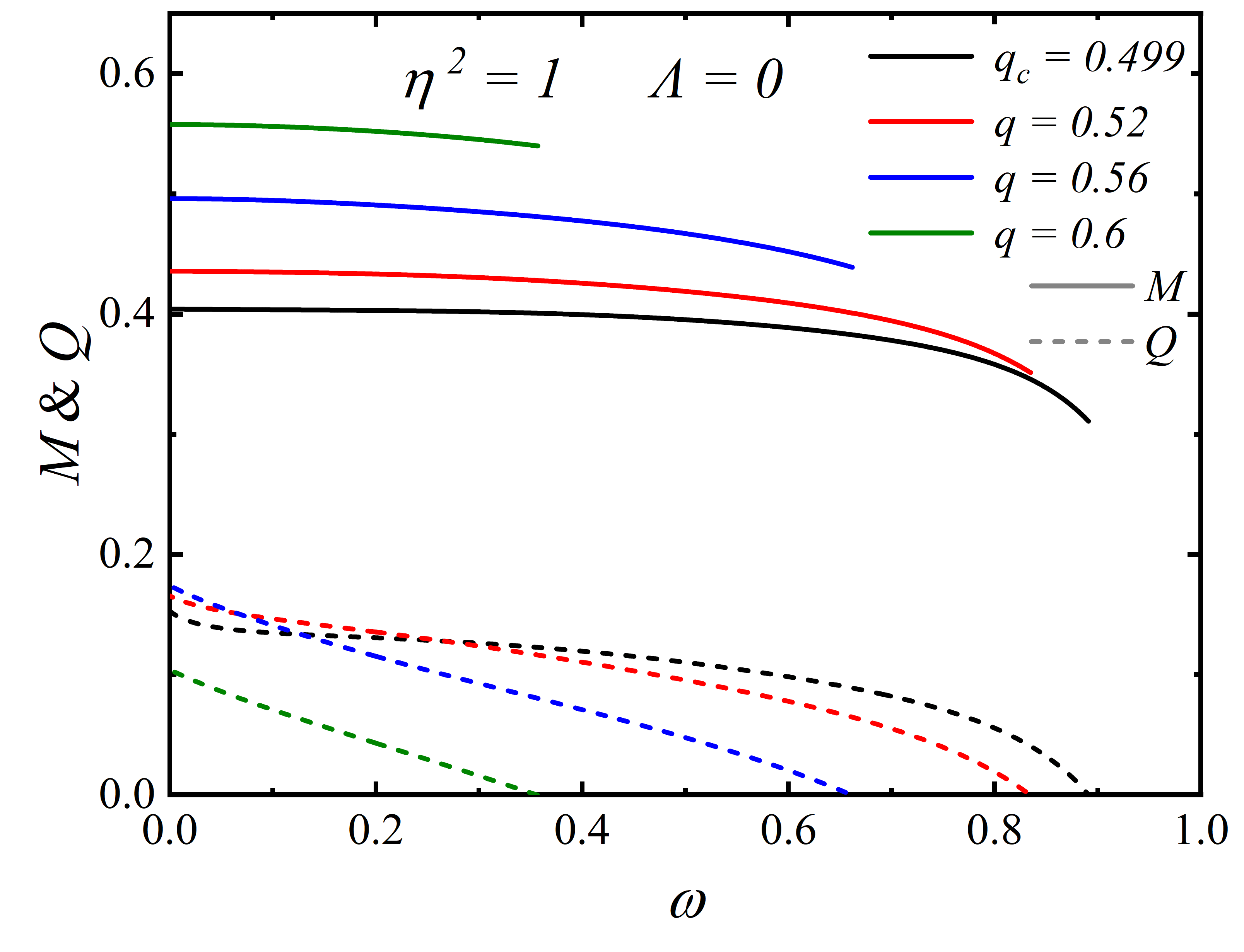
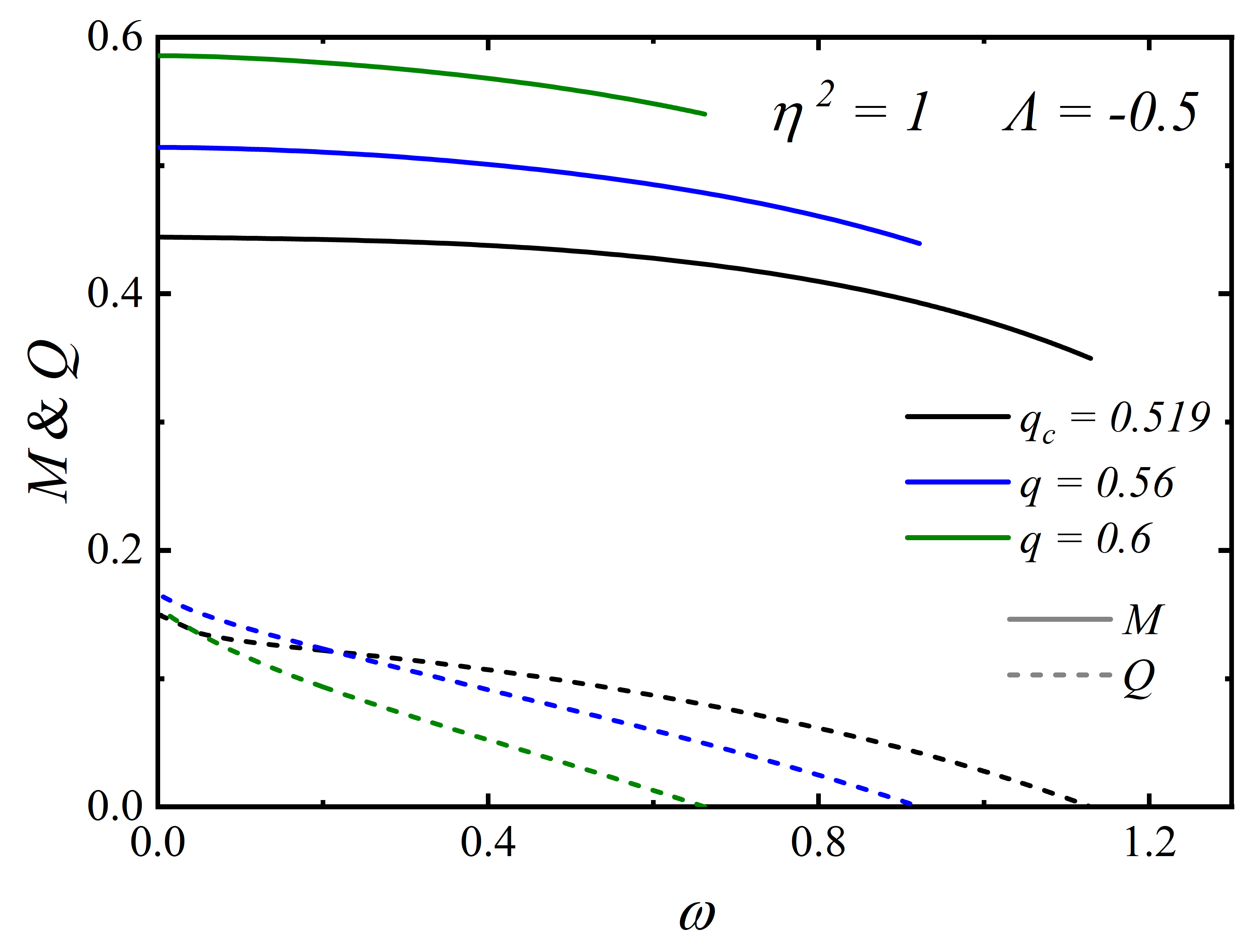
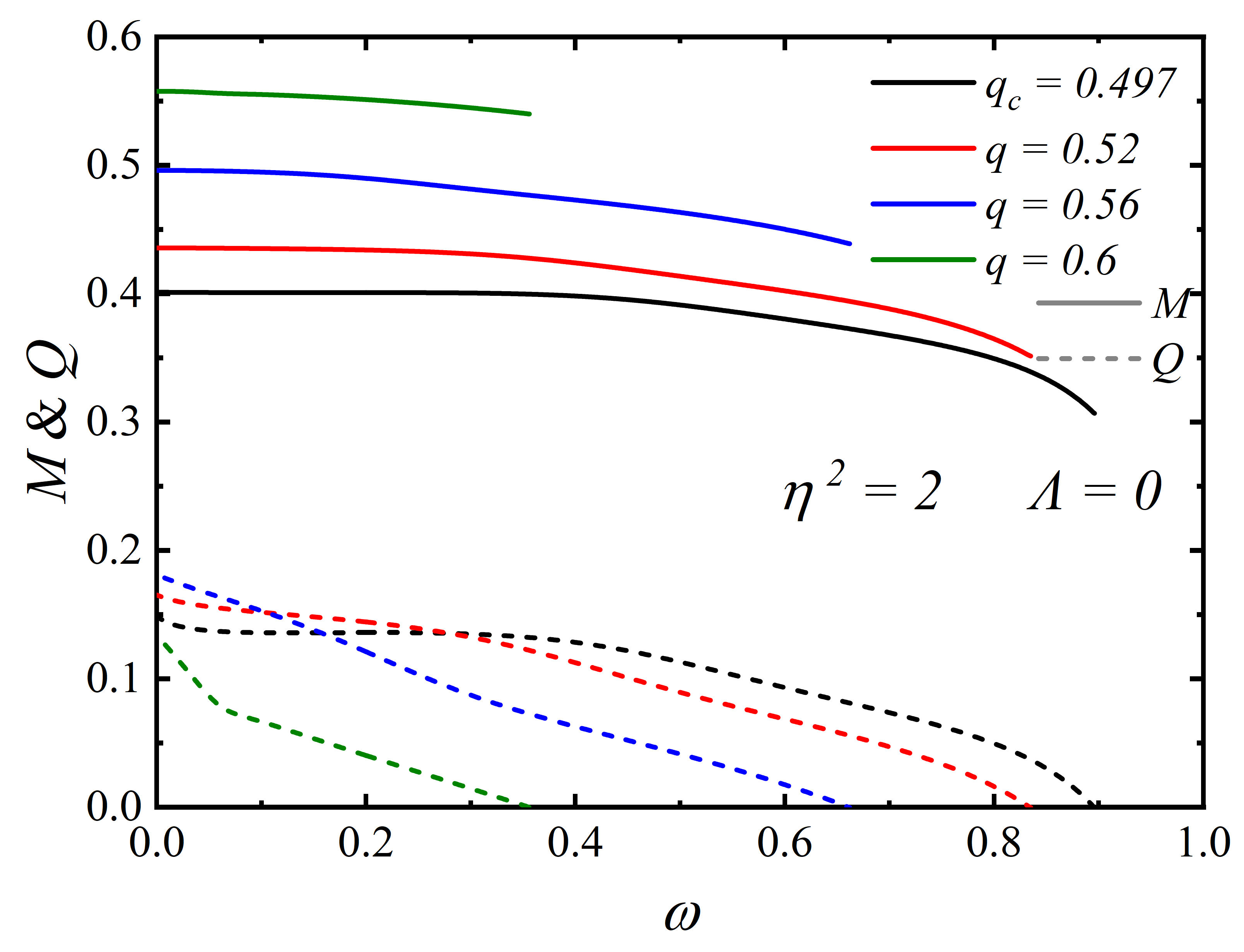
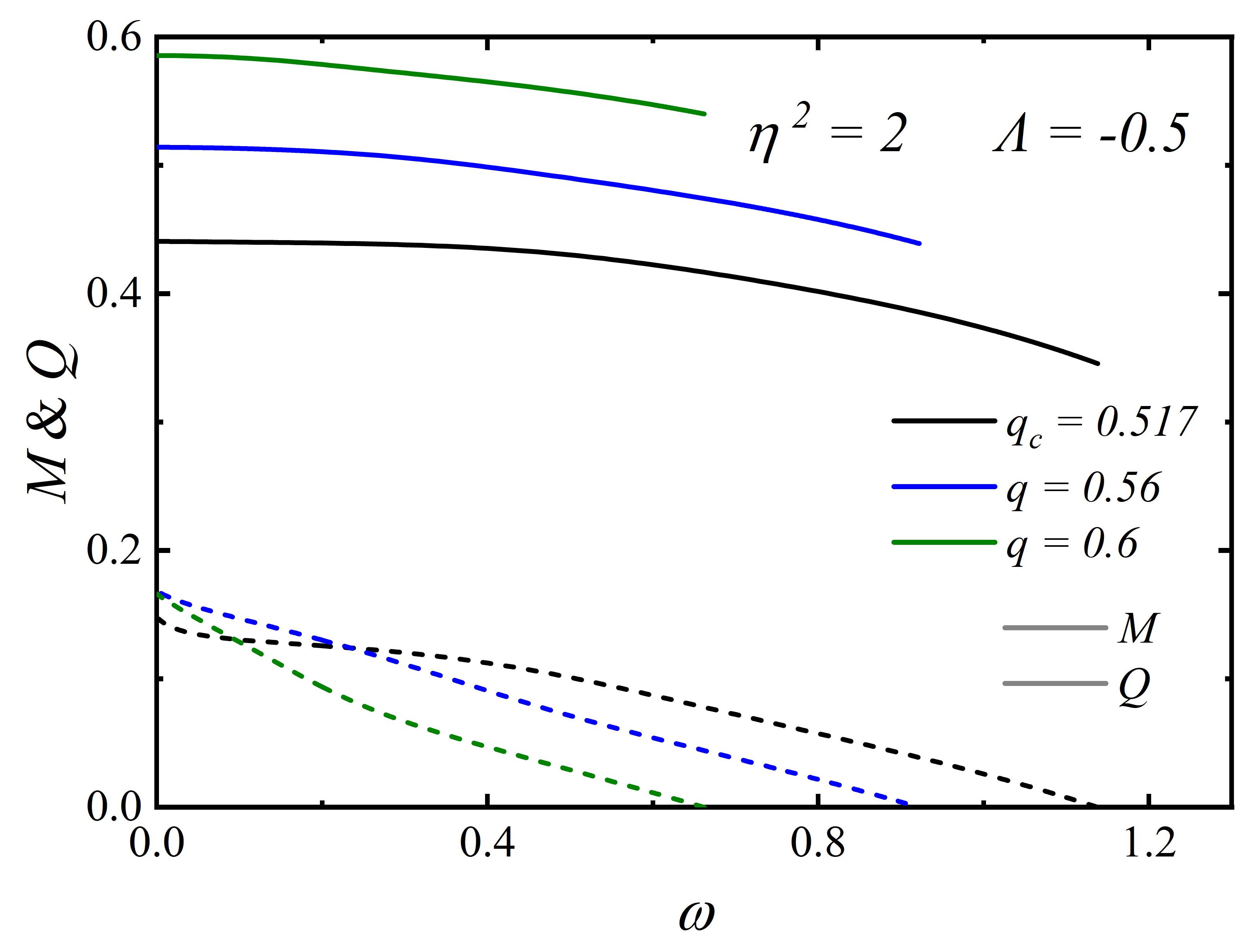
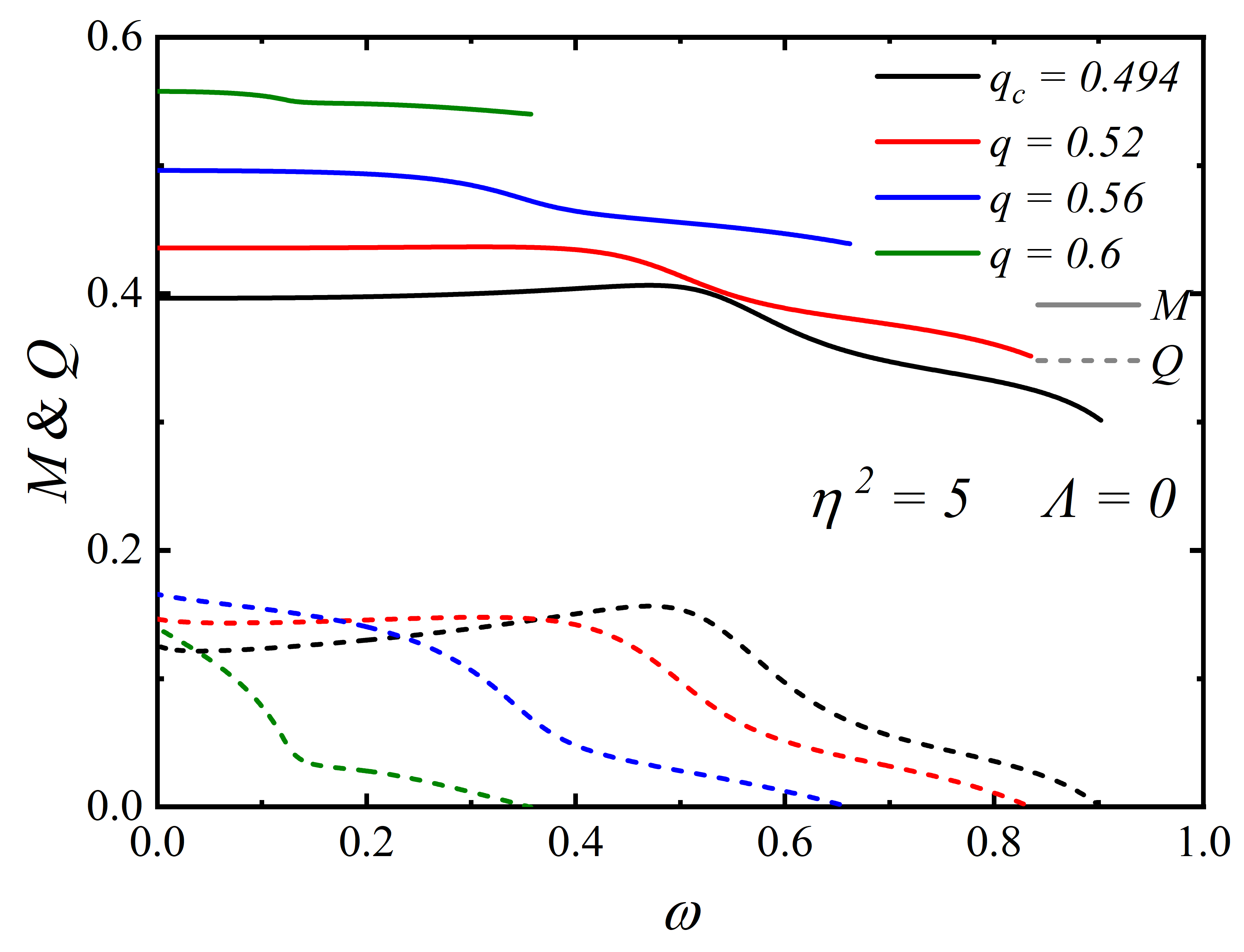
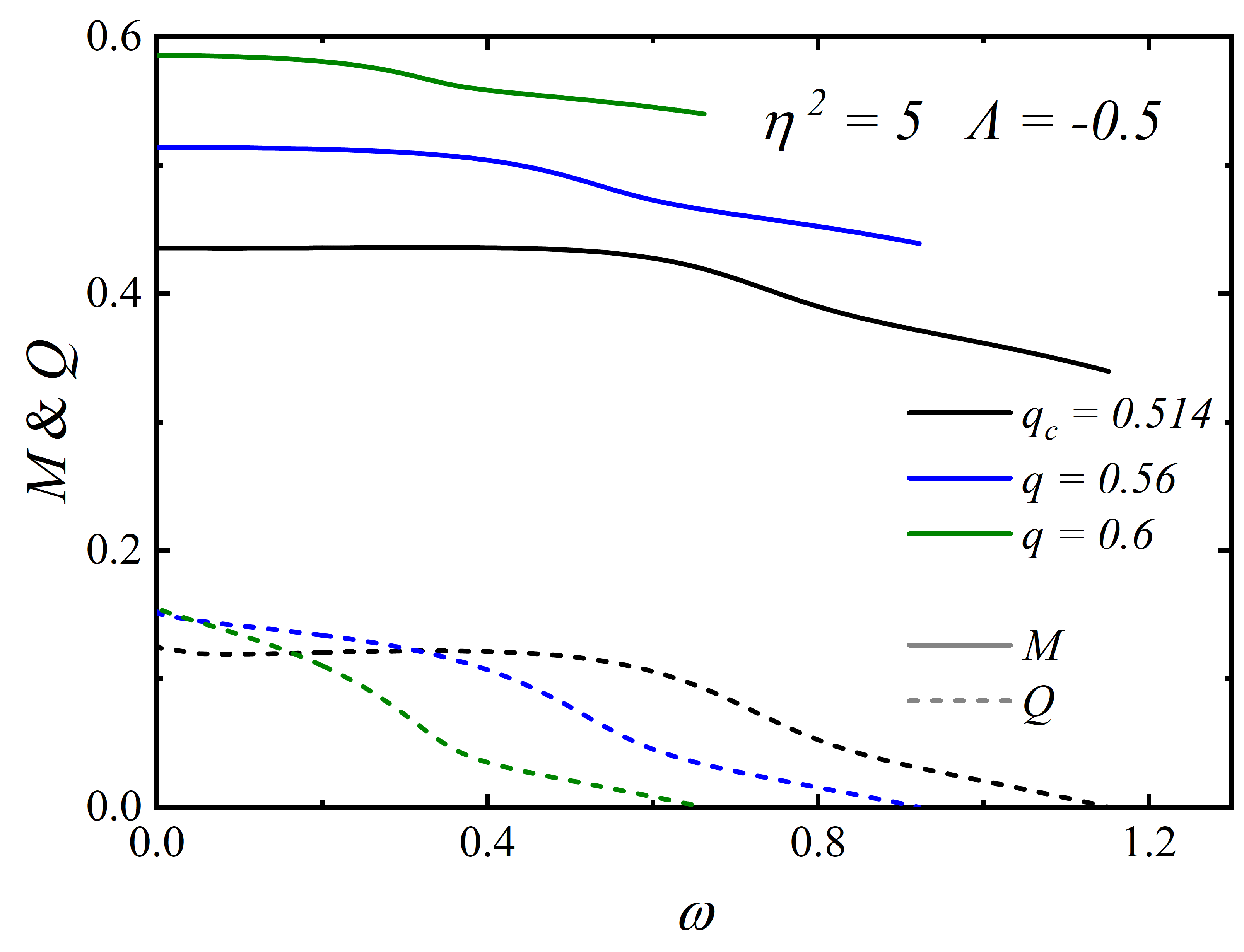
Figure 2: M and Q versus ω for q>qc; the existence of extreme solutions with ω→0 is clear, in contrast to the q<qc regime.
Geometry and Field Structure of Frozen Solutions
The frozen solutions exhibit marked geometric features: the scalar field and energy density are almost entirely confined inside rc, and spacetime is arbitrarily close to forming a horizon. Beyond rc, the metric quickly transitions to its asymptotic AdS form, while inside, the lapse and radial components become extremely suppressed, mimicking staticity from the perspective of an asymptotic observer.
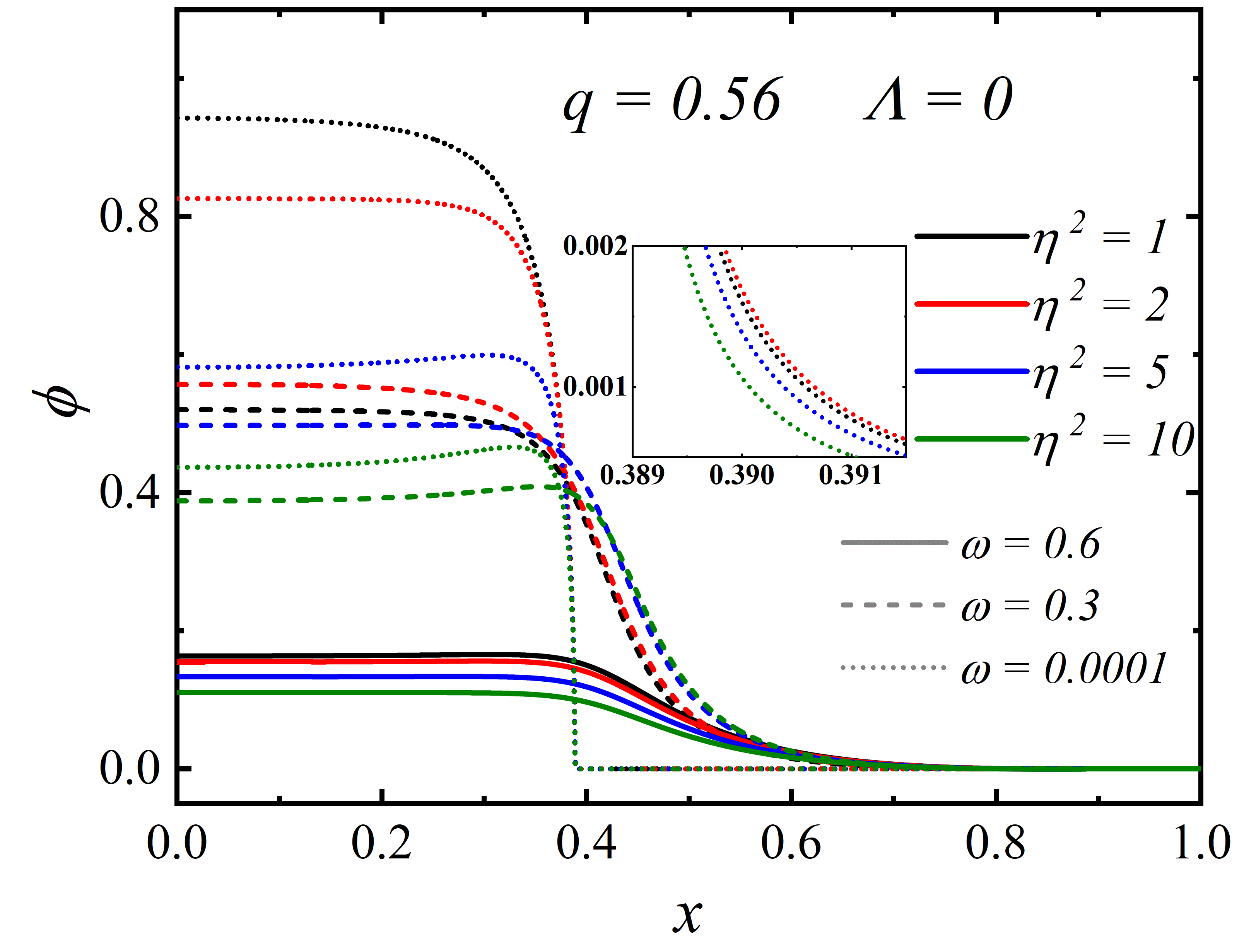
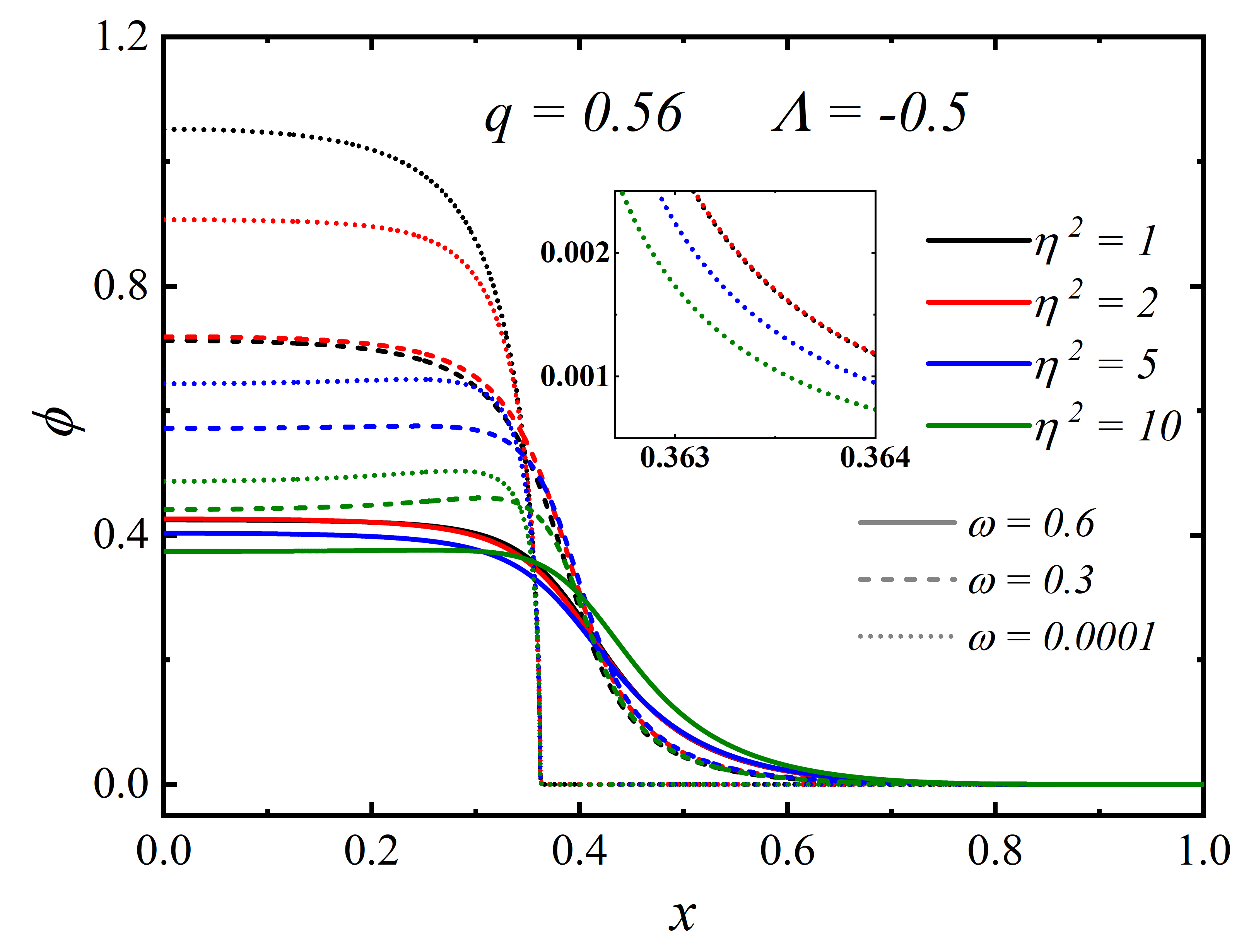
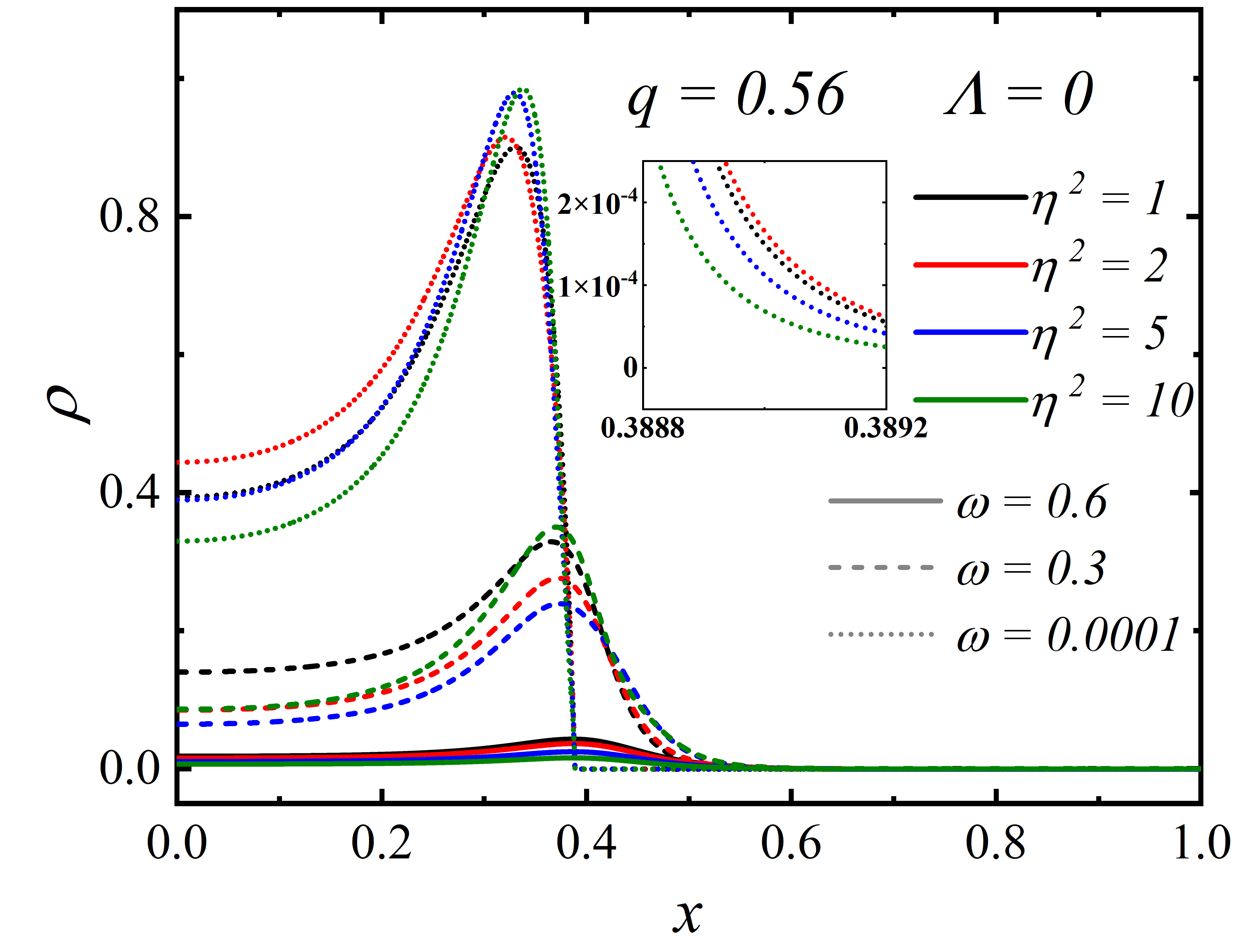
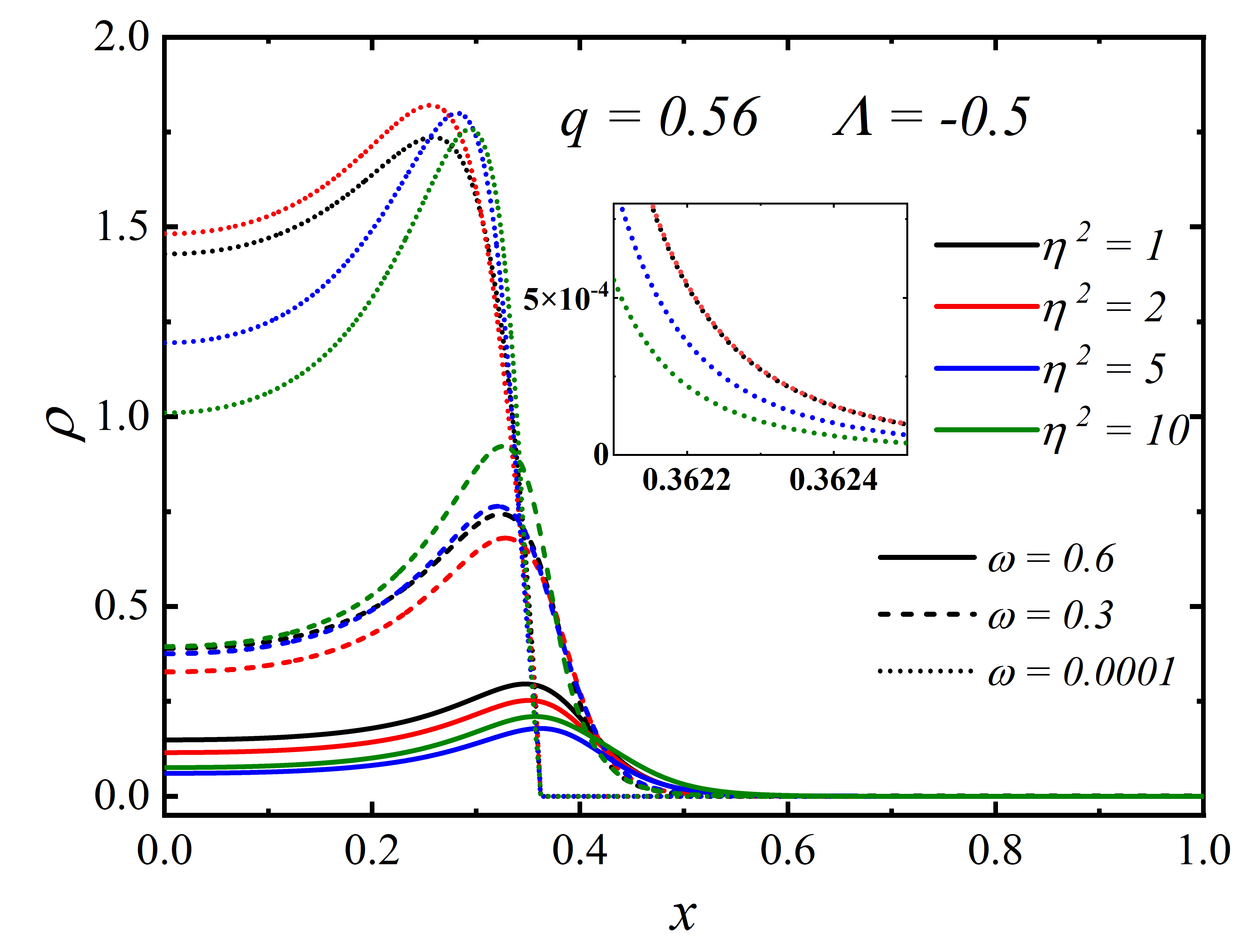
Figure 3: Radial profiles of the scalar field ϕ and energy density ρ for SHBSs at several frequencies and couplings, illustrating the confinement as ω→0.
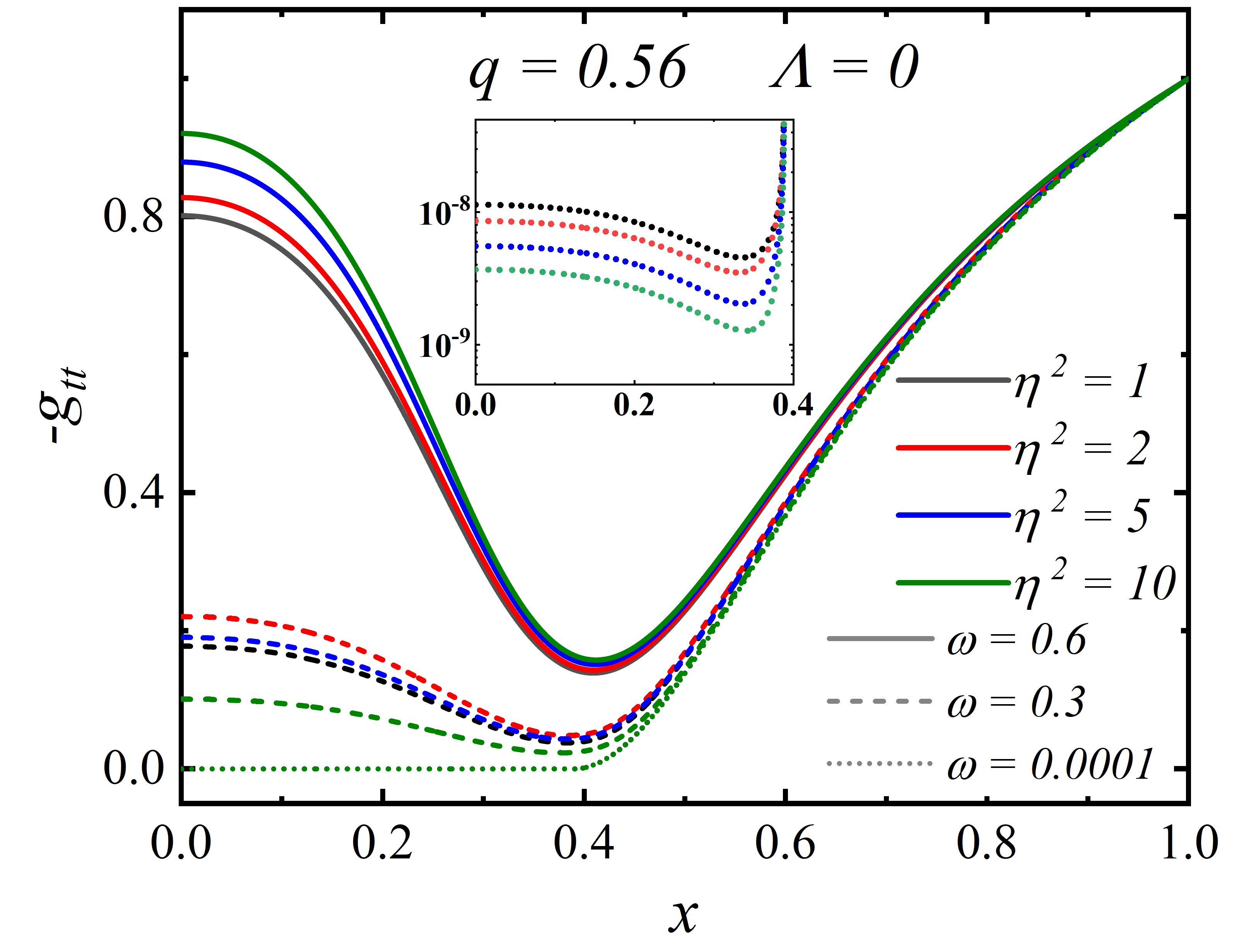
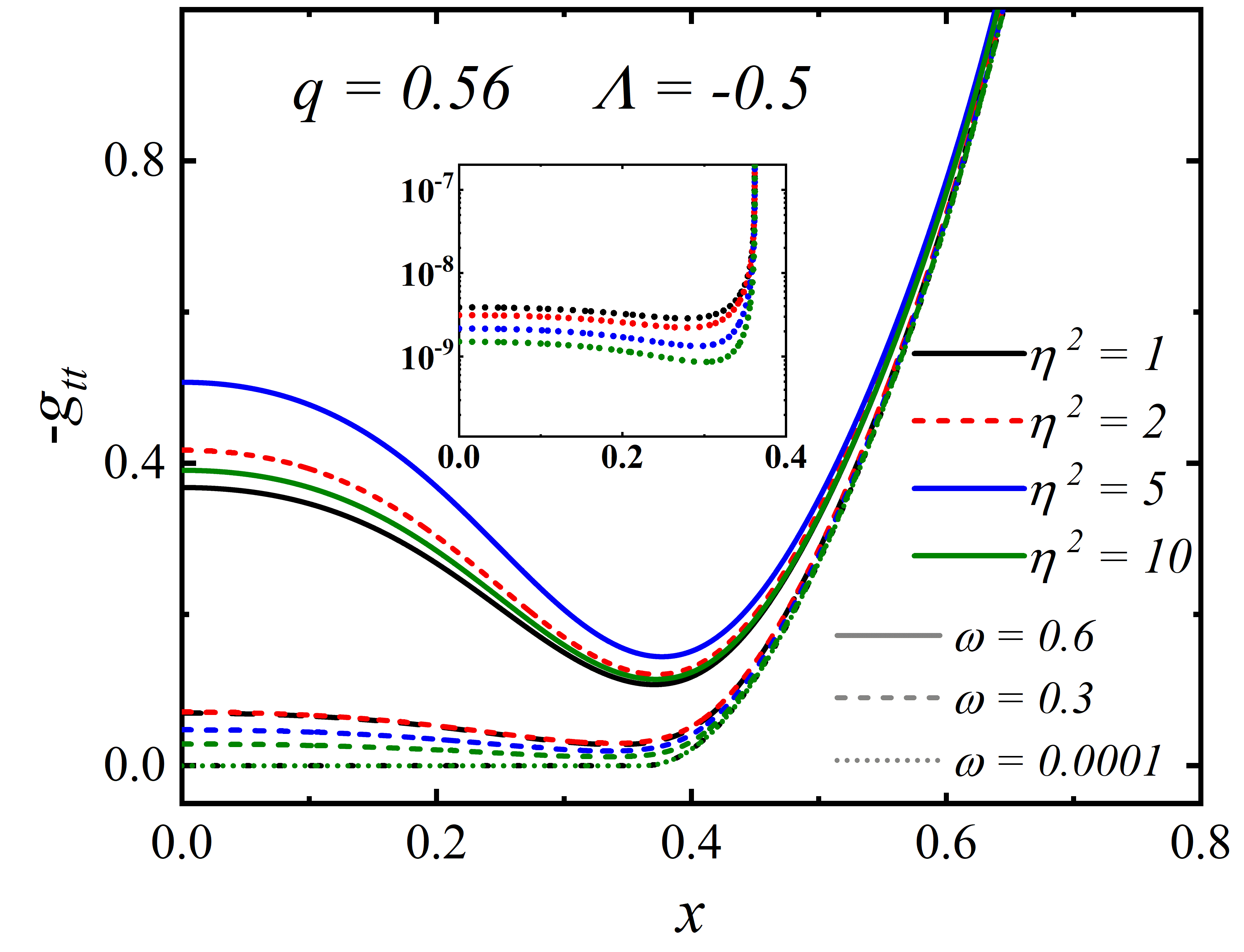
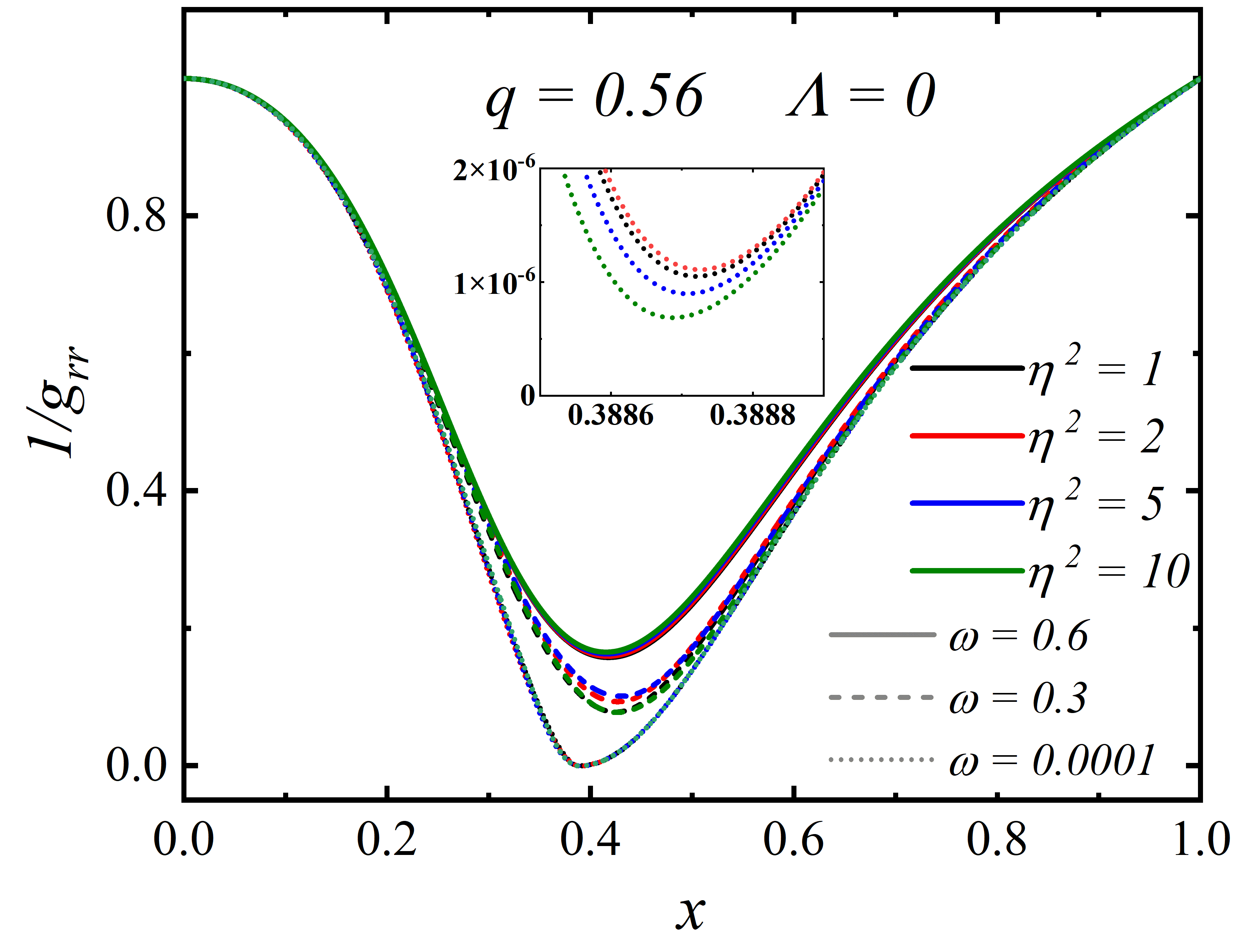
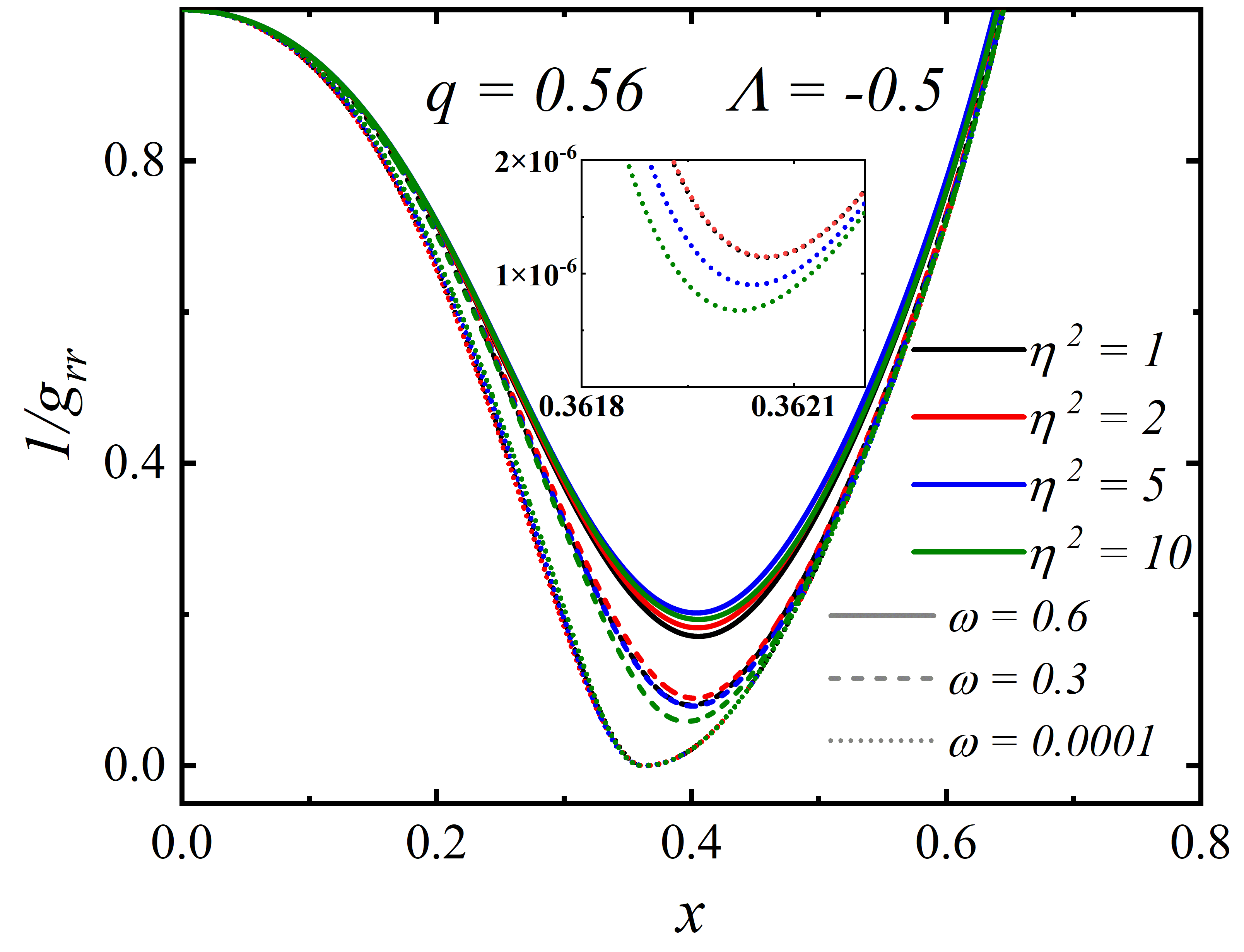
Figure 4: Radial behavior of metric components; in the frozen regime, −gtt and 1/grr approach machine precision near rc.
By tuning η and Λ, the structure and critical charge qc can be controlled. Notably, qc is non-monotonic in η but increases monotonically as Λ becomes more negative. The ADM mass of the extreme, frozen solutions is essentially independent of η, while the Noether charge is sensitively dependent on both η and Λ.
Effective Potentials and Light Rings
The authors systematically analyze null geodesics and the associated effective potential for photon orbits in SHBS spacetimes. The effective potential Veff reveals the existence and multiplicity of light rings (photon circular orbits), which are critical in understanding the compactness, stability, and potential observational signatures of these horizonless objects.
For q<qc, the system can support zero or two light rings depending on parameters, with transitions in their number as the frequency is varied. For q≥qc and especially in the frozen regime, light rings become sharply localized; the inner ring is always stable, and the outer one is unstable. The analysis also identifies the birth of an additional pair of light rings in the second solution branch—a feature absent in simpler boson star models.
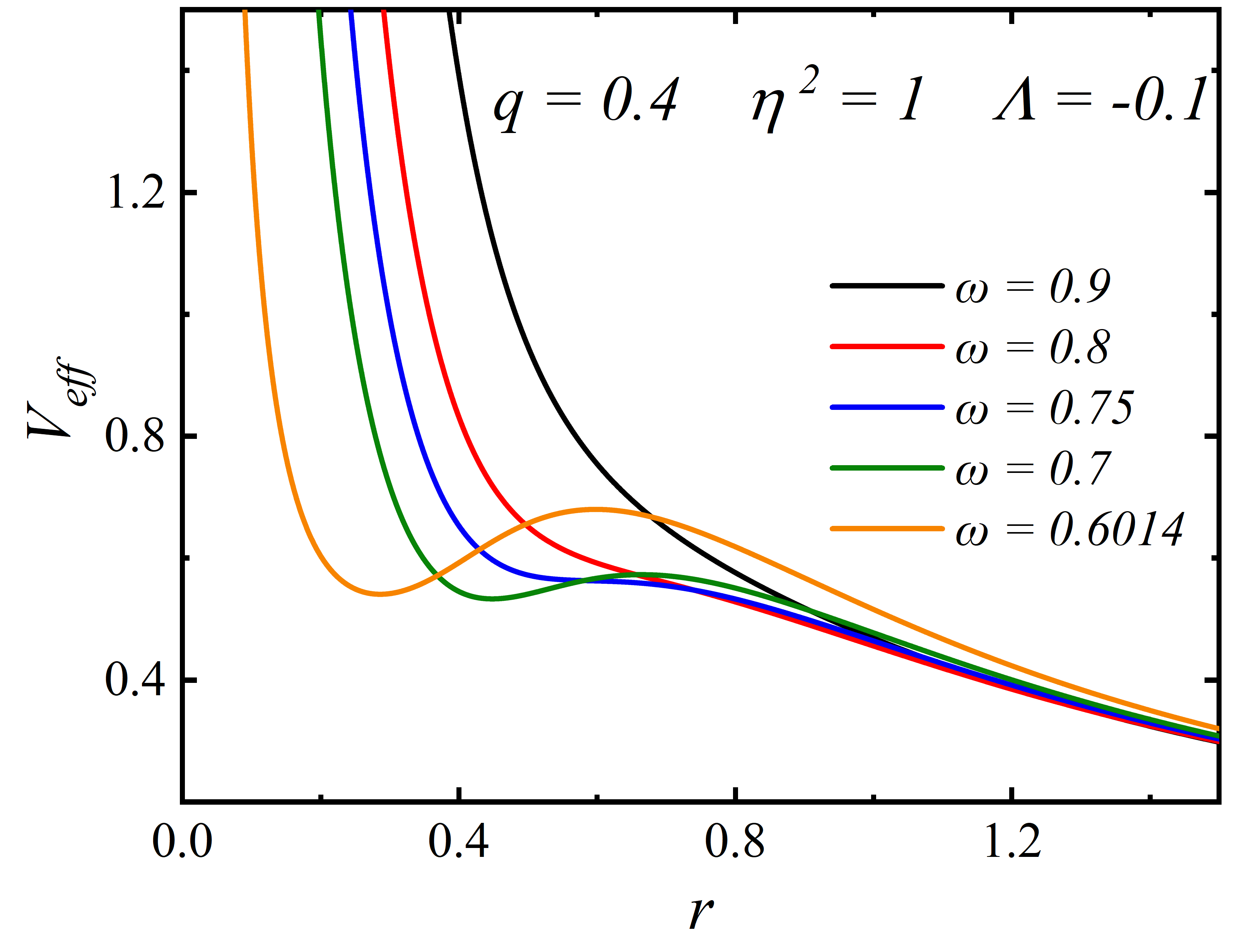
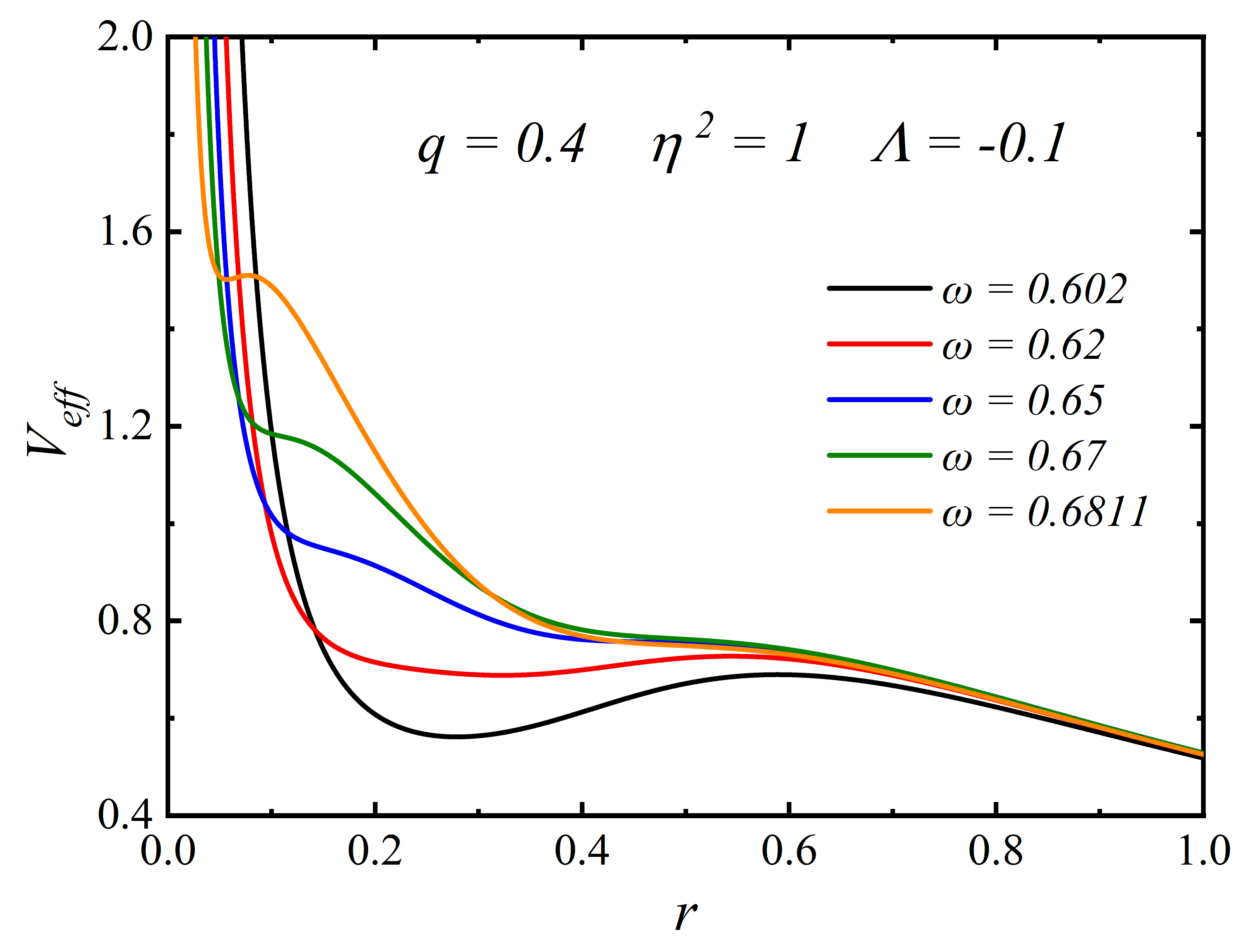
Figure 5: Effective potential as a function of radius for different ω; emergence and disappearance of light rings in first and second branches, respectively.
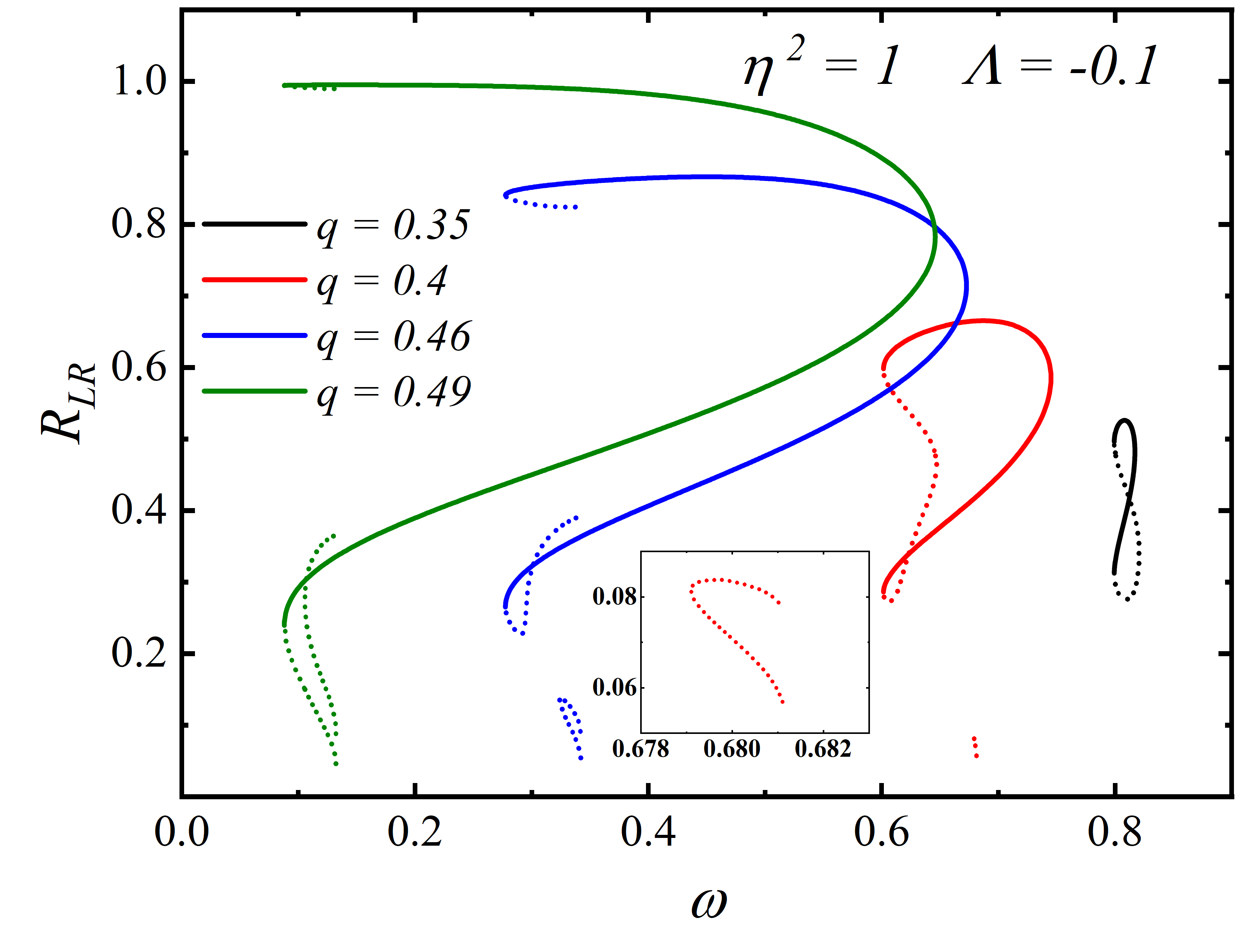
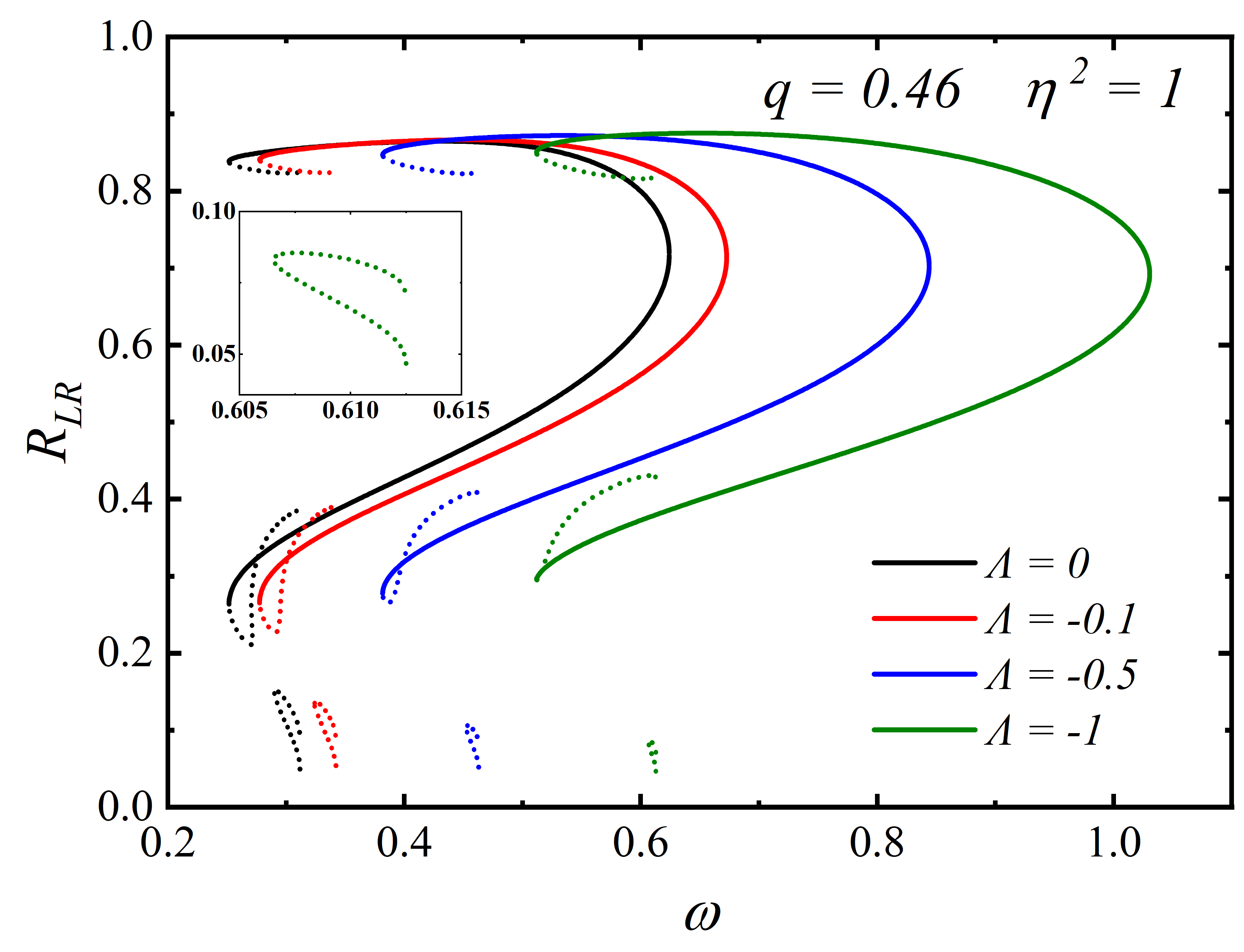
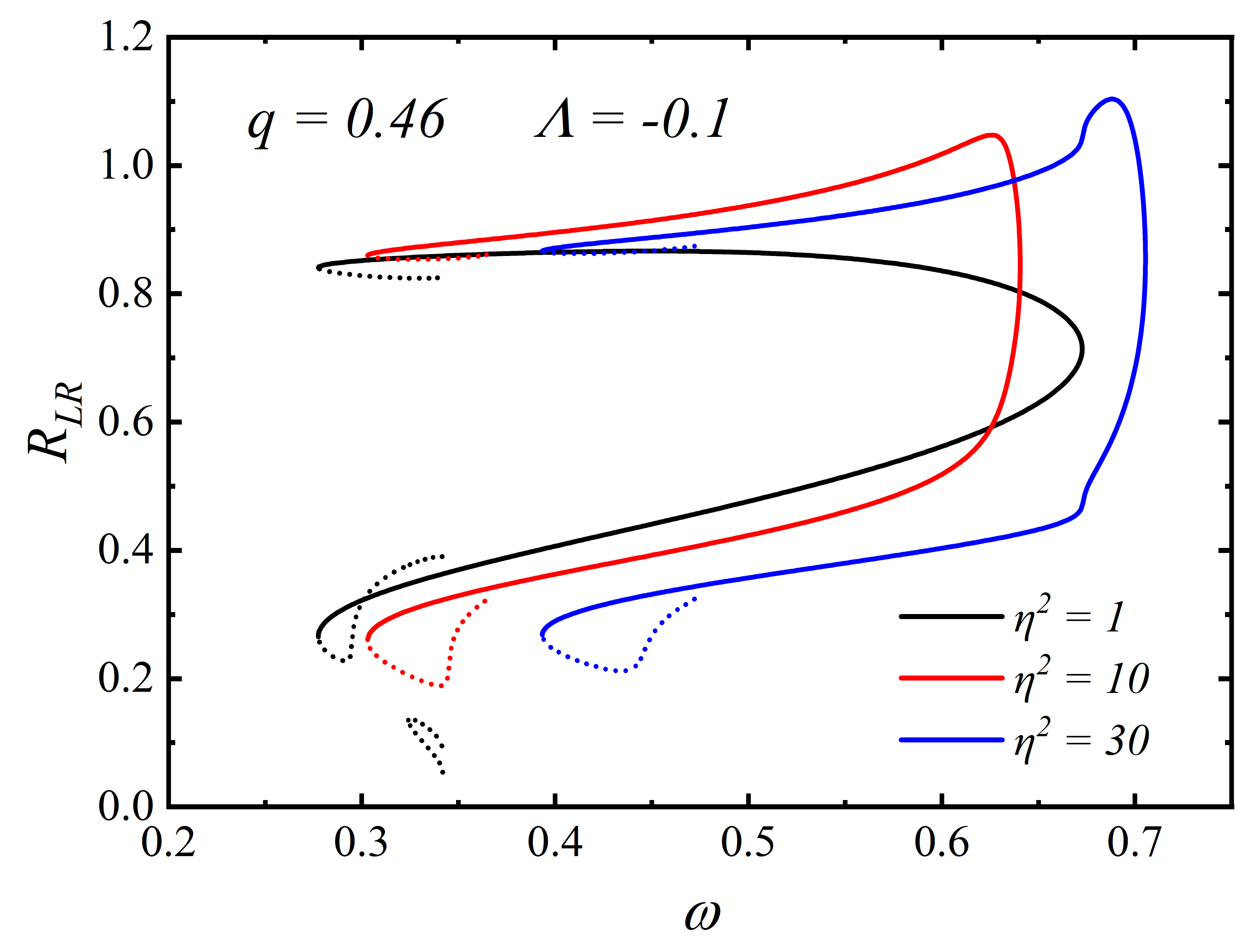
Figure 6: Light ring position RLR versus ω. Solid and dashed lines indicate the first and second branches; transition behaviors as q, Λ, and η are varied.
Parameter Dependence and Limiting Behavior
A detailed parametric study quantifies the boundaries of the frozen regime and elucidates the impact of each physical parameter:
- Magnetic charge q: Controls the onset of the frozen regime via qc, affects the size and compactness of the core.
- Self-coupling η: Non-monotonic influence on qc, affects charge accumulation and inner structure but not total mass in the extreme limit.
- Cosmological constant Λ: Larger negative values raise qc and shrink the frozen regime; spiral features in M–ω reappear if Λ is too negative, destroying the frozen solution.
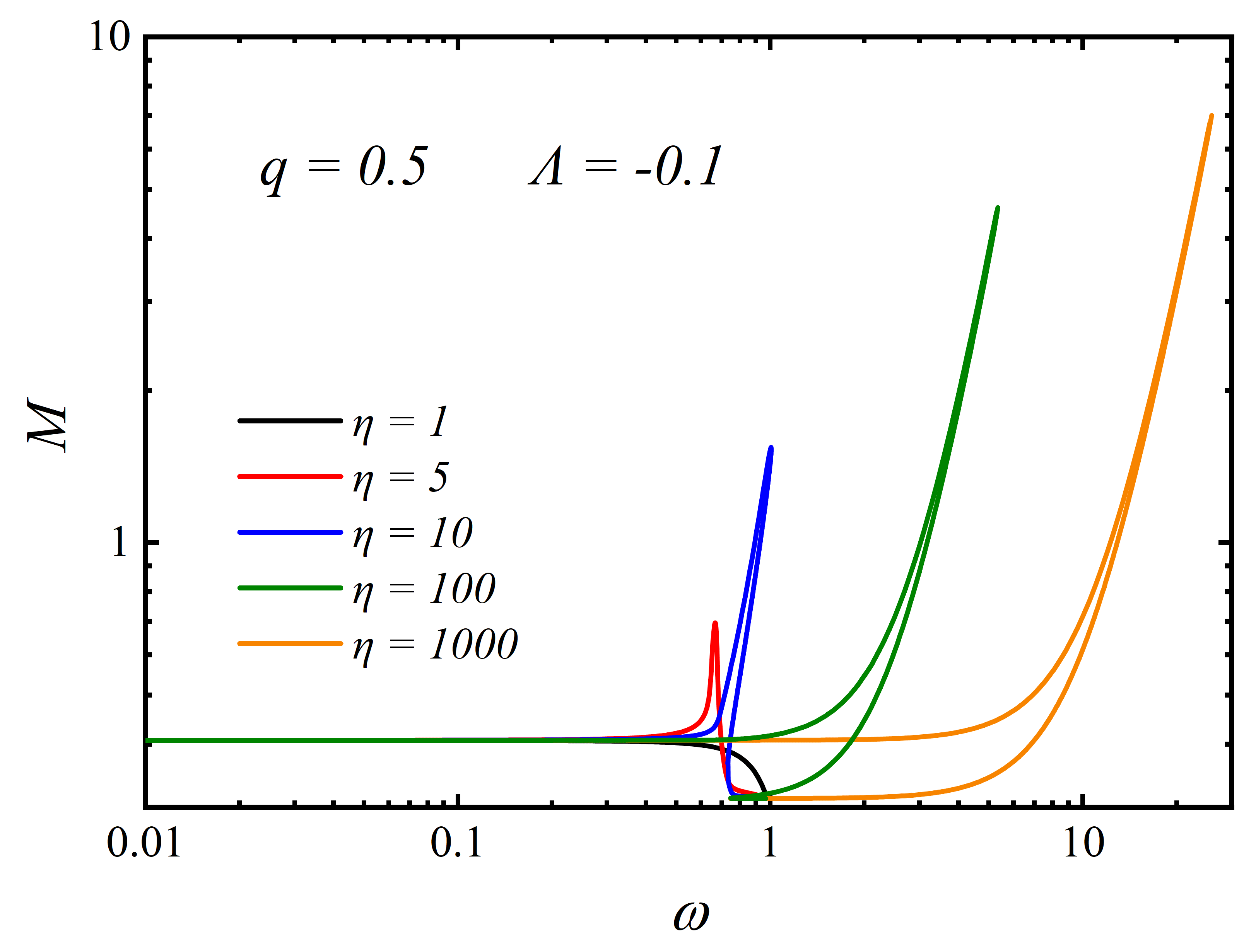
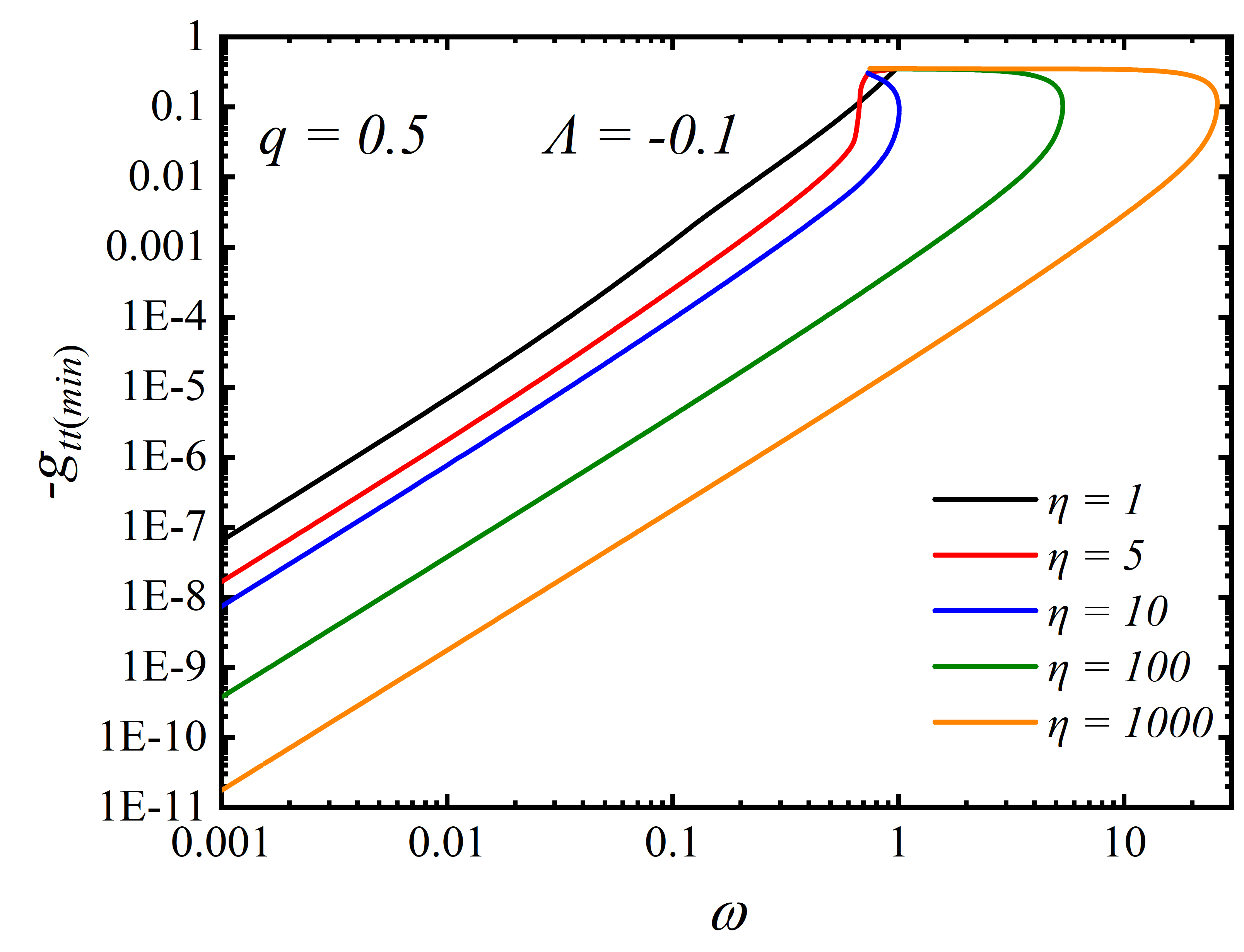
Figure 7: M and minimal −gtt as functions of ω, for various η and Λ, illustrating multi-branch structure and approach to the pure Hayward limit.
Implications and Future Directions
The results have several theoretical and phenomenological implications. The frozen SHBSs inhabit the borderland between traditional boson stars and regular black holes, providing potential microphysical models for ultracompact horizonless objects. Their AdS asymptotics are relevant for holographic applications and the large-charge sector of dual CFTs. The delicate dependence of the critical charge on the scalar self-interaction and cosmological constant will inform the ongoing search for universal behaviors of compact objects near horizon formation in alternative theories of gravity.
The identification of additional light ring branches implies potentially rich phenomenology for gravitational wave echoes and lensing in spacetimes without event horizons. The independence of ADM mass from scalar self-coupling, in the frozen limit, places sharp constraints on solitonic compact star mass hierarchies.
Open directions include time-dependent stability analysis of FSHBSs in AdS, the impact of higher-dimensional generalizations, and dualities to strongly coupled CFT states. The model serves as a guide for constructing regular, ultracompact alternatives to black holes with tunable horizon-proximate features.
Conclusion
By unifying nonlinear electromagnetic regularization and self-interacting scalar field dynamics, this work establishes the existence and structure of solitonic Hayward-boson stars and their frozen analogs in AdS spacetime. The dependence of the frozen regime on microscopic parameters is mapped in detail, and unique geometric and null-geodesic properties are revealed that distinguish these solutions from standard boson stars. The results delineate the boundary between horizon formation and solitonic confinement, offering a foundation for future research on horizonless ultracompact structures in general relativity and quantum gravity contexts.