HybridSplat: Fast Reflection-baked Gaussian Tracing using Hybrid Splatting
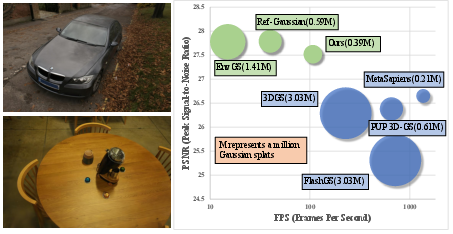
Abstract: Rendering complex reflection of real-world scenes using 3D Gaussian splatting has been a quite promising solution for photorealistic novel view synthesis, but still faces bottlenecks especially in rendering speed and memory storage. This paper proposes a new Hybrid Splatting(HybridSplat) mechanism for Gaussian primitives. Our key idea is a new reflection-baked Gaussian tracing, which bakes the view-dependent reflection within each Gaussian primitive while rendering the reflection using tile-based Gaussian splatting. Then we integrate the reflective Gaussian primitives with base Gaussian primitives using a unified hybrid splatting framework for high-fidelity scene reconstruction. Moreover, we further introduce a pipeline-level acceleration for the hybrid splatting, and reflection-sensitive Gaussian pruning to reduce the model size, thus achieving much faster rendering speed and lower memory storage while preserving the reflection rendering quality. By extensive evaluation, our HybridSplat accelerates about 7x rendering speed across complex reflective scenes from Ref-NeRF, NeRF-Casting with 4x fewer Gaussian primitives than similar ray-tracing based Gaussian splatting baselines, serving as a new state-of-the-art method especially for complex reflective scenes.

Paper Prompts
Sign up for free to create and run prompts on this paper using GPT-5.
Top Community Prompts
Explain it Like I'm 14
What is this paper about?
This paper is about making shiny things in 3D scenes look realistic while keeping the rendering very fast and memory‑friendly. The authors present “HybridSplat,” a new way to draw 3D scenes that include mirrors, glass, and glossy surfaces without slowing everything down.
What questions were the researchers trying to answer?
They focused on two simple questions:
- How can we keep reflections and shiny details looking realistic in 3D scenes?
- How can we render these scenes much faster and with less memory than existing methods?
How did they do it? (Methods in everyday language)
Before the details, here’s a quick, plain-language primer.
Background: “Gaussian splatting” in plain words
Imagine building a 3D scene out of millions of tiny, soft “fuzzy stickers” (like little blurry dots). Each sticker has a position, size, color, and direction. When you look at the scene from a camera, the renderer “splats” (paints) these stickers onto the screen to make the full image. This approach is called Gaussian splatting.
- 3D Gaussian splatting: uses 3D fuzzy dots.
- 2D Gaussian splatting: uses thin, oriented “disks” that lie on surfaces, which helps with sharper geometry.
Reflections are hard because the color of a shiny spot depends on where you’re looking from, like a mirror.
The HybridSplat idea: “Bake” reflections into each sticker
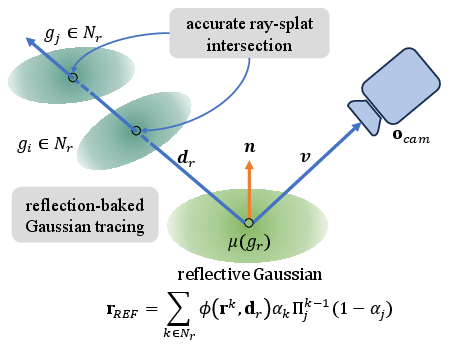
Old methods that handle reflections do “ray tracing”: for each pixel on the screen, they shoot virtual rays to find reflections. That’s accurate but slow—like checking every single pixel with a tiny flashlight.
HybridSplat flips the work:
- Instead of doing ray tracing per pixel, it does it per sticker (per Gaussian).
- For each reflective sticker, it calculates what that sticker should reflect for the current viewpoint and “bakes” that result into the sticker’s data.
- Then, it uses the fast splatting renderer to paint the reflection image, avoiding the heavy pixel-by-pixel ray tracing.
Think of it like pre-cooking the reflection for each sticker so the final painting step is quick.
One engine for two kinds of stickers
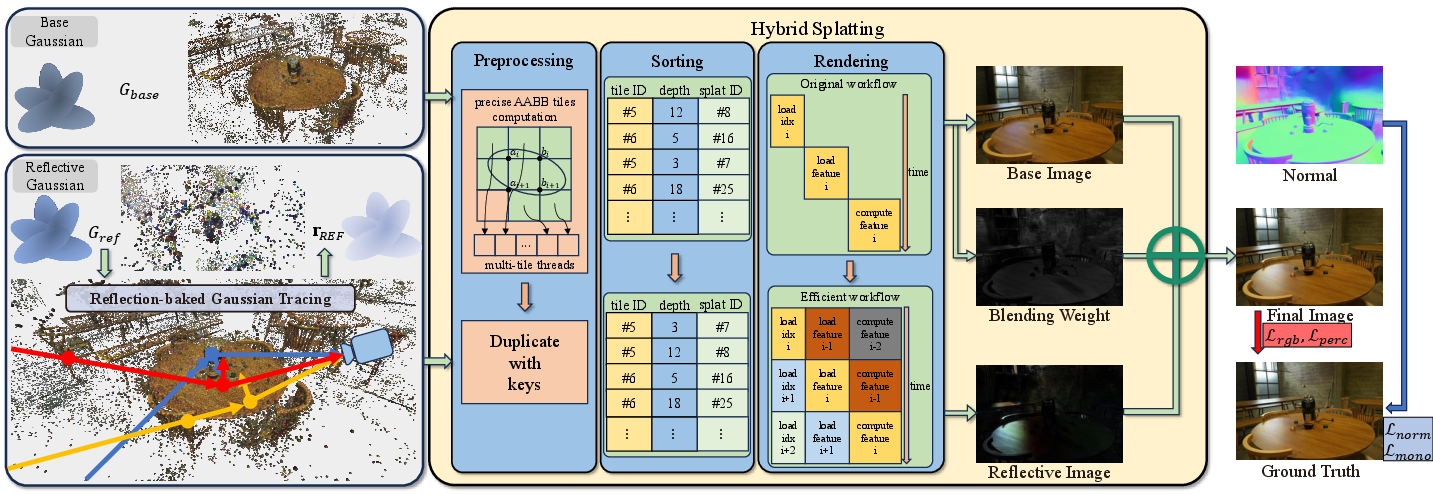
HybridSplat uses a unified, efficient splatting pipeline for two sets of stickers:
- Base Gaussians: handle the normal (non-reflective) appearance.
- Reflective Gaussians: hold reflection info that’s been “baked in.”
The final image blends the base image and the reflection image with a learned weight. That way, shiny parts get more of the reflective image; matte parts get more of the base image.
Speed-ups under the hood
To make the pipeline faster, the authors add two practical accelerations:
- More precise screen tiling: The screen is divided into small tiles. They quickly figure out exactly which stickers affect which tiles using better bounding boxes and a fast, parallel “does this sticker hit this tile?” check. That avoids wasting work.
- Better GPU workflow: They reorganize how data is loaded and computed so the GPU can fetch, prepare, and compute in parallel steps instead of doing everything in a strict, slow order.
Pruning: removing stickers you don’t need
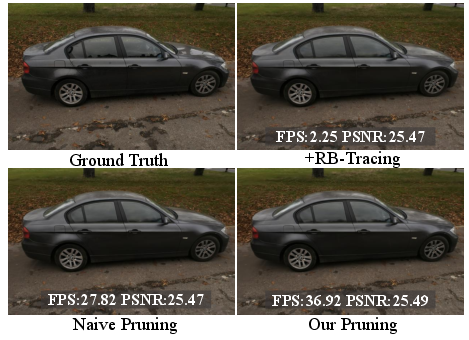
The model can end up with lots of redundant stickers. The authors designed a pruning strategy that’s “reflection-sensitive.” That means:
- Stickers are scored by how much they really matter to the final image, taking into account how reflective an area is.
- Less important stickers are removed, saving memory and speeding up rendering—without hurting reflective details.
What did they find?
On datasets with shiny, reflective scenes (like Ref-NeRF and NeRF-Casting), HybridSplat:
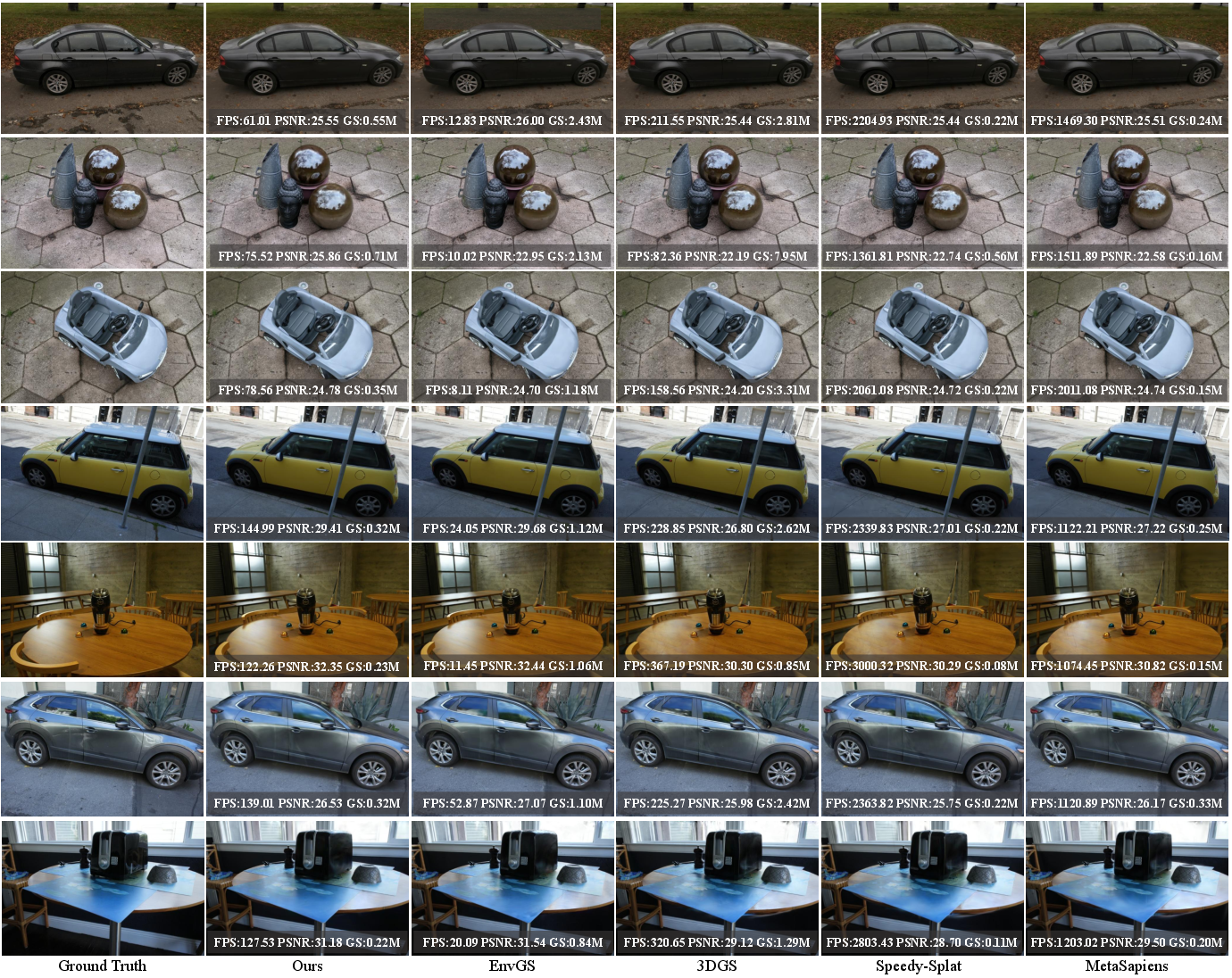
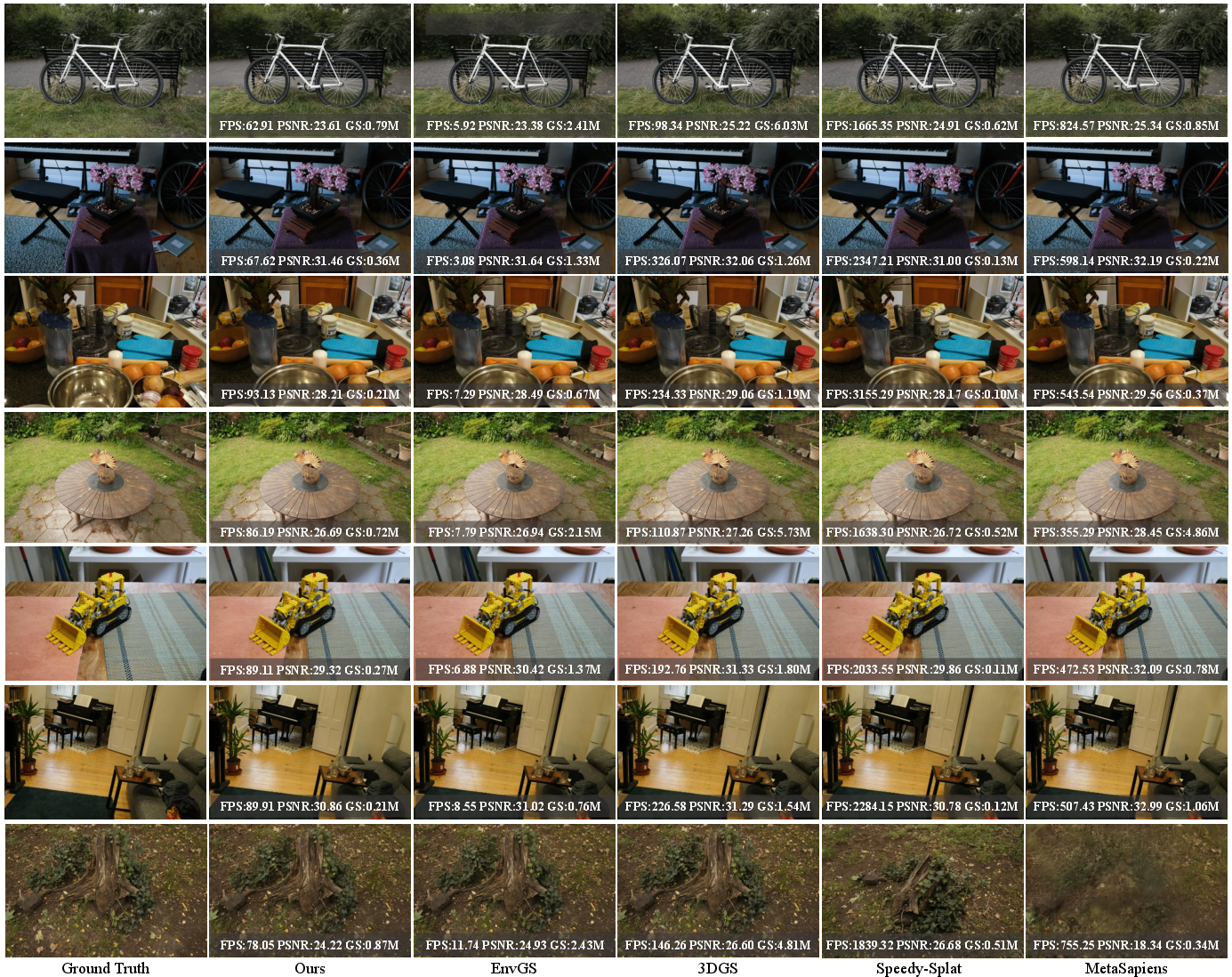
- Rendered about 7× faster than a strong reflective baseline called EnvGS.
- Used about 4× fewer Gaussian “stickers” than EnvGS.
- Kept similar image quality for tricky reflections (and was notably better than non–ray-tracing methods that are faster but blur or miss reflections).
- Also ran nearly 2× faster than another reflective method (Ref-Gaussian) with about 2× fewer stickers, while keeping high quality.
In short: similar or better realism for reflections, with big gains in speed and memory.
Why does it matter?
- Faster rendering of shiny scenes makes real-time graphics more practical for games, AR/VR, robotics, and digital twins.
- Using fewer stickers means models are lighter and easier to store or send to mobile devices.
- Keeping realistic reflections without heavy computation helps bridge the gap between great visuals and real-time performance.
A simple wrap-up (implications and impact)
HybridSplat shows that you can keep the realistic look of reflections by “baking” them per sticker and then using a fast splatting renderer. Combining:
- reflection baking,
- a unified pipeline,
- smart GPU scheduling,
- and reflection-aware pruning,
the approach delivers a strong speed/quality/storage balance. It’s a step toward smooth, real-time, photorealistic scenes—even when objects are shiny—without needing huge computers.
Note: The authors mention that extremely close, mirror-like reflections and very precise surface directions (normals) can still be challenging, and they plan to improve this in future work.
Knowledge Gaps
Knowledge gaps, limitations, and open questions
Below is a single, concrete list of what remains missing, uncertain, or unexplored in the paper, aimed to guide future research:
- Formal specification of the reflection-baked tracing: the paper defers the definition of the weighting function φ(·), the construction and ordering of the traced set N_r, and the exact ray–splat intersection procedure to the supplementary; a precise, reproducible formulation (including alternatives and their impact) is needed in the main text.
- Handling of occlusion along reflected rays: the method references transmittance terms but does not detail how self-occlusion, inter-object occlusion, and visibility along d_r are robustly resolved within the per-Gaussian tracing pipeline.
- Physical reflectance modeling: the approach uses a deterministic specular reflection direction and “reflection coefficients” ri without modeling Fresnel terms, microfacet roughness, anisotropy, or BRDFs; open question: how to integrate physically-based reflectance (including rough specular and multi-lobe BRDFs) into reflection-baked splatting without losing speed.
- Multi-bounce and transmissive effects: only single-bounce specular reflections are implied; refractions, transparency (glass), subsurface scattering, and higher-order interreflections remain unsupported and unquantified.
- Near-field single-object limitation: explicitly acknowledged as a drawback; concrete strategies to resolve near-field artifacts (e.g., improved intersection, per-Gaussian micro-geometry, local environment modeling) are not developed.
- Normal estimation accuracy: the conclusion notes a need for “more precise Gaussian normal estimation,” but the paper does not specify the normal estimation pipeline, supervision sources, or robust strategies under noisy geometry (nor ablations showing sensitivity to normal errors).
- Blending weight β: the paper uses β to mix base and reflective images and fixes β during pruning, but does not specify whether β is per-pixel, per-Gaussian, or global, how it is predicted or trained, or how its value affects reflection fidelity and pruning decisions across views.
- Assignment and densification of reflective vs base Gaussians: it remains unclear how G_ref vs G_base are initialized, split, and densified during training; criteria, thresholds, and dynamics for moving Gaussians between sets are not described or ablated.
- Approximation of 2D ellipse via “thin 3D Gaussian”: the augmentation with ε to approximate an explicit ellipse is not analyzed for error; sensitivity of ε to scene scale, tile size, and projection geometry, and its impact on culling accuracy and quality are not quantified.
- Tile–ellipse intersection details: the multi-tile threading and intersection test are left to the supplementary; a rigorous comparison to existing culling strategies (accuracy, false positives/negatives, compute/memory trade-offs) is not provided.
- Pipeline acceleration mechanics and portability: the “efficient workflow” with global-memory prefetch and OptiX shuffling is described at a high level; there is no analysis of occupancy, bandwidth, synchronization, fallback paths without OptiX, or portability to other runtimes (DXR, Vulkan RT, AMD GPUs).
- Complexity and scalability: the paper lacks formal complexity analysis (e.g., cost with respect to number of Gaussians, tiles, image resolution) and scaling curves; open question: how does the method behave for very large scenes (10–100M Gaussians) or ultra-high resolutions.
- Memory usage quantification: results report Gaussian counts but not actual memory footprints (MB/GB), attribute layouts (e.g., SH vs ri cost), or compression compatibility; concrete memory benchmarks and breakdowns would substantiate “lower storage” claims.
- Training-time cost and convergence: only epoch counts are reported; training wall-clock, data-parallel scalability, and convergence behavior vs baselines (e.g., EnvGS) are not measured or discussed.
- Losses and supervision specifics: the paper references RGB, normal consistency, monocular normal supervision, and perceptual losses but does not specify sources, networks, or exact formulations; reproducibility and the effect of each loss (especially normal supervision) remain unclear.
- Metric adequacy for reflections: PSNR/SSIM/LPIPS may not capture view-dependent specular fidelity; a gap remains for reflection-specific metrics (e.g., highlight sharpness, angular error of reflected features, view-dependent consistency) and user studies.
- Quality–speed trade-off analysis: ablations show small PSNR/SSIM drops, but the causes (approximate culling, baked reflection simplifications, pruning aggressiveness) and per-component contributions to speed/quality are not analyzed across scenes.
- Pruning policy and schedule: the chosen pruning ratio (0.05 per 500 iterations) is not justified or adaptive; an open question is how to design pruning schedules that consider viewpoint-dependent reflection sensitivity without over-pruning critical reflective Gaussians.
- Robustness to pose/noise: there is no evaluation of sensitivity to camera pose errors, calibration noise, or image noise—important for real-world deployments.
- Dataset breadth and diversity: evaluations cover a small number of reflective scenes; larger, more diverse datasets (outdoor, HDR, glass-heavy, brushed metal, complex interreflections) are needed to stress-test the method.
- Comparison breadth: reflection-focused comparisons are mainly to EnvGS and Ref-Gaussian; missing comparisons to IRGS and other recent reflective 2DGS-based tracing approaches limit positioning.
- Generalization to dynamic scenes: applicability to non-static content (moving objects, changing lighting) and incremental updates is not explored.
- Interaction and editing: the paper does not address how reflection-baking affects downstream tasks (relighting, material editing, scene manipulation) or whether the baked formulation constrains editability.
- View-dependent caching: since reflection is “baked per Gaussian during rendering,” questions remain about reusing or caching r_REF across views, cache invalidation, and memory/speed trade-offs.
- Integration with compression: compatibility with quantization or VQ-based compression (LightGaussian, CompactGS) for ri, normals, and other attributes is not studied.
- Open-source and reproducibility: there is no mention of code or model release; without detailed algorithmic descriptions in the main text, reproducing the pipeline (especially intersection, acceleration, and pruning) may be challenging.
Practical Applications
Immediate Applications
The following applications can be deployed with current tooling and hardware, leveraging HybridSplat’s reflection-baked Gaussian tracing, hybrid splatting pipeline, and reflection-sensitive pruning to accelerate photorealistic rendering of reflective scenes.
- High-speed reflective scene capture for VFX and virtual production
- Sectors: Media/Entertainment, Software
- What: Replace pixel-wise Gaussian ray tracing (e.g., EnvGS) with HybridSplat to render reflective sets and props faster during lookdev, previs, and post.
- Tools/Products/Workflows: HybridSplat renderer plugin for DCCs (Blender, Houdini), Unreal/Unity plugins; pipeline: multi-view capture → HybridSplat training → pruning → high-FPS playback for shot planning and reviews.
- Assumptions/Dependencies: Static scenes; known camera poses; multi-view capture; GPU (e.g., RTX 4090 or cloud); reasonable surface normals; OptiX/CUDA support if using the described execution flow.
- Interactive product visualization for shiny objects (jewelry, watches, cars)
- Sectors: E-commerce, Marketing, Retail
- What: Serve web or app viewers with higher-fidelity reflections and faster interaction (rotate/zoom) than baseline 3DGS/NeRF.
- Tools/Products/Workflows: “HybridSplat Viewer” for web (cloud-rendered) and native apps; capture rigs (turntables) → HybridSplat → model pruning and compression → CDN delivery.
- Assumptions/Dependencies: Static products; multi-view images; GPU for training; streaming for low-end clients.
- Real estate and interior virtual tours with mirrors and glass
- Sectors: Real estate, AEC, Digital Twins
- What: Reduce ghosting/blurriness from mirrors, polished floors, and glass in walkthroughs; speed up rendering for live tours.
- Tools/Products/Workflows: Integration with tour platforms (e.g., Matterport-like) as a HybridSplat export; cloud inference for smooth playback.
- Assumptions/Dependencies: Accurate camera calibration; reflective surfaces present; static interiors.
- XR content preparation with better specular fidelity
- Sectors: AR/VR, Metaverse, Gaming
- What: Prepare photoreal assets of reflective rooms/objects for high-fidelity PC/console XR experiences with improved FPS relative to ray-tracing Gaussian baselines.
- Tools/Products/Workflows: Unity/Unreal HybridSplat importers; offline training on captured scenes; reflection-aware pruning for deployment.
- Assumptions/Dependencies: Tethered high-end GPU or cloud streaming; static/slowly changing content.
- Robotics and embodied AI dataset generation in specular environments
- Sectors: Robotics, Autonomous Systems, Research
- What: Generate training/evaluation data for perception in environments with mirrors and glossy surfaces to reduce domain gaps.
- Tools/Products/Workflows: Scene capture → HybridSplat reconstruction → multi-view synthetic renderings with viewpoint sampling → data export (images, depth).
- Assumptions/Dependencies: Static scenes; multi-view capture; integration into existing dataset toolchains (e.g., OpenMMLab, PyTorch).
- Automotive and ADAS camera simulation for urban glass/metal scenes
- Sectors: Automotive, Simulation
- What: Simulate complex reflections from building facades, vehicles, and road furniture to stress-test vision models.
- Tools/Products/Workflows: HybridSplat as a scene asset within a simulator; render diverse viewpoints at high FPS for data generation.
- Assumptions/Dependencies: Camera-only (no LiDAR physics); static backgrounds; known capture trajectories or proxy scenes.
- Cultural heritage digitization of glossy artifacts
- Sectors: Museums, Archiving
- What: Produce faithful virtual exhibits with specular highlights preserved (e.g., polished metals, ceramics) while keeping model sizes modest.
- Tools/Products/Workflows: Museum capture protocols → HybridSplat reconstruction → VR/AR exhibit viewers.
- Assumptions/Dependencies: Controlled multi-view capture; surface normal regularization; static artifacts.
- Cost and energy reduction for cloud-based rendering of digital twins
- Sectors: Energy, Cloud, Digital Twins
- What: Reduce GPU hours and storage by using reflection-sensitive pruning and faster hybrid splatting for reflective facilities (factories, labs).
- Tools/Products/Workflows: HybridSplat deployment in cloud render farms; monitoring of cost/FPS trade-offs per scene.
- Assumptions/Dependencies: Cloud GPUs; static twins; governance for model compression and quality thresholds.
- Academic baselines for reflective scene reconstruction
- Sectors: Academia/Research
- What: Use HybridSplat as a fast, strong baseline for photorealistic NVS on reflective datasets (Ref-NeRF, NeRF-Casting), including ablations on pipeline accelerations and pruning.
- Tools/Products/Workflows: PyTorch/EasyVolCap-based reference implementation; reproducible scripts for training/pruning; benchmark leaderboards.
- Assumptions/Dependencies: Availability of datasets and calibration; comparable training settings to prior work.
- Reflective-aware compression for model shipping
- Sectors: Software, Mobile
- What: Ship pruned, reflection-sensitive Gaussian models to edge devices for interactive visualization where possible.
- Tools/Products/Workflows: Pruning as a post-process; optional quantization/compression; progressive streaming of Gaussian sets.
- Assumptions/Dependencies: Resource-constrained clients may still need server-side or hybrid rendering; static content.
Long-Term Applications
These opportunities require further research, scaling, or engineering, primarily around dynamics, mobile deployment, real-time updating, and tighter ecosystem integration.
- Real-time on-device AR with high-quality reflections
- Sectors: Mobile AR, Consumer Apps
- What: Achieve 60–120 FPS on phones/headsets for reflective scene content without cloud offload.
- Tools/Products/Workflows: Mobile-optimized HybridSplat kernels, foveated rendering, quantization, hardware-accelerated splatting.
- Assumptions/Dependencies: Mobile GPU/SoC support; further pipeline optimization; battery/thermal constraints.
- Game engine integration as a reflection alternative to ray tracing/SSR
- Sectors: Gaming, Engines (Unreal/Unity)
- What: Provide a HybridSplat-based reflection system for static or semi-static areas as a hybrid with PBR ray tracing.
- Tools/Products/Workflows: Engine plugins with baking, streaming, and LOD/pruning; tooling to blend with rasterized/PBR content.
- Assumptions/Dependencies: Handling dynamic objects and lighting; pipeline for incremental scene updates; editor UX.
- Dynamic/near-field specular rendering for moving objects and lighting
- Sectors: VFX, Robotics, XR
- What: Extend reflection-baked tracing to robustly handle very near-field reflections and dynamic BRDF/lighting changes.
- Tools/Products/Workflows: Online/continual training or micro-updates; fast normal refinement; material-aware splatting.
- Assumptions/Dependencies: Improved normal estimation; streaming optimization; view-time baking with tight latency budgets.
- Photometric inverse rendering and material estimation
- Sectors: Vision, Graphics, Manufacturing QC
- What: Use reflection-baked coefficients as signals to estimate BRDFs and separate reflectance/illumination for inspection and editing.
- Tools/Products/Workflows: Joint optimization pipelines (material + HybridSplat); editors for material tweaking; PBR export.
- Assumptions/Dependencies: Ground-truth or proxy lighting; additional priors/sensors; differentiable material models.
- SLAM and mapping robust to mirrors and glossy surfaces
- Sectors: Robotics, AR
- What: Integrate HybridSplat-like reflective modeling into real-time SLAM to reduce failures in mirror-rich environments.
- Tools/Products/Workflows: Hybrid mapping back-end; loop closure aware of specular ambiguities; reflective-aware densification.
- Assumptions/Dependencies: Real-time updates to Gaussian sets; efficient online pruning; sensor fusion (IMU/Depth).
- Volumetric telepresence and free-viewpoint video with specular fidelity
- Sectors: Communications, Events
- What: Enable low-latency streaming of static/slow-changing scenes with realistic reflections for telepresence and live performances.
- Tools/Products/Workflows: Cloud capture → hybrid baking → adaptive streaming of pruned models → client-side splatting.
- Assumptions/Dependencies: Network QoS; low-latency encoding; incremental updates for scene edits.
- Safety-critical simulators with glare and reflection realism
- Sectors: Aviation, Manufacturing, Healthcare training
- What: Improve training realism (e.g., reflective instruments, surgical tools) without full-blown ray tracing costs.
- Tools/Products/Workflows: Simulation asset pipeline using HybridSplat; scenario authoring tools; QA metrics for photometric fidelity.
- Assumptions/Dependencies: Domain validation (psychophysics/user studies); standards for realism thresholds.
- Hardware and API support for hybrid splatting and per-Gaussian tracing
- Sectors: Semiconductors, GPU APIs
- What: Introduce kernel primitives, memory layouts, and API extensions (e.g., OptiX-like) for tile-ellipse intersection and hybrid execution flows.
- Tools/Products/Workflows: Vendor SDKs; compiler passes for splatting graphs; driver-level scheduling of fetch/compute overlap.
- Assumptions/Dependencies: Industry adoption; co-design with engines; benchmarking suites.
- Policy and standards around sustainable rendering for digital twins
- Sectors: Public sector, AEC, Energy
- What: Encourage adoption of energy-efficient rendering (e.g., hybrid splatting) in procurement and compliance for large-scale twins.
- Tools/Products/Workflows: Benchmark protocols for FPS/Watt; best-practice capture guides for reflective facilities; evaluation datasets.
- Assumptions/Dependencies: Multi-stakeholder alignment; transparency of energy/cost metrics; dataset openness.
- End-to-end scene editing with reflectivity-aware tools
- Sectors: DCC, AEC, Product Design
- What: Provide interactive editing (geometry, materials, lighting) with immediate, reflection-accurate feedback via HybridSplat.
- Tools/Products/Workflows: Scene graph editors; “reflection layers” controls; delta-updates to Gaussian sets; hybrid PBR pipelines.
- Assumptions/Dependencies: Differentiable editing with fast convergence; consistency across edits; UX research.
Cross-cutting assumptions/dependencies impacting feasibility
- Data and capture: Multi-view images with accurate camera poses are required; reflective quality depends on normal estimation and training losses.
- Scene type: Method targets static scenes; dynamic content and extreme near-field reflections remain challenging.
- Compute: Current reported speedups rely on desktop/cloud GPUs; mobile deployment needs additional optimization and possibly hardware support.
- Software stack: Implementations assume PyTorch/EasyVolCap-like frameworks and GPU APIs (CUDA/OptiX) for pipeline acceleration.
- Quality–speed trade-offs: Reflection-sensitive pruning and compression alter model size and may require per-project tuning to hit visual targets.
- IP and integration: Engine/DCC integration requires licensing, tooling, and workflow adaptation; validation for safety-critical or regulated domains is non-trivial.
Glossary
- 2D Gaussian Splatting (2DGS): A surface-based rendering approach that represents scenes with oriented 2D Gaussian disks enabling accurate ray-splat intersection and view-consistent geometry. Example: "2D Gaussian Splatting (2DGS)\cite{2dgs} further replaces 3D Gaussian primitives with 2D Gaussian surfels, allowing more depth-accurate surface rendering."
- 3D Gaussian Splatting (3DGS): A point-based radiance field method that renders scenes using anisotropic 3D Gaussian primitives via efficient rasterization. Example: "Rendering complex reflection of real-world scenes using 3D Gaussian splatting has been a quite promising solution for photorealistic novel view synthesis."
- AABB (Axis-Aligned Bounding Box): A box aligned with coordinate axes used to bound projected splats for fast intersection and tile culling. Example: "for each Gaussian primitive's projection, we explicitly calculate the precise AABB box"
- AABB-tiles: Screen-space tiles paired with AABB bounds to accelerate tile-level intersection and rasterization. Example: "more precise AABB-tiles"
- anisotropic Gaussian primitives: Gaussian splats with direction-dependent covariances used to model complex shapes and appearance. Example: "with anisotropic Gaussian primitives using efficient tile-based splatting"
- Bidirectional Reflectance Distribution Function (BRDF): A function describing how light reflects at a surface as a function of incoming and outgoing directions. Example: "physically-based rendering with BRDF materials splatting for highly accurate reflective objects rendering."
- Bounding Volume Hierarchy (BVH): A tree of bounding volumes that accelerates ray intersection queries in rendering. Example: "geometry proxies like BVH (3DGRT~\cite{moenne20243d}, 3DGUT)~\cite{wu20253dgut}, mesh (MeshSplat~\cite{tobiasz2025meshsplats}) or without~\cite{byrski2025raysplats,govindarajan2025radiant}"
- densification: The process of splitting or adding Gaussians during optimization to improve coverage and reconstruction fidelity. Example: "introduces blur split and depth reinitialization strategies in densification to reorganize the spatial distribution of Gaussians"
- environmental lighting: Illumination from the surrounding environment modeled to capture reflections and global lighting effects. Example: "adopt to additionally model the environmental lighting and perform joint optimization of 3DGS and lighting for accurate 3DGS reconstruction"
- Foveated Rendering (FR): A rendering technique that allocates higher quality to the foveal region and reduces detail in the periphery to improve performance. Example: "Foveated Rendering (FR) method, utilizing the characteristic that humans' visual system are not acute enough in peripheral regions."
- Gaussian primitive pruning: Removing low-importance Gaussians to reduce model size and speed up rendering with minimal quality loss. Example: "Gaussian primitive pruning (PUP-3D~\cite{HansonTuPUP3DGS}) or vector quantization based compression\cite{fan2024lightgaussian,lee2024compact} further reduce the 3D Gaussian primitive storage."
- Gaussian ray-tracing: Tracing rays that intersect Gaussian splats to compute view-dependent and secondary lighting effects. Example: "the Gaussian ray-tracing is performed in a pixel-wise manner."
- Hybrid Splatting (HybridSplat): A unified splatting mechanism that blends base and reflective Gaussians to render high-fidelity scenes efficiently. Example: "This paper introduces a new and novel hybrid Splatting (HybridSplat) mechanism to reconstruct real-world scene with complex reflection"
- LPIPS: A learned perceptual metric for image similarity used to evaluate rendering quality. Example: "we use PSNR, SSIM\cite{ssim} and LPIPS\cite{lpips} to evaluate the image rendering quality"
- near-field scenarios: Configurations where reflective sources are close to surfaces, requiring accurate local reflection modeling. Example: "which achieve remarkable reflection reconstruction quality even under near-field scenarios."
- Neural Radiance Fields (NeRF): An implicit representation that models scene appearance and geometry via volumetric rendering from neural networks. Example: "neural radiance fields (NeRF)~\cite{mildenhall2020nerf} has motivated 3D novel view synthesis applications"
- NVIDIA OptiX: A GPU-accelerated ray tracing framework used to speed up ray-based rendering. Example: "NVIDIA OptiX~\cite{10.1145/1778765.1778803}"
- novel view synthesis: Rendering images from camera viewpoints not present in the training set. Example: "photorealistic novel view synthesis"
- PSNR: Peak Signal-to-Noise Ratio, an image quality metric measuring reconstruction fidelity. Example: "we use PSNR, SSIM\cite{ssim} and LPIPS\cite{lpips} to evaluate the image rendering quality"
- ray-splat intersection: The computation of intersections between rays and projected Gaussian splats for accurate rendering. Example: "perform 2DGS-based ray-tracing with more accurate ray-splat intersection"
- reflection-baked Gaussian tracing: Precomputing per-Gaussian reflection contributions and then rasterizing them to avoid pixel-wise ray tracing. Example: "a novel Reflection-baked Gaussian Tracing over 2D Gaussian primitives, which bakes the reflection within each Gaussian primitive"
- specular reflection: Mirror-like reflection producing highlights that vary strongly with viewpoint. Example: "which feature complex specular reflection appearance"
- spherical harmonics (SH): Orthogonal basis functions used to model view-dependent color or lighting on Gaussians. Example: "g_bi restores SH attribution (to calculate the view-dependent color )"
- SSIM: Structural Similarity Index, an image quality metric comparing structural information. Example: "we use PSNR, SSIM\cite{ssim} and LPIPS\cite{lpips} to evaluate the image rendering quality"
- surfel (2D Gaussian surfel): A surface element represented as an oriented 2D disk used in surface-based splatting. Example: "2D Gaussian Splatting (2DGS)\cite{2dgs} further replaces 3D Gaussian primitives with 2D Gaussian surfels"
- tile-based Gaussian splatting: A rasterization approach that processes screen-space tiles to render Gaussian splats efficiently. Example: "rendering the reflection using tile-based Gaussian splatting"
- transmittance: The remaining fraction of light after compositing opaque splats along a pixel’s front-to-back order. Example: "each tile need first fetch index from the global memory and then calculate transmittance and color within GPU"
- vector quantization: A compression method that maps parameters to a codebook to reduce memory footprint. Example: "vector quantization based compression\cite{fan2024lightgaussian,lee2024compact} further reduce the 3D Gaussian primitive storage"
- view-dependent reflection: Reflections whose appearance varies with the camera view direction. Example: "for expressive view-dependent reflection"
- volumetric rendering: Integrating radiance and opacity along rays through a volume to produce images. Example: "the dense volumetric rendering that NeRF required leads to slow rendering speeds"
Collections
Sign up for free to add this paper to one or more collections.