Follow-up Observations of Candidate White Dwarf Planets with MIRI
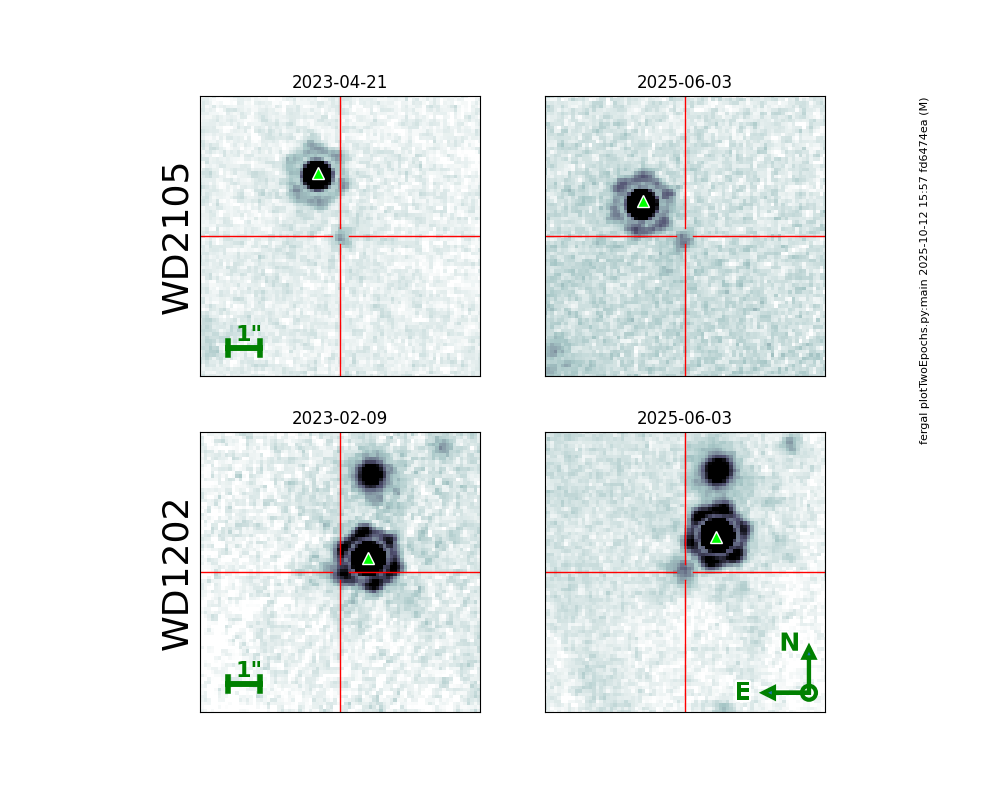
Abstract: We report on second-epoch imaging of two candidate planet-hosting white dwarfs stars, WD2105-82 and WD1202-232. Both stars showed evidence of resolved, planet-mass candidate companions in observations using the MIRI mid-infrared imager on JWST. WD2105-82 also showed evidence of an infrared excess consistent with an unresolved 1.4 Jupiter mass companion with an orbital separation of <4 au. Our second epoch observations confirm that the source of the excess shares common proper motion with the star. The excess is almost certainly due to a companion planet or debris disk. However, neither of the two resolved sources with projected separations of >1" in the first epoch of JWST observations show measurable proper motion and are thus likely faint, unresolved background galaxies. We also search for common proper motion companions out to hundreds of au, but find no evidence of widely separated companions.
Paper Prompts
Sign up for free to create and run prompts on this paper using GPT-5.
Top Community Prompts
Explain it Like I'm 14
What is this paper about?
This paper is about hunting for planets around white dwarfs using the James Webb Space Telescope (JWST). A white dwarf is the hot, dense core left behind when a Sun-like star runs out of fuel. Some white dwarfs are mysteriously “dirty” on the outside: they show heavy elements like iron and calcium in their thin atmospheres, even though gravity should quickly pull those elements down. One popular idea is that leftover planets and asteroids get stirred up and fall onto the white dwarf, sprinkling it with metals. The team used JWST’s mid-infrared camera (called MIRI) to look for planets that could be causing this.
What were the researchers trying to find out?
In simple terms, they asked:
- Are the faint, planet-like dots seen near two white dwarfs actually planets, or are they just distant background galaxies that happened to line up in the same place?
- Is the extra “heat glow” seen right on top of one white dwarf coming from a close-in planet, or something else?
- Are there any other planets far from these stars that we can spot by looking for objects that move through the sky together with the white dwarf?
How did they do it?
Think of the sky like a big photo. If you take a photo now and another one a couple of years later, nearby stars shift a tiny bit against the backdrop of very distant galaxies. That slow shift is called “proper motion.”
- The team took “first-epoch” images (their first set) with JWST/MIRI in 2023 and “second-epoch” images (their follow-up set) in 2025 of two white dwarfs, named WD 2105−82 and WD 1202−232.
- They looked at mid-infrared light (around 15 microns), which is basically heat. Planets are much cooler than stars, so they don’t shine much in visible light, but they do glow in the infrared—like seeing a warm object with a thermal camera in the dark.
- They checked whether the planet-like dots near the stars moved across the sky together with the white dwarf between the two sets of images. If a dot moves with the star, it’s likely a real companion. If it stays put while the star moves, it’s probably a faraway background galaxy.
- They also searched for any other companions much farther out by cleverly subtracting the two images to remove stationary background objects and highlight anything that shares the star’s motion.
Two useful ideas:
- “Resolved” companion: you can see a separate dot next to the star (like a firefly next to a streetlamp).
- “Unresolved” companion: you can’t see a separate dot, but the star looks slightly brighter in infrared than expected—as if a hidden warm object is adding extra glow.
What did they find?
- The two “resolved” planet candidates are not planets. In the second set of images, the white dwarfs clearly moved across the sky, but those faint dots did not. That means the dots are almost certainly distant, faint galaxies in the background.
- A close-in, “unresolved” infrared excess around WD 2105−82 is real and moves with the star. The extra heat glow appears in both 2023 and 2025 and is tied to the star’s position. This strongly suggests there is something physically associated with the white dwarf—very likely a planet about the mass of Jupiter or a dusty debris disk very close to the star. The data can’t yet tell which one it is.
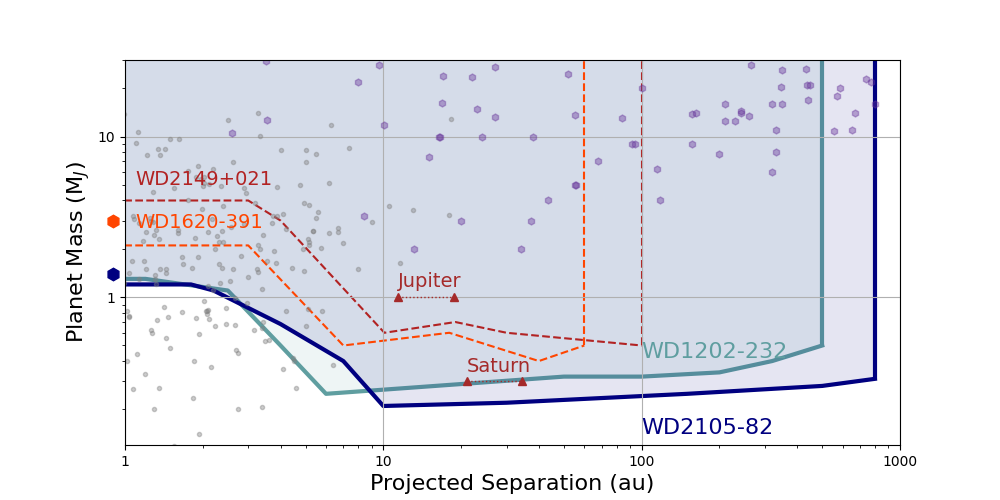
- No wide companions were found. Using the two-epoch method, they searched far from the stars and did not find any objects that share the star’s motion. Their data are sensitive enough that, at those distances, they would likely have seen planets roughly as massive as Saturn (or heavier), so this non-detection matters.
Why is this important?
- It confirms that two earlier “planet” dots were actually false alarms caused by background galaxies—a common challenge in deep space images.
- It strengthens the case that WD 2105−82 really does have a close-in companion or disk.
- It sets new, strong limits on how many big, far-out planets these two white dwarfs could have.
Why does it matter?
- Understanding “polluted” white dwarfs: If planets are stirring up asteroids and causing metals to fall onto white dwarfs, we should find planets around many of them. This study shows that big, far-out Jupiter-like planets are not showing up (at least in this small sample), suggesting they may not be the main culprits for every polluted white dwarf.
- A promising close-in case: The confirmed infrared excess at WD 2105−82 is very likely a nearby planet or a warm dust ring. With future JWST observations (especially spectroscopy, which splits light into colors to read “chemical fingerprints”), scientists can tell whether the glow comes from a planet’s atmosphere or from dust.
- Better planet hunting with JWST: The method—take images years apart and check what moves—helps separate true companions from background galaxies. The team shows that JWST/MIRI can reach sensitivities good enough to detect planets as small as Saturn at wide separations, and even Neptune-like planets in deeper, carefully planned surveys.
- Bigger picture: Finding planets around white dwarfs tells us how planetary systems survive after their stars die. It also tests whether giant planets really do drive the metal pollution we see. Early results hint that the story is more complicated—smaller planets, specific orbits, or dusty debris may play a bigger role than previously thought.
In short: Two suspected planets turned out to be background galaxies, but a close-in, real infrared glow around one white dwarf remains—and it’s likely a planet or a dusty disk. The work sharpens our tools for finding white dwarf planets and brings us closer to solving how these dead stars keep getting “re-polluted” long after their main lives have ended.
Knowledge Gaps
Knowledge gaps, limitations, and open questions
Below is a concise list of what remains missing, uncertain, or unexplored in the paper. Each item is framed to enable concrete follow-up by future researchers.
- Nature of the unresolved infrared excess at WD 2105–82 remains ambiguous (planet vs. debris disk vs. magnetic process); no spectroscopic or multi-band second-epoch data were obtained to disambiguate the origin.
- No repeat observation at 21 µm in Cycle 3; the strongest reported excess (5σ at 21 µm) has not been confirmed in a second epoch or with spectroscopy.
- The method and evidence used to claim “common proper motion” for an unresolved excess are insufficiently described; a clear astrometric procedure (e.g., centroid tracking relative to background sources across epochs) is needed to robustly demonstrate CPM for blended emission.
- Orbital parameters (semi-major axis, eccentricity, inclination) of the putative companion producing the unresolved excess are unconstrained; no kernel-phase analysis, high-contrast imaging, or astrometric wobble measurement is presented to localize the source or derive its orbit.
- Dust-disk versus planet degeneracy is unresolved; there is no modeling of plausible dust geometries, compositions, temperatures, or variability signatures that could be used to discriminate the scenarios.
- Potential magnetospheric or cyclotron-related mid-IR emission mechanisms in magnetic white dwarfs (e.g., WD 2105–82, 9.2 kG) are speculative and unmodeled; predictive spectral/temporal signatures are not developed or tested.
- Planet cooling/evolution models are extrapolated beyond the available grid (BEX, Linder 2019) to infer masses below Saturn; improved models for old, cold, sub-Saturn to Neptune-mass planets at JWST/MIRI wavelengths are needed to avoid ad hoc extrapolation.
- White dwarf mid-IR atmosphere models (used to predict photospheric flux) may be outdated/uncertain for 15–21 µm; updated WD atmospheres including mid-IR opacities and magnetic effects are needed to tighten excess-inference systematics.
- Ages and distances adopted from external sources (e.g., Debes 2025) are not propagated with uncertainties into mass/separation limits; a full posterior accounting for WD age/distance errors is missing.
- Statistical inference on planet occurrence rates is limited by a tiny, heterogeneous sample (N=4) and simplified binomial treatment; completeness curves that incorporate per-target mass–separation sensitivity, and a hierarchical model for occurrence rates, are absent.
- The widely separated companion search is constrained by variable background and dither coverage (sensitivity degrades beyond ~35–45 arcsec); completeness and false-negative rates are not quantified via PSF injection–recovery tests in the difference images.
- No quantitative assessment of contamination by co-moving field stars in the CPM search; criteria (e.g., parallax, color/Sed, morphology) to distinguish bound companions from co-moving interlopers are not applied.
- Faint, unresolved galaxy surface densities at 15–21 µm remain poorly characterized; the paper does not incorporate updated deep JWST galaxy counts to refine false-positive rates and search radii.
- Instrumental systematics (e.g., diffraction spike residuals, correlated noise, resampling kernel choices) are acknowledged but not quantified; sensitivity to pipeline parameter choices and robust mitigation strategies are not presented.
- The second-epoch observing strategy (single-band F1500W only) limits SED-based diagnostics; multi-band photometry (e.g., 5.6, 7.7, 15, 21 µm) and MIRI MRS are needed to characterize temperature and composition of candidate companions/disks.
- Reported fluxes and several quantities lack clear units and sometimes identifiers (e.g., “<4” without units, incomplete WD designations, flux units at 15 µm); this impedes reproducibility and independent verification.
- No variability analysis (intra- or inter-epoch) of the unresolved excess is conducted; variability could help distinguish a planet (stable thermal emission) from transient or evolving dust.
- Kernel Phase Imaging (KPI) is not applied to the new data, despite KPI’s sensitivity to close-in companions; KPI across both epochs could constrain sub-diffraction separations inside ~1–2 λ/D.
- Survey feasibility for a background-limited, two-epoch program sensitive to Neptune-mass planets (0.1 M_J) is asserted but not quantified; required exposure times, baselines, confusion limits, and sample sizes are not worked out.
- Synergies with other methods (pulsation timing, Gaia astrometry, transit searches, RV limits) are not integrated; a multi-technique framework to jointly constrain occurrence rates and orbits of WD companions is absent.
Practical Applications
Immediate Applications
The following items summarize practical uses that can be deployed now, based on the paper’s findings, methods, and analysis workflows.
- Two-epoch common proper motion vetting for JWST/MIRI planet candidates (Academia: astronomy/exoplanets)
- Potential tools/products/workflows: A standardized two-epoch imaging protocol with motion-differenced vetting to rule out background galaxies, using the calwebb pipeline settings described and affine alignment plus A–B/B–A differencing.
- Assumptions/dependencies: Sufficient time baseline (≥1–2 years), measurable stellar proper motion (ideally multi-pixel shifts across epochs), stable instrument calibration, accurate WD positions.
- Wide-separation companion search via motion-differenced coadds (Academia: astronomy/exoplanets)
- Potential tools/products/workflows: Affine alignment of epochs, differencing to remove stationary sources, and coaddition after shifting by the WD’s measured proper motion to enhance signals of co-moving companions out to hundreds of arcseconds.
- Assumptions/dependencies: High proper-motion targets; two epochs with similar sensitivity and PSF; robust handling of diffraction spikes and residuals.
- Infrared-excess confirmation and triage workflow (Academia: astronomy/exoplanets)
- Potential tools/products/workflows: Consistent multi-epoch photometry with WD atmosphere fits to confirm statistically significant excesses; immediate planning of MIRI Medium Resolution Spectroscopy (MRS) to distinguish planet versus dust disk.
- Assumptions/dependencies: Reliable flux calibration (≈2%), valid WD atmosphere models, awareness that SED degeneracy (planet vs dust vs magnetic effects) requires spectroscopy.
- JWST/MIRI pipeline parameterization template for imaging analyses (Software/Space operations)
- Potential tools/products/workflows: A reproducible recipe using calwebb_detector1 (e.g., rejection_threshold=5, find_showers=False), calwebb_image2 defaults, and calwebb_image3 (kernel='square', weight_type='exptime', tuned outlier scales), plus median sky subtraction before resampling.
- Assumptions/dependencies: Pipeline v1.18.0, CRDS jwst_1364.pmap (or matched contexts), validation of settings against current JWST pipeline defaults and instrument best practices.
- Background-limited sensitivity optimization via dither strategy (Space operations/Instrumentation)
- Potential tools/products/workflows: Adopt higher dither-count patterns with fewer integrations per dither to maintain or improve background noise performance, as demonstrated by similar background despite shorter exposure time in the second epoch.
- Assumptions/dependencies: Field coverage and dither geometry, operational overheads, PSF stability; optimal strategy may vary by target and sky background.
- Detection limit estimation by concentric-aperture statistics (Academia: astronomy/exoplanets)
- Potential tools/products/workflows: Use 65% encircled-energy apertures in concentric rings, MAD-based outlier filtering, and 5σ thresholds to derive flux limits and translate them to mass limits via BEX models (with caution for extrapolation).
- Assumptions/dependencies: Accurate encircled-energy curves for filters, reliable background characterization, appropriate planetary flux models and WD ages/distances.
- Occurrence-rate constraints from null detections (Academia/Policy: survey design)
- Potential tools/products/workflows: Apply binomial statistics to null detections (e.g., 2σ upper bounds on occurrence rates) to inform survey targeting and theoretical expectations for WD system architectures.
- Assumptions/dependencies: Small-sample caveats; well-characterized completeness across mass–separation space.
- False-positive mitigation guidelines for direct imaging (Policy/Academia)
- Potential tools/products/workflows: Community-facing guidance that direct-imaging claims near WDs should include two-epoch common-proper-motion confirmation, with explicit treatment of unresolved background galaxies in the mid-IR.
- Assumptions/dependencies: Editorial and facility policy adoption; availability of follow-up time; clear reporting of surface density of faint galaxies and false-positive rates.
- Reproducible research and data stewardship practices (Policy/Data management)
- Potential tools/products/workflows: DOI-backed data citations (MAST), explicit pipeline contexts and parameter logs, and shared analysis notebooks (e.g., Numpy/Astropy/Matplotlib/Jdaviz) to ensure repeatable results.
- Assumptions/dependencies: Sustained archive support; versioning of pipelines and contexts; team buy-in on documentation.
- Education and outreach modules on proper motion and vetting (Education/Daily life)
- Potential tools/products/workflows: Classroom activities or citizen-science lessons using the paper’s two-epoch images to illustrate proper motion, background confusion, and rigorous follow-up in exoplanet discovery.
- Assumptions/dependencies: Open access to images, age-appropriate materials, educator support.
Long-Term Applications
The following items describe applications that will benefit from further research, scaling, or development before broad deployment.
- Background-floor JWST/MIRI survey of DAZ white dwarfs (Academia: astronomy/exoplanets)
- Potential tools/products/workflows: A multi-epoch program designed to reach MIRI’s background limit and detect Neptune-mass planets, with MRS follow-up to classify excesses; resulting WD exoplanet catalog and demographics.
- Assumptions/dependencies: JWST time allocation; robust target selection; improved models of cold planet spectra; two-epoch scheduling; community data analysis infrastructure.
- Standardization of two-epoch confirmation in mid-IR exoplanet imaging (Policy/Space operations)
- Potential tools/products/workflows: Best-practices documents and publication standards requiring motion-confirmation to authenticate direct-imaging detections near compact stars.
- Assumptions/dependencies: Coordination among observatories, journals, and funding agencies; training and tooling support.
- Improved models of faint mid-IR galaxy counts and SEDs (Academia: extragalactic/astronomy)
- Potential tools/products/workflows: Deeper MIRI fields to constrain surface densities and colors of faint, unresolved galaxies at 15–21 μm for better false-positive rates and survey completeness estimates.
- Assumptions/dependencies: Availability of ultra-deep JWST programs; cross-calibration with existing extragalactic surveys; robust source classification pipelines.
- Spectral libraries and retrieval tools for 100–300 K exoplanets (Academia/Software)
- Potential tools/products/workflows: Atmospheric models and MRS spectral templates for very cold giants; retrieval frameworks to distinguish planets from dust disks and other phenomena around WDs.
- Assumptions/dependencies: Laboratory opacity data at mid-IR; validated radiative-transfer codes; benchmark observations (e.g., WD 1856+534 b).
- Machine learning classifiers for planet–galaxy discrimination in MIRI data (Software/Data science)
- Potential tools/products/workflows: Training on labeled archival JWST datasets to build robust mid-IR classifiers using morphology, SEDs, and motion cues; deployment as analysis plugins.
- Assumptions/dependencies: Adequate training sets with ground truth; generalization across fields and observing modes; interpretability for scientific use.
- Pipeline modules for automated CPM vetting and sensitivity reporting (Software/Space operations)
- Potential tools/products/workflows: Extensions to the JWST pipeline (or affiliated tools) that automate alignment, differencing, motion coadds, and ring-based sensitivity metrics, producing companion-search summary reports.
- Assumptions/dependencies: Pipeline governance and acceptance; thorough validation; maintainability across versions and instruments.
- Refined WD pollution models informed by occurrence limits (Academia: planetary dynamics)
- Potential tools/products/workflows: Dynamical simulations constraining the role of giant planets versus smaller perturbers (down to lunar masses) in driving DAZ accretion, updated with empirical limits from mid-IR surveys.
- Assumptions/dependencies: Larger samples and tighter limits; coupling to asteroid belt architectures; improved post-main-sequence evolution models.
- Cross-instrument transfer of methods to ELT-class imagers (Academia/Instrumentation)
- Potential tools/products/workflows: Adaptation of motion-differenced imaging, kernel-phase techniques, and sensitivity estimation to ground-based mid-IR systems (e.g., MICADO/ERIS) for cold planet searches around compact stars.
- Assumptions/dependencies: ELT commissioning status; PSF knowledge and stability; atmospheric backgrounds and calibration strategies.
- Citizen-science CPM discovery programs in JWST archives (Education/Crowdsourcing)
- Potential tools/products/workflows: Public platforms to inspect two-epoch JWST images, identify CPM candidates, and flag diffraction residuals—supporting large-scale vetting.
- Assumptions/dependencies: Platform development; expert oversight; clear labeling and feedback loops to research teams.
- Mission concepts targeting cold exoplanets around compact stars (Space policy/Industry)
- Potential tools/products/workflows: Roadmaps for next-generation mid-IR observatories with enhanced sensitivity to 0.1–1 M_J at tens of AU around WDs (e.g., cryogenic telescopes, advanced detectors).
- Assumptions/dependencies: Funding, technology maturation (detectors, cryogenics), community prioritization in decadal surveys.
- Time-allocation guidelines that prioritize multi-epoch direct-imaging surveys (Policy)
- Potential tools/products/workflows: TAC criteria that recognize the critical role of second epochs for wide-separation completeness and false-positive suppression.
- Assumptions/dependencies: Facility scheduling constraints; balanced portfolio across programs; demonstrable gains in scientific reliability.
Glossary
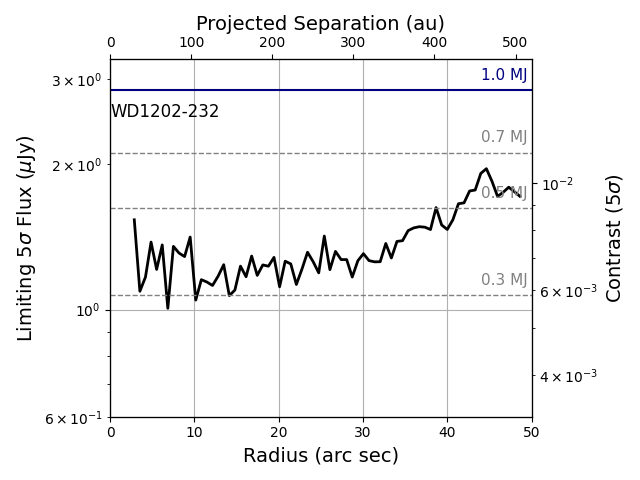
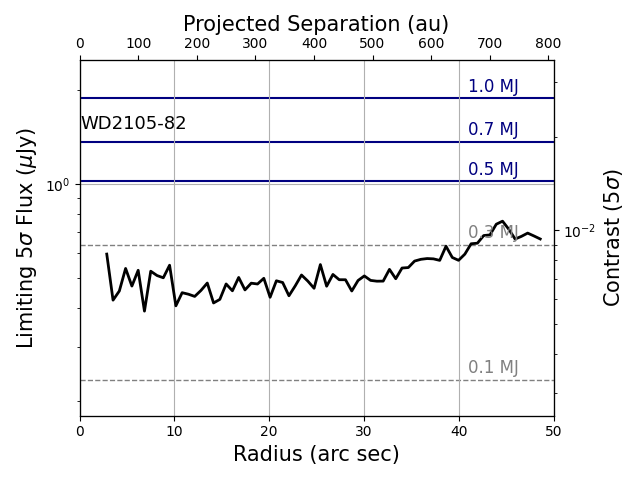
- 5σ detection limit: A sensitivity threshold corresponding to five standard deviations above the background noise, used to claim robust detections. "5 detection limits for resolved companions around WD\ in units of limiting flux and contrast."
- Absolute flux calibration uncertainty: The systematic uncertainty in converting instrument counts to physical flux units. "Assuming an absolute flux calibration uncertainty of 2\%"
- Adiabatic outward migration: The expansion of planetary orbits due to stellar mass loss occurring slowly enough to preserve orbital adiabatic invariants. "after adiabatic outward migration of WD\ (expansion factor of 2.2, the left triangle) and WD\ (expansion factor of 3.6, right triangle)"
- Affine transformation: A geometric transformation (translation, rotation, scaling, shearing) used to map one image coordinate system to another. "we calculate an affine transformation to align the first epoch to the coordinates of the second epoch."
- Background floor: The limiting sensitivity set by sky and instrument background, beyond which deeper exposures do not improve detectability. "observe a population of DAZs to MIRI's background floor."
- BEX models: Planet atmosphere/evolutionary models used to convert flux limits into mass limits. "We used the BEX models \citep{Linder19} to convert our 5 detection limits into limiting masses."
- Common proper motion: The shared apparent motion of two objects across the sky, indicating they are physically associated. "confirm that the source of the excess shares common proper motion with the star,"
- Contrast ratio: The brightness ratio between a host star and a companion at a given wavelength. "The contrast ratio between a \,K WD and a Jovian mass planet at 300\,K is only at mid-infrared wavelengths ($15-20$)."
- Coronagraph: An optical device that blocks starlight to enable direct imaging of nearby faint companions. "Jovian companions to WDs at moderate orbital separations () can be directly detected by JWST with MIRI photometry without using the coronagraph."
- Cosmic ray shower: A burst of high-energy particles hitting the detector, producing spurious signals that must be identified and removed. "in order to skip cosmic ray shower finding."
- CRDS context: The Calibration Reference Data System configuration tag that specifies which calibration files the pipeline uses. "with the CRDS context of jwst_1364.pmap."
- DA spectral class: White dwarfs with hydrogen-dominated atmospheres. "hydrogen-atmosphere WDs (the DA spectral class) show metal-lines in their spectra"
- DAZ subclass: DA white dwarfs whose spectra show metal lines, indicating ongoing or recent accretion of heavy elements. "forming the DAZ subclass"
- Dither positions: Small, intentional offsets in telescope pointing used to improve image sampling and mitigate detector artifacts. "There were 19 dither positions, with 70 groups and two integrations at each dither position, taken with the FASTR1 mode."
- Encircled energy: The fraction of a point source’s total light contained within a specified aperture radius. "3.55\,pixel radius apertures (65\% encircled energy)"
- F1500W filter: The JWST/MIRI wide filter centered at 15 µm used for imaging. "WD\ was observed with the F1500W filter on MIRI."
- FASTR1 mode: A JWST/MIRI detector readout pattern optimized for rapid imaging. "taken with the FASTR1 mode."
- Kernel Phase Imaging: A high-resolution imaging technique that uses linear combinations of Fourier phases to detect close companions beyond the classical diffraction limit. "using the Kernel Phase Imaging search of \citet{Debes25}"
- Median absolute deviation: A robust statistic for measuring variability, less sensitive to outliers than standard deviation. "after removing values with a median absolute deviation more than 5"
- Micro-lensing: Brightness variations caused by gravitational lensing from a compact mass passing near the line of sight. "Two separate micro-lensing events from distant, undetected sources that are presumed to be WD stars have also been reported"
- Mid-Infrared Instrument (MIRI): JWST’s instrument for imaging and spectroscopy in the mid-infrared. "using JWST's Mid-Infrared Instrument (MIRI); at 200\,K, it is the coldest exoplanet with observed thermal emission."
- Proper motion: The apparent angular motion of a star across the sky due to its velocity relative to the Sun. "The WDs, marked with a green triangle in each image, show significant proper motion relative to the candidates"
- Pulsation timing technique: A method that detects planets via periodic variations in a star’s pulsation arrival times caused by orbital motion. "using the pulsation timing technique"
- Roche limit: The critical distance from a massive body within which tidal forces can disrupt orbiting objects. "When these bodies pass inside the star's Roche limit they disintegrate into a cloud of dust and gas,"
- Solar metallicity: A chemical composition with heavy-element abundance comparable to the Sun’s. "We assumed solar metalicity"
- Spectral energy distribution: The distribution of an object’s flux as a function of wavelength or frequency. "with the right brightness and spectral energy distribution"
Collections
Sign up for free to add this paper to one or more collections.

