On vertex-minimal simplicial maps to the sphere
Abstract: For positive integers , let be the minimal number of vertices of a triangulation of -sphere which admits a degree simplicial map to the boundary of -simplex. We show that for any , disproving O. Musin's conjecture. Using similar idea, for any we construct a triangulation of , , for which $\frac{f_j}{f_i}>C$, for any $0\le i<j\le n$ such that $i<\lfloor\frac{n-1}2\rfloor$. All triangulations we obtain are isomorphic to boundaries of convex polytopes in .
Paper Prompts
Sign up for free to create and run prompts on this paper.
Top Community Prompts
Explain it Like I'm 14
What this paper is about (big picture)
This paper studies how simply you can “build” a sphere out of basic pieces (like higher‑dimensional triangles) and still have a map from that sphere to a standard sphere that “wraps” around it a certain number of times. The main surprise: in three or more dimensions, you can get maps that wrap around many times while using surprisingly few corner points (vertices). This overturns a recent guess (a conjecture) about how many vertices you would need.
The main questions, in simple terms
- Imagine you cut a sphere into little flat pieces (triangles in 2D, tetrahedra in 3D, and so on). That’s called a triangulation. The number of corner points you use is the number of vertices.
- A “degree d” map from one sphere to another means the first sphere wraps around the second one d times (counting direction). Think of shrinking and stretching rubber without tearing or gluing.
- The key question: If you want a triangulated n‑dimensional sphere that wraps d times around the standard n‑sphere using a “piecewise straight” (simplicial) map, how few vertices do you need? Call this minimum number λ(n, d).
The paper proves that for every dimension n ≥ 3, the number of vertices you need per wrap goes to zero as d grows. In math form: λ(n, d)/d → 0 as d → ∞. That means high‑degree wrapping does not force you to use lots of vertices.
The authors also ask a second question: Can we make triangulations where the number of higher‑dimensional pieces (like tetrahedra) is much, much larger than the number of lower‑dimensional pieces (like edges), by any factor we want? They show the answer is yes in many cases.
Key ideas and methods (with plain-language explanations)
First, a few simple translations:
- Triangulation: Cutting a shape into simple building blocks—points (0D), line segments (1D), triangles (2D), tetrahedra (3D), etc. These are called simplices.
- Simplicial map: A map that sends vertices to vertices and respects the simplices (so faces map to faces). Think of a “LEGO-legal” way to send one construction to another without breaking how pieces fit.
- Degree of a map: How many times one sphere covers another under the map, counting direction. Like how many times a rubber band loop wraps around a pole.
The paper relies on three construction tricks:
- Join operation: If you have one triangulated sphere A and another B, their join A ⋆ B is a higher‑dimensional sphere formed by “connecting every point of A to every point of B.” For simplices, this creates many combined pieces. Importantly, the number of top‑dimensional simplices multiplies, and the dimension adds.
- Degree multiplies under join: If you have maps f: A → A′ and g: B → B′ of certain degrees, then the joined map f ⋆ g: A ⋆ B → A′ ⋆ B′ has degree equal to (degree of f) × (degree of g). This lets you build high‑degree maps by combining simpler ones.
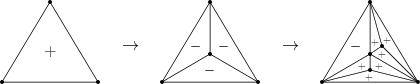
- Local “degree booster” (central subdivision): You can take one simplex, insert a new vertex in its center, and split it into smaller pieces. With a careful assignment of orientations, this can raise the map’s degree by 1 while adding only a constant number of new vertices. Doing this repeatedly lets you adjust the degree one step at a time without blowing up the vertex count.
Using these, the authors:
- Build 3D examples where the degree d can be factored as k1·k2, and the needed vertices are at most about 3k1 + 3k2.
- Extend this idea to all n ≥ 3 by adding extra joins with simple spheres, leading to bounds like λ(n, k1·k2) ≤ 3k1 + 3k2 + (n − 2).
- Choose k1 = k2 = k so d = k² and get λ(n, d) ≤ 6k + (n − 2), so λ(n, d)/d ≤ (6k + n − 2)/k² → 0.
- Tweak any nearby degree by +1 steps using the central subdivision trick, with only a small extra vertex cost per step.
They also construct triangulations with very unbalanced “f-vectors” (counts of simplices of each dimension). By taking the join of several copies of a big cycle (a k‑gon, which is a triangulated circle), they make higher‑dimensional faces grow much faster than lower‑dimensional ones, so the ratio f_j/f_i can be made larger than any chosen number C, for many pairs i < j.
What they found and why it matters
Main results:
- For all n ≥ 3, the ratio λ(n, d)/d goes to 0 as d → ∞. In words: You can get maps that wrap around the sphere many times while using very few vertices per wrap.
- This disproves a recent conjecture that predicted λ(n, d)/d would tend to a positive constant (specifically (n + 2)/n).
- They also show that, for any chosen factor C, there exist triangulations of Sn where the number of higher‑dimensional pieces dwarfs the number of lower‑dimensional pieces by more than C, for many index pairs (i, j). This shows how extreme triangulations can be in higher dimensions.
- All their triangulations can be chosen to be “polytopal”: they come from the boundaries of convex polytopes. That means the constructions are not just topological tricks—they fit nicely in ordinary Euclidean space.
Why it’s important:
- It reveals an unexpected gap between “how complicated the map is” (degree d) and “how many vertices you need” to support it. In higher dimensions, you can achieve large degrees very economically.
- It gives concrete building methods (joins and local subdivisions) that might be useful in other problems about mapping and triangulating manifolds.
- The extreme f‑vector examples show that the combinatorial shape of high‑dimensional spheres can be wildly unbalanced, which informs both discrete geometry and topology.
Broader impact and open directions
This work reshapes expectations about the “cost” (in vertices) of high‑degree maps between triangulated spheres in dimensions 3 and higher. It suggests new strategies for designing efficient triangulations that support complex mappings.
The paper ends with open questions, including:
- Even though λ(n, d)/d → 0, how fast can it go to 0? Can we pin down tighter bounds?
- What happens if we only allow maps that never “flatten” top‑dimensional pieces (i.e., no degenerate simplices) or that keep all simplices orientation‑preserving? Do the same estimates still hold?
These questions invite sharper understanding of the trade‑offs between combinatorial simplicity (few vertices) and topological complexity (high degree).
Knowledge Gaps
Knowledge gaps, limitations, and open questions
Below is a concise list of what the paper leaves unresolved or insufficiently explored. Each item is stated to be actionable for future research.
- Exact values of λ(n, d) for n ≥ 3:
- The paper shows λ(n, d)/d → 0 but does not determine λ(n, d) exactly for any n ≥ 3 and specific d. Compute λ(3, d), λ(4, d), etc., for small and moderate d, and develop methods to prove exact minimality.
- Tight asymptotics for λ(n, d):
- The proof yields λ(n, d) = O(√d) via two-factor joins, and a remark suggests (but does not formalize) a stronger bound from h-fold joins (with h = ⌊(n + 1)/2⌋), implying λ(n, d) = O(d{1/h}). Derive and rigorously prove sharp upper bounds with explicit constants c(n), and establish nontrivial lower bounds to determine whether λ(n, d) = Θ(d{1/h}) holds for n ≥ 3.
- Lower bounds beyond the trivial n + 2:
- The paper provides no d-dependent lower bounds for λ(n, d) when n ≥ 3. Develop topological or combinatorial techniques to prove λ(n, d) ≥ g(n, d) for some function g(n, d) that grows with d (e.g., polylogarithmic or polynomial), and test optimality against the join-based constructions.
- Incremental “degree-by-one” cost:
- Proposition λ(n, d + 1) ≤ λ(n, d) + 3 uses central subdivisions to adjust degree at a cost of +3 vertices. Determine whether this +3 is optimal in dimension n ≥ 3, or if +1 or +2 is achievable; conversely, prove any necessary lower bound per unit degree increase.
- Nondegenerate and positive-only simplicial maps:
- The constructions allow degenerate images (some n-simplices collapse) and mixed orientation. Determine asymptotic behavior and exact values of λ(n, d) under constraints such as “no n-simplex degenerates” and/or “all mapped n-simplices are orientation-preserving.” Is λ(n, d)/d still → 0 under these restrictions, or does it have a positive limit?
- Dependence on the target triangulation:
- λ(n, d) is defined with the target fixed to the boundary of an (n + 1)-simplex Sn_{n+2}. Investigate how λ(n, d) changes if maps are allowed to general triangulations of Sn. Is λ(n, d) invariant up to constant factors across all polytopal triangulations of Sn, or does the choice of target affect the minimal vertex count significantly?
- Formalization of degree counting with degenerations:
- The degree is counted via nondegenerate preimages, but the paper does not rigorously prove independence of the count from the chosen target n-simplex τ when degenerations are present. Provide a formal proof or conditions ensuring the degree is well-defined under simplicial maps with degenerate n-simplices.
- Orientation conventions and multiplicativity under joins:
- Proposition “deg(f ⋆ g) = deg f * deg g” relies on join orientations and sign multiplication. Supply a complete, reference-backed argument fixing orientation conventions and verifying sign consistency for arbitrary numbers of join factors.
- Strengthening the general join-based bound:
- The final remark hints at using h-fold joins of S1 to obtain improved asymptotics but contains a malformed formula. Make precise and prove the general construction: for h = ⌊(n + 1)/2⌋, show λ(n, d) ≤ c(n) d{1/h} with explicit c(n), and quantify how even/odd n affects constants via an additional S0 join.
- f-vector growth: exact counts and broader index ranges:
- Theorem on f-vectors gives big-O growth and covers j/i ratios only when i < ⌊(n − 1)/2⌋. Derive exact formulas for f_i of h-fold joins of cycles (including constants), and determine whether arbitrarily large ratios f_j/f_i can be achieved when i ≥ ⌊(n − 1)/2⌋, subject to Dehn–Sommerville and g-theorem constraints for polytopal spheres.
- Polytopality and realization details:
- The paper claims the constructed triangulations are boundaries of convex polytopes via cone-and-join arguments. Provide a rigorous proof (or standard references) that:
- Joins of polytopal boundaries are polytopal spheres in the appropriate ambient space.
- The “cone over S at the origin equals conv(S)” and has boundary exactly S under the stated hypotheses.
- The multi-join and central-subdivision steps preserve polytopality and yield realizations in ℝ{n+1}.
- Dimension-dependent constants:
- Corollary adds an (n − 2) term in λ(n, k₁k₂) ≤ 3k₁ + 3k₂ + (n − 2). Investigate whether this additive overhead can be reduced to an n-independent constant, or if an inherent dimension-dependent overhead is necessary.
- Exact structure in the n = 3 case:
- Lemma provides λ(3, k₁k₂) ≤ 3k₁ + 3k₂, implying O(√d) upper bounds. Assess whether the constant “6” is optimal and attempt to compute exact λ(3, d) for a range of d to calibrate bounds.
- Algorithmic aspects:
- The paper does not address the computational problem of determining λ(n, d) or constructing vertex-minimal triangulations achieving a given degree. Develop algorithms, complexity analyses, and certificates of optimality for λ(n, d).
- Extension beyond spheres:
- Explore analogs of λ(M, d) for maps from triangulated closed oriented n-manifolds M to Sn (or other targets), including whether sublinear-in-d vertex bounds persist and how they depend on the topology of M.
- Clarifications and corrections needed for reproducibility:
- Several statements/formulas appear malformed or incomplete (e.g., missing ε in inequalities, the final remark’s formula, typos in macro definitions). Provide corrected statements of the main inequalities in Theorem 1’s proof, a precise version of the h-fold join bound, and a fully specified “central subdivision” degree-change argument to ensure the constructions are verifiable and reusable.
Practical Applications
Immediate Applications
The findings and constructions in the paper enable several deployable workflows and tools across computational geometry, software testing, and education. Below are specific, actionable use cases that can be implemented now.
- Computational geometry and mesh processing (software)
- Controlled-degree simplicial mapping on sphere meshes:
- Use central subdivision (Proposition d+1) to increment the degree of a simplicial map by exactly +1 while adding only three vertices each step, enabling precise, low-overhead degree tuning of mappings from a triangulated sphere to the boundary of a simplex.
- Workflow: start from a degree-d simplicial map K → Sn_{n+2}, apply the central subdivision on a positive n-simplex and its immediate refinements to adjust degree incrementally without changing the underlying manifold topology.
- Tool/product idea: a mesh library module providing “degree-controlled refinement” operations, with automatic orientation handling and degree verification.
- Assumptions/dependencies: n ≥ 3; orientation must be well-defined; simplices may be mapped with degeneracies; geometric quality (angles/aspect ratios) is not guaranteed and may need post-processing.
- Polytopal realizations for robust geometric embedding:
- All constructed triangulated spheres are isomorphic to boundaries of convex polytopes in ℝ{n+1} (Remark on polytopal realizability), making them compatible with convex-hull-based workflows and collision detection pipelines.
- Workflow: build sphere triangulations via joins of lower-dimensional polytopal boundaries; embed them canonically as ∂P ⋆ ∂Q ⊂ ℝ{k+m+2}, then realize as the boundary of the cone at the origin.
- Tool/product idea: a generator of convex-polytopal sphere meshes parameterized by f-vector targets and degree constraints, outputting data structures suitable for computational geometry packages (CGAL, Polymake).
- Assumptions/dependencies: requires polytopes with origin inside; embedding dimension grows with n; mesh quality for FEM/CFD is not addressed.
- Stress-testing and benchmarking for topological and geometric algorithms (academia/software)
- Extreme f-vector ratios on spheres (Theorem on f-vectors) allow creation of complexes with substantially more higher-dimensional faces than lower-dimensional ones, exposing algorithmic bottlenecks in homology computation, persistence, and mesh traversal.
- Workflow: generate Sn via repeated joins of S1_k (and S0 when n is even) to produce tunable f_j/f_i ratios; run TDA pipelines and measure memory/time performance on face-heavy instances.
- Product idea: a curated benchmark suite of triangulated spheres parameterized by (n, k, target ratios), with ground-truth homology and degree metadata.
- Assumptions/dependencies: n ≥ 3; geometric embedding exists but may produce skinny simplices; degeneracy of mapped n-simplices may occur.
- Educational resources (academia/education)
- Counterexample-driven instruction:
- Use the main result (lim_{d→∞} λ(n,d)/d = 0 for n ≥ 3) to teach limitations of degree-vs-complexity heuristics and illustrate how joins and degree multiplicativity produce high-degree maps with few vertices.
- Deliverables: lecture notes, interactive notebooks showing constructions of K ⋆ L, degree multiplicativity (deg(f ⋆ g) = deg f * deg g), and central subdivision effects.
- Assumptions/dependencies: requires basic background in algebraic and combinatorial topology.
- Spherical parameterization for graphics and visualization (software/media)
- Simplicial maps from Sn to the boundary of (n+1)-simplex offer simple, piecewise-linear parameterizations that can be used for texture mapping or partitioning spherical data.
- Workflow: choose low-vertex sphere meshes supporting high-degree mappings; map to simplex boundary to organize patches; apply texture or data overlays per simplex.
- Assumptions/dependencies: mappings may be non-injective or degenerate on some simplices; UV quality depends on geometric realization and may need smoothing.
Long-Term Applications
These applications are promising but will require further research, scaling, or engineering, especially regarding mesh quality, non-degeneracy, and high-dimensional practicality.
- High-dimensional simulation and FEM/CFD on spheres (engineering/software)
- Low-vertex/high-face sphere triangulations may reduce memory footprints or enable scalable assembly of operators on spherical domains, provided mesh quality constraints (angles, shape regularity) are satisfied.
- Potential product: a “degree-aware spherical mesher” integrating join constructions with shape-optimization and refinement to produce FEM-ready meshes in higher dimensions.
- Dependencies: robust geometric optimization, non-degenerate mappings, accurate numerical conditioning; extension of constructions to quality-controlled meshes.
- Topology-aware modular mapping design (software/robotics/graphics)
- Exploit degree multiplicativity under joins (deg(f ⋆ g) = deg f * deg g) to compose complex mappings from simpler components, enabling modular pipelines that guarantee global degree constraints.
- Potential workflow: build multi-stage parameterizations (sensor spheres, panoramic imaging, environment maps) by composing lower-dimensional maps.
- Dependencies: careful orientation bookkeeping; efficient data structures for large joins; ensuring non-degenerate behavior where required.
- Manifold learning and topologically constrained embeddings (data science/ML)
- Map spherical data to simplex boundaries with prescribed degrees to enforce topological constraints in classification or clustering (e.g., multi-cover labeling on spherical features).
- Potential product: a library of topologically certified embeddings offering control over covering multiplicity via degree.
- Dependencies: integration with ML pipelines; theoretical guarantees linking degree to statistical properties; handling degeneracies and continuity in data-driven settings.
- Spherical sensor design and coverage planning (robotics)
- Use degree-controlled mappings to model and optimize overlapping field-of-view partitions on spherical domains (degree representing overlap multiplicity), possibly reducing hardware complexity (vertex count) for a target coverage.
- Potential workflow: co-design sensor placement with triangulation degree targets; simulate coverage and resolve blind spots via central subdivision adjustments.
- Dependencies: mapping non-degeneracy, physical constraints of sensors, geometric calibration; bridging from combinatorial constructions to physical layouts.
- Polytopal optimization and combinatorial geometry (academia/industry)
- New families of convex polytopes arising as sphere triangulations (with extreme f-vector profiles) can inform polytope enumeration, face lattice optimization, or testing in integer programming and combinatorial optimization.
- Potential product: datasets and algorithms for extreme polytopal cases, improving solver robustness and heuristics.
- Dependencies: scalable generation in high dimensions; integration with existing solvers; careful management of combinatorial explosion.
- Standards and reproducibility in computational topology (policy/academia)
- Establish benchmark standards for triangulated spheres (with degree metadata and f-vector targets) to improve comparability of TDA and mesh algorithms across labs and systems.
- Potential outcome: community repository with documented constructions, code, and validation artifacts.
- Dependencies: community adoption; tooling for verification of degree and face counts; maintenance and governance.
Cross-cutting assumptions and dependencies
- Dimensionality constraints: most asymptotic results and constructions target n ≥ 3; n = 1, 2 behave differently and may require specialized handling.
- Map degeneracy: many applications (numerical simulation, certain visualizations) require non-degenerate mappings; the paper raises open questions about maintaining non-degeneracy and positivity of simplices.
- Mesh quality: constructions optimize combinatorial counts rather than geometric quality; practical deployments will need shape regularity, angle bounds, and conditioning improvements.
- Orientation and degree computation: reliable orientation management and degree calculation are essential for correctness; implementations must include robust verification routines.
- Embedding and scalability: joins increase embedding dimension and combinatorial size; efficient data structures and parallel generation are needed for large n or k.
Glossary
- Boundary of (n+1)-simplex: The collection of all faces of an -simplex forming an -sphere. "the boundary of -simplex."
- Boundary of a convex polytope: The simplicial complex formed by the facets (faces) of a convex polytope. "boundaries of convex polytopes in ."
- Central subdivision: Subdivision that inserts a new vertex in a simplex and replaces it by cones over its boundary. "we make a {\it central subdivision}:"
- Combinatorial triangulation: A triangulation defined purely combinatorially, satisfying the PL-manifold conditions via links of simplices. "consider only {\it combinatorial} triangulations."
- Cone (over a subcomplex): The complex obtained by joining every point of a subcomplex to a new apex. "replace by the cone over "
- Convex hull: The smallest convex set containing a given set; often denoted . "coincides with $\mathrm{conv}(S)\subsetR^{k+m+2}$"
- Convex polytope: A bounded convex polyhedron, equivalently the convex hull of finitely many points. "convex polytopes containing the origins in their interiors,"
- Degree (of a map): The integer induced by the top-dimensional homology map, counting oriented preimages of a regular value. "The {\it degree} is an integer "
- Euler's formula: The relation among counts of vertices, edges, and faces (e.g., ) used to deduce combinatorial bounds. "the lower bound for obviously follows from the Euler's formula:"
- f-vector: The sequence recording counts of simplices by dimension in a complex. "its {\it -vector} is the sequence "
- Geometric realization: The topological space obtained by gluing geometric simplices according to the combinatorics of a complex. "is called {\it the geometric realization} ."
- Homology (group): An algebraic invariant measuring -dimensional cycles modulo boundaries. "the -th homology homomorphism f_*:H_n(M;Z)=Z\toZ=H_n(N;Z)"
- Join (of simplicial complexes): An operation forming a new complex by connecting all simplices across two complexes, increasing dimension. "their {\it join} is a complex "
- Non-degenerate simplex: A simplex whose image under a map has the same dimension (is not collapsed). "non-degenerate -simplex"
- Oriented manifold: A manifold equipped with a consistent choice of orientation. "oriented -manifolds"
- PL-atlas: A collection of piecewise-linear charts endowing a PL manifold structure. "so the stars form a -atlas of~"
- Regular value: A value whose preimage consists of points where the map is locally well-behaved (e.g., differential surjective for smooth maps). "preimages of any regular value of "
- Simplicial complex: A set of vertices with a family of faces closed under taking subsets. "A {\it simplicial complex} is a set of vertices "
- Simplicial embedding: A simplicial map realized as an embedding in Euclidean space. "the star of every vertex has simplicial embedding into "
- Simplicial map: A map on vertices that sends faces to faces (and linearly on each simplex in realization). "A {\it simplicial map} of complexes is a map of the sets of vertices"
- Star (of a vertex): The union of all simplices containing a given vertex. "the star of every vertex"
- Triangulation: A simplicial complex whose realization is homeomorphic to a given space, providing a piecewise-linear structure. "a triangulation of "