Obstruction reasoning for robotic grasping
Abstract: Successful robotic grasping in cluttered environments not only requires a model to visually ground a target object but also to reason about obstructions that must be cleared beforehand. While current vision-language embodied reasoning models show emergent spatial understanding, they remain limited in terms of obstruction reasoning and accessibility planning. To bridge this gap, we present UNOGrasp, a learning-based vision-LLM capable of performing visually-grounded obstruction reasoning to infer the sequence of actions needed to unobstruct the path and grasp the target object. We devise a novel multi-step reasoning process based on obstruction paths originated by the target object. We anchor each reasoning step with obstruction-aware visual cues to incentivize reasoning capability. UNOGrasp combines supervised and reinforcement finetuning through verifiable reasoning rewards. Moreover, we construct UNOBench, a large-scale dataset for both training and benchmarking, based on MetaGraspNetV2, with over 100k obstruction paths annotated by humans with obstruction ratios, contact points, and natural-language instructions. Extensive experiments and real-robot evaluations show that UNOGrasp significantly improves obstruction reasoning and grasp success across both synthetic and real-world environments, outperforming generalist and proprietary alternatives. Project website: https://tev-fbk.github.io/UnoGrasp/.
Paper Prompts
Sign up for free to create and run prompts on this paper using GPT-5.
Top Community Prompts
Explain it Like I'm 14
Obstruction reasoning for robotic grasping — explained simply
What is this paper about?
This paper teaches robots how to pick up a specific item in a messy pile by first figuring out which other items are in the way and must be moved. The authors build:
- UNOGrasp: a vision-LLM (a computer program that understands images and text) that plans which objects to remove before grabbing the target.
- UNOBench: a large dataset and test to train and measure how well models do this “unblock-then-grab” reasoning.
In short: it’s about helping robots clean a path to the thing you want.
What questions are the researchers trying to answer?
The paper focuses on three simple questions:
- If you ask a robot, “Pick up the white iPhone box,” can it find the exact box in a cluttered scene?
- If the box is blocked, which objects are blocking it?
- In what order should the robot move those blocking objects so it can finally pick up the box?
How did they approach the problem?
Think of a cluttered bin like a pile of toys on the floor. If your favorite toy is at the bottom, you need a plan to remove the toys on top first. The authors turn this idea into tools a robot can use.
Here’s how:
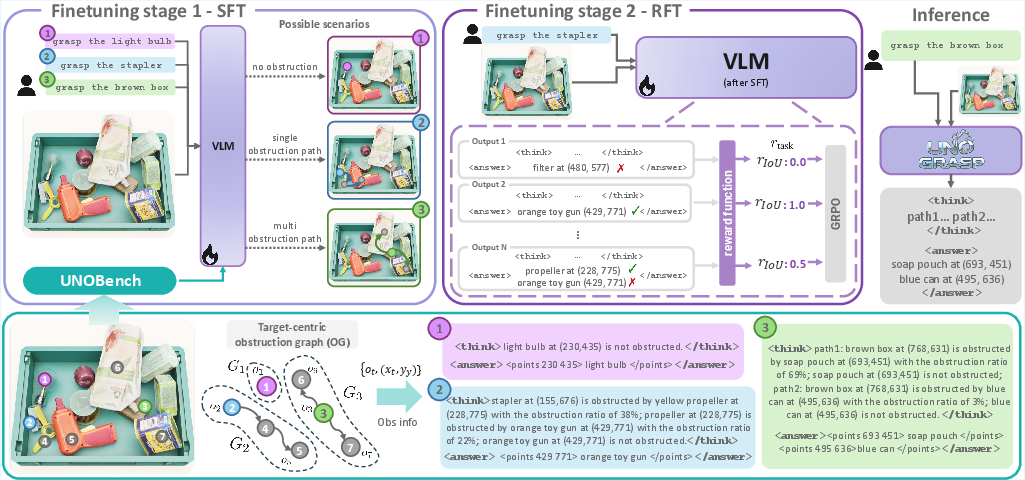
- Target-centric obstruction graph
- Imagine each object as a dot (a “node”), and draw an arrow from the blocked object to the object blocking it. These arrows form paths from the target up to the items on top that you can grab right away.
- The important set is the “top-level obstructors”: the items at the end of those paths that are not blocked by anything else. Remove those first to make progress.
- This is like making a mini to-do list starting from the target and working upward through blockers.
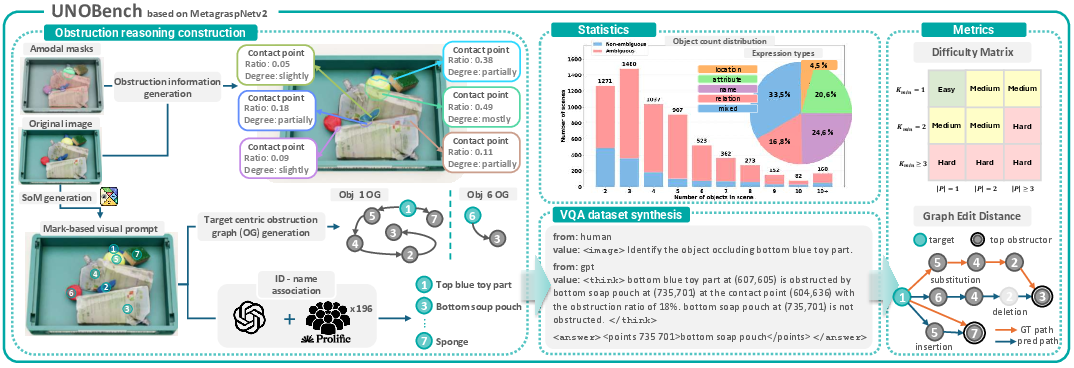
- UNOBench dataset (what the robot learns from)
- Built on a big 3D grasping dataset, it adds:
- Names for objects (like “blue can,” “brown box”) written by humans.
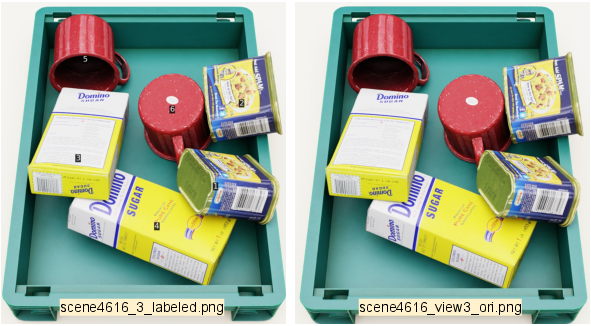
- Numbers painted on each object in the image (called Set-of-Marks, like jersey numbers) so the model can refer to the right item without confusion.
- Details about blockage: how much one object covers another (obstruction ratio), where they touch (contact points), and step-by-step “unblocking paths.”
- Two ways to test models:
- Oracle (with numbers): the model gets the numbered IDs, so the task is pure reasoning.
- Natural language: the model must understand a normal sentence (like “grab the white box on the left”), find the object, and plan how to unblock it.
- Training UNOGrasp (how the model learns)
- Step 1 — Supervised fine-tuning (SFT): show the model many examples with “think” steps (its reasoning) and an “answer” (the final list of blockers to remove). The examples include names and coordinates to anchor its thinking to real pixels.
- Step 2 — Reinforcement fine-tuning (RFT): reward the model when its final blocker list matches the correct one. The reward is “soft”: even partial matches earn points, which helps the model improve smoothly. The model is also rewarded for formatting its reasoning clearly.
- Measuring success
- Final answer accuracy (did it choose the correct blockers?).
- Reasoning quality (does its step-by-step plan match the true plan?).
- A path similarity score (MP_NED) that says how close the model’s plan is to the correct plan; lower is better. You can think of it like “how many edits would you need to fix the plan?”
What did they find, and why does it matter?
- UNOGrasp outperformed strong general-purpose models (including a proprietary robotics model and an open-source one) on both synthetic images and real scenes.
- It worked especially well on harder cases (deeply buried targets or multiple valid unblocking paths).
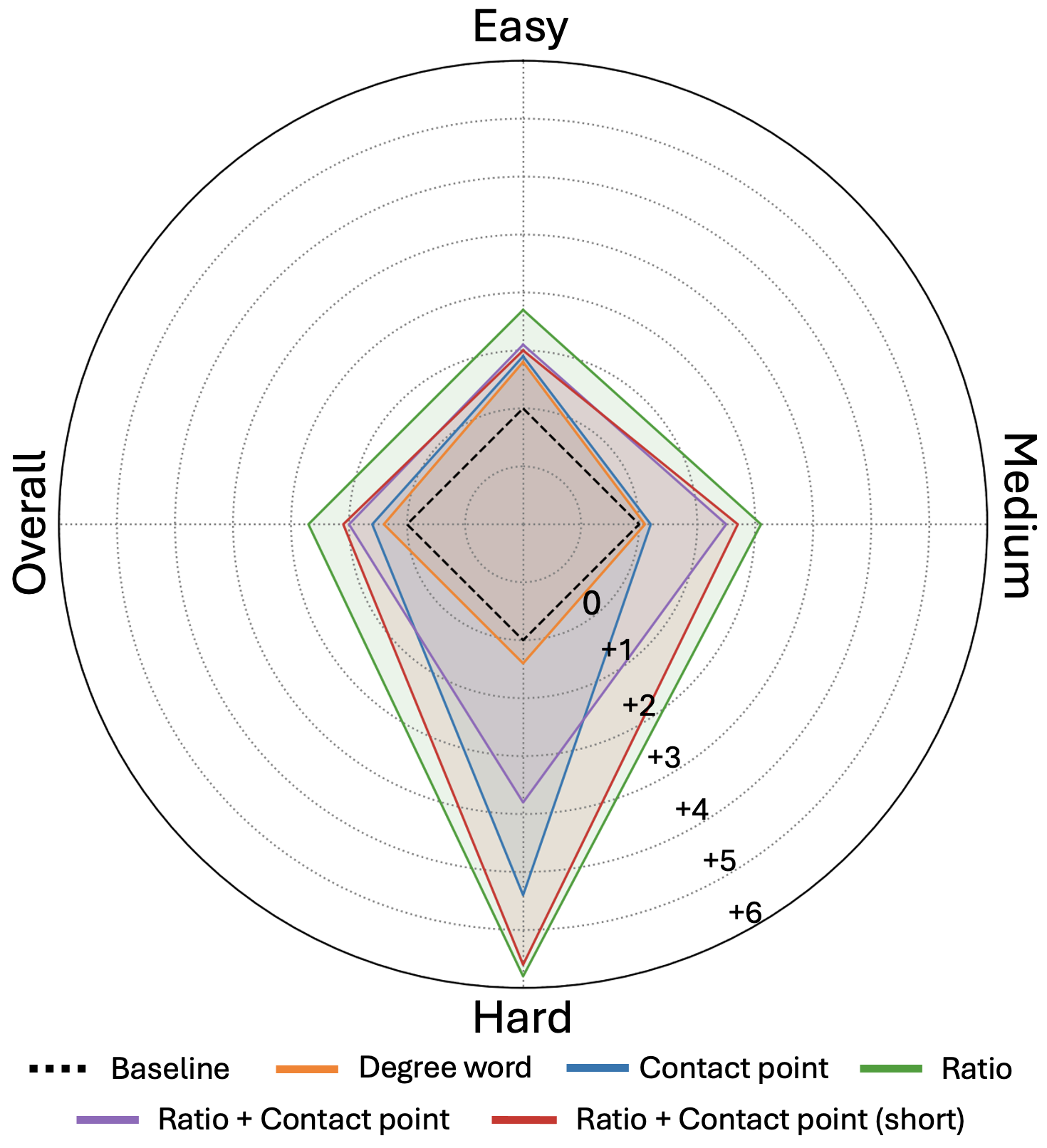
- Adding “obstruction-aware” details during training (like how much one object covers another) made the model noticeably better.
- The reinforcement step with the “soft” reward improved results further, especially in tough scenes.
- Real robot tests in the lab showed UNOGrasp planned better removal sequences, leading to more successful grasps.
Why it matters: In real life, objects aren’t neatly laid out. A robot that can plan how to clear a path is more reliable in homes, factories, warehouses, and hospitals.
What could this change in the real world?
- More helpful home robots: clearing dishes from a sink or finding a specific item in a drawer without knocking everything over.
- Smarter warehouse picking: grabbing the right product even when it’s covered by others.
- Safer, more efficient automation: fewer failed grasps and less trial-and-error.
The authors also release the dataset, code, and model so others can build on their work, which can speed up progress in robot planning and manipulation.
Helpful terms in plain language
- Vision-LLM (VLM): A model that looks at images and reads text, then links the two (e.g., “the white box on the left” in a photo).
- Obstruction: When one object physically blocks another from being grabbed.
- Target-centric obstruction graph: A map that starts at the target and traces which objects are blocking it, ending at the items you can remove first.
- Top-level obstructors: The blockers on top that are immediately removable.
- Supervised fine-tuning (SFT): Learning by example.
- Reinforcement fine-tuning (RFT): Learning by reward (do better, get points).
- MP_NED: A score of how similar your plan is to the correct plan (lower is better).
In one sentence: This paper gives robots a practical “unblocking plan” so they can grab the right thing in a messy scene, and proves the approach works in both simulated and real tests.
Knowledge Gaps
Knowledge gaps, limitations, and open questions
Below is a concise list of what remains missing, uncertain, or unexplored in the paper. Each point is framed to be directly actionable for future research.
- Viewpoint dependence of obstruction: Obstruction edges are defined “when viewed from the camera,” yet robot approach direction may differ; develop multi-view or 3D obstruction graphs that align with motion planning and end-effector approach vectors.
- Single-view RGB-centric reasoning: Depth is only used for grasp point estimation, not for obstruction reasoning; investigate using RGB-D or 3D reconstructions (amodal volumetrics) to reason about occlusion chains and hidden geometry.
- Obstruction severity and cost models: The paper explicitly excludes quantifying how different obstructions impede grasping; design measurable severity/cost functions (e.g., visibility gain per removal, stability risk, expected time) to guide removal order and trade-offs.
- Closed-loop, dynamic replanning: Reasoning is evaluated as a static multi-step chain; study online replanning as objects shift, are removed, or unexpectedly move, including active perception actions (e.g., camera repositioning).
- Integration with kinematics and reachability: UNOGrasp outputs a set of top-level obstructors without considering robot kinematics, reachability, and collision constraints; jointly optimize obstruction reasoning with motion planning and grasp feasibility.
- Target invisibility handling: The method “uses contextual cues” when targets are not visible, but lacks a formalized strategy or evaluation; benchmark and improve inference when the target is fully occluded or off-FOV.
- Segmentation dependency and amodal gap: UNOBench relies on amodal masks to compute obstruction ratios/contact points, while real deployments use visible segmentation (e.g., GroundedSAM); quantify sensitivity to segmentation errors and develop amodal inference from noisy, partial observations.
- Multi-view and active perception: Scenes are primarily top-down single-view; explore multi-camera setups, view planning, and active sensing to reduce occlusion uncertainty and improve grounding.
- Physics and stability modeling: Reasoning ignores object properties (mass, fragility, deformability) and stability of stacks; integrate physics-informed models to avoid unsafe removals (e.g., cascading collapses) and plan safe manipulation.
- Order selection within top-level obstructors: UNOGrasp returns a set of accessible obstructors but not an optimal removal order; develop policies that choose the next object based on predicted benefit, risk, and success likelihood.
- Handling cycles and mutual obstructions: The target-centric graph assumes directed acyclic paths; investigate detection and resolution of viewpoint-induced cycles or mutual obstructions and their impact on planning.
- Metric limitations: MP_NED measures structural edit distance but not coordinate/pose accuracy, spatial grounding fidelity, or physical optimality; add metrics for coordinate correctness, grounding calibration, and removal cost-efficiency.
- Reward shaping in RFT: RFT uses only format and final-set IoU rewards; evaluate path-level rewards (e.g., MP_NED-based), grounding accuracy rewards (coordinate IoU), and anti-hallucination penalties to improve process fidelity.
- Generalization beyond bin picking: UNOBench focuses on cluttered bins; assess transfer to shelves, drawers, tabletops, assembly tasks, and mobile manipulation with diverse access directions.
- Real-world dataset scale and diversity: The real split (520 scenes; 1 view/scene) and lab tests (30 scenarios) are limited; expand real-world data with varied lighting, backgrounds, materials (transparent/reflective), and deformable items.
- Language grounding breadth: Object descriptions are mostly names refined by annotators; test robustness to ambiguous, noisy, or relational instructions (e.g., “grab the second mug left of the blue box”) and across languages.
- Identity confusion and lookalikes: Failures with visually similar items and dense clusters are noted; incorporate instance-level tracking, fine-grained recognition, and uncertainty calibration to reduce misidentification.
- Domain gap analysis: Systematic study of synthetic-to-real transfer is missing; quantify and mitigate domain shift (appearance, occlusion patterns, segmentation quality) via adaptation or domain randomization.
- Efficiency and latency on-robot: Inference time, compute load, and memory footprint (especially with > traces) are not reported; characterize and optimize for real-time deployment on embedded systems.
Safety and ethical considerations: No analysis of collateral damage, object safety (fragility), or human co-presence; formalize safety constraints, failure recovery policies, and risk-aware planning.
- Baseline coverage: Comparisons include a proprietary generalist and an open-source VLM but omit specialized obstruction planners/detection-based methods; include physics- or graph-based baselines to isolate benefits of language-grounded reasoning.
- Hidden target evaluation protocol: Create dedicated splits where the target is fully occluded to rigorously assess inference under occlusion, and measure confidence calibration for such cases.
- Robust obstruction quantification: Obstruction ratios and contact points are computed from ground-truth amodal masks; investigate learning to predict these cues from raw inputs and quantify their estimation uncertainty.
- Explicit structured internal representations: The model outputs text-based chains but lacks an explicit internal graph module; explore latent graph construction, differentiable scene graphs, or neuro-symbolic structures for more reliable multi-step reasoning.
- Post-removal state estimation: After each removal, obstruction graphs may change; implement and evaluate state updates and graph recomputation to maintain accurate plans throughout execution.
- Multi-object interaction effects: Removing an object can alter stability or occlude/unocclude others; simulate and learn these interaction effects to anticipate downstream changes in the obstruction graph.
- Cross-lingual and multi-modal prompts: Current annotations are in English; evaluate multilingual grounding and multimodal prompting (speech, pointing, laser marks) for more natural HRI.
- Calibration and uncertainty reporting: Predictions lack confidence estimates; add calibrated probabilities over obstruction sets and paths to inform robust action selection and human oversight.
Practical Applications
Immediate Applications
The following applications can be deployed now by leveraging UNOGrasp’s target-centric obstruction reasoning, UNOBench’s training/evaluation assets, and the SFT+RFT training recipe with verifiable rewards. Where relevant, we name sectors, outline tools/workflows, and call out assumptions.
- Robotics/logistics (e-commerce, 3PL): bin/tote picking with clearance-first plans
- What: Reduce pick failures by explicitly identifying and removing top-level obstructors before grasping the requested SKU.
- Tools/workflows: ROS2 node or MoveIt plugin for “Obstruction Graph + Grasp,” integrating RGB-D perception (e.g., GroundedSAM), UNOGrasp for > /<answer>, and GraspNet for pose generation. > - Assumptions/dependencies: Calibrated RGB-D camera (top-down is best), reliable instance segmentation/detection, gripper reach constraints modeled, cycle-time budget for extra removal steps, SKU-to-language mapping or label grounding. > > - Manufacturing (kitting, small-parts assembly cells): clearance-aware pick-and-place > - What: In trays/bins with stacked parts, automatically infer minimal unobstruction steps to expose target components, reducing jams and retries. > - Tools/workflows: “Clear-then-pick” task template in cell controller; obstruction set verification before motion planning; reasoner logs for traceability. > - Assumptions/dependencies: Stable scenes (limited dynamics), known grasp affordances, safety interlocks to avoid forceful prying, mapping between part IDs and natural-language references. > > - Retail backroom automation: tote-to-shelf restocking > - What: Identify and remove low-risk blockers (e.g., lightweight items on top) before extracting the target item, improving success rates and product handling quality. > - Tools/workflows: Warehouse Management System calls “Top-Obstructor API” to request next removal; visual UI overlays show the predicted obstructors. > - Assumptions/dependencies: Gentle handling constraints (fragility), occlusion varies by view—single-view may miss hidden obstructions, operator oversight for exceptions. > > - Healthcare (hospital supply/pharmacy bins): low-disturbance retrieval > - What: Retrieve requested sterile supplies by planning removal order to minimize disturbance and cross-contamination risk. > - Tools/workflows: “Sterile bin fetch” mode; pre-execution checklists using <think> traces; audit logs for compliance. > - Assumptions/dependencies: Strict hygiene protocols, validated object lists, controlled lighting, clinician override. > > - Service robotics (facility inventory, tool cribs): explainable pick assistance > - What: Robots present a step-by-step unobstruction plan for operators to approve before executing in shared spaces. > - Tools/workflows: HRI panel showing obstruction graph and candidate next objects; voice or button-based approval; automatic re-planning on failure. > - Assumptions/dependencies: Reliable grounding of language to specific items; mixed-initiative control policies; latency tolerances for human oversight. > > - Software/ML engineering: spatial-reasoning finetuning and benchmarking > - What: Use UNOBench to train and measure obstruction-aware reasoning (SR-F1, MP_NED, object triplets), and replicate SFT+RFT with verifiable IoU rewards for other vision-language planning tasks. > - Tools/workflows: CI pipelines that report UNOBench metrics; reward-shaping templates; obstruction path mining from logs to improve models. > - Assumptions/dependencies: Access to GPUs; dataset license adherence; compatible VLM base models (e.g., Qwen2.5-VL family). > > - Academic instruction and labs: curriculum on grounded multi-step reasoning > - What: Hands-on assignments building target-centric obstruction graphs, analyzing <think>/<answer>, and ablation studies on occlusion cues (ratios, contact points). > - Tools/workflows: Jupyter labs tied to UNOBench; classroom robot kits (UR5e, Franka) or simulators; evaluation leaderboards. > - Assumptions/dependencies: Compute availability; curated scene subsets for course timelines. > > - QA and safety gates in robot cells: “don’t force the pick” guardrail > - What: Before a grasp, check if the target is predicted “No-Occ”; if not, block execution and propose the top-level obstructor set. > - Tools/workflows: Safety PLC interface that rejects risky motions; standardized pre-pick validation step; operator notifications. > - Assumptions/dependencies: Acceptance of minor cycle-time overhead; threshold tuning to limit false positives; clear fallback procedures. > > - AR guidance for people-in-the-loop picking (daily life and light industry) > - What: Capture a shelf/drawer/bin with a phone/tablet, then get a minimal sequence of removals to access the requested item. > - Tools/workflows: Mobile app with on-device monocular depth or LiDAR; overlay of numbered removal steps; re-scan and update on user feedback. > - Assumptions/dependencies: Adequate lighting; device depth quality; safety disclaimers; generalization to non-benchmarked objects. > > - Vendor evaluation and procurement: obstruction reasoning KPIs > - What: Use UNOBench metrics (SR-F1, OP/OR/F1rel, MP_NED) to compare robotic systems’ clearance planning ability when buying new cells. > - Tools/workflows: Standardized test kits; acceptance tests reporting MP_NED alongside grasp success. > - Assumptions/dependencies: Agreement on test splits and difficulty tiers; reproducible camera setups; open reporting of logs. > > ## Long-Term Applications > > These applications likely require further research, scaling, multi-view/dynamic scene support, or productization beyond current laboratory or controlled-bin setups. > > - Home assistance robots: fetching in cluttered, dynamic households > - What: Multi-room mobile manipulation that plans unobstruction under varied viewpoints and lighting; robust to unknown objects and deformables. > - Tools/products: “Home fetch” planner integrating SLAM, active perception, tactile feedback; severity-aware obstruction scoring. > - Assumptions/dependencies: Multi-view fusion, long-horizon task memory, safety certification for domestic use, robust generalization. > > - Active perception and view planning: plan to see, then plan to clear > - What: Robots choose new viewpoints to reduce uncertainty in obstruction graphs before acting, trading motion for information gain. > - Tools/products: View-selection module coupled to UNOGrasp; POMDP-style planners; uncertainty-aware MP_NED objectives. > - Assumptions/dependencies: Real-time SLAM, camera-actuated or mobile platforms, latency budgets. > > - High-speed conveyor picking: dynamic unobstruction under motion > - What: Clearance planning on moving belts where objects enter/exit the scene; handle partial observations and strict timing. > - Tools/products: Low-latency VLM variants; temporal obstruction tracking; conveyor synchronization. > - Assumptions/dependencies: Edge accelerators, predictive tracking, fast re-planning, industrial safety constraints. > > - Human-robot collaboration: mixed-initiative clearance > - What: Robots ask humans to remove only the highest-impact obstructor (or vice versa), balancing ergonomic load and cycle time. > - Tools/products: Collaborative UIs with voice/natural language; ergonomic risk models; shared responsibility logs. > - Assumptions/dependencies: Clear task handoff protocols, worker training, union/safety policies. > > - Physics- and severity-aware planning: beyond existence of obstruction > - What: Incorporate obstruction severity (mass, friction, stability) and downstream graspability to choose the “cheapest” unobstruction path. > - Tools/products: Learned physics surrogates; simulation-calibrated severity estimators; multi-objective planners (accessibility × risk × time). > - Assumptions/dependencies: Reliable physical property estimation, sim-to-real transfer, safe exploration strategies. > > - Cross-domain generalist manipulation models with explicit obstruction reasoning > - What: Foundation VLA/VLM models that expose verifiable <think> traces and target-centric graphs across tasks (tool use, assembly, maintenance). > - Tools/products: “Obstruction Reasoning Head” as a reusable module; standardized reasoning APIs; audit-friendly logging. > - Assumptions/dependencies: Scaling laws and datasets beyond UNOBench (e.g., household, factory, outdoor), compute budgets. > > - Policy and standards: benchmarks and explainability requirements > - What: Procurement and safety standards that require reporting obstruction-reasoning metrics (e.g., SR-F1, MP_NED) and human-auditable reasoning traces. > - Tools/products: ISO/IEC test suites; certification checklists for clearance planning in shared environments. > - Assumptions/dependencies: Industry and regulator alignment; privacy-compliant logging; incident investigation workflows. > > - Field maintenance and energy sector robotics: debris and access management > - What: Robots that plan unobstruction steps to access valves/panels in cluttered or debris-laden environments (substations, refineries). > - Tools/products: Ruggedized perception; obstruction graph + map semantics; remote supervisor review of <think> plans. > - Assumptions/dependencies: Outdoor robustness, low-bandwidth comms for teleoperation, hazard modeling. > > - Teleoperation copilots: unobstruction guidance for remote operators > - What: AI assistant proposes clearance sequences, highlights top-level obstructors, and checks for hallucinations before human confirms actions. > - Tools/products: Operator consoles with reasoning overlays; “plan critique” mode monitoring MP_NED-like deviations across frames. > - Assumptions/dependencies: Trust calibration, explainability UX, latency budgets, fallback to manual control. > > - Education and competitions: multi-agent clearance and complex scenes > - What: Research challenges that extend UNOBench to multi-agent coordination, deformables, and long obstruction chains. > - Tools/products: Annual benchmarks and leaderboards; curriculum packs; synthetic-to-real transfer tracks. > - Assumptions/dependencies: New datasets with richer physics and language; community sponsorship. > > - Enterprise analytics and ROI modeling: value of clearance-first policies > - What: Decision tools quantify throughput, damage reduction, and rework avoided by adopting obstruction reasoning. > - Tools/products: “Pick-path optimizer” dashboard; A/B testing harnesses linking failure logs to obstruction causes. > - Assumptions/dependencies: Instrumented cells with outcome logging; data-sharing agreements; causal analysis methods. > > ### Cross-cutting assumptions and dependencies > > - Perception stack quality: UNOGrasp’s reasoning benefits from accurate instance segmentation/detection and depth; amodal masks used in training may not be available at runtime. > > - Viewpoint dependence: Single-view RGB-D limits inference of hidden structure; multi-view or active perception will improve reliability. > > - Hardware constraints: End-effector geometry, reachability, and grasp affordance often determine whether predicted top-level obstructors are actually graspable. > > - Domain shift: Models trained on UNOBench may require finetuning for new object distributions, lighting, or camera geometry. > > - Safety and compliance: Clearance steps must satisfy safety envelopes and handling constraints (sterility, fragility), and be auditable via <think> traces. > > - Data and licensing: Use of UNOBench and UNOGrasp depends on release terms; proprietary baselines may have usage restrictions. > > - Compute and latency: Real-time deployment in high-throughput settings may require model distillation or edge acceleration.
Glossary
- Affordance understanding: Modeling the actionable possibilities of objects (e.g., how or where they can be grasped or manipulated). "Affordance understanding is also being integrated (RoboPoint~\cite{yuan2024robopoint}, ~\cite{xu2025a0})"
- Amodal masks: Object masks that represent the full extent of objects, including the occluded parts not visible in the image. "from amodal masks, we compute contact points, obstruction ratios, and obstruction degrees"
- Amodal segmentation: Segmenting objects in a way that captures both visible and occluded regions, enabling reasoning about hidden geometry. "MetaGraspNetV2 provides amodal segmentation and object geometry"
- Contact points: Specific locations where objects touch or physically interact, used to infer obstruction relationships. "from amodal masks, we compute contact points, obstruction ratios, and obstruction degrees"
- Embodied spatial reasoning: Reasoning about spatial relationships for agents that perceive and act in physical environments. "We advance embodied spatial reasoning for robotic grasping in clutter"
- Format reward: A reinforcement learning signal that checks the structural correctness of outputs (e.g., presence of prescribed sections). "The format reward, $r_{\text{fmt}$, is binary ($1$ or $0$), promoting structural validity by checking for the correct presence and closure of the reasoning > and action <answer> contexts."
Grasp pose prediction: Estimating the position and orientation for a robot gripper to successfully grasp an object. "using GroundedSAM~\cite{ren2024groundedSAM} and GraspNet~\cite{Gilles2024MetaGraspNetV2} for grasp pose prediction~\cite{jiao2025free}"
- GraspNet: A computational model/tool used to predict feasible grasp configurations for objects. "using GroundedSAM~\cite{ren2024groundedSAM} and GraspNet~\cite{Gilles2024MetaGraspNetV2} for grasp pose prediction~\cite{jiao2025free}"
- GroundedSAM: A segmentation system that combines grounding with Segment Anything for identifying objects to support downstream tasks like grasping. "using GroundedSAM~\cite{ren2024groundedSAM} and GraspNet~\cite{Gilles2024MetaGraspNetV2} for grasp pose prediction~\cite{jiao2025free}"
- Group Relative Policy Optimization (GRPO): A reinforcement learning algorithm that averages rewards across sampled outputs to stabilize training. "We adopt Group Relative Policy Optimization (GRPO)~\cite{shao2024deepseekmath} to average rewards across multiple sampled outputs"
- Hungarian algorithm: An optimization method for solving assignment problems efficiently, used here to match predicted and ground-truth reasoning paths. "We then find the minimal-cost assignment via the Hungarian algorithm using as the cost matrix."
- In-Context Learning (ICL): Guiding model behavior at inference time by providing few-shot examples in the prompt. "In-Context Learning (ICL), prompted with three few-shot examples covering all obstruction types (no, single-path, and multi-path obstruction)."
- Intersection over Union (IoU): A set-level metric measuring overlap between predicted and ground-truth sets, used for task rewards. "using a set-level (Intersection over Union) IoU metric:"
- Levenshtein distance: A string edit distance measuring the minimum number of single-character edits to transform one sequence into another. "where EditDist is the Levenshtein distance."
- Multi-Path Normalized Edit Distance (MP_NED): A metric quantifying structural alignment between predicted and ground-truth reasoning paths across multiple chains. "MP_NED measures the structural alignment between predicted (=) and ground-truth (=) reasoning paths."
- Natural Language Prompting: A dataset setting where models must reason and ground using free-form textual instructions without explicit IDs. "the Natural Language Prompting dataset evaluates obstruction reasoning and grounding based on free-form instructions"
- Object Triplet Precision (OP): Precision computed on triplets of (object A, object B, relation), measuring correct identification of both objects and their obstruction relation. "Object-level reasoning is computed using Object Triplet Precision (OP), Recall (OR), and $\text{F1}_{\text{rel}$"
- Object Triplet Recall (OR): Recall computed over triplets of (object A, object B, relation), assessing coverage of correctly identified relations. "Object-level reasoning is computed using Object Triplet Precision (OP), Recall (OR), and $\text{F1}_{\text{rel}$"
- Object-centric obstruction graph: A directed graph representing which objects obstruct which, centered on the target and encoding obstruction attributes. "Object-centric obstruction graph: for each target, we build a directed graph where nodes are SoM IDs and edges represent ``the obstructed the obstructing'' relations with associated obstruction attributes"
- Occlusion ratio: A quantitative measure of how much an object is visually blocked by others in the scene. "encourages obstruction reasoning with obstruction-aware visual cues, like occlusion ratio."
- Obstruction-aware visual cues: Visual signals (e.g., occlusion ratios, contact points) used to anchor and guide reasoning about obstructions. "We anchor each reasoning step with obstruction-aware visual cues to incentivize reasoning capability."
- Obstruction degree: Categorization of obstruction severity (e.g., slightly, partially, mostly, heavily) derived from visual analysis. "obstruction degrees (slightly, partially, mostly, heavily obstructed)"
- Obstruction path: A directed chain from a target to accessible obstructors, describing the sequence of objects blocking access. "We devise a novel multi-step reasoning process based on obstruction paths originated by the target object."
- Obstruction ratio: The proportion of a target’s area obstructed by other objects, computed from amodal masks. "we compute contact points, obstruction ratios, and obstruction degrees"
- Oracle (SoM): A dataset variant that uses numeric IDs (Set-of-Marks) to eliminate ambiguity and isolate reasoning ability. "the Oracle with Set-of-Mark (SoM) dataset assesses structured reasoning with explicit grounding"
- Reinforcement finetuning (RFT): Post-SFT training that optimizes behavior using task-specific rewards to enhance reasoning outcomes. "then reinforcement finetuning (RFT) based on verifiable rewards and obstruction-aware visual cues to boost model's reasoning."
- Set-of-Marks (SoM): A visual prompting scheme assigning unique numeric marks to objects to unambiguously reference instances. "Set-of-Marks (SoM) preparation: we overlay unique numeric marks \cite{yang2023set} on each object instance in the ground-truth masks, assigning an ID and centroid ;"
- Spatial grounding: Aligning linguistic references to precise spatial locations in the image to reduce ambiguity during reasoning. "aligning with findings that spatial grounding encourages visual reasoning~\cite{sarch2025groundedreinforcementlearningvisual}"
- Supervised finetuning (SFT): Training with labeled examples to initialize a model’s reasoning and grounding capabilities. "supervised fine-tuning (SFT) to initialize its reasoning capability"
- Target-centric obstruction graph: A directed graph rooted at the target that includes only objects affecting its accessibility. "we construct a target-centric obstruction graph that exclusively captures the objects relevant to the accessibility of "
- Top-level obstructors: Obstructing objects that are themselves accessible and must be removed first to clear the target. "When multiple top-level obstructors exist, provides a set of next-step candidates"
- Unobstruction plan: A sequence of actions to remove obstructions so the target can be grasped. "we aim to produce an unobstruction plan to grasp ."
- Vision-LLM (VLM): A model that jointly processes visual and textual inputs to reason about and act in scenes. "Vision-LLMs (VLMs) \cite{bai2025qwen2} to not only visually ground and differentiate the target object, but also understand inter-object physical dependencies"
- Visual grounding: Linking language descriptions to specific visual entities or regions in the image. "UNOGrasp, a learning-based vision-LLM capable of performing visually-grounded obstruction reasoning"
- Visual Question Answering (VQA): A task where models answer questions about images, often used to gauge visual-language understanding. "VLMs are limited in 3D spatial reasoning despite high VQA performance~\cite{wang2025spatial457, pothiraj2025capture}."
Collections
Sign up for free to add this paper to one or more collections.