- The paper presents a system that pre-trains large models and distills their features onto lightweight models to enable continual error correction using prototype-based inference.
- It achieves high error correction accuracy (up to 96% with sufficient corrections) while maintaining minimal catastrophic forgetting (<1%) on diverse datasets.
- The approach extends to object detection with real-time adjustments through user-driven prototype updates, ensuring privacy and efficiency on low-resource devices.
Continual Error Correction on Low-Resource Devices
Introduction
The recent saturation of AI-driven computer vision models in consumer electronics necessitates robust, adaptive, and privacy-aware mechanisms for correcting prediction errors post-deployment. "Continual Error Correction on Low-Resource Devices" (2511.21652) addresses a significant and underexplored challenge: on-device correction of AI misclassifications, specifically for image classification and object detection, within severe computational and storage constraints typical of resource-limited consumer hardware.
System Architecture and Methodology
The proposed system architecture is decomposed into distinct server-side and device-side pipelines, orchestrated to maximize error correction capability with deterministic guarantees on resource utilization.
Server-Side Pipeline
The server-side workflow comprises three sequential stages:
- Foundation Model Pre-training: A large transformer-based foundation model, such as DINO-v2, is fine-tuned in a classifier-headless regime using ProtoNet loss. This supervision strategy ensures learned feature spaces are explicitly structured around class prototypes, facilitating subsequent prototype-based inference.
- Knowledge Distillation: Recognizing the infeasibility of deploying large foundation models to end-devices, the optimal feature extractor is distilled onto a lightweight student model (MobileNet-V2). This is accomplished via L1 loss over class tokens, directly aligning the output representations to preserve discriminative capacity after architectural downsizing.
- Prototype Computation: For each class, the distilled model processes all available training examples to extract feature vectors. Intra-class K-means is then employed to cluster these features into a compact set of prototypes per class (typically K=3), enabling efficient prototype-based classification on-device.
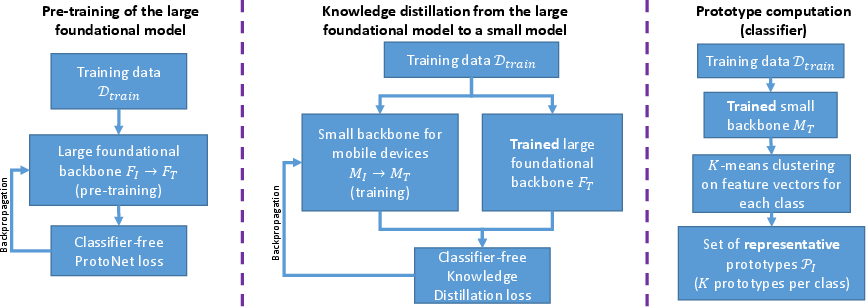
Figure 1: The server-side image classification pipeline, illustrating large foundation model pre-training, knowledge distillation, and per-class prototype extraction.
Device-Side Pipeline
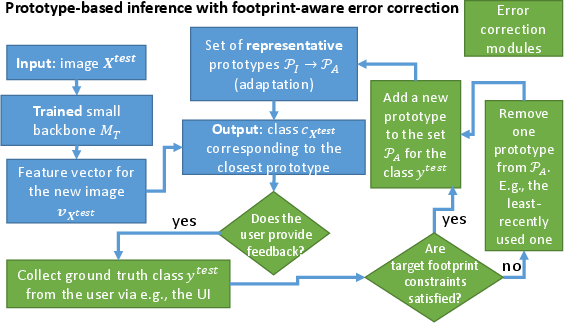
On-device, the system forgoes expensive backpropagation or model parameter updates. Instead, it leverages the prototype-based structure:
Extension to Object Detection
For object detection, the pipeline incorporates an efficient detector (e.g., YoloV8-nano) to localize objects. Each detected region is cropped and subsequently classified through the adapted image classifier. This modularity allows independent optimization of detection and classification performance and facilitates rapid correction of errors at the granularity of object instances.
Experimental Evaluation
The methodology is evaluated across two diverse datasets—Food-101 and Flowers-102—characterized by non-trivial domain shifts from ImageNet, necessitating foundation model adaptation. The experimental setup quantifies:
- Error Correction Accuracy (AccE): Proportion of originally misclassified samples correctly classified after user correction.
- Forgetting Rate (For): Proportion of previously-correctly classified samples that are misclassified post-adaptation (catastrophic forgetting).
Key findings include:
- In one-shot correction scenarios, the system corrects 51.1% (Food-101) and 54.3% (Flowers-102) of errors with minimal catastrophic forgetting (<0.02%). Increasing user corrections (s) monotonically improves AccE, exceeding 96% with s=50 per class, while For remains well below 1%.
- The adaptation is strictly local: only prototypes are augmented, and no backpropagation occurs on-device, ensuring computational determinism and privacy.
- Quantization (to 8-bit) delivers a 3× inference acceleration with <1% accuracy drop (MobileNet-V2 and YoloV8-nano), allowing real-time execution on consumer smartphones (e.g., <40 ms inference per frame on Galaxy S24 Ultra).
- Ablation experiments demonstrate that naïve fine-tuning or reliance on either a linear classifier head or a non-adapted foundation model yields substantially degraded error correction rates, substantiating the necessity of prototype-based continual correction layered atop knowledge-distilled backbones.
Demonstration and User Interaction
The system is deployed in a practical Android demo application, enabling seamless user correction through UI gestures. For object detection, users tap misclassified regions and supply the correct label, after which subsequent inferences leverage the augmented prototype set for improved accuracy.
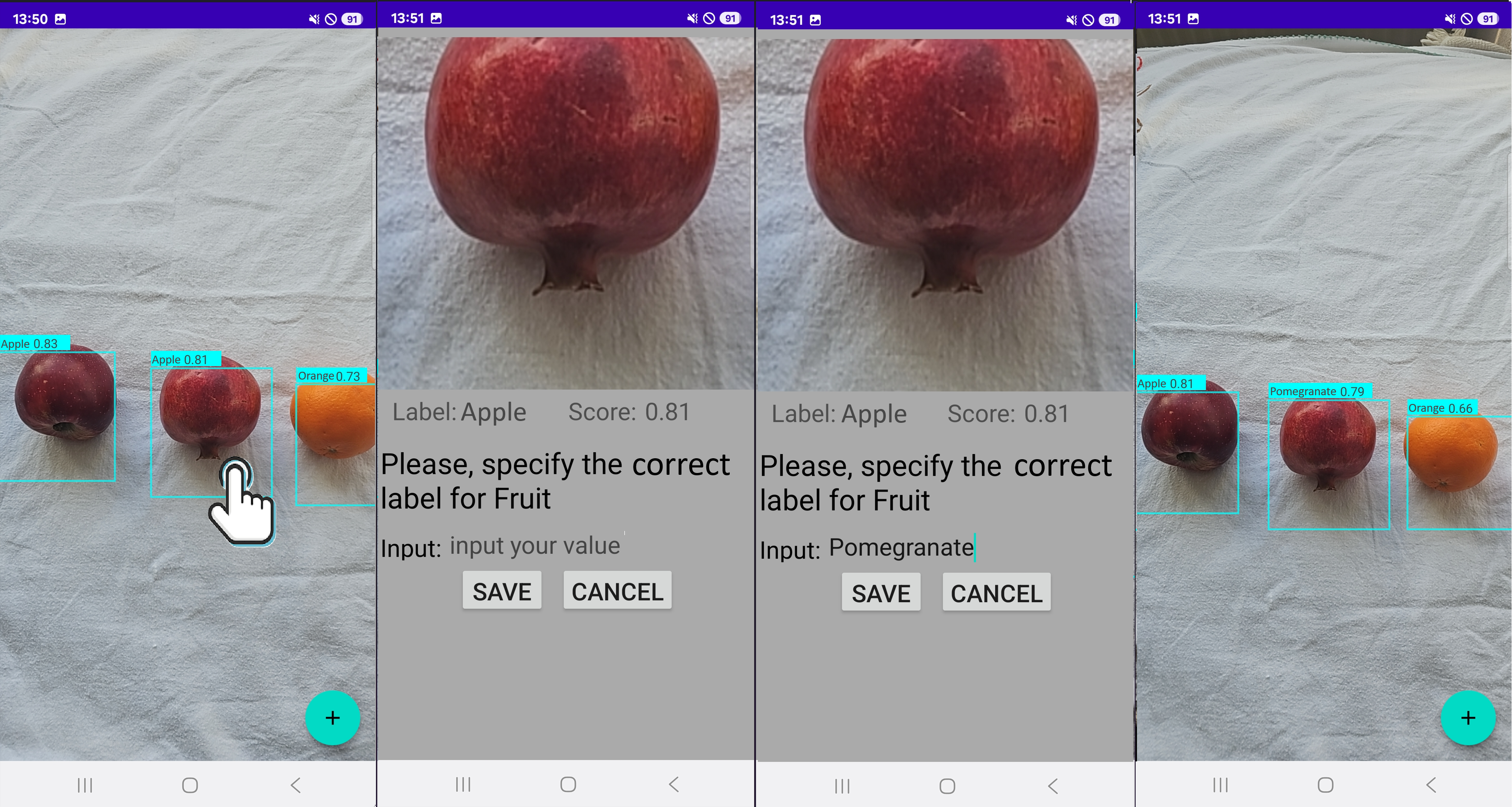
Figure 3: Demonstration workflow showing user-driven correction and immediate post-correction improvement on subsequent predictions.
Implications, Limitations, and Future Directions
This work provides a strong formal and empirical basis for deploying adaptive continual error correction in edge AI applications. Notably, the mechanism achieves high error correction rates with vanishingly small forgetting, all within the strict constraints of low-power devices, and without any remote connectivity or cloud compute reliance—addressing core privacy and reliability concerns.
From a theoretical perspective, the results reinforce the efficacy of prototype-based continual learning, especially when paired with foundation model-derived features and knowledge distillation. The practical implications are substantial for personalization and long-term autonomous operation of AI on user devices.
Potential directions for extension include:
- Integration of prototype condensation techniques or representative selection strategies to maximize adaptability within fixed memory budgets.
- Exploration of multi-modal or federated adaptation signals, allowing community-driven correction without model leakages.
- Tighter coupling of detection and classification backbones in the object detection use case, leveraging shared feature maps for further computational efficiency.
Conclusion
The presented system constitutes a compelling paradigm for user-centric continual error correction on low-resource devices, combining foundation model expressivity with lightweight prototype adaptation. The empirical validation demonstrates its effectiveness and practicality for both image classification and object detection. This approach provides a scalable and privacy-preserving path toward fully adaptive, AI-powered consumer devices.