- The paper presents a vDBF algorithm leveraging Sparse Pauli Dynamics to estimate ground state energies with sub-1% error on Heisenberg and Hubbard models.
- It adopts dynamic Pauli truncation and greedy generator selection for efficient operator evolution, significantly reducing computational complexity.
- Energy-variance extrapolation and correction methods are used to refine energy estimates, demonstrating rapid convergence even on large, nontrivial 2D lattices.
Rapid Ground State Energy Estimation via Sparse Pauli Dynamics-enabled Variational Double Bracket Flow
Overview
This work introduces a variational double bracket flow (vDBF) algorithm for ground state energy estimation in strongly correlated quantum systems, leveraging Sparse Pauli Dynamics (SPD) as the computational core. The method exploits Heisenberg picture operator evolution with dynamic Pauli truncation, optimal variational rotation selection, and energy-variance extrapolation to obtain sub-1% errors relative to DMRG benchmarks for large Heisenberg and Hubbard models. On highly nontrivial two-dimensional lattices—where tensor network methods become prohibitive—vDBF demonstrates significant computational acceleration, yielding credible energies for 100–128-qubit (site) systems within hours on a single CPU thread.
Technical Approach
Sparse Pauli Dynamics and Operator Evolution
The algorithm parametrizes the unitary evolution of the Hamiltonian using sequential Pauli rotations. Each Pauli rotation is expressed as Uj(θ)=exp(−iθPj/2), with operator evolution in the Heisenberg picture exploiting the binary algebra of Pauli strings. While the repeated application of Pauli rotations nominally incurs exponential operator growth, the method stabilizes complexity through dynamic coefficient-based truncation, discarding Pauli terms below threshold ϵ at each step.
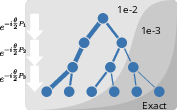
Figure 1: Schematic depiction of the evolution of a single Pauli string under three small-angle rotations with color-coded truncation domains.
This strategy enables memory-efficient representation and rapid evaluation of expectation values required during variational optimization.
The vDBF method adopts a double bracket flow generated by G(s)=[H(s),ρ], with ρ approximated as the single-particle Z-projector, effectively building a cost function gradient encoded in nested commutators. Rather than employing small integration steps, each Pauli rotation is chosen to globally minimize the ground state energy at every iteration. The selection of variational angles, θi∗, is performed analytically, optimizing the reference state expectation of the energy functional post-rotation.
Greedy Generator Selection and Truncation Mechanisms
To maximize efficacy and computational efficiency, a greedy strategy selects generators with the steepest energy gradient magnitude, rotating only by those with the most significant variational impact. Operator growth is further controlled by aggressive coefficient truncation, ensuring that at each iteration, the runtime remains manageable.
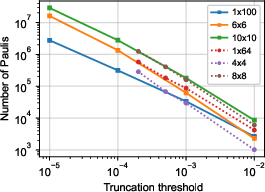
Figure 3: The number of Pauli strings in the truncated Hamiltonian scales quasi-linearly with the threshold ϵ, as empirically shown across Heisenberg and Hubbard models.
Corrected Energy and Energy-Variance Extrapolation
Recognizing the truncation-induced loss in energy expectation, the authors implement a correction by summing discarded contributions throughout the flow, refining the energy estimate. Further, extrapolation versus variance (and/or discarded weight) is used to systematically remove both truncation and convergence errors, typically using linear and quadratic fits to the late-iteration segment of the energy-variance trajectory.
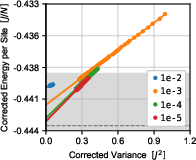
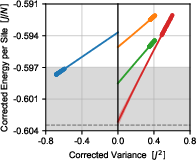
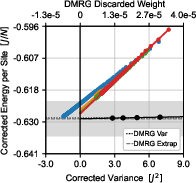
Figure 4: Representative energy versus variance extrapolation for the 1x100-site Heisenberg model, illustrating linearity in the near-converged regime.
Numerical Results
Heisenberg Model Benchmarks
Evaluations are performed for large 1D and 2D Heisenberg instantiations (e.g., 1x100, 6x6, 10x10 lattices). For the 100-site 1D system, vDBF achieves sub-0.1% error in less than 3 minutes on a single core, surpassing DMRG runtimes by over an order of magnitude. For the 100-qubit 2D Heisenberg lattice, vDBF obtains <1% error in under 15 minutes, whereas DMRG required over 50 hours with a bond dimension over 3000.
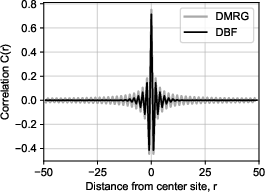
Figure 5: Spin-spin correlation functions for the 1x100 Heisenberg lattice; DMRG recapitulates the algebraic decay, while vDBF’s truncation enforces an exponential envelope beyond local correlations.
The method’s truncation bias is evident in correlation functions, where energy-optimized flows rapidly suppress nonlocal correlation structure, yielding short-range accurate (but long-range suppressed) behaviors.
Hubbard Model Applications
The Fermi-Hubbard benchmarks illustrate similar performance: On an 8x8 lattice (128 qubits, two modes per site), vDBF delivers energies within 1% of the DMRG-extrapolated ground state in approximately 3 hours; DMRG, at similar accuracy, required over three days on large-scale parallel hardware.
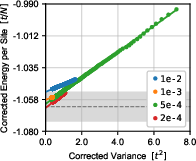
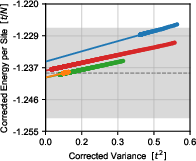
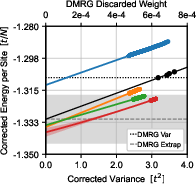
Figure 2: Representative energy-variance extrapolation for a 1x64 Hubbard chain, demonstrating rapid convergence and linearity towards the exact energy.
The number of nontrivial Pauli strings grows quasi-linearly with inverse truncation threshold, with larger operator proliferation for Hubbard than Heisenberg systems, suggesting more complex entanglement structure and reduced intrinsic sparsity in the former.
Comparative Analysis with Existing Methods
The vDBF approach can be viewed as a classical analog to ADAPT-VQE, iQCC, and the recent Double Bracket Diagonal Operator Iterations quantum algorithm, but it departs decisively by using an SPD kernel, aggressive operator truncation, and step-wise variational minimization. Unlike traditional Schrödinger-picture methods, it leverages the algebraic structure and locality of Paulis for both efficiency and truncation, with the tradeoff that only local (energy-immediate) correlations are well preserved.
Practical and Theoretical Implications
The results emphasize that classical simulation techniques grown out of the quantum advantage benchmarking landscape, such as SPD and Pauli propagation, are directly repurposable as competitive tools for many-body energy estimation, especially as quantum hardware still lacks practical supremacy in Hamiltonian simulation. For high-dimensional, strongly correlated problems where established tensor network methods are impractical, SPD-based classical algorithms significantly expand the tractable system size and accuracy regime.
From a theoretical standpoint, the variational SPD framework formalizes a new family of flows adaptable to other cost functionals, reference states, or projective objectives. However, inherent limitations remain: vDBF does not preserve symmetries such as spin or particle number, and the aggressive focus on ground state energy does not generalize to accurate property or correlation estimation out-of-the-box. Enhancements via symmetry-preserving rotations, hybrid Schrödinger-Heisenberg updating, or robust cost-constraint integration are logical next steps.
Conclusion
This work establishes Sparse Pauli Dynamics-enabled variational double bracket flow as a competitive framework for rapid ground state energy estimation on classically intractable quantum systems. By combining efficient greedy truncation with extrapolation schemes anchored to energy variance, vDBF achieves strong accuracy-time tradeoffs on benchmarks where established methods falter. Future research is merited to extend the framework towards more general observables, symmetries, and hybrid variational strategies, with the expectation that classical-quantum algorithmic cross-pollination will continue to yield advances in computational many-body physics.

