- The paper introduces a simulation framework using the Besançon Galactic Model to robustly estimate stellar bycatch, improving constraints on ETI transmitter prevalence.
- It demonstrates that synthetic modeling yields a sample over 20× larger than Gaia-only estimates, covering a wider range of stellar types and distances.
- The approach sets statistically valid upper limits on high-duty-cycle transmitters and offers a public calculator for designing future SETI surveys.
Simulating the Stellar Bycatch in Radio SETI: Constraining Technosignature Prevalence
Introduction
The detection limits for extraterrestrial technosignatures in radio SETI surveys critically depend on accurate accounting of all stellar systems within a telescope’s field of view—commonly termed the "stellar bycatch." The paper "Simulating the Stellar Bycatch: Constraining the Prevalence of Extraterrestrial Transmitters within Radio SETI Surveys" (2511.20231) presents a rigorous methodology for estimating the true stellar population captured in radio SETI pointings, surpassing traditional census approaches restricted by instrument sensitivities and completeness, particularly those reliant on Gaia survey data.
Using the Besançon Galactic Model (BGM), the authors simulate the underlying statistical stellar population for each pointing, enabling more robust upper limits on the prevalence of high-duty-cycle extraterrestrial transmitters (ETIs). This framework improves constraints for SETI survey results across a much larger volume of the Milky Way and a broader range of stellar types, addressing longstanding biases in observational and theoretical analyses.
Limitations of Gaia-Based Bycatch Estimation
Gaia, with its precise astrometric catalog of approximately 1.8 billion objects, is transformative yet incomplete. Its selection function is magnitude-limited, with declining completeness in highly crowded fields (notably dropping significantly above G∼17 in dense regions), and its distance inference deteriorates for objects with fractional parallax errors f>0.2. Quality filtering to ensure clean samples further discards the majority of Gaia's entries, leading to a substantial underestimate of the stellar bycatch relevant for SETI, especially at large galactocentric distances or toward the Galactic Plane.
The Besançon Galactic Model: A Comprehensive Synthetic Approach
The BGM provides a population-synthesis-driven framework that models the Galaxy as a combination of the thin and thick disc, bulge, and halo, each with their own initial mass function (IMF), star formation histories, and structural parameters. Stellar densities are set by dynamical consistency with the Galaxy's potential, with subpopulations individually constrained by fits to extensive photometric and astrometric survey data (Hipparcos, Gaia, RAVE, 2MASS). The BGM assigns physical properties (luminosity, Teff, gravity), evolutionary states, and detailed extinction corrections per line of sight. Its synthetic reach extends to $25$ kpc, thus exceeding the typical magnitude and completeness limits of Gaia by an order of magnitude or more.
Application to Breakthrough Listen SETI Surveys
The authors applied the BGM to simulate all stellar objects within the fields of view of 1,229 unique pointings of the Breakthrough Listen Enriquez/Price survey, yielding a total synthetic sample of 6,182,364 stars—over 20× larger than samples derived purely from Gaia for these same pointings.
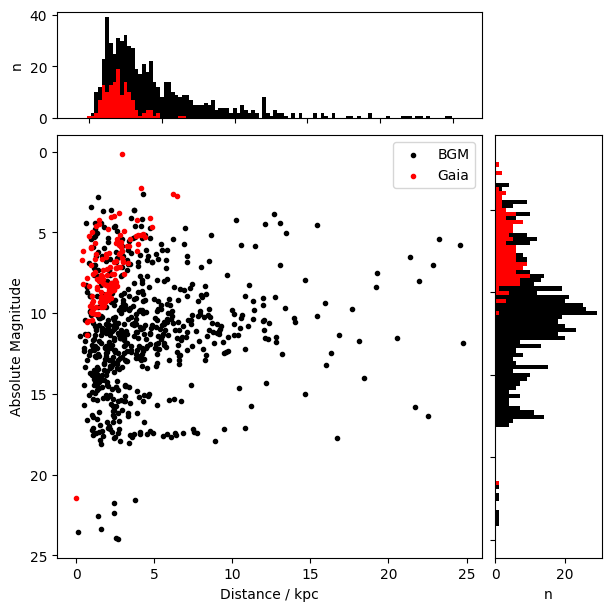
Figure 1: The BGM simulation (black) vastly broadens the sampled stellar distance and absolute magnitude distributions compared to Gaia-only measurements (red) for a representative pointing.
This expanded sampling is crucial: it improves both the count of examined stars (the denominator in prevalence limits) and the dynamic range in spectral types and luminosity classes, with direct implications for the reliability and scope of technosignature prevalence estimates over the entire Milky Way.
Impact on Detection Sensitivity and Technosignature Constraints
For each simulated star, the minimum detectable equivalent isotropic radiated power (EIRPmin) is computed as a function of distance and beam response. Surveys are generally sensitive to transmitters exceeding EIRPmin≳5×10¹⁶ W. The inclusion of the broader stellar bycatch from the BGM reduces the inferred upper limit prevalence for persistent, high-power technosignature emitters. Within 2.5 kpc, the authors set a limit of ≤(0.000995±0.000002)% of surveyed stellar systems hosting such transmitters.
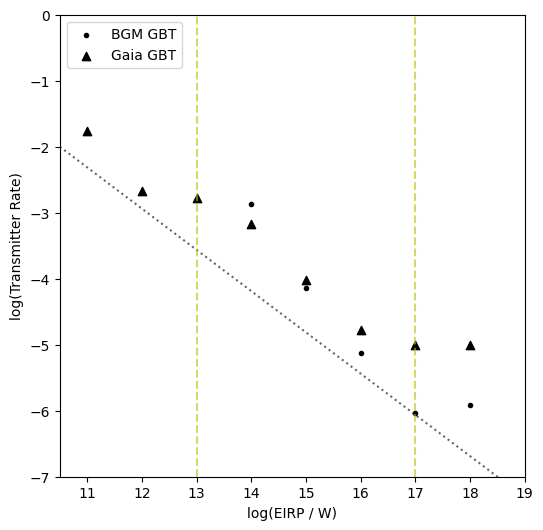
Figure 2: The EIRPmin versus estimated transmitter rate shows the BGM sample pushes parameter space into lower prevalence limits at higher distances and transmitter powers compared to Gaia-limited studies.
This expanded parameter space meets and exceeds previous values set using Gaia-limited bycatch, notably in the intermediate and far-field Galactic regime.
Diversity of the Stellar Bycatch and Survey Bias
A critical observation from the simulation is the intrinsic diversity of the bycatch: strong representation of both main sequence extremes and compact objects.
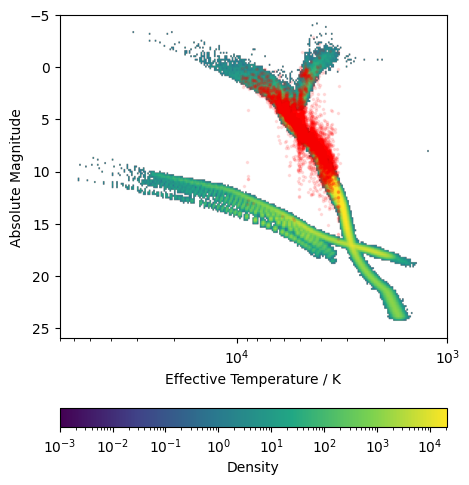
Figure 3: Hertzsprung–Russell diagram illustrating the full breadth of BGM-simulated stellar types, capturing white dwarfs and high-mass main sequence stars that Gaia omits due to photometric incompleteness or astrometric inaccuracy.
Moreover, the spectral type and luminosity class diversity remains approximately stable as a function of Galactic latitude and longitude, limiting bias even in dense regions.
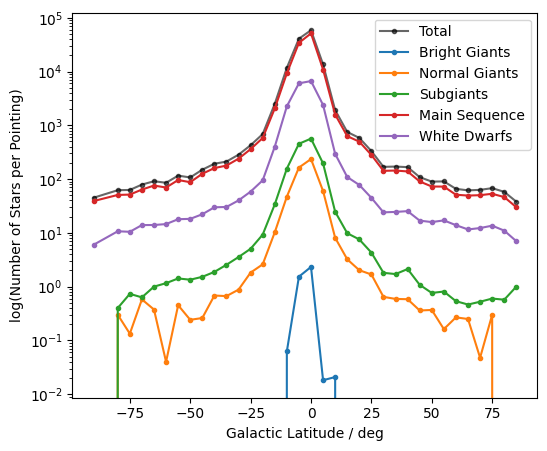
Figure 4: Simulated spectral type diversity peaks at the Galactic Plane but proportions remain consistently distributed across latitudes.
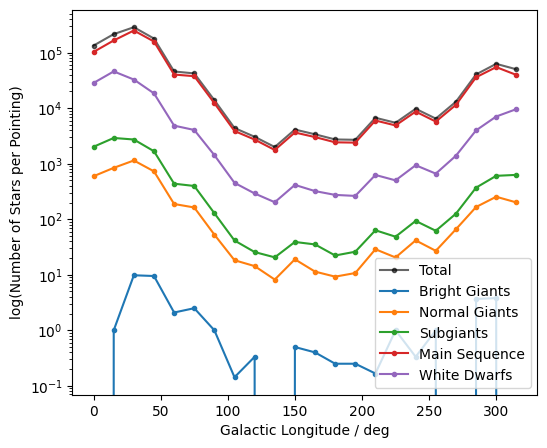
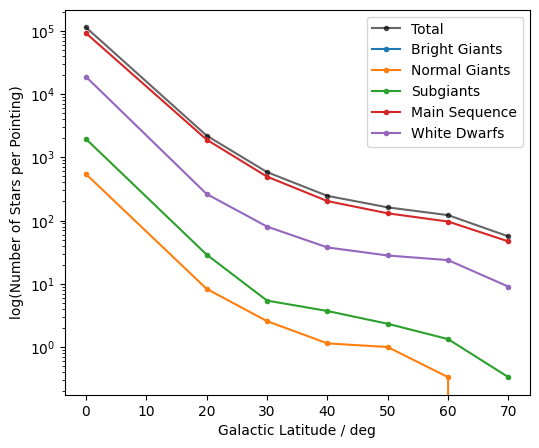
Figure 5: Stellar bycatch as a function of Galactic latitude (top) and longitude (bottom) demonstrates opportunistic sampling bias toward the Galactic Centre.
This comprehensive census enables estimates of technosignature prevalence per stellar type and luminosity classification (see Appendix of the paper), challenging the assumption that SETI surveys are overly anthropocentric in design.
Robust Prevalence Limits and Statistical Methods
Treating technosignature detection as a Poisson process, and observing zero positive detections, the upper bound on the prevalence is set by the classical “Rule of Three.” The key result is the ability to set much stricter, more statistically valid upper bounds, particularly at greater distances, due to vastly increased sample sizes from BGM simulations.
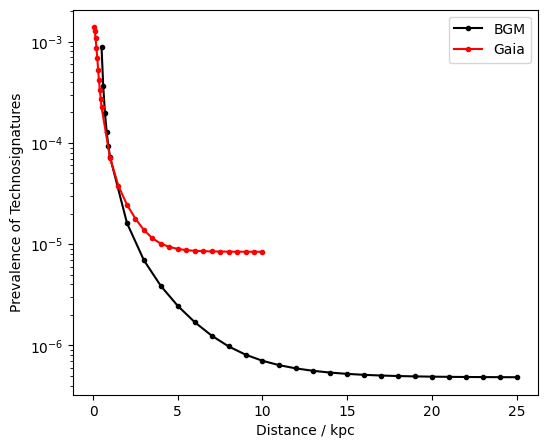
Figure 6: Prevalence estimates for transmitters across the Milky Way are reduced by an order of magnitude beyond Gaia's reach when using BGM-derived bycatch populations.
To democratize access to this methodology, the authors provide a public calculator that automates BGM pointings for arbitrary field-of-view parameters and telescope configurations, calculates per-star EIRPmin, corrects for Doppler smearing and beam attenuation, and produces diagnostic plots of the bycatch population and detection parameter space.
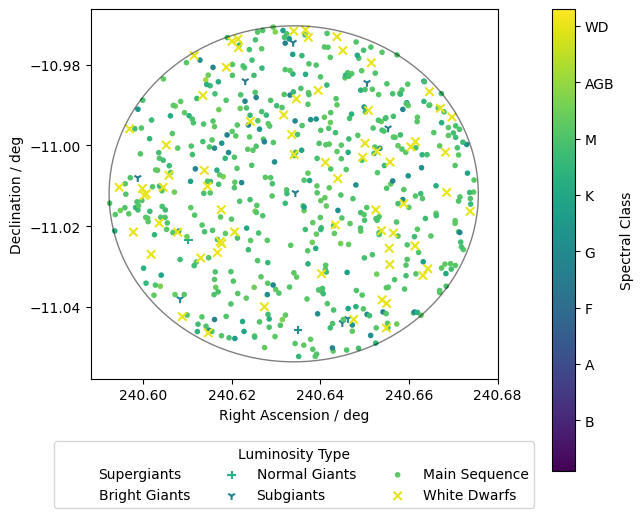
Figure 7: Example field-of-view output from the calculator—color-coded by spectral and luminosity class—enabling researchers to robustly estimate survey completeness and bias for any planned pointing.
Theoretical and Practical Implications
The use of BGM-driven bycatch estimation addresses major theoretical shortcomings in previous SETI prevalence estimates: the underestimation due to magnitude-limited, incomplete catalogs and the non-uniformity of stellar class sampling. Practically, this approach allows ongoing and future radio SETI surveys—especially those employing large single-dish beams or incoherent beamforming on arrays—to set stricter and more universal constraints on the density of Galactic technosignatures. The strong numerical result for high-duty-cycle, high-power emitters—ftx≤0.001% within 2.5 kpc—directly informs both the astrophysical search strategy and the statistical interpretation of null results.
Furthermore, the demonstrated robustness of bycatch diversity and the availability of transparent simulation tools will support the design of surveys targeting diverse Galactic environments (e.g., toward or away from the Galactic Centre) and inform the optimal allocation of time/resources in SETI programs.
Conclusion
This work establishes that synthetic galactic modelling, specifically via the Besançon Galactic Model, is essential for realistic, bias-minimized estimation of SETI survey reach and detection statistics. Surpassing the constraints imposed by magnitude-limited catalogs, this method enables both tighter prevalence limits for extraterrestrial transmitters and more reliable characterization of survey bias. The approach shows that single-dish radio surveys, even when nominally targeted, examine a broad and representative array of Galactic environments and stellar types. This work will underpin the next generation of SETI survey design and post-hoc statistical analysis, facilitating more generalizable and stringent interpretations of technosignature search results.

