- The paper presents a UML-based system that automatically generates network configuration instructions by comparing AsIs and ToBe models.
- It utilizes a detailed network configuration metamodel to document configurations precisely and enable dynamic changes, such as the transition from static to OSPF-based routing.
- The system demonstrated robust practical performance at Shinshu University, effectively reducing manual configuration overhead and accommodating easy model extensions.
Automatic Generation of Network Configuration Instructions: A Study
Introduction
The paper "A System to Automatically Generate Configuration Instructions for Network Elements from Network Configuration Models" (2511.18100) addresses a prevalent challenge in network engineering: the manual creation of configuration procedures that often diverge from specified requirements. This research introduces a method to automatically generate configuration procedures using UML for modeling network configurations, aiming to maintain strict adherence and allow ease of extension. The study demonstrates the method's application through a practical scenario at Shinshu University, transitioning a network from static to dynamic routing, resulting in an expectedly functioning network.
Proposed Method
The paper's central proposition involves two core elements:
- Network Configuration Metamodel and Model: This defines the grammatical structure and instances of network configurations using UML, facilitating detailed and native granular documentation of network device configurations. This method aims to surpass conventional design diagrams by integrating logical and physical design perspectives, ensuring extensibility and precision.
- Automatic Configuration Procedure Generation: By leveraging UML, the proposed method automatically generates configuration commands based on differences detected between two network configuration models (AsIs and ToBe models). This approach enables efficient switching between network configurations, necessary for dynamic network environments.
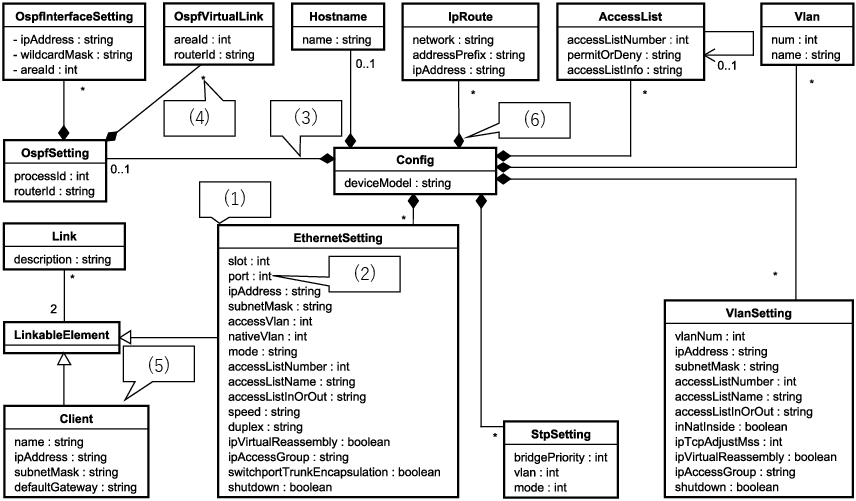
Figure 1: Network configuration metamodel.
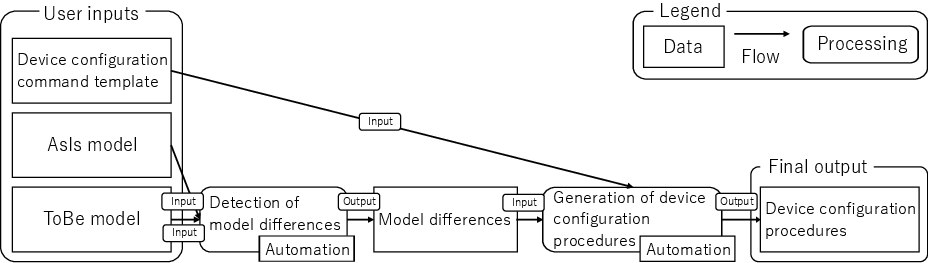
Figure 2: Overview of the proposed method to generate configuration commands for network elements.
The network configuration metamodel, expressed through UML class diagrams, encapsulates configuration specification items and their relationships, enabling a structured representation of network configurations. This methodological framework balances precision and extensibility by facilitating detailed and clear documentation, enabling seamless network component management. The paper emphasizes the method's ease of extending specification items with evolving communication protocols. However, it does not provide multi-vendor compatibility within its current scope.
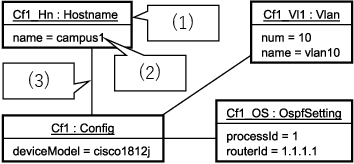
Figure 3: Network configuration model.
Device Configuration Procedure Generation
The approach to generating configuration procedures involves detecting model discrepancies between AsIs and ToBe models, thereafter deriving configuration commands using templates. These templates are tailored for specific network device models and incorporate conditional generation strategies to ensure precision. The generated procedures are designed to allow rollbacks and modifications while emphasizing ease of model extension and adaptation to varied network environments.
Evaluation
The proposed system was evaluated in a real-world scenario involving configuration changes at Shinshu University, transitioning from static routing with no redundancy to a dynamic OSPF-based network with redundancy. The system's effectiveness was validated through an expert review and practical tests using actual network devices. Confirmed outcomes on device routing tables and path determination during network failures demonstrated the system's efficacy.

Figure 4: AsIs network diagram.
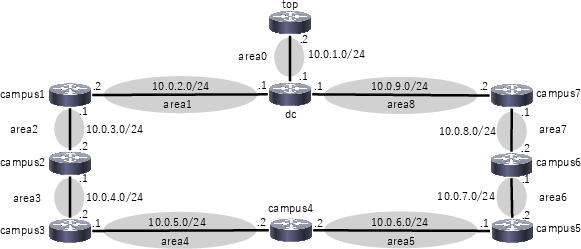
Figure 5: ToBe network diagram.
Implications and Future Developments
This research has substantial implications for reducing manual overhead in network configuration processes and mitigating engineer-induced errors, thus offering a pathway to more consistent network operations. Future work should focus on extending the method's application scope to include a broader array of protocols and multi-vendor environments, and developing verification tools to enhance the modeling process's robustness and reliability.
Conclusion
The paper successfully demonstrates a method for automating the generation of network configuration procedures, resulting in configurations that align precisely with requirements. The proposed system offers significant benefits in terms of precision, extensibility, and engineer workload reduction. Ongoing research should aim to enhance the system's flexibility and adaptability, ultimately facilitating its integration into diverse networking environments.
In conclusion, the study provides a foundation for future advancements in automated network management systems, presenting an approach that promises robustness and efficiency in complex networking scenarios.