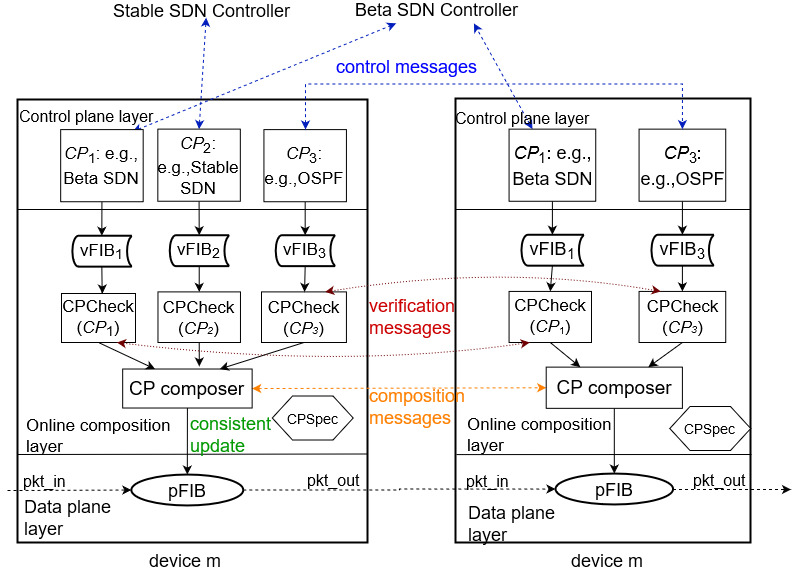
- The paper introduces a novel method that uses real-time multiple control plane composition with the CPCheck framework to ensure high network reliability.
- It employs a flexible CPSpec grammar and a robust DV-protocol to dynamically assign control responsibilities while solving complex reachability verifications.
- Rigorous evaluations on backbone and data center networks reveal that Carbide scales efficiently with minimal overhead and outperforms centralized verification approaches.
Carbide: Highly Reliable Networks Through Real-Time Multiple Control Plane Composition
Carbide presents a sophisticated system designed to achieve elevated network reliability through the use of real-time multiple control plane composition. This paper explores how Carbide leverages distributed verification to manage complex network requirements efficiently while ensuring minimal downtime and optimal network performance.
Introduction and Background
The demand for higher network reliability has surged alongside the increase in business-critical applications, leading to costly implications of network downtime. Traditional approaches tend to centralize verification, which ironically introduces a single point of failure and often results in bottlenecks, hampering real-time reaction to network changes. Carbide aims to circumvent these limitations using a distributed architecture.
Architecture and Key Components
Carbide fundamentally integrates distributed verification with multiple control plane composition to enhance network reliability:
Distributed Verification Process
Carbide's distributed verification process involves transforming a generic network requirement into a DV-Network verification problem, addressing issues such as waypoint routing and subnet isolation within DAGs:
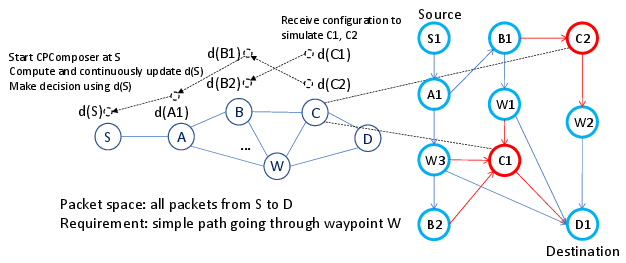
Figure 2: DV-Network for general topology and waypoint requirement.
- Transformation of Generic Networks: By using product graphs, Carbide effectively transforms diverse verification problems to DV-Network verification problems, accommodating a wide range of network paths and constraints.
- Robust to Failures: The DV-protocol employed by Carbide is resilient to network partitioning and operates independently of the control plane, enabling real-time verification of network correctness.
- Extensions: Handling packet modifications, multicast, anycast, link-state check, and even enforcing conditional or coverage requirements further exemplifies Carbide's flexibility and robustness.
Carbide's implementation was rigorously evaluated to demonstrate its capabilities:
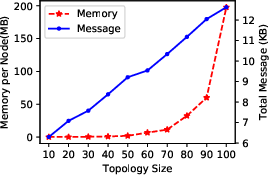
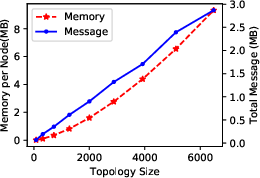
Figure 3: Average memory consumption per device and total message after a FIB update. (a) Backbone (b) Data center.
- Efficiency: The evaluation on diverse topologies, including backbone and data center networks, showed that Carbide considerably reduced average network downtime compared to traditional SDN and OSPF implementations.
- Scalability: Carbide scaled effectively, maintaining operational efficiency in large-scale network environments with minimal overhead in memory and messaging, outperforming leading centralized verification frameworks.
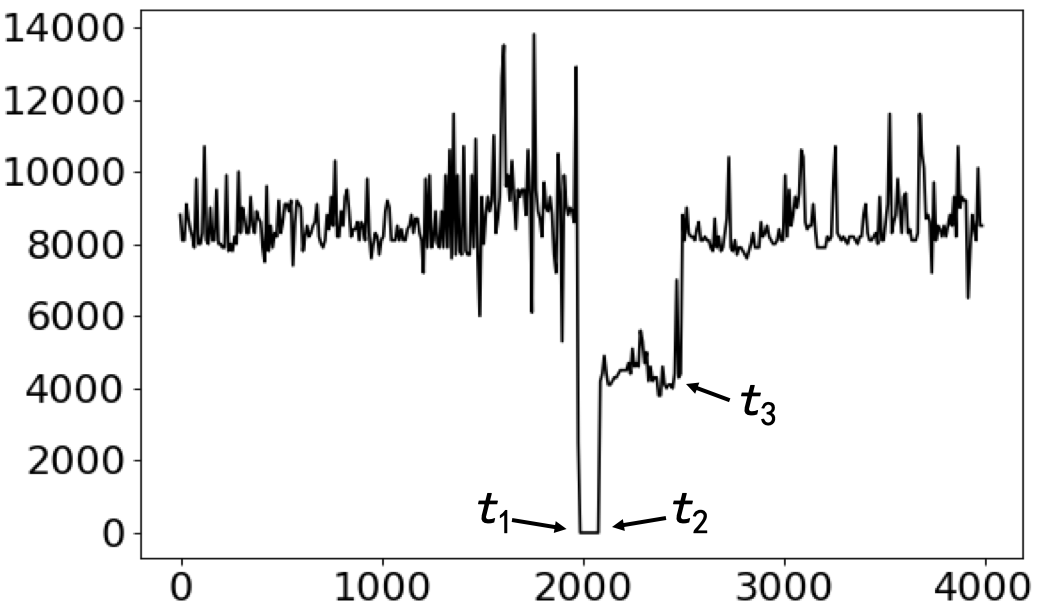
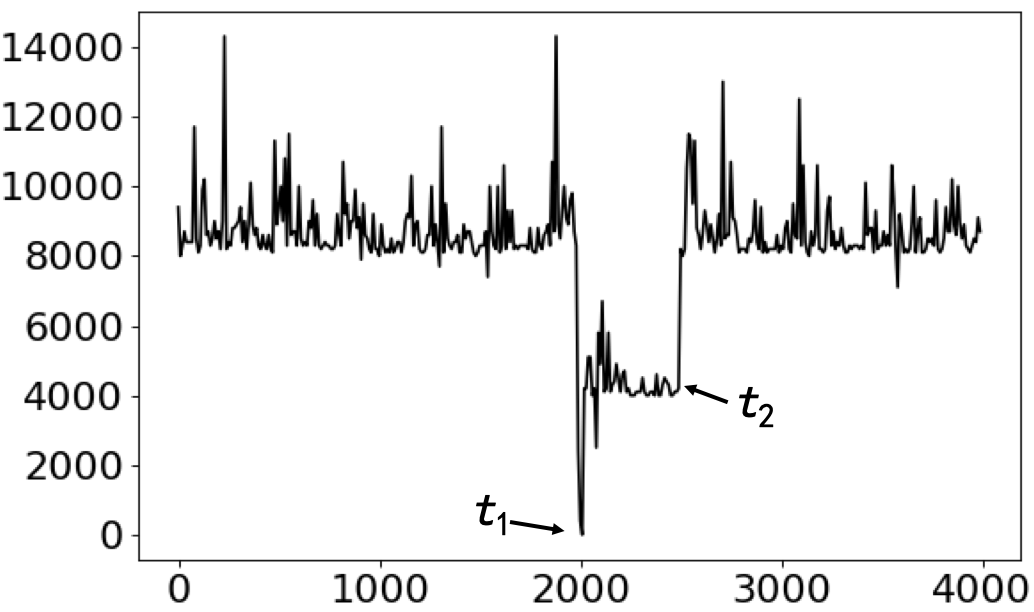
Figure 4: Packet receiving rate for the fast recovery experiments. The failure in (a) affects both the SDN and OSPF CPs, while that in (b) affects only the current SDN.
Implications and Future Directions
Carbide’s methodology of integrating multiple control planes through distributed verification presents significant implications for both practical network management and future innovations in network verification technologies. It offers a pathway toward more adaptive and resilient network infrastructures that can dynamically react to configuration changes and potential failures without compromising on speed or reliability. Future advancements in AI-driven network management systems could leverage Carbide's architecture for more intelligent, automated decision-making processes.
Conclusion
The Carbide system sets a new paradigm in network management by efficiently composing multiple control planes with comprehensive real-time verification, thus ensuring high reliability and consistent network operation. This approach addresses the complexities associated with network verification and correct configuration enforcement, proving its potential as a cornerstone technology for future scalable, resilient network systems.