- The paper demonstrates that UL-CA delivers consistently higher uplink throughput than UL-MIMO, especially in challenging RF environments.
- It employs comprehensive testing on T-Mobile’s 5G SA network, using mid-band TDD and FDD frequencies across urban, suburban, and rural areas.
- The study highlights that UL-MIMO can be beneficial in dense networks by conserving spectral resources, suggesting a strategic deployment trade-off.
Introduction
The paper "Performance Comparison of 5G NR Uplink MIMO and Uplink Carrier Aggregations on Commercial Network" (2511.16751) investigates the comparative performance of Uplink Multiple-Input Multiple-Output (UL-MIMO) and Uplink Carrier Aggregation (UL-CA) on T-Mobile's 5G network within various radio frequency (RF) environments. In recent years, with increasing demands for uplink capabilities driven by applications like social media streaming, 4K video, and IoT, the efficient management of uplink spectrum resources has become critical. This study offers a comprehensive evaluation of these two techniques, providing insights into their throughput performance across diverse contexts of signal reception and transport conditions.
Network Environment and Methodology
The testing was conducted over T-Mobile's 5G Standalone (SA) network, utilizing mid-band TDD (Time Division Duplex) band n41 and FDD (Frequency Division Duplex) bands n25 and n71. The geographical area examined ranged across urban, suburban, and rural routes around Toledo, Ohio. A Samsung Galaxy S24 with a Snapdragon X75 modem and a Pixel 9 Pro with an Exynos 5400 modem were employed for data collection, depending on the specific test environment.
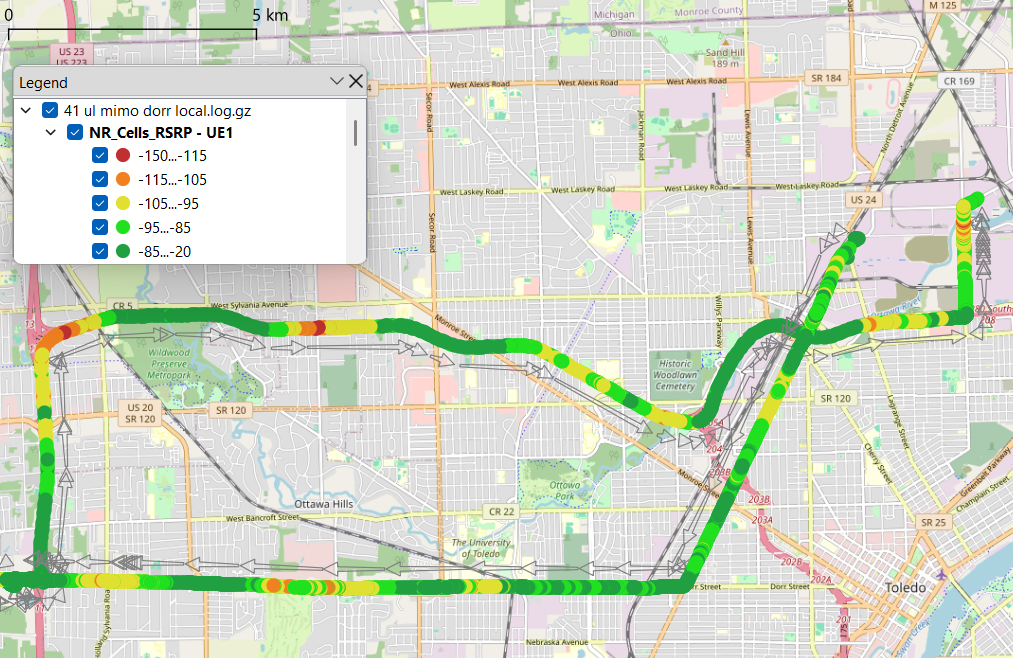
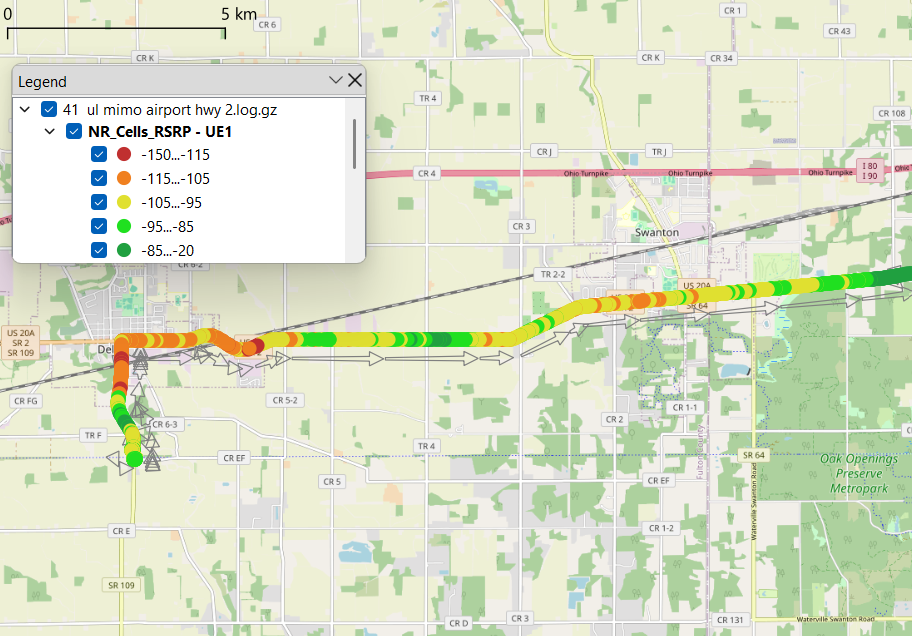
Figure 1: Urban Route
The experiment setup ensured data normalization was necessary due to varying channel widths and network conditions, providing an adjusted metric for throughput comparisons. The network was configured to allow tests of UL-MIMO in mid-band frequencies and UL-CA involving combinations of TDD and FDD bands.
Results and Analysis
The paper's findings demonstrate that UL-CA uniformly yields superior uplink throughput compared to UL-MIMO across all measured environments. Notably, the performance benefit of UL-CA is accentuated in weaker RF conditions, where the diversity of frequencies enabled better modulation coding schemes (MCS), affording a higher throughput. For instance, in urban environments, UL-CA significantly outperformed UL-MIMO, particularly notable in the 10th percentile throughput improvement over UL-MIMO. In suburban settings, the user-experienced interference minimized on the less congested 600 MHz band (n71), led to pronounced efficiency gains for UL-CA.
In contrast, UL-MIMO presented an advantage in densely populated scenarios, primarily due to its ability to conserve spectral resources by utilizing a single band, thereby avoiding splitting resources across multiple carriers.
Modulation and MIMO Usage
The modulation analysis reveals that UL-CA fostered a higher prevalence of high-order modulation schemes, such as 256QAM, attributed to improved power per stream allocations. However, in the weaker signal domains of rural areas, the modulation effectively defaulted to simpler forms like QPSK. The UL-MIMO's ability to leverage spatial multiplexing (rank 2 transmissions) was limited by the UE's fallback to rank-1 transmission under suboptimal conditions, significantly curbing its throughput potential.
Conclusions
The study provides substantive empirical evidence to support the superiority of UL-CA over UL-MIMO in delivering consistent uplink performance across various environments within a commercial 5G network. The findings suggest a strategic emphasis on deploying UL-CA for enhancing throughput, especially in non-urban areas with challenging RF environments. Furthermore, the research recommends dynamic traffic steering policies for optimal resource utilization, advocating UL-MIMO usage in cell-dense areas to conserve spectral capacity. The authors call for further exploration into UL Tx Switching and a deeper analysis of UL-CA's impact on specific application scenarios, alongside implications for UE power consumption.