- The paper demonstrates that dual-transmission HPUE yields up to 15.7% uplink throughput improvement over baseline configurations by enhancing signal quality and spectral efficiency.
- The methodology employs modified firmware on a Snapdragon X60 modem and structured field tests in a dense urban campus to assess throughput, modulation efficiency, and retransmission rates.
- The study finds that while HPUE improves reliability for Dual-Tx UEs, its benefits for Single-Tx UEs are limited and come with increased power consumption, prompting careful network optimization.
Evaluations of High Power User Equipment (HPUE) in Urban Environment
Introduction
The deployment of 5G New Radio (NR) networks, particularly using Time Division Duplexing (TDD) within urban environments, poses significant challenges due to increased path loss at higher frequency bands like the C-Band (3.5 GHz) and BRS (2.5 GHz). These frequencies provide higher downlink throughput but challenge uplink performance, especially at cell edges where User Equipment (UE) experiences higher path loss [10570635]. To address these challenges, the 3GPP has introduced the High Power User Equipment (HPUE) specification, allowing devices to exceed the traditional 23 dBm power limit, thereby enhancing throughput, Quality of Experience (QoE), and reliability.
This paper evaluates HPUE's performance within an urban setting using both standalone (SA) and non-standalone (NSA) 5G NR networks. By modifying UE modem firmware, the study examines throughput, modulation efficiency, retransmission rates (ReTx Rate), and power consumption to understand HPUE's practical implications and benefits.
Methodology
The study employs the ASUS Smartphone for Snapdragon Insiders with Qualcomm's Snapdragon X60 modem, capable of operating in multiple power classes, to assess UE performance in various transmission scenarios. Experiments were conducted across multiple configurations, including Power Class 1.5 (PC1.5) in dual-transmission mode, which necessitates firmware modifications to override network-imposed power restrictions.
Testing took place within the Chulalongkorn University campus in Bangkok using commercial 5G services. This environment features a high density of base stations, primarily configured with Huawei 64T64R Massive MIMO Active Antenna Units. Testing followed a defined route aboard a shuttle bus, allowing for consistent measurement conditions across various urban settings.

Figure 1: Field Test: Map of Pop Bus Route Two. Green pins represent gNodeB locations.
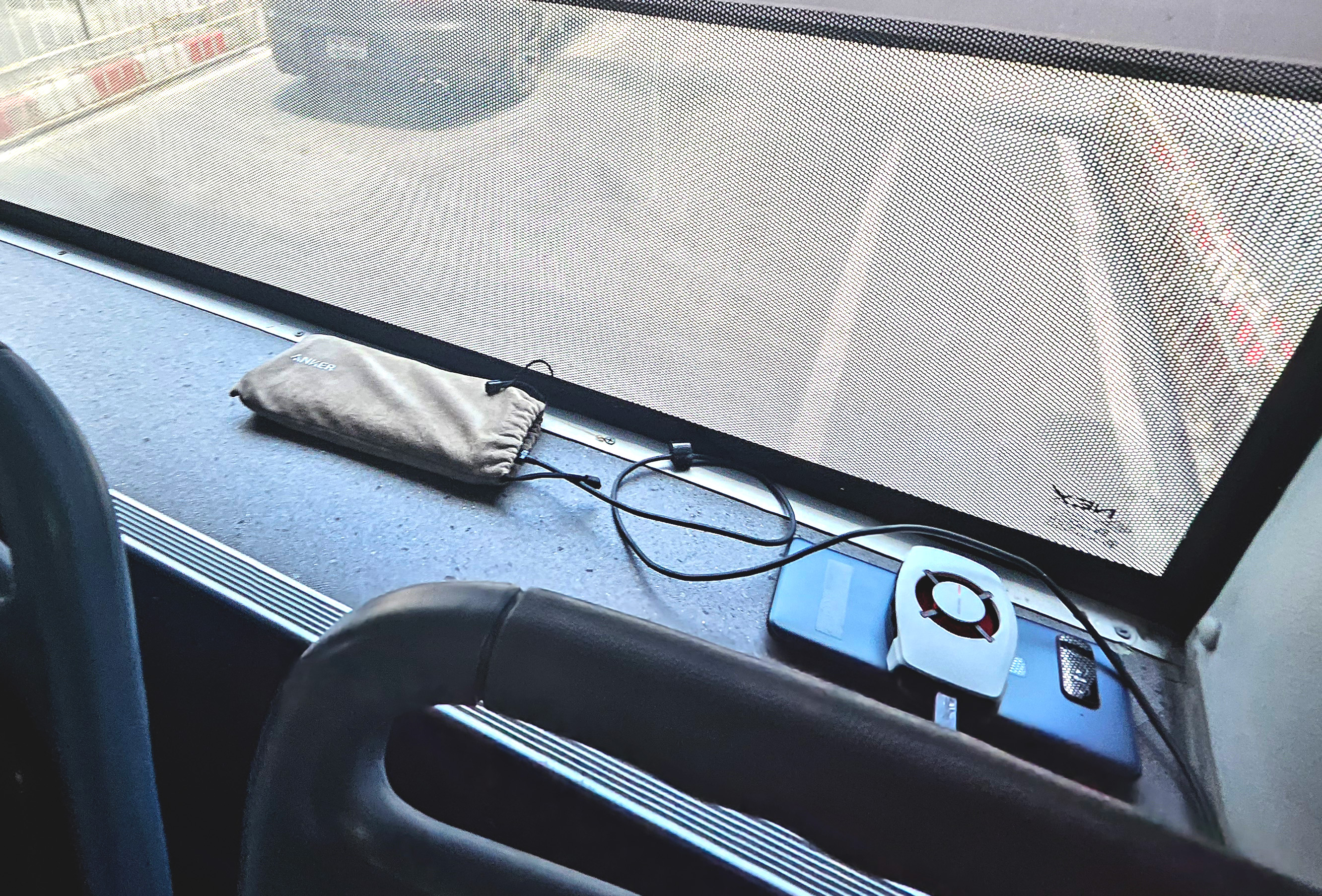
Figure 2: Field Test: UE Placement
Results and Analysis
Uplink Throughput and Modulation Efficiency:
In standalone (SA) mode, results showed that enabling HPUE for dual-transmission UEs results in substantial uplink throughput improvements. The Dual-Tx PC2 and PC1.5 configurations achieve a 13.0% and 15.7% uplink throughput improvement, respectively, over the baseline Dual-Tx PC3 configuration. This indicates that high power classes restore effective transmission power per antenna chain, leading to improved spectral efficiency through higher Modulation and Coding Scheme (MCS) utilization.
Conversely, Single-Tx UEs showed negligible throughput improvements with HPUE, as PC3 already provides sufficient power levels for their operation in urban settings. The interference concerns and additional power consumption associated with higher HPUE classes are thus not justified for Single-Tx UEs operating in SA mode.
Retransmission Rate Improvements:
Demonstrable reductions in ReTx rates for Dual-Tx configurations highlight HPUE's role in improving communication reliability. For PC2 Dual-Tx UEs, ReTx rates decreased slightly, suggesting enhanced link stability due to better signal quality. However, this effect was not observed for Single-Tx UEs, reinforcing the conclusion that standard power class levels suffice for their reliable operation within urban environments.
Power Consumption Concerns:
The additional power consumption that accompanies HPUE is a critical factor. In both SA and NSA modes, increased power consumption from higher power classes only marginally benefits throughput for high-density scenarios. Battery life estimates indicate reduced operational durations with higher power configurations, which can significantly affect user experience, particularly during activities requiring sustained high data rates.
Conclusions
The findings suggest that while HPUE configurations can significantly benefit Dual-Tx UEs in urban environments by enhancing throughput and reliability, these advantages come at the cost of increased power consumption and potential interference. Single-Tx UEs, however, attain sufficient performance with baseline power levels, making higher classes unnecessary for typical urban scenarios.
Future investigations should explore the complete impact of HPUE on inter-cell interference and develop strategies like Fractional Frequency Reuse (FFR) to mitigate negative effects, especially in densely deployed network environments. This research sets the groundwork for understanding HPUE's role in real-world 5G implementations and informs network optimizations to balance performance gains with operational costs.