- The paper presents AI-driven techniques that adaptively optimize energy efficiency in complex 6G networks through dynamic, real-time decision-making approaches.
- It categorizes various AI methods across use cases like UAV, RIS, IoT, and V2X, highlighting key tradeoffs between energy savings and network performance.
- The study emphasizes balancing computational complexity, network performance, and user fairness to achieve sustainable energy-efficient operations.
Toward Hyper-Adaptive AI-Enabled 6G Networks for Energy Efficiency: Techniques, Classifications, and Tradeoffs
The paper "Toward hyper-adaptive AI-enabled 6G networks for energy efficiency: techniques, classifications and tradeoffs" (2511.16296) presents an in-depth examination of the role of artificial intelligence in optimizing energy efficiency within 6G networks. As the advent of 6G approaches, the complexity and heterogeneity of network environments intensify, demanding intelligent, real-time adaptability to meet escalating service demands sustainably. The paper categorizes AI techniques utilized in various 6G use cases, assesses their adaptability to critical network dynamics, and explores the tradeoffs inherent in striving for energy efficiency.
Introduction to AI-Driven Energy Efficiency in 6G
6G networks signify a departure from conventional infrastructure-centric models by integrating terrestrial, aerial, satellite, and underwater communication systems. This unification aims to deliver global connectivity across varied scenarios, from urban environments to remote areas. As network heterogeneity increases, so does the need for adaptive solutions to manage its associated complexities. AI/ML provides dynamic capabilities to infer network conditions, predict user actions, and optimize resource usage, thus ensuring resilience and efficiency despite fluctuating conditions.
Adaptability to Key 6G Dynamics
The adaptability of AI techniques within 6G spans several critical dynamic aspects (Figure 1). These include user and device mobility, channel variability, QoS constraints, resource constraints, and heterogeneous service demands. For instance, in UAV-assisted networks and V2X communications, reinforcement learning (RL) algorithms are applied to adaptively manage trajectory optimization, power control, and mode selection, ensuring energy-efficient operations despite rapid environmental changes. Multi-agent RL and meta-learning further enhance system responsiveness by allowing distributed decision-making that scales with network density and mobility.
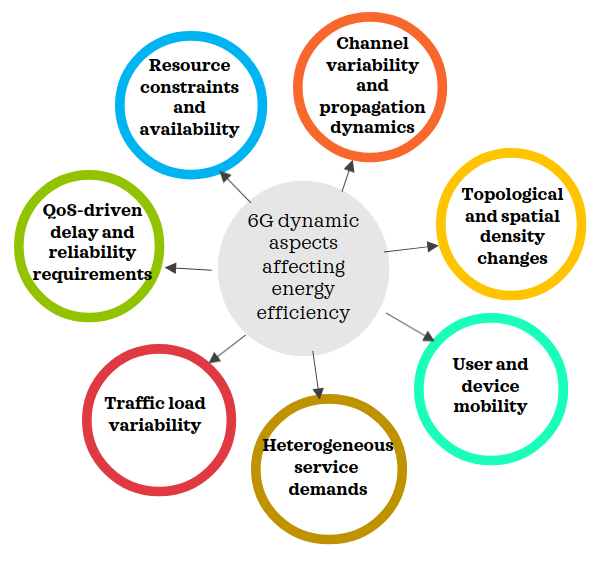
Figure 1: The inherent 6G dynamic aspects affecting EE.
AI Techniques for Diverse Use Cases
AI applications in 6G vary significantly across use cases, with techniques tailored to specific scenarios:
- RIS-Assisted Communication: DRL techniques optimize RIS phase configurations to enhance coverage and reduce power use. This includes mobile RIS scenarios where QoS constraints are dynamically integrated into learning objectives.
- Industrial IoT and Smart Cities: Predictive models like CNNs and decision trees facilitate device-level energy management, while digital twins simulate deployment scenarios for proactive planning.
- UAV Communication: RL agents guide UAVs in energy-efficient trajectory planning and resource allocation, adapting to changing coverage needs and channel conditions.
- Network Operation: AI-enabled base station control and resource allocation schemes reduce idle power and improve spectral efficiency through context-aware adaptations.
- V2X Communication: Multi-agent systems and federated learning improve resource management in highly mobile environments, leveraging AI to balance energy expenditure with real-time service demands.
Core Tradeoffs in AI-Driven Energy Efficiency
Achieving energy efficiency in 6G is inherently tied to several tradeoffs (Table 1), including:
- Energy vs. Network Performance: Balancing power savings with latency and reliability requires QoS-aware RL and multi-objective optimization strategies.
- Energy vs. Computational Complexity: Simplified RL models and quantized neural networks mitigate the computational burden while ensuring energy-efficient inference.
- Energy vs. User Fairness: Fairness-aware reward shaping in RL models ensures that energy optimizations do not lead to service deprivation for weaker users.
- Energy vs. Task Utility: Selective data usage and early-exit mechanisms maintain task accuracy while reducing energy-intensive computations.
(Table 1)
Future Directions and Conclusion
The exploration of AI in 6G networks reveals both its potential and existing limitations. Although significant strides have been made, challenges such as generalization across dynamic scenarios, efficient use of learning processes in resource-constrained environments, and real-time adaptability persist. Future research must focus on developing hybrid AI frameworks that unite reactive real-time control with proactive long-term planning. Emphasizing cross-layer integration, standardized benchmarks for tradeoff management, and explainable AI models will be vital for advancing sustainable, intelligent network architectures.
In conclusion, AI is poised to play a central role in shaping the energy-efficient future of 6G networks. By aligning adaptability with sustainability goals, AI-driven solutions promise to transform next-generation wireless systems into intelligent, resilient platforms capable of navigating complex, evolving environments efficiently.

