- The paper introduces a Graph-Aware Temporal Encoder (GATE) to model spatial and temporal dynamics for optimized service migration and resource allocation.
- It integrates a two-layer graph convolutional network with a temporal convolutional network to capture satellite-user dependencies and short-term trends.
- The proposed GATE-HPPO framework outperforms PPO and SAC by enhancing accumulated rewards, service reliability, and reducing migration overhead.
Graph-Aware Temporal Encoder Based Service Migration and Resource Allocation in Satellite Networks
Introduction
The paper "Graph-Aware Temporal Encoder Based Service Migration and Resource Allocation in Satellite Networks" (2511.16011) addresses the challenges faced by satellite networks in providing global, low-latency service coverage through edge computing capabilities. By equipping satellites with onboard computational resources, the paper aims to improve service continuity and quality of service (QoS) by optimizing both resource allocation and service migration strategies.
Motivation and Challenges
Satellite networks have emerged as pivotal infrastructures for communication, yet they encounter distinct challenges due to their dynamic topology and constrained resources. The paper identifies key issues such as the rapid mobility of satellites causing fluctuations in network topology, limited onboard computational and communication resources, and the necessity for efficient service migration to sustain service continuity.
Proposed Solution: Graph-Aware Temporal Encoder (GATE)
The authors propose a Graph-Aware Temporal Encoder (GATE) to jointly model spatial correlations and temporal dynamics within satellite networks. This encoder uses a two-layer graph convolutional network (GCN) to understand dependencies among satellites and users, and a temporal convolutional network to capture their short-term evolution.
- Spatial Modeling: GATE uses GCNs to extract relevant features from a constructed graph, where satellites, ground users, and flight users are represented as nodes. The adjacency matrix is constructed based on real-time satellite-user visibility.
- Temporal Encoding: To address dynamic variations, GATE incorporates a temporal convolutional network with a sliding window approach, enabling the capture of short-term trends and immediate past states.
These spatio-temporal representations are integrated into a Hybrid Proximal Policy Optimization (HPPO) framework, further enhancing the decision process for service migration and resource allocation among the satellites.
Hybrid Proximal Policy Optimization (HPPO)
HPPO extends Proximal Policy Optimization (PPO) to handle combined discrete-continuous action spaces required for decision-making in satellite environments. A multi-head actor outputs discrete decisions (service migration) and continuous ratios (resource allocation). The critic provides value estimation to refine the policy.
Experimental Evaluation
The proposed GATE-HPPO framework was extensively evaluated against baselines including PPO and Soft Actor Critic (SAC). Results demonstrate that GATE-HPPO consistently outperforms these baselines in terms of:
- Accumulated Reward: GATE-HPPO achieves a notable improvement in cumulative reward, highlighting the algorithm’s effectiveness in optimizing long-term operational gains.
- Service Reliability: The algorithm reduces service failure rates by efficiently managing migration and resource allocation decisions, maintaining high service continuity under dynamic conditions.
- Migration Overhead: The number of service migrations is significantly reduced, showcasing the efficiency of the temporal encoding approach in maintaining stable operation.
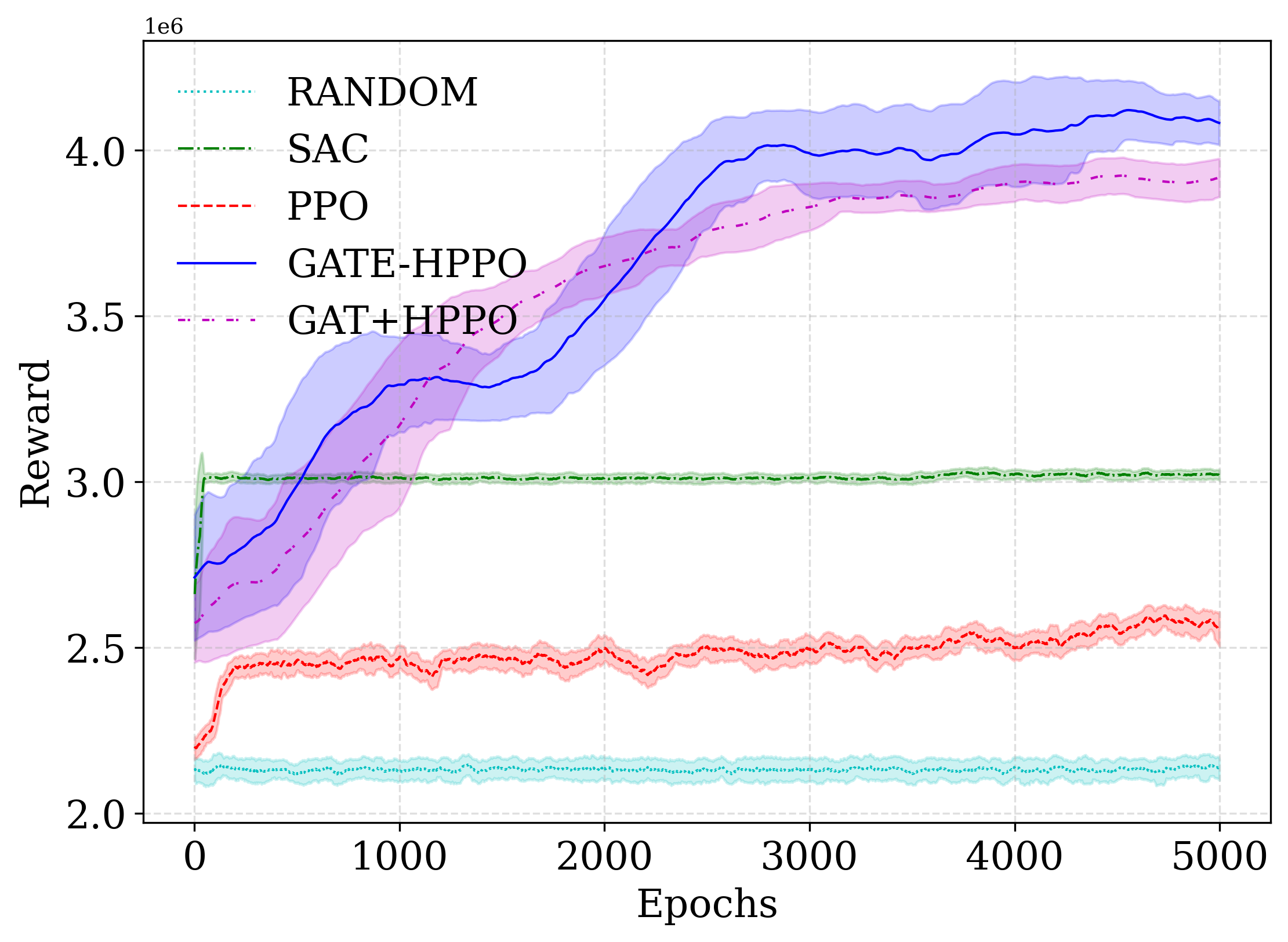
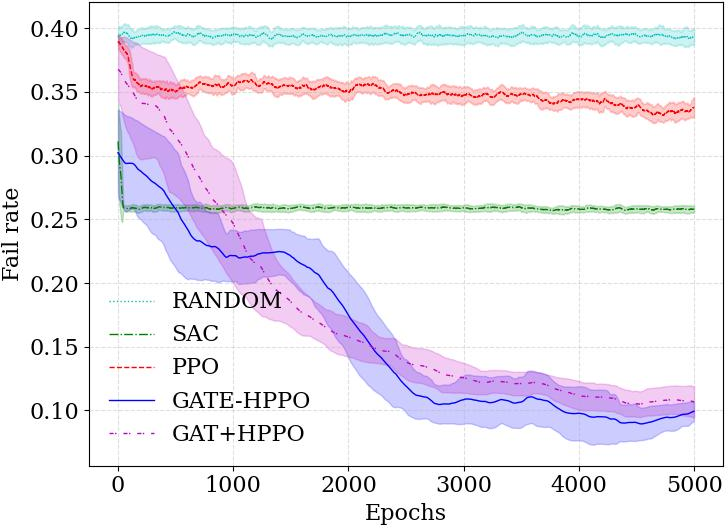
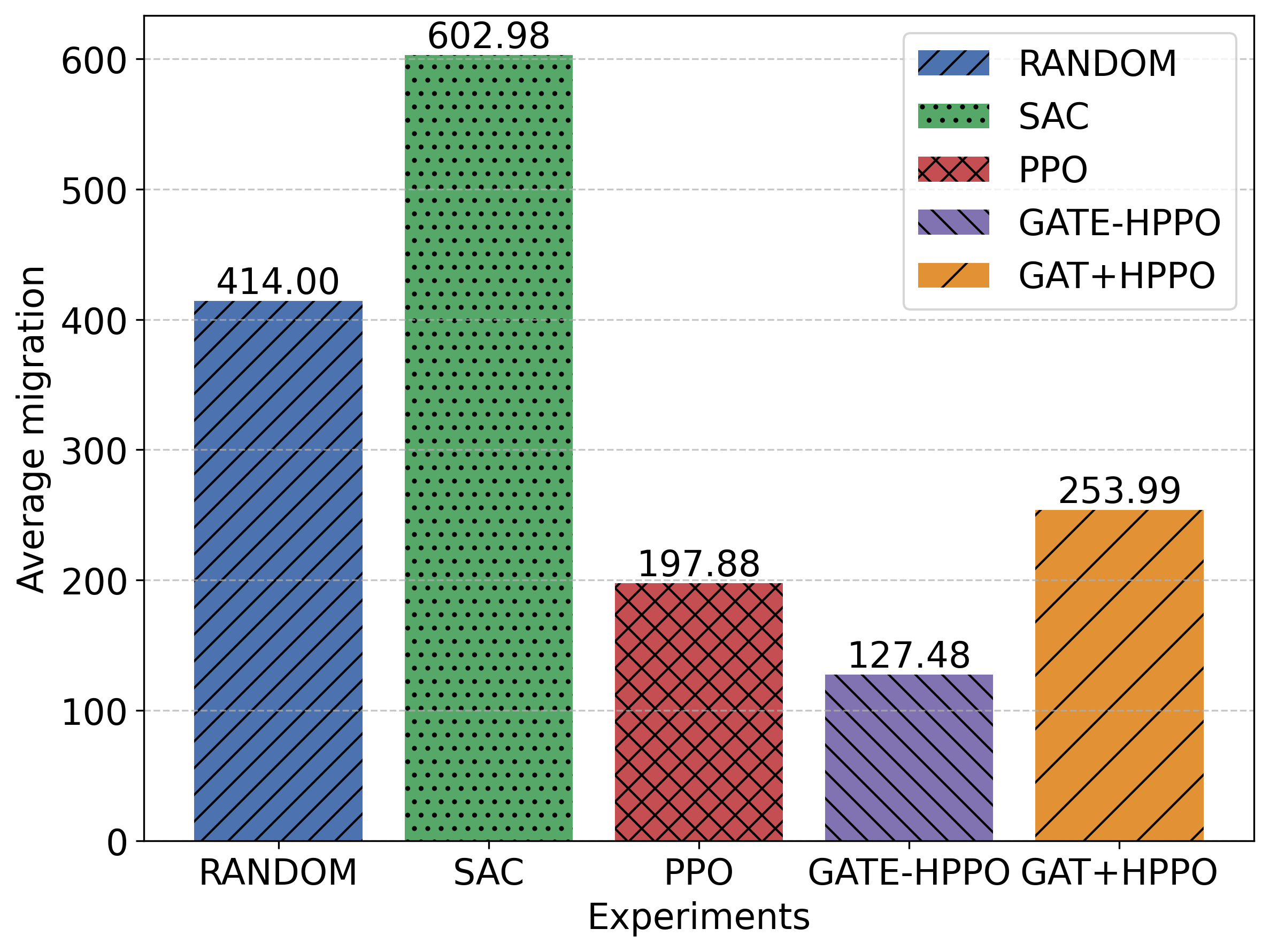
Figure 1: Performance of the proposed algorithm and the other baselines.
Implications and Future Directions
The integration of graph-based spatio-temporal modeling within satellite networks is shown to greatly enhance both service efficiency and reliability. The paper suggests several implications:
- Practical Applications: The framework can be adapted for real-world satellite constellations such as LEO and MEO systems, supporting the growing demand for global connectivity.
- Scalability: The algorithm's linear complexity in relation to graph size ensures scalability for large-scale satellite networks, critical for future space network expansions.
Future work could further explore adaptive windowing strategies for temporal encoding or incorporate real-time feedback to refine state models, enhancing performance in even more dynamic network conditions.
Conclusion
The research presented in this paper establishes a robust framework for optimizing service migration and resource allocation in satellite networks through graph-aware and temporal reinforcement learning strategies. By effectively capturing the unique spatial and temporal characteristics of satellite environments, the proposed approach provides significant advancements in ensuring reliable and efficient satellite communication services.

