- The paper introduces an AI-driven iterative paradigm that transforms end-to-end software development by leveraging LLMs and orchestrated agent systems.
- It details a four-phase process (analyze-plan-implement-deliver) that minimizes human intervention while ensuring traceability and efficient updates.
- Case studies demonstrate the paradigm's effectiveness across diverse domains, highlighting both scalability challenges and opportunities for refinement.
Iterative End-to-End Automated Software Development Paradigm
Introduction
The paper "A Viable Paradigm of Software Automation: Iterative End-to-End Automated Software Development" (2511.15293) proposes a novel paradigm for software development automation leveraging AI, specifically focusing on LLMs and orchestral agent systems. This iterative end-to-end approach aims to redefine the software development lifecycle into a continuous loop of analyze-plan-implement-deliver, thereby reducing human intervention primarily to the articulation of requirements and physical constraints. The integration of AI throughout the development process underscores a potential shift from conventional programming practices to a more automated system where human intent in natural language is transformed into executable software.
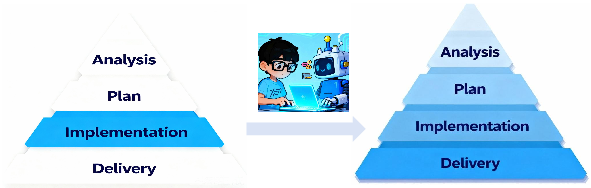
Figure 1: Transformation of automated software development paradigm.
Paradigm Overview
The proposed paradigm operates through four distinct stages: analysis, planning, implementation, and delivery. Each stage is designed to maximize the involvement of AI systems while minimizing human input to essential aspects only. During the analysis phase, AI systems elicit and refine user requirements through interactive dialogue, subsequently generating a standardized requirements document. The planning phase involves human-provided constraints guiding AI systems to determine the optimal technology stacks and architectural designs. Implementation then encompasses automated code generation and testing, ensuring the functionality meets predefined requirements and standards. The final delivery stage involves packaging and deployment actions, making the software ready for user feedback.
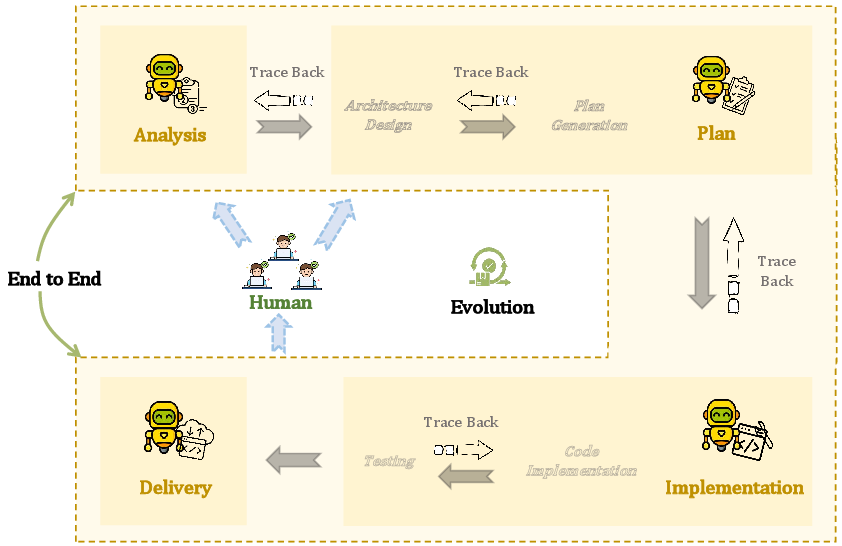
Figure 2: Overview of the iterative end-to-end automated software development paradigm, operating in an analyze-plan-implement-deliver loop.
Key Features
Traceability
The paradigm ensures each component of the process—from requirements to testing—is interconnected. This traceability allows seamless updates and corrections across stages when requirements change or errors occur. The system maintains a clear mapping from user stories to code and test cases, facilitating precise modifications without the need for complete redevelopment.
Optimal Human-AI Interaction
By limiting human interactions to requirement articulation and design constraints, the paradigm supports automation without necessitating human expertise in programming languages or systems architecture. The approach provides an intuitive interaction method, enabling users to influence system design while AI systems handle the technical execution.
End-to-End Automation
Unlike existing practices focusing solely on code generation, the proposed paradigm covers the full cycle from human intent to deployable software. This comprehensive automation could democratize software development, allowing non-experts to create and evolve high-quality software solutions based on their conceptual ideas.
Case Studies
The research delineates the paradigm's effectiveness through several case studies, including game development, management systems, personal assistants, and application services. These illustrative examples demonstrate the adaptability and robustness of the system across various domains. Key findings highlight the system's capacity to handle complex rules, data-intensive applications, multi-modular synchronization, and domain-specific expertise conversion.
Challenges and Future Directions
The scalability of the paradigm to complex software solutions remains a challenge, necessitating further research into large-scale application scenarios. Improving human-AI interaction models and managing long-context information are essential for optimizing user experiences. The authors propose developing standardized benchmarks to reliably assess the paradigm's efficacy in diverse environments. Continuous improvement in AI system robustness and reliability is anticipated through adversarial testing and enhanced verification strategies.
Conclusion
This research outlines a transformative vision for automated software development, significantly reducing manual intervention by incorporating AI systems as first-class actors throughout the software lifecycle. The presented paradigm offers promising implications for accelerating software delivery while simultaneously placing emphasis on quality and maintainability. Future efforts are expected to address challenges in scalability, interaction design, and systematic validation to refine this approach for broader adoption.
Overall, this paradigm could represent a pivotal step towards the realization of fully automated, intent-driven software development practices in the industry.